1
SUP0462-01
19 APR 2002
PAGE 7
CH.1
CHAPTER 1: INTRODUCTION
1.1
Overview
The DeviceNet Scanner (HE800DNT450) is an intelligent communications interface module. The
DNT450 allows an Operator Control Station (OCS) to supervise a DeviceNet network.
Up to 63 slave devices can be connected via DeviceNet to the DNT450. Depending on baud rate and the
cable type used, the DeviceNet slave nodes can be located up to 1,500 feet (457.2 meters) from the
PLC.
DNT450 Polled data is mapped directly into the PLC's %I, %Q, %AI and %AQ registers. The ladder
programmer can treat the DNT450 and its attached DeviceNet nodes as a large I/O module. Polled data
is transferred between the PLCs registers and the DeviceNet slave nodes without any user or ladder
code intervention.
The DeviceNet specification provides two methods of establishing communications between a scanner
and its nodes. The first method makes use of the “Unconnected Message Manager” (UCMM) and the
second is known as “Group 2 Only”. “Group 2 Only” is the simplest. Because of its simplicity, many slave
devices only support the “Group 2 Only” method. The DNT450 allows both of these methods to be used
simultaneously. Any single DeviceNet slave device can be either a Group 2 Only node or a UCMM node,
never both. A DeviceNet network can be made up of a mixture of “Group 2 Only” and UCMM” slave
devices.
1.2
DNT450 Features
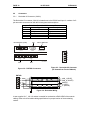
The DNT450 supports the following DeviceNet features:
• Baud Rates: 125K, 250K, and 500K,
• UCMM protocol (Log on),
• Group 2 Only protocol,
• The Polled Connection,
• Ladder Initiated Explicit Messaging (LIEM),
• Fragmentation on both polled and explicit connections,
• All four Message Body Formats under UCMM.
When using Polled Messaging, data is read from the PLC’s %Q and %AQ registers by the DNT450,
formatted into DeviceNet packets and sent to the DeviceNet nodes. As data produced by the DeviceNet
nodes is received by the DNT450, it is converted into PLC register notation and stored in the PLC's %I
and %AI registers. This happens automatically without the need for block move or other ladder program
intervention.