1
2.3 Microcontroller and Code
The PLL chip within the MiniCircuits modules must be configured each time it is powered up.
OpenSynth PLL uses a microcontroller to send the appropriate commands to the PLL chip (any of
several Analog Devices PLL synthesizer chips).
As shipped, each microcontroller is pre-programmed to the frequency specified when ordering.
Provisions are made on the board for user reprogramming using any of several programmers including
the inexpensive AVRISP from Atmel. Source code is available on the Reactance Labs website as well
as in this document.
2.3.1
Microcontroller Hardware
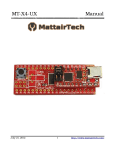
The microcontroller used in this circuit is an 8-bit Atmel ATTiny2313. This microcontroller was
chosen for ease of programming (free C compilers exist and are well supported), its popularity in the
hobbyist community, and its large amount of I/O pins. It is an excessive microcontroller for the
application, but allows for additional applications which users may choose to implement.
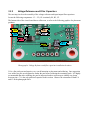
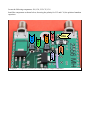
Illustration 4: Microcontroller Pinout - Green blocks
indicate signal names
The ATTiny2313 has an internal oscillator and requires no external parts to function. As seen above in
Illustration 4, there are 18 total I/O pins, in banks called PB, PD, and PA. OpenSynth uses 4 pins to
communicate with the PLL module (LD (Lock Detect), CLK (Clock), DATA, and LE (Latch
Enable)).
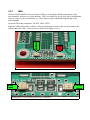
LDO (Lock Detect Output) is an output line which lights an LED when the PLL is in a locked state. It
is tied to the 6-pin header connector as are PD3 – PD5 which are extra I/O pins available for
programming for other uses. PA0 is tied to a red LED on the PCB and is also user definable (as
delivered, this LED has no function).