1
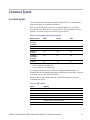
Command Syntax
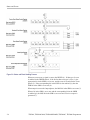
ACQuire:MODe AVErage; NUMAVg 16
The longer version works equally well:
ACQuire:MODe AVErage;:ACQuire:NUMAVg 16
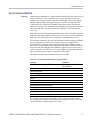
Never precede a star (*) command with a colon or semicolon:
ACQuire:MODe AVErage;*TRG
The oscilloscope processes commands that follow the star command as if
the star command was not there, so:
ACQuire:MODe AVErage;*TRG;NUMAVg 16
sets the acquisition mode to average and sets acquisition averaging to 16. The
*TRG command is ignored.
When you concatenate queries, the responses to all queries are combined into
a single response message. For example, if channel 1 coupling is set to DC
and the bandwidth is set to 20 MHz, the concatenated query:
CH1:COUPling;BANdwidth
returns CH1:COUPLING DC;:CH1:BANDWIDTH ON if header is on, or
DC;ON if header is off.
You can concatenate set commands and queries in the same message. For
example:
ACQuire:MODe AVErage;NUMAVg;STATE
is a valid message that sets the acquisition mode to average, queries the
number of acquisitions for averaging, and then queries the acquisition state.
The oscilloscope executes concatenated commands and queries in the order
it receives them.
Any query that returns arbitrary data, such as ID, must be the last query when
part of a concatenated command. If the query is not last, the oscilloscope
generates event message 440.
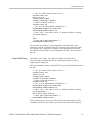
Here are some INVALID concatenation examples:
CH1:COUPling DC;ACQuire:NUMAVg 16 (missing colon before ACQuire)
CH1:COUPling DC;:BANDwidth ON (invalid colon before BANDwidth)
CH1:COUPling DC;:*TRG (invalid colon before a star (*) command)
HORizontal:MAIn:POSition 0;MAIn:SCAle 1E-13 (levels of mnemonics are
different; either remove the second occurrence of MAIn:, or put HORizontal:
in front of MAIN:SCAle)
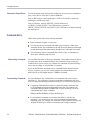
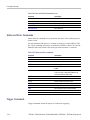
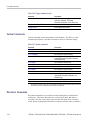
Message Terminators
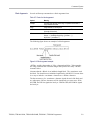
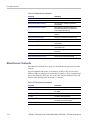
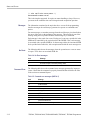
This manual uses the term <EOM> (End of message) to represent a message
terminator.
TDS200, TDS1000/2000, TDS1000B/2000B, TDS2000C, TPS2000 Programmer
2-5