1
•
~
I
I
I
I
I
I
I
I
I
I
I
I
I
I
I
I
I
I
I
Report No. 2183
July 1977 Revision
3.
Bolt Beranek and Newman Inc.
Page
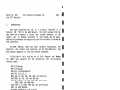
THE TIP COMMAND FORMAT
The user at a terminal will at various times be talking directly
to his TIP instead of to the remote Host. A typical message of this
sort might look like:
@ OPEN 15
Such a command always starts with symbol @ and ends with either a
linefeed* or a rubout, depending on whether the user is satisfied with
the command or wishes to abort it. The only exception to this rule is
the specific command
@@
which inserts an @ in the data stream to the Host. Commands may occur
anywhere, and need not start on a new line. Upper and lower case may
be freely intermixed in the command.
Between the @ and the
more words to identify
parameter. The TIP is not
important thing about a
user to abbreviate a bit;
example might be:
linefeed there will typically be one or
the command, perhaps followed by a single
very sophisticated, and thinks the only
word is its first letter. This permits the
the more usual rendering of the first
@O 15
Once the user has started typing the parameter of a command the
old value of the command will have been destroyed, and cannot be
recovered by aborting the command.
Almost without exception the effect of a TIP command is to set a
parameter or mode for the terminal. Even apparently direct commands
like
@ OPEN 15
(which initiates an elaborate exchange of messages resulting i n a
connection to the remote Host system) actually set a mode flag to
request the appropriate action when the TIP is free to undertake it.
To understand the TIP behavior is really to understand the complete
set of parameters and the commands to change them.
Normally, any
parameter can be changed at any time by the user at his terminal.
Exceptions occur when the user tries to change connection parameters
*On 2741 terminals the return key transmits carriage-return/ linefeed
to the TIP and ASCII terminals are normally operated in a mode where
typing a carriage-return is interpreted as carriage-return/linefeed;
both can be used to terminate TIP commands in addition to a linefeed
alone.
7