1
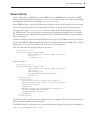
18 ❘ Chapter 1 Getting to Know XMPP The following example IQ-error stanza shows a fully constructed error response to a publish-subscribe related <iq> stanza: <iq from=’pubsub.pemberley.lit’ to=’[email protected]/sitting_room’ type=’error’ id=’subscribe1’> <pubsub xmlns=’http://jabber.org/protocol/pubsub’> <subscribe node=’latest_books’ jid=’[email protected]’/> </pubsub> <error type=’cancel’> <not-allowed xmlns=’urn:ietf:params:xml:ns:xmpp-stanzas’/> <closed-node xmlns=’http://jabber.org/protocol/pubsub#errors’/> <text xmlns=’urn:ietf:params:xml:ns:xmpp-stanzas’> You must be on the whitelist to subscribe to this node. </text> </error> </iq> The error’s type is cancel, indicating that this action should not be retried and the condition <not-allowed/> indicates the general failure. The <text/> child contains a description of the problem. Finally, the application condition element, <closed-node/>, gives the exact application error. The Connection Life Cycle The three stanzas you’ve learned about can accomplish virtually any task in XMPP when combined properly. However, sending stanzas usually requires an authenticated XMPP session be established. This section describes the other portions of an XMPP connection’s life cycle — connection, stream set up, authentication, and disconnection. Connection Before any stanzas are sent, an XMPP stream is necessary. Before an XMPP stream can exist, a connection must be made to an XMPP server. XMPP includes some sophisticated support for establishing connections to the right servers. Typically clients and servers utilize the domain name system (DNS) to resolve a server’s domain name into an address they can connect to. E‑mail services in particular use mail exchange (MX) records to provide a list of servers that handle mail for a given domain so that one well-known server address does not have to handle every service. E‑mail, being an early Internet application, got special treatment in DNS. These days, service records (SRV) are used to provide a similar function for arbitrary services. The first thing an XMPP client or server does when connecting to another XMPP server is to query the appropriate SRV record at the server’s domain. The response may include multiple SRV records, which can be used to load balance connections across multiple servers. If an appropriate SRV record cannot be found, the application tries to connect to the given domain directly as a fallback. Most libraries also allow you to specify a server to connect to explicitly.