1
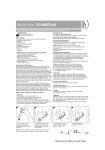
For internal application the special applicator can be used.
It is included in the box and can be screwed onto the tube.
With the applicator you can apply the gel into the vagina where
it can act for a longer time. After use you can leave the
1.
1. Take the cap of the tube.
Use the backside of the cap to
pierce the sealed tube, prior to
initial use.
5.
applicator on the tube, wash it with warm water and then place
the cap on the applicator. Wash your hands and apply at least
the amount of a fingertip on the tip of your index finger.
Insert your finger into your vagina.
3.
2.
2. Screw the special applicator,
which is inside in the box,
on the tube.
6.
4.
3. Take the small cap off the
applicator.
4. Take the tube in one hand
and squeeze slightly until the gel
comes out of the front side of
the applicator. When the gel
comes out you know that the
applicator is filled with gel and
ready for use. Practice how much
will come out with a slight
squeezing; you need at least the
amount of a fingertip (2 ml).
7.
8.
1x
5. Insert the applicator, which
remains on the tube, into the
vagina as the picture shows.
The vagina is 7-8 cm long and
in correspondence with the
indexfinger of the individual
woman. The length of the
applicator is approx. the same
as an index finger and will not
damage the cervix.
6. Squeeze the tube slightly.
You need at least the amount
of a fingertip. There is however
no limitation and no hazard if
you apply more.
7. After use you can leave the
applicator on the tube and
wash it with warm water.
8. Place the small cap on the
applicator
J. Background information
Intimate discomforts are more common than you may think. Many women will recognize the problem: irritation, soreness, burning sensation,
unpleasant odor or discharge, sensitivity during or after making love, irritated labia and itch. Itch, burning sensation or irritation often worsen
because of tight clothes, humid panty liners or hygienic bandages. Multi-Gyn ActiGel is the effective and natural solution to all such intimate
discomforts.
Bacterial Vaginosis
Yeast
What is bacterial vaginosis?
Bacterial vaginosis is a disturbance -a misbalance- in the vaginal
environment caused by bacteria. The vagina normally contains a lot of
"good" bacteria, called lactobacilli, and a few other types of bacteria,
called coccoid bacteria. Lactobacilli are responsible for the healthy
vaginal acidity in which the coccoid bacteria don't grow well.
Loss of this vaginal acidity and the presence of too many coccoid
bacteria is called "bacterial vaginosis".
What is yeast?
Yeast (fungus) has 2 phases; a spore phase that does not cause
problems and a threadlike phase that can cause problems. Like the
lactobacilli yeast needs cell sugar for its growth and are in
competition over this food source. Therefore yeast is mostly found
in a vaginal environment with a normal (optimal) acidity.
How do I know I have bacterial vaginosis?
You may notice a different discharge from your vagina. The discharge
may be clear or colored and may be excessive. It most often has a fishy
smell, especially after unprotected intercourse. Often you will suffer of
vaginal discomforts such as itch, irritations, sensitivity, redness, and
soreness. Some women have bacterial vaginosis without any symptoms.
The vaginal acidity is always abnormal; pH > 5
If this is an infection, did I catch it from someone?
No, not with normal hygiene. Bacterial vaginosis is an overgrowth of
bacteria that are often present in the vagina, because of the proximity
of the anus. While it's more common in women who are sexually active,
it also occurs in women who are not sexually active.
Does it have to be treated?
Yes. Bacterial vaginosis is a truly undesirable vaginal flora. If bacterial
vaginosis is not treated, the bacteria may get up into the uterus and
cause serious problems. Treatment is especially important in pregnant
women. Of course prevention is always best.
How do I know I have yeast?
You will most often notice a non-smelly, white, cottage cheese like
discharge and suffer of vaginal discomforts such as itch, irritations,
sensitivity, redness, and soreness.
If this is an infection, did I catch it from someone?
Not necessarily. Yeast is often just an uninvited guest. However
when you suffer recurrent infections, it might be that your partner
is a source. Recurrent yeast infections are often seen in diabetes,
because of the sugar, the food source of yeast. A low resistance to
yeast infections is also seen in families, so there is a genetic
background as well.
Does it have to be treated?
Contrary to bacterial vaginosis, yeast is not a really dangerous
vaginal infection. It is however a great nuisance and affects the
quality of life very much. When suffering infectious complaints,
treatment with special antifungal medication is therefore indicated.
Prevention is of course always best.
ART NUMMER/ Date code BASIC110I.2