Transcript
Revision No.: ZJ0007
Issue Date: Jul 1st, 2012
Bordetella Pertussis Real Time PCR Kit User Manual
For In Vitro Diagnostic Use Only
RD-0061-02
For use with ABI Prism®7000/7300/7500/7900/Step One Plus; iCycler iQ™4/iQ™5;
Smart Cycler II;Bio-Rad CFX 96;Rotor Gene™6000; Mx3000P/3005P;MJ-Option2/Chromo4;
LightCycler®480 Instrument
Obelis S.A.
Boulevard Général Wahis 53
1030 Brussels, BELGIUM
Tel: +(32) 2.732.59.54
Fax: +(32) 2.732.60.03
E-Mail : [email protected]
Shanghai ZJ Bio-Tech Co., Ltd.
www.liferiver.com.cn
Tel: +86-21-34680596
[email protected]
Fax: +86-21-34680595
nd
2 floor,No.15 Building,No.188 Xinjunhuan road,
PuJiang Hi-tech Park Shanghai China
1. Intended Use
Bordetella Pertussis real time PCR Kit is used for the detection of bordetella pertussis by real time PCR
systems in samples like nasal and pharyngeal secretions, sputum, and etc.
2. Principle of Real-Time PCR
The principle of the real-time detection is based on the fluorogenic 5’nuclease assay. During the PCR
reaction, the DNA polymerase cleaves the probe at the 5’ end and separates the reporter dye from the
quencher dye only when the probe hybridizes to the target DNA. This cleavage results in the
fluorescent signal generated by the cleaved reporter dye, which is monitored real-time by the PCR
detection system. The PCR cycle at which an increase in the fluorescence signal is detected initially (Ct)
is proportional to the amount of the specific PCR product. Monitoring the fluorescence intensities
during Real Time allows the detection of the accumulating product without having to re-open the
reaction tube after the amplification.
3. Product Description
Bordetella pertussis is the cause of one of the most contagious human diseases known as whooping
cough. B. pertussis causes severe coughing spells, with a characteristic “whoop” made as the affected
person struggles to breathe through narrowed airway passages between coughing spasms. B. pertussis
is a small gram-negative aerobic coccobacillus that colonizes the cilia of the nose and throat of infected
humans. Toxins produced by B. pertussis paralyze the cilia and cause inflammation of the respiratory
tract, interfering with the clearance of pulmonary secretions. This disease was first described in the 16th
century and was one of the most frequent and severe diseases in infants in the United States, commonly
resulting in morbidity and mortality among children prior to introduction of an effective vaccine. The
incidence decreased dramatically following the introduction of the vaccine; however, incidence has
been gradually increasing since the early 1980’s. One explanation for the increase might be the
adaptation of B. pertussis bacteria to vaccine-induced immunity.Bordetella pertussis real time PCR kit
contains a specific ready-to-use system for the detection of Bordetella Pertussis by polymerase chain
reaction (PCR) in the real-time PCR system. The master contains reagents and enzymes for the specific
amplification of the bordetella pertussis DNA. Fluorescence is emitted and measured by the real time
systems´ optical unit during PCR. The detection of amplified bordetella pertussis DNA fragment is
performed in fluorimeter channel FAM with the fluorescent quencher BHQ1. DNA extraction buffer is
available in the kit. In addition, the kit contains a system to identify possible PCR inhibition by
measuring the HEX/VIC/JOE fluorescence of the internal control (IC).An external positive
control(1×10⁷copies/ml) contained, allow the determination of the gene load. For further information,
please refer to section 9.3 Quantitation.
4. Kit Contents
Ref.
Type of Reagent
Presentation 25rxns
1
DNA Extraction Buffer
2 vials, 1.5ml
2
B. Pertussis Reaction Mix
1 vial, 950µl
3
1 vial, 12µl
PCR Enzyme Mix
4
Molecular Grade Water
1 vial, 400µl
5
Internal Control(IC)
1 vial, 30µl
7
6
B. Pertussis Positive Control (1×10 copies/ml)
1 vial, 30µl
3
3
Analysis sensitivity:1×10 copies/ml;
LOQ: 2×10 ~1×10⁸ copies/ml
Note: Analysis sensitivity depends on the sample volume, elution volume, nucleic acid extraction
methods and other factors .If you use the DNA extraction buffer in the kit, the analysis sensitivity is the
same as it declares. However, when the sample volume is dozens or even hundreds of times greater
than elution volume by some concentrating method, it can be much higher.
5. Storage
• All reagents should be stored at -20°C. Storage at +4°C is not recommended.
• All reagents can be used until the expiration date indicated on the kit label.
• Repeated thawing and freezing (>3x) should be avoided, as this may reduce the sensitivity of the
assay.
• Cool all reagents during the working steps.
• Reaction Mix should be stored in the dark.
6. Additionally Required Materials and Devices
• Biological cabinet
• Real time PCR system
• Trypsin digestive Solution
• Vortex mixer
• Real time PCR reaction tubes/plates
• Cryo-container
• Pipets (0.5 µl – 1000 µl)
• Sterile filter tips for micro pipets
• Sterile microtubes
• Disposable gloves, powderless
• Biohazard waste container
• Refrigerator and Freezer
• Desktop microcentrifuge for “eppendorf” type tubes (RCF max. 16,000 x g) • Tube racks
7.
Warnings and Precaution
• Carefully read this instruction before starting the procedure.
• For in vitro diagnostic use only.
• This assay needs to be carried out by skilled personnel.
• Clinical samples should be regarded as potentially infectious materials and
should be prepared in a laminar flow hood.
• This assay needs to be run according to Good Laboratory Practice.
• Do not use the kit after its expiration date.
• Avoid repeated thawing and freezing of the reagents, this may reduce the sensitivity of the test.
• Once the reagents have been thawed, vortex and centrifuge briefly the tubes before use.
• Prepare quickly the Reaction mix on ice or in the cooling block.
• Set up two separate working areas: 1) Isolation of the RNA/ DNA and 2) Amplification/ detection
of amplification products.
• Pipets, vials and other working materials should not circulate among working units.
• Use always sterile pipette tips with filters.
• Wear separate coats and gloves in each area.
• Avoid aerosols
8. Sample Collection, Storage and transport
• Collect samples in sterile tubes;
• Specimens can be extracted immediately or frozen at -20°C to -80°C.
• Transportation of clinical specimens must comply with local regulations for the transport of etiologic agents
9. Procedure
9.1 DNA-Extraction
DNA extraction buffer is contained in the kit. Please thaw the buffer thoroughly and spin down briefly
in the centrifuge before use. It’s better to use commercial kits for nucleic acid extraction.
9.1.1 Sputum samples
1) Trypsin digestive Solution preparation
Add 10g trypsin to 200ml purified water and mix thoroughly. Adjust PH value to 8.0 with 2 % N a O H
solution. Add 2mL CaCl2 (25mmol/L), mix thoroughly and store at 4℃. Please incubate at 37℃ for
10 minutes before use.
2) Estimate the volume of the sputum and add partes aequales of the Trypsin digestive Solution then
vortex vigorously. Set at room temperature for 30 minutes. Transfer 0.5ml mixture to a new tube.
Centrifuge the tube at 13000rpm for 5 minutes, carefully remove and discard supernatant from the tube
without disturbing the pellet.
3) Add 1.0ml normal saline. Resuspend the pellet with vortex vigorously. Centrifuge at 13000rpm for 5
minutes. Carefully remove and discard supernatant from the tube without disturbing the pellet.
4) Repeat step 3)
5) Add 100µl DNA extraction buffer, close the tube then suspend the pellet with vortex vigorously.
Spin down briefly in a table centrifuge.
6) Incubation the tube for 10 minutes at 100°C.
7) Centrifuge the tube at 13000rpm for 10 minutes. The supernatant contains DNA extracted and is
used for PCR template.
9.1.2 Nasal and pharyngeal secretions samples
1) Take 1ml sample in a tube, centrifuge the tube at 13000rpm for 2min, and remove the supernatant
and keep the pellet.
2) Add 100µl DNA extraction buffer to the pellet, close the tube then vortex for 10 seconds. Spin down
briefly in a table centrifuge.
3) Incubate the tube for 10 minutes at 100°C.
4) Centrifuge the tube at 13000rpm for 10 minutes. The supernatant contains the DNA extracted and
can be used for PCR template.
Attention:
A. During the incubation, make sure the tube is not open, as the vapor will volatilize into the air and
may cause contamination in case the sample is positive.
B. The extraction sample should used in 3 hours or store at -20°C for one month.
C. DNA extraction kits are available from various manufacturers. You can also use your own extraction
systems or the commercial kit depending on the yield. For DNA extraction, please comply with the
manufacturer’s instructions.
9.2 Internal Control
It is necessary to add internal control (IC) in the reaction mix. Internal Control (IC) allows the user to
determine and control the possibility of PCR inhibition.
Add the internal control (IC) 1µl/rxn and the result will be shown in the HEX/VIC/JOE.
9.3 Quantitation
The kit can be used for quantitative or qualitative real-time RT-PCR. A positive control defined as
1×10⁷copies/ml is supplied in the kit.
For performance of quantitative real-time PCR, Standard dilutions must prepare first as follows.
Molecular Grade Water is used for dilution.
Dilution is not needed for qualitative real-time PCR detection.
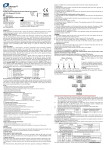
Take positive control (1×10⁷copies/ml) as the starting high standard in the first tube. Respectively
pipette 36ul Molecular Grade Water into next three tubes. Do three dilutions as the following figures:
To generate a standard curve on the
real-time system, all four dilution
standards should be used and defined
as standard with specification of the
corresponding concentrations.
Attention:
A. Mix thoroughly before next
transfer.
B. The positive control
7
(1×10 copies/ml) contains high concentration of the target DNA. Therefore, be careful of dilution in
order to avoid contamination.
9.4 PCR Protocol
The Master Mix volume for each reaction should be pipetted as follows:
OR
1)
2)
3)
4)
※PCR system without HEX/VIC/JOE channel may be treated with 1µl Molecular Grade Water instead of 1µl IC.
The volumes of Reaction Mix and Enzyme Mix per reaction multiply with the number of
samples, which includes the number of controls, standards, and sample prepared. Molecular
Grade Water is used as the negative control. For reasons of unprecise pipetting, always add an
extra virtual sample. Mix completely then spin down briefly in a centrifuge.
Pipet 36µl (22.5µl for Smart Cycler II)Master Mix with micropipets of sterile filter tips to each
Real time PCR reaction plate/tubes. Separately add 4µl (2.5µl for Smart Cycler II)DNA
sample, positive and negative controls to different reaction plate/tubes. Immediately close the
plate/tubes to avoid contamination.
Spin down briefly in order to collect the Master Mix in the bottom of the reaction tubes.
Perform the following protocol in the instrument:
37°C for 2min
1cycle
Selection of fluorescence channels
94°C for 2min
1cycle
FAM
Target Nucleic Acid
93°C for 15sec, 60°C for 1min
HEX/VIC/JOE
IC
40cycles
( Fluorescence measured at 60°C)
5)
If you use ABI Prism® system, please choose “none” as passive reference and quencher.
10. Threshold setting: just above the maximum level of molecular grade water.
11.Calibration for quantitative detection: Input each concentration of standard controls at the end of
run, and a standard curve will be automatically formed.
12. Quality control: Negative control, positive control, internal control and QS curve must be
performed correctly, otherwise the sample results is invalid.
Channel
Ct value
Control
FAM
HEX/VIC/JOE
Molecular Grade Water
UNDET
25~35
Positive Control(qualitative assay)
≤35
——
QS(quantitative detection)
Correlation coefficient of QS curve≤-0.98
13. Data Analysis and Interpretation : The following sample results are possible:
Ct value
Result Analysis
FAM
HEX/VIC/JOE
1#
UNDET
25~35
Below the detection limit or negative
2#
Positive; and the software displays the quantitative value
≤38
——
3#
25~35
Re-test; If it is still 38~40, report as 1#
38~40
4#
UNDET
UNDET
PCR Inhibition; No diagnosis can be concluded.
For further questions or problems,please contact our technical support at [email protected]