1
US008200983B1
(12)
United States Patent
(10) Patent N0.:
(45) Date of Patent:
Victorov
(54)
SYSTEM AND METHOD FOR
TAMPER-PROOFING EXECUTABLE BINARY
ASSEMBLIES
US 8,200,983 B1
Jun. 12, 2012
2005/0252977 A1*
11/2005
2006/0080531 A1*
4/2006
GreZes et a1. ............... .. 235/492
Sinha et a1.
2007/0169019 A1*
7/2007
Leino et a1. ................. .. 717/136
.. 713/168
OTHER PUBLICATIONS
(75) Inventor: Victor Y. Victorov, St. Petersburg (RU)
(73) Assignee: 9Rays.Net, Inc., Alexandria, VA (US)
Notice:
Subject to any disclaimer, the term of this
patent is extended or adjusted under 35
“ObfuscationiString Encryption,” Jason Haley, Jun. 16, 2006,
http://j asonhaley.com/blog/po st/2006/ 06/ 1 5/ Obfuscation-String
Encryption-.aspx.*
“ObfuscationiRenaming and Simple Code Removal,” Jason Haley,
Jun. 4, 2006, http://jasonhaley.com/blog/post/2006/06/04/Obfusca
tion-Renaming-and-Simple-Code-Removal.aspx.*
“Obfuscate ItiThwaIt Reverse Engineering of Your Visual Basic
.NET or C# Code,” Torok et al., Gabriel Torok; Bill Leach, Nov.
2003*
“Remotesoft .NET Obfuscator User Manual,” Remotesoft, Nov. 6,
U.S.C. 154(b) by 1145 days.
(21) Appl. No.: 11/766,764
2002,
(22)
Filed:
Jun. 21, 2007
“Review: RemoteSoft Explorer, Decompiler, Obfuscator and Protec
tor,” Bromberg, Dec. 13, 2002, http://www.eggheadcafe.com/ar
Related US. Application Data
ticles/20021213.asp.*
(60) Provisional application No. 60/825,117, ?led on Sep.
9, 2006.
(51)
(74) Attorney, Agent, or Firm * Bardmesser LaW Group
(2006.01)
US. Cl. ......................... .. 713/187; 726/30; 713/194
Field of Classi?cation Search ...................... .. None
See application ?le for complete search history.
(56)
assembly-time constants during the assembly process using
U.S. PATENT DOCUMENTS
6,560,774 Bl *
B1*
B1*
B1*
B1*
B1*
B2 *
B2 *
A1*
2004/0003380 A1*
2004/0236955 A1*
2005/0015753 A1*
5/2003
7/2003
4/2004
8/2004
2/2005
10/2006
12/2006
1/2010
10/2003
1/2004
Gordon et al. .............. .. 717/146
Chow et al.
Stoutamire
Chow et al.
Syme et a1.
Franz et al.
Meijer et al.
Sinha et a1.
Sinha et a1.
..
..
..
..
..
.
..
..
713/190
711/170
713/189
717/146
717/144
717/116
726/23
713/176
Fedorov ..... ..
717/148
11/2004 Chow et al. ..
713/190
1/2005
(57)
ABSTRACT
A method, system and computer program product for tamper
proo?ng an executable assembly, including identifying
assembly-time constants in source code; encrypting the
References Cited
6,594,761
6,728,852
6,779,114
6,851,108
7,117,488
7,155,703
7,644,440
2003/0191940
* cited by examiner
Primary Examiner * Oscar Louie
Int. Cl.
G06F 21/00
(52)
(58)
http://web.archive.org/web/20030418073048/www.
remotesoft. com/ salamander/ obfuscator/manual/ index .html. *
public key cryptography; and signing the executable assem
bly using a digital signature. The executable assembly, at
run-time, decrypts the assembly-time constants using the
digital signature. A hashing function, a compression function
or a one-Way cryptographic block function is used to encrypt
the assembly-time constants. Different keys or the same keys
can be used to launch the assembly and to encrypt the assem
bly-time variables. The assembly-time constants are placed
into a heap prior to the encrypting step. The assembly-time
constants include strings and databases.
22 Claims, 4 Drawing Sheets
Meijer et al. ................ .. 717/136
Mewam
MWFRWWU .
Size:
. . .,
US. Patent
Jun. 12, 2012
“PE
Sheet 1 of4
g3a%g.“.
US 8,200,983 B1
US. Patent
.9"N
Jun. 12, 2012
Sheet 2 of4
US 8,200,983 B1
US. Patent
Jun. 12, 2012
Sheet 4 0f 4
.mUxH.wznmUuic?nugeE.
[email protected];i
2E,. Emimui
m E.JUm.E
E
mmmcmr?mm
.U
U.
US 8,200,983 B1
US 8,200,983 B1
1
2
SYSTEM AND METHOD FOR
TAMPER-PROOFING EXECUTABLE BINARY
ASSEMBLIES
ability of tWo different input ?les generating the same hash
function values (Where there are 240 or 264 possible hash
function values, or 2160 for some of the stronger hash func
tions, such as SHAl) is vanishingly small.
.NET assemblies have an optional provision for including
CROSS REFERENCE TO RELATED
APPLICATIONS
tamper resistance (also knoWn as “integrity veri?cation” or
“strong-name”) as part of the build. To generate a .NET
This application is a non-provisional of US. Provisional
assembly, source code (such as C++, JAVA, etc.) is converted
PatentApplication No. 60/825,117, ?led 9 Sep. 2006, entitled
to What is knoWn as “intermediate language”, or IL, format.
The IL code is then assembled into a binary executable ?le.
The mechanism for tamper resistance in the .NET assemblies
SYSTEM AND METHOD FOR TAMPER-PROOFING
EXECUTABLE BINARY ASSEMBLIES, Which is incorpo
rated herein by reference in its entirety.
uses cryptography to embed into the executable public part of
BACKGROUND OF THE INVENTION
key for signing and subsequent veri?cation of assembly
integrity by .Net runtime. If the assembly has changed, then
the hash Would not match the stored value, and the .Net
assembly Would trigger a strong name veri?cation exception.
.NET metadata stores information relating to the public
1. Field of the Invention
The present invention is related to protection of executable
softWare code from copying by hackers and cloners, and more
particularly, to the use of encryption and cryptography for
generating of tamper-proof softWare executable code builds.
2. Description of the Related Art
The problem of prevention of copying of softWare is one
that has great relevance today, particularly Where many tools
key and the hash of the public key, and de?nes Whether this
build is signed or not signed, using a cryptographic key (using
20
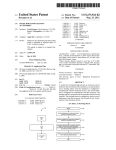
speci?ed by the virtual address in the metadata (see FIG. 1),
and its siZe is de?ned by the CLIHeader (or COM+ header).
are available to hackers and cloners to copy, reverse assemble,
reverse compile code. The problem has been particularly
25
exacerbated in recent years due to the fact that much of the
softWare is noW available in doWnloadable form. Early
attempts at creation of tamper-resistant code builds involved
relatively simple schemes, such as checksum functions, CRC
(cyclic redundancy check) or digital signature functions. As
a public key cryptography scheme). The public portion of the
key is also located in the executable assembly, at an offset
30
The .Net runtime identi?es the presence of the signature, and
veri?es it. If the signature is correct (i.e., the assembly has not
been altered), the .Net runtime then launches the assembly.
Thus, if the executable ?le is signed, the .Net runtime Will
check that Whether or not this is a signed assembly, and then,
using the public portion of the key Which is also embedded in
the binary executable ?le, Will check that the control value
part of the tamper-proof mechanism, the executable code
generated from the key is the same as the control value gen
generated a value, such as a checksum, a CRC value or a
erated from the executable binary. If the control values
digital signature hash (digest of a signature) value, from the
executable code (in other Words, from itself), and compared
(hashes) do not match, then the attempt to run the executable
code Will fail.
This scheme, hoWever, has a ?aWithe location of the
that value With a value that Was stored someWhere Within the
code. A difference in the tWo values meant that the copy of the
executable ?le that Was being run Was a fraudulently obtained
35
signature and public key that determines Whether this build is
one, and the tamper resistance mechanism Would abort the
execution of the executable ?le.
A similar digital signature technology is used in email
encryption, When the email itself contains a public portion of
40
the key, so that the recipient of the email can be certain that the
sender has not faked his identity. The same mechanism is used
for assembly veri?cation (assembly signing), to created
strong-named assemblies, Where the runtime process that
a signed assembly or an unsigned assembly, is knoWn. A
hacker can manually edit the binary (or use any of the variety
of tools that permit patching of executable binaries), to Zero
out that ?eld in the binary ?le (resulting in a clear or empty
signature), so that the executable code, When installing and
launching, Will consider itself to be an unsigned build. As
such, the presence of the public portion of the key in the
45
executable ?le becomes irrelevant, since the executable
binary Will never check it. Also, the hacker can generate his
installs the assembly and launches its execution can check the
oWn key, and alter the public key portion of the key stored in
signature and con?rm that the contents of the assembly has
not been tampered With.
In recent years, various cryptographic functions have been
used to enhance the protection and the tamper resistance level
available to vendors of softWare. Rather than using relatively
the binaryiin other Words, the hacker can generate his oWn
keys, re-sign the assembly, and therefore, sell his oWn
licenses to the assembly, or distribute them for free, adding
50
his oWn license generator.
After generating an unsigned executable binary, a hacker
simple (in cryptographic terms) functions such as checksums
can then publish the code as freeWare, or can add a Wrapper
and CRCs, other, more advanced mechanisms have been
around it, Which Will require a digital signature of its oWn, or
employed. For example, various hash functions have become
more popular, as a means for generating a value (called “hash
can add his oWn Wrapper around the binary, Which Will then
55
value”) based on the ?le (in this case, the executable ?le).
Examples of such hash functions include MD4, MD5, etc.
so, the hacker can get into the business of selling or distrib
uting the same product code, but requiring a license to him
self, not to the vendor of the softWare.
ithe nature of the hash functions is such that even a small
change in the input, or even a 1 bit change in the input ?le used
to generate the hash function value, Will result in a completely
different hash function value.
Furthermore, hash functions are an example of “one Way
Accordingly, there is a need in the art for a more reliable
60
mechanism of tamper-proo?ng binary assemblies.
SUMMARY OF THE INVENTION
functions”ii.e., functions such that knoWing the output
value, it is virtually impossible to WorkbackWards to generate
the original data used to generate the hash function value.
Furthermore, With most modern hash functions, Which gen
erate 40-bit output values, or 64-bit output values, the prob
require a signature from the useriin other Words, by doing
Accordingly, the present invention is related to a system,
65
method and computer program product for tamper-proo?ng
executable binary assemblies that substantially obviates one
or more of the disadvantages of the related art.
US 8,200,983 B1
4
3
Additional features and advantages of the invention Will be
set forth in the description that follows, and in part Will be
apparent from the description, or may be learned by practice
of the invention. The advantages of the invention Will be
realiZed and attained by the structure particularly pointed out
Certain other variables are treated essentially as constants.
For example, some numerical values (e.g., the value of pi,
3.14, or the value of e, 2.718), or the values of certain string
variables used in the graphical user interface, are constants.
For instance, if a user is asked Whether or not he Wants to save
the results of his Work, a function (or “method,” in .NET
terminology) such as WriteLine (string) needs to be invoked,
in the Written description and claims hereof as Well as the
appended drawings.
to Write a line to the screen. In this case, the function Would
It is to be understood that both the foregoing general
description and the folloWing detailed description are exem
plary and explanatory and are intended to provide further
explanation of the invention as claimed.
look like WriteLine (“Project ‘{0} ’ has been changed. Save
changes?”). Most softWare programs, particularly those that
interface to users through various on-screen queries, WiZards,
forms, etc., contain numerous such string-type variables,
Which are essentially constants. These might be kept as sepa
BRIEF DESCRIPTION OF THE ATTACHED
FIGURES
rate variables (for example, by initialiZing a string variable
“SAVEQUESTION” to “Project ‘{0} ’ has been changed.
Save changes?”), or by simply Writing the value of the string
The accompanying draWings, Which are included to pro
vide a further understanding of the invention and are incor
porated in and constitute a part of this speci?cation, illustrate
embodiments of the invention and together With the descrip
tion serve to explain the principles of the invention.
In the draWings:
Within the source code itself (i.e., WriteLine (“Project ‘{0} ’
has been changed. Save changes?”)), but they are normally
20
The modern approach is to place all such assembly time
variables into a “heap” Which is essentially a container for
FIG. 1 illustrates an example of hoW metadata is used to
holding such numeric and string type data constants. Other
sign an assembly.
FIG. 2 illustrates an example of data that can be encrypted
25
using the approach described herein.
’ has been changed. Save changes?” is an example of User
FIG. 4 illustrates an assembly tree With the resources iden
30
DETAILED DESCRIPTION OF THE PREFERRED
EMBODIMENTS
Reference Will noW be made in detail to the preferred
35
illustrated in the accompanying draWings.
One-Way functions, such as hash functions, have long been
bly time constants can be foundiby examining the binary, a
hacker can gain a substantial amount of insight into the code,
as Well as be able to distribute the codes himself, by defeating
the integrity checking mechanism of .NET assemblies, as
discussed above.
The solution to this is therefore to use cryptographic func
used as a mechanism for converting data into control values.
40
tions, to encrypt the assembly time variables/constants. In the
example above, the string “Project ‘{0}’ has been changed.
Save changes?” Would be encrypted, using public key cryp
operate by converting an input string of an arbitrary length
tography. Thus, the form in Which that string is stored in the
executable binary is essentially meaningless. Even if a hacker
into a control value, knoWn as the “hash value,” Which is of a
speci?ed length. Using the SHA-l function as an example,
Strings Stream data that is determined at assembly time, and
Will be encrypted using the approach described herein. Simi
larly, the entry “Save Project” in FIG. 2 Would be encrypted.
In the conventional approach, the heap is then assembled
into an area Within the executable binary, Where these assem
embodiments of the present invention, examples of Which are
Examples of commonly used hash functions are MD4, MD5,
SHA-0, SHA-l, SHA-224, SHA-256, SHA-5l2, as Well as
many others. Most of the commonly used hash functions
types of variables can also be placed in the heap, such as
databases, etc. In essence, multiple lines of binary code are
generated, containing the constants and the strings in a set of
lines. For example, in FIG. 2, the metadata entry “Project ‘{0}
FIG. 3 illustrates an example of a computer system on
Which the invention may be implemented.
ti?ed.
initialiZed at assembly time, since their values are knoWn in
advance.
45
Were to Zero out the byte that determines Whether this is a
signed or unsigned assembly, the display that the user Would
the hash value is 160 bits long, Which means that the number
of possible hash values is 21 6O. This is, obviously, a very large
see on the screen Would be essentially garbage, because of
number. Furthermore, most one-Way functions used in cryp
tographic applications are such that a change of even one bit
in the input data stream results in a completely different hash
value at the output. Thus, While the hashing does not guaran
tee that tWo different inputs (for example, tWo different pass
Words, or tWo different ?les) Will result in a unique hash
incorrect/failed decryption. Instead of meaningful strings
representing characters and Words, essentially random bits
50
attempt to print such unprintable characters at runtime using
the WriteLine function Will either fail, or may result in a
system crashithis therefore means that demand for cloned/
value, With 2160 possible hash values, in practice, this is usu
ally the case. Any of these functions can be used in the present
invention for purposes of encryption of a passWord or key
needed to decrypt the assembly time constants.
55
most such executable code hasivariables Whose values are
determined at run-time, and variables Whose values are deter
mined at assembly time. Run-time values are those that
pirated softWare from this hacker should rapidly evaporate.
In many practical examples, it is not just individual strings
that can be encrypted this Way, but multiple strings, or
The approach described herein utiliZes public key cryptog
raphy to encrypt certain information Within the executable
binary itself. In particular, there are tWo types of variables that
Would be displayed if the hacker Were to examine the binary
?leiincluding unprintable characters. In some cases, the
60
“heaps”iin essence, a very long string (While the functions
that Work With such strings knoW Where to ?nd “their” string
in the heap). Also, in addition to strings, other forms of binary
data embedded in the binary executable can be encryptedi
e.g., images, embedded graphics, bitmaps, jpegs, video,
audio, mpegs, Way ?les, avi ?les, animation, logos, ?ash, and
any other resources that are visible or audible to the user in the
depend on some input, for example, from the useriWhen a
program asks a user to enter his age, it needs to Wait for that 65 form of GUI. For example, many of the images that the user
input before it can do anything else. This is an example of a
Would see on the screen can be encrypted this Way, rendering
run-time variable.
the GUI of the hacker’s assembly useless.
US 8,200,983 B1
6
5
addition of this mechanism would affect usability and the
time needed to launch the software in any signi?cant way.
It should also be noted that the approach described herein
is particularly useful for those languages and software archi
tectures that utiliZe an intermediate language. Some examples
Furthermore, it will be appreciated that the technology
described herein is not particularly limited to .NET assem
blies, but can be applicable to any tamper proo?ng scheme,
where public key cryptography is used to verify the build
integrity or the rights of the user to run the code.
As yet a further embodiment, as a separate option, or as an
of this are .NET architecture, JAVA, VisualBasic, and so on.
Another “collection” of data that can be handled in a simi
option combined with the embodiment described above, the
heap can be compressed, using archiving algorithms, such as
lar manner is something called “ManagedResource” in the
.NET architecture. This refers to data, both structured and
PKZIP, RAR, as well as many others. It should also be noted
that although some algorithms are commonly used, such as
unstructured, that is frequently used only once, for example,
ZIP, GZIP and RAR, there are many such archiving/compres
sion algorithms, and many variations on these algorithms,
which are regarded as somewhat exotic, and are rarely used.
during boot up or initialization, or ?rst use of the program,
and rarely ever used again. Yet another resource where this
approach can be applied to is data, both structured and
unstructured, for ?lling out forms that is present in many
software applications. For example, the names of the ?elds in
The decompression algorithm itself (but not the compression
algorithm) can be embedded in the assembly, making it dif
?cult for the hacker to know what the compres sion algorithm
was, since it is rarely obvious from the decompression code
exactly which compression algorithm used. Such compres
sion algorithms can also be customiZed for minor variations.
The use of such compression/decompression algorithms
therefore will make it necessary for the cloner to acquire
expertise in compressioniin addition to the subject matter of
20
the forms, the questions that prompt the user, and so on. More
generally, almost any assembly-time information that can be
used as a resourceistrings, ?xed numeric values, images,
video, audio streams, unstructured BLOBs or ?le streams
embedded into assembly as resource.
Yet another entity that can be handled in a similar manner
the software itself. This means that without being able to
as discussed above is something called BLOB in .NET archi
compress the heap into its compressed form for assembly, the
tecture, which stands for binary large object (sometimes
hacker could not generate a workable build.
25
called “stream” in modern terminology), which is a binary
resource loaded in a particular way such that the code loading
the stream knows how to interpret it (essentially, where the
offsets in the stream are for each particular piece of data). The
30
BLOB can be embedded in the code itself, rather than as a
separate .NET entity, such that a hacker will see that there are
It should also be noted that decompression is a relatively
fast process (unlike some cryptographic algorithms, e.g.,
AES, DES, Blow?sh, Two?sh, etc., which are relatively pro
cessor-intensive), thus, compressing the heap before encrypt
ing it is a useful optimization.
BLOB is where binary data (rather than text data) is kept. The
Additionally, the compressed heap can be password pro
tected, with the password also embedded in the assembly
the password again or without having to extract password
no such managed resources, and no text lines, and no binary
data that he can look at, in order to reconstruct the algorithm
of the code.
It is also worth recalling that many hackers and cloners are
often more interested in understanding the algorithm of the
from license. The password can be the same password as used
for protecting the entire assembly, or can be a different pass
cally copying the code by roteiby understanding the algo
itself, or a license protected with a password embedded in the
license. The heap can also be automatically decompressed,
using the same password, without having to ask the user for
word. With strong enough encryption, and with using su?i
ciently robust hashing functions, such as SHAl, SHA256,
and so on, the heap itself can be protected from cryptographic
attack in a relatively straightforward manner.
It should also be noted that even though the password itself
can be stored as part of the build, it is stored in its hashed form,
rather than in its original form. Therefore, even if the hacker
removes the requirement for checking whether or not the
35
software they are trying to clone, rather than just mechani
rithm, they can offer similar products, at a much lower price,
40
45
or some binary “phrases” that the user sees as part of the
graphical user interface of a program are often repetitive. For
be “off limits” to the hacker.
50
even if the sentences themselves are different.
55
even for the more complex algorithms that involve compres
sion and encryption. Therefore, it is not expected that the
Also, many different words that are used as part of the
graphical user interface can have the same roots, word por
tions, suf?xes or pre?xes. For example, the words “box,” “in,”
“boxer”, “inbox” (a commonly used word in the IT industry),
video, and so on. These elements can be encrypted/tamper
protected as described herein. However, it is worth noting that
even if only the text is made tamper proof, but not other
elements, this would still render the bootleg copy of the
software with the tamper proo?ng ?ag reset virtually unus
able, since a large part of the graphical user interface between
the software and the end user would look like garbage.
It should also be noted that the decompression discussed
earlier needs to be done only once, during launch, which is a
very fast process for heaps that are 100-200 kilobytes in siZe,
example, many questions that are often asked in different
forms are very similar, often differing by only one or two
words out of a sentence, or are frequently identical. Also,
many words are often repetitive, from sentence to sentence,
mon for most commercial software sold on the consumer
market to have large text-based heaps. The recent trend has
been in the direction of larger heaps, particularly due to the
use of graphical elements, such as images, animation, ?ash,
binary data in this manner, the job of the hacker or cloner will
be made considerably more dif?cult.
As yet another option, the text portion of the heap or
ManagedResource can be compressed in a parsed/text-based/
binary-based manner. For example, many words and phrases,
assembly is protected against tampering, the heap would still
It should also be recalled that most heaps, for typical
assemblies, are relatively manageable in siZe, a few tens of
kilobytes, perhaps 100-200 kilobytes. It is generally not com
although sometimes with somewhat less functionality. Thus,
by compressing and/or encrypting the text, video, and other
60
can be compressed into a string “inboxer,” and the necessary
word canbe “constructed” for the GUI by specifying an offset
into the string, and the number of letters/ symbols used (or a
combination of several such offsets and number of letters
used). A similar approach can be taken with binary datai
binary “phrases” can be stored in the bitstream, and repetitive
patterns or portions of patterns can be “hidden” within larger
65
patterns. For example, the binary phrase {0x0l, 0 x05, 0x10,
0xff, 0xfa, 0xde}, can “hide” the phrase {0x05, 0x10, 0xff,
0xfa} within itself.
US 8,200,983 B1
7
8
By going through the heap and the binary stream, and
packing such repetitive Words, repetitive sentences, com
.SomeClass.resources), it is necessary to invoke that resource
by forming the name of the resourceiie, it is necessary to
monly used su?ixes, roots, and so on, the siZe of a heap can be
reduced. But just as importantly, even if the hacker somehoW
Were able to decrypt or decompress the heap, What he Would
see Would be a long string of letters that is virtually unread
use the same cryptographic function used to encrypt Some
Company.SomeClass.resources into Qdljl:sl+sl:s;kss;k/+
e.resources in order to generate the correct name.
(b) The class-Wrapper does a similar process, but prior to
able. This provides yet another level of tamper proo?ng.
Although in theory, a hacker, if he spent enough time, could
accessing the resources, it forms a correct name for those
resources Whose name has been encrypted.
reconstruct the Words and the sentences, this Would be a time
Thus, if the assembly is not a legitimate one, the resources
consuming process, and even after that, the hacker Would still
Will not load correctly, since the name of the resource Will not
need to knoW the algorithm for compression, the algorithm
be formed correctly, and the resource Will not be found, most
for encryption, and so oniin other Words, the cost of the
cloned product, after having to expend so much effort on
likely leading to non-functioning code.
Since the link betWeen the classes and their associated
resources is broken, it is necessary to ?rst establish Which
resource is associated With Which encrypted name, i.e., the
resource names need to be ?rst decrypted, and then re-encrypt
them in the cloned copy With a neW key. This complicates the
cloning it, might be higher than the cost of the legitimate
product. As a practical matter, most hackers and cloners have
to Work With relatively tight deadlines, and software code that
is encrypted/compressed/packed in the manner described
above presents a relatively “tough nut to crack” for a typical
cloner. Given ?nite resources and time, a typical cloner Would
be more likely to seek easier targets of opportunity than
20
softWare code protected against tampering in this manner.
Thus, to achieve the maximum possible protection against
tampering, all of the folloWing can be done:
Since decompilers/disassemblers typically use the same
mechanisms for referring to classes as described earlier, and
the resource names are already encrypted, this creates tWo
(a) scan the code for assembly-time constants, such as text,
binary data, audio, video, etc.
di?iculties for the hacker:
25
(b) form a heap from the constants;
(c) optimiZe/pack the heap by looking for repetitive pat
terns;
(d) compress the heap, if possible, both to reduce the siZe of
the heap, and to provide an optional extra layer of tamper
30
(e) encrypt the heap;
(f) place the encrypted heap into the assembly.
As yet another item that can be protected/ encrypted against
35
(a) Take the name of the class to Which the resource belongs
40
(b) Take the name of the class (“SomeClass”)
(c) Join the tWo using a separator (“.”)iresulting in the full
class name SomeCompany.SomeClass
(d) To the full class name, add the extension “.resources”,
to produce the ?nal resource name: SomeCompany.Some
Class.resources.
Alternatively, a class can be referenced directly as folloWs:
Working With such code Will be di?icult for the clonerithe
unprintable characters Will cause problems When printing or
displaying the code on the monitor, and the ?le system Will
assembly itself. This Will prevent the cloner from forging
identity of the assembly and, using an algorithm for license
generation, change the name of the assembly (e.g., from
SomeCompany.UsefulProgram to HackersCompany.Cool
Program). In the process of encryption of the heap, the key
can be a combination of a key stored in the assembly and the
full name of the assembly (Which is also stored in the assem
45
bly). For example, the full name of the assembly could be:
NineRays .ILOMDTest,
Version:l .0.27 l 4 .7697,
Culture:neutral,
PublicKeyToken:59d4bed86448880l .
This include the version, language, data format, hash of the
public key (PublicKeytoken). To prevent the cloner from
ResourceManager("someResource.resources”). In this case,
the resource name is “someResource.resources”.
The assembly tree With the resources is illustrated in FIG.
characters for use in ?le namesiresulting in errors When
attempting to reference external resources or ?les. Therefore,
constantly return errors.
Another item that can be encrypted is the name of the
ager forms the resource name as folloWs:
(SomeCompany)
(l) the decompiler/disassembler Will be unable to fully
decompile the class; and
(2) the encryption algorithm Will convert the resource
name into a string of symbols that often contain unprintable
characters, or characters that the ?le system Will not permit as
proo?ng;
tampering is reference to a resource in an assembly. The
resource is referenced using a class as folloWs: ResourceM
anager(typeof(SomeClass))). In this case, the resource man
life of a cloner considerably (separate and apart from using
the other mechanisms described herein).
50
changing the full name to
CoolHacker.Hello, Ver
4. To protect against tampering, the tamper-proo?ng algo
sion:l .0.27 1 4.7697,
rithm:
(l) Encrypts the names of the resources embedded in the
PublicKeyToken:59d4bed86448880l the name can be
assembly, by using a public key also embedded in the assem
bly. For example, the resource With the name “SomeCom
55
pany.SomeClass.resources” Will noW look like “Qdljl:sl+
sl:s;kss;k/+e.resources”.
(2) All instances of resource managing classes (often
named ResourceManager, for example, or similar names,
although, obviously the choice of the class name is up to the
60
developer) in the assembly are replaced by a special class
Wrapper, Which inherits from resource managing classes
(e.g., ResourceManager) (i.e., uses he same mechanism for
encryptedithus, even Without signing the assembly With his
oWn key, the cloner Will be unable to get the assembly to Work,
since the identity of the assembly has been changed.
This situation is not possible is .net assemblies, since
changing the name of the assembly inherently changes the
“intemals” of the assembly, Which Would violate the integrity
of the assembly. Such an assembly cannot be launched since
it Would not pass signature veri?cation. But if the assembly is
not signediie, When the public key is not embedded in the
assemblyiencrypting the name in this manner can be useful.
naming resources for accessing those resources). The primary
difference is that:
(a) Since the resource names are encrypted, then, to refer to
the resource associated With that name (e.g., SomeCompany
Culture:neutral,
65
Instead of the public key, the full name of the assembly is
used. For unsigned assemblies, it Will look like:
NineRays .ILOMDTest,
Version:l .0.27 l 4 .7697,
Culture:neutral. For the general case, it is useful for runtime
veri?cations, Where there is no signature veri?cation.
US 8,200,983 B1
10
As yet a further option, actual Intermediate Language
code, or portions of Intermediate Language code, can also by
tions include a local area netWork (LAN) 51 and a Wide area
encrypted in the same manner as discussed above.
monplace in of?ces, enterprise-Wide computer netWorks,
With reference to FIG. 3, an exemplary system for imple
menting the invention includes a general purpose computing
Intranets and the Internet.
When used in a LAN netWorking environment, the per
sonal computer 20 is connected to the local netWork 51
through a netWork interface or adapter 53. When used in a
netWork (WAN) 52. Such netWorking environments are com
device in the form of a personal computer or server 20 or the
like, including a processing unit 21, a system memory 22, and
a system bus 23 that couples various system components
including the system memory to the processing unit 21. The
system bus 23 may be any of several types of bus structures
WAN netWorking environment, the personal computer 20
typically includes a modem 54 or other means for establish
ing communications over the Wide area netWork 52, such as
the Internet. The modem 54, Which may be internal or exter
including a memory bus or memory controller, a peripheral
bus, and a local bus using any of a variety of bus architectures.
nal, is connected to the system bus 23 via the serial port
The system memory includes read-only memory (ROM) 24
and random access memory (RAM) 25. A basic input/ output
system 26 (BIOS), containing the basic routines that help to
transfer information betWeen elements Within the personal
computer 20, such as during start-up, is stored in ROM 24.
The personal computer 20 may further include a hard disk
drive 27 for reading from and Writing to a hard disk, not
shoWn, a magnetic disk drive 28 for reading from or Writing to
a removable magnetic disk 29, and an optical disk drive 30 for
reading from or Writing to a removable optical disk 31 such as
a CD-ROM, DVD-ROM or other optical storage devices. The
interface 46. In a netWorked environment, program modules
depicted relative to the personal computer 20, or portions
20
area netWorks, and so forth. These netWorks can link various
resources, such as user computers, servers, Internet service
providers, telephones connected to the netWork, and so on.
hard disk drive 27, magnetic disk drive 28, and optical disk
drive 30 are connected to the system bus 23 by a hard disk
drive interface 32, a magnetic disk drive interface 33, and an
optical drive interface 34, respectively. The drives and their
associated computer-readable media provide non-volatile
storage of computer readable instructions, data structures,
program modules and other data for the personal computer
20. Although the exemplary environment described herein
25
Having thus described a preferred embodiment, it should
be apparent to those skilled in the art that certain advantages
of the described method and apparatus have been achieved. It
should also be appreciated that various modi?cations, adap
tations, and alternative embodiments thereof may be made
Within the scope and spirit of the present invention. The
30
invention is further de?ned by the folloWing claims.
What is claimed is:
1. A computer-implemented method of tamper-proo?ng an
executable .Net assembly, the method comprising:
employs a hard disk, a removable magnetic disk 29 and a
removable optical disk 31, it should be appreciated by those
skilled in the art that other types of computer readable media
that can store data that is accessible by a computer, such as
thereof, may be stored in the remote memory storage device.
It Will be appreciated that the netWork connections shoWn are
exemplary and other means of establishing a communications
link betWeen the computers may be used. Such computers as
described above can be used in conventional netWorks, such
as the Internet, local area netWorks, regional netWorks, Wide
on a computer having a processor, identifying assembly
35
time constants in intermediate language code;
magnetic cassettes, ?ash memory cards, digital video disks,
forming a heap of assembly-time constants, the heap being
Bernoulli cartridges, random access memories (RAMs),
read-only memories (ROMs) may also be used in the exem
compressing the heap;
assembled as part of the executable .Net assembly;
plary operating environment.
A number of program modules may be stored on the hard
40
disk, magnetic disk 29, optical disk 31, ROM 24 or RAM 25,
including an operating system 35 (e.g., WindoWsTM 2000).
and
signing the executable .Net assembly using a digital signa
ture,
The computer 20 includes a ?le system 36 associated With or
included Within the operating system 35, such as the WindoWs
NTTM File System (NTFS), one or more application programs
37, other program modules 38 and program data 39. A user
may enter commands and information into the personal com
puter 20 through input devices such as a keyboard 40 and
encrypting the heap during an assembly, With a key for the
encryption being derived from embedded information
that uniquely identi?es the executable .Net assembly;
45
Wherein the executable .Net assembly, at run-time,
decrypts the assembly-time constants using the key
relative to the personal computer 20, although only a memory
derived from the embedded information that uniquely
identi?es the executable .Net assembly.
2. The method of claim 1, Wherein a cryptographic function
is used to encrypt the assembly-time constants in the heap,
and Wherein the same passWord is used for the encryption of
the assembly time constants as for protecting the entire
executable .Net assembly.
3. The method of claim 1, Wherein a compression algo
rithm is used to compress the assembly-time constants that
Were compressed into the heap.
4. The method of claim 1, further comprising packing text
strings of the assembly-time constants into a heap such that
duplicate strings are eliminated.
5. The method of claim 1, Wherein a cryptographic block
function is used to encrypt the assembly-time constants, and
Wherein a different passWord is used for the encryption of the
assembly time constants as for protecting the entire execut
able .Net assembly.
6. The method of claim 1, Wherein different keys are used
to launch the executable .Net assembly and to encrypt the
storage device 50 has been illustrated. The logical connec
assembly-time variables.
pointing device 42. Other input devices (not shoWn) may
include a microphone, joystick, game pad, satellite dish,
50
scanner or the like. These and other input devices are often
connected to the processing unit 21 through a serial port
interface 46 that is coupled to the system bus, but may be
connected by other interfaces, such as a parallel port, game
port or universal serial bus (USB). A monitor 47 or other type
of display device is also connected to the system bus 23 via an
55
interface, such as a video adapter 48. In addition to the moni
tor 47, personal computers typically include other peripheral
output devices (not shoWn), such as speakers and printers.
The personal computer 20 may operate in a netWorked
environment using logical connections to one or more remote
computers 49. The remote computer (or computers) 49 may
be another personal computer, a server, a router, a netWork
PC, a peer device or other common netWork node, and typi
cally includes many or all of the elements described above
65
US 8,200,983 B1
11
12
7. The method of claim 1, wherein the assembly-time con
stants are placed into the heap prior to the compressing and
20. A system con?gured to tamper-proof an executable
.Net assembly, the system comprising a processor, a memory
coupled to the processor, and computer code loaded into the
encrypting steps.
memory for implementing:
8. The method of claim 1, Wherein the assembly-time con
stants include strings.
9. The method of claim 1, Wherein the assembly-time con
means for forming a heap from assembly-time constants in
intermediate language code, the heap being assembled
as part of the executable .Net assembly;
means for compressing the heap;
means for encrypting the heap during an assembly process,
With a key for the encryption being derived from embed
ded information that uniquely identi?es the executable
stants include databases.
10. The method of claim 1, Wherein the assembly-time
constants include graphical images.
11. The method of claim 1, Wherein the assembly-time
constants include video images.
12. The method of claim 1, Wherein the assembly-time
means for signing the executable .Net assembly using a
constants include any of strings, images, video, audio, binary
constants, numeric constants, arrays of data, Manage
Wherein the executable .Net assembly, at run-time,
.Net assembly; and
digital signature,
decrypts the assembly-time constants using the key
dResources, BLOBs and binary streams.
13. The method of claim 1, Wherein the assembly-time
derived from the embedded information that uniquely
identi?es executable .Net assembly.
21. A system con?gured to tamper-proof an executable
constants include resource names.
14. The method of claim 1, Wherein the assembly-time
.Net assembly, the system comprising:
constants include a name of the executable .Net assembly.
means for packing text strings and binary stream portions
of assembly-time constants into a heap such that dupli
cates are eliminated, the heap being assembled as part of
the executable .Net assembly;
means for encrypting the packed assembly-time constants
during an assembly process, With a key for the encryp
tion being derived from embedded information that
uniquely identi?es the executable .Net assembly; and
means for signing the executable .Net assembly using a
15. A computer-implemented method of tamper-proo?ng
an executable .Net assembly, the method comprising:
on a computer having a processor, identifying assembly
time constants in intermediate language code;
packing text strings and binary stream portions of the
assembly-time constants into a heap such that duplicates
are eliminated, the heap being assembled as part of the
executable .Net assembly;
encrypting the packed assembly-time constants during an
assembly process, With a key for the encryption being
digital signature,
Wherein the executable .Net assembly, at run-time,
derived from embedded information that uniquely iden
ti?es the executable .Net assembly; and
signing the executable .Net assembly using a digital signa
ture,
Wherein the executable .Net assembly, at run-time,
decrypts the assembly-time constants using the key
derived from the embedded information that uniquely
identi?es executable .Net assembly.
22. A method of tamper-proo?ng an executable .Net
assembly, the method comprising:
decrypts the assembly-time constants using the key
on a computer having a processor, identifying resource
derived from the embedded information that uniquely
identi?es the executable .Net assembly.
16. The method of claim 15, further comprising forming
the heap from the assembly-time constants, and compressing
the heap prior to the encrypting step.
17. The system of claim 16, Wherein a cryptographic func
tion is used to encrypt the assembly-time constants in the
heap, and Wherein the same passWord is used for the encryp
tion of the assembly-time constants as for protecting the
entire executable .Net assembly.
18. The method of claim 15, Wherein the assembly-time
constants include strings.
19. The method of claim 15, Wherein the assembly-time
constants include graphical images.
names in intermediate language code;
replacing resource managing classes With a class-Wrapper
40
that inherits from a resource managing class;
encrypting the resource names during an assembly process
With a key derived from embedded information that
uniquely identi?es the executable .Net assembly, includ
ing a full assembly name; and
45
signing the executable .Net assembly using a digital signa
ture,
Wherein the executable .Net assembly, at run-time,
decrypts the resource names using one of the key and the
full assembly name.
*
*
*
*
*