1
USERS MANUAL
For English speaking countries only
P&P Rescue Nappie
EN1498 Class B
Thank you for purchasing this P&P Rescue Nappie. Please take time to familiarize yourself with the correct attachment,
positioning and adjustment procedure. It is imperative that this P&P Rescue Nappie is only used for its intended
purpose and that it is subject to a periodic recorded detailed inspection by a competent person.
To avoid personal injury, prior to using this P&P Rescue Nappie or training others to use it, CAREFULLY READ and
understand these instructions. If there is anything you do not understand, DO NOT use this Rescue Nappie, contact the
supplier or P&P for further details.
Certain information in this manual is governed by law and is subject to change without prior notice. Great care has been taken
to ensure that the information is correct at the time of publication. However, it is the user’s sole responsibility to ensure that
they fully comply with all legal requirements. P&P will not accept liability for any inaccuracy or incorrectly stated legal
requirements.
P&P operate a policy of continual improvement and reserve the right to change specifications without notice. The
Manufacturer and / or their recognised agents, directors, employees or insurers will not be held liable for consequential or
other damages, losses or expenses in the connection with or by reason of or the inability to use the P&P Rescue Nappie for
any other purpose.
Note; training should only be delivered by a suitably qualified and competent person, i.e. a P&P products trainer.
P&P Part No: # 90008
Description
Usage
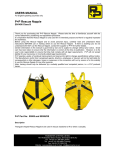
Triangular shaped Rescue Nappie to be used in
rescue situations to lift or lower a casualty.
It is vital for the safety of the casualty that the
Rescue Nappie is correctly connected in
accordance with the following instructions:
Application
A Rescue Nappie classed as a rescue loop is to
provide a means of attachment to a casualty in a
rescue situation to facilitate safe lowering or raising
of the casualty. The Rescue Nappie is constructed in
such a way that during the rescue process, the
casualty is held in a sitting position. The Rescue
Nappie is not intended or designed to protect against
falls from height.
The P&P Rescue Nappie consists of a rescue loop
with “D” rings and central attachment strap with a
“D” ring to provide an attachment point so the
casualty is held in a sitting position. The Rescue
Nappie is manufactured from polyester webbing and
nyplax PVC with non-corrosive fittings.
a) Pass the chest strap of the Rescue Nappie behind
the casualty, with the crotch strap hanging down, and
the webbing on the outer side with PVC against the
casualty.
b) Pass the “D” rings on each end of the chest strap
underneath the casualty’s armpits (if shoulder straps
are fitted, the arms should pass through them),
bringing them together on the casualty’s chest.
c) Pass the crotch strap between the casualty’s legs
bringing the crotch strap “D” ring also up to the
casualty’s chest.
d) Using all 3 “D” rings, connect together with a
connector.
e) The additional webbing loop on the outer edge of
the rescue strop may have a guideline attached in
certain situations to facilitate the rescue in difficult
situations.
Important
Do
• Prior to use, a full visual inspection of the
Rescue Nappie must be carried out by the user
as instructed in this P&P User Manual.
• The Rescue Nappie is for personal use only.
• Only use connectors (hooks and karabiners
etc.) approved and recommended by P&P.
• The Rescue Nappie should only be used with
P&P compatible equipment.
• Check the inspection record for this Rescue
Nappie to ensure regular inspections have
been correctly recorded.
• It is strongly recommended that the user be
given adequate practical training prior to using
this Rescue Nappie or any other P&P product.
DO NOT
• Use this Rescue Nappie until you have read
and fully understand both these instructions
and the user instructions for any P&P
compatible item used in the system.
Modifications and Repairs
No repairs, modifications or alterations are to be
carried out on this Rescue Nappie.
Rescue Plan
Rescue Plan
As part of your risk assessment you MUST have in place a
rescue plan to deal with any emergency, which may occur
during use. Access to the user, directly or indirectly and
their safe retrieval is of paramount importance, including
preparations for dealing with potential Post Fall Suspension
Syncope
Inspection
Check your Rescue Nappie for any damage or
malfunction prior to each and every use. If there is
any doubt about the safe condition of the system, it
should be immediately withdrawn from use and
inspected by a competent person or returned to the
supplier/manufacturer.
The product name, unique serial number and date of
manufacture will be found on the product label.
Always ensure the product label is present, shows
both the serial number and date of manufacture and
that it matches your inspection Record
Document/this manual. If the Product Label numbers
are not legible or do not match your inspection
record document/this manual – Do not use the
system.
Detailed Recorded Inspections should only be carried
out by a competent person, appointed by the
employer. Additional, recorded interim inspections
may be required where risks from transient arduous
working conditions exist. This should be identified
through risk assessment.
These recorded inspections must be carried out at
least every 12 months as a requirement of EN365;
however in the UK the HSE would like all fall
prevention PPE to have a Detailed Recorded
Inspection every 6 months.
The pre-use check must include (but is not limited
to):
•
Check all webbing / rope for signs of cuts,
abrasions, fraying, tears, burns, mold,
discolouration or chemical attack.
• Check all stitching for signs of loosening,
pulling or cut thread. There must be no
evidence of damaged stitching on either side
of the stitch pattern.
• If the Rescue Nappie has been subject to
significant paint overspray, it must not be
used.
• Adjusters and connectors MUST be free from
rust, excessive wear, distortions or cracks.
If during the pre-use check any part is found to be, or
believed to be faulty, DO NOT use it. Remove ALL
components from site to ensure that they cannot be
used by anyone.
Marking of PPE
Textile products including webbing and rope must
not be marked using ink or paint. Marker pens and
paint will contaminate textile fibres leading to
potential damage from material stiffening or even
chemical attack.
Plastic or Metal casings of components must not be
marked by stamping, etching or engraving. These
processes may weaken the material or damage
protective coatings.
P&P advise that if additional identification is required,
a tagging system (label or electronic) should be used,
that does not interfere in any way with the operation
of equipment or devices. Contact P&P or your
supplier for advice on additional labelling.
Cleaning, Maintenance and Storage
Statement of Obsolescence
You may clean the P&P Rescue Nappie of light soiling,
using warm water (40ºC max) with pure soap or mild
detergent. Heavy deposits of creosote or grease may
be removed with a diluted solution of heavy
detergent and water.
Due to the ingress of dirt and grit, chemical contamination,
edge and surface damage, ultraviolet light degradation, and
wear and tear, Fall Protection Equipment manufactured
from synthetic fibres (webbing and/or rope) is subject to a
manufacturer’s statement of obsolescence, which is a
requirement of BS EN 365:2004 a European Product
Standard.
Any item of Fall Protection Equipment manufactured by
P&P Limited with synthetic fibre components (webbing
and/or rope) is subject to a maximum working life of 5
years from the recorded date of first use, provided that
the item has been correctly stored, maintained and
subjected to regular inspections by a trained and
competent person. However, if the item fails any
inspection it MUST be destroyed.
Avoid getting soap / detergent into buckles. After
cleaning, rinse thoroughly with fresh clean water then
remove excess water with a dry cloth. Finally, allow
the Rescue Nappie to dry naturally then give it a full
inspection before storing.
Store in a cool dry place, which will protect the
Rescue Nappie from extreme humidity, direct heat
and sunlight. Allocate a storage area specifically for
your Rescue Nappie. If the Rescue Nappie is wet,
allow to dry naturally BEFORE storing.
Chemical Attack
Avoid contact with any chemical, which might affect the
performance of this Rescue Nappie, e.g these include all
acids and strong caustic substances (vehicle battery acid,
bleach etc)
If subject to chemical attack, you must remove it from
service and check with the supplier or P&P for advice on
the possible consequence of chemical degradation.
Storage
After any necessary cleaning, dry completely then store in
a cool dry place, which will protect it from extreme
humidity and direct heat.
Transportation
Care should be taken to protect the Rescue Nappie from
risks such as those detailed under Service Life. A simple
effective way is to transport the system in a suitable bag or
container, which prevents abrasion.
Service Life
The P&P Rescue Nappie has a maximum working life of 5
years from date of first use, provided it is correctly stored
and maintained. However, if the system fails any inspection
it MUST be destroyed. See the Statement of Obsolescence
within this manual.
About This Manual
This User Manual is for English speaking countries only. If
you require this manual in a different language, please
Contact P&P. When this Rescue Nappie is sold on, this
manual must accompany it.
Warning
This P&P Rescue Nappie must be used by persons who
are medically fit to do so. If you have any medical
condition, are recovering from any medical condition or
suffer from any physical or mental disability you must seek
professional medical advice before using this P&P Rescue
Nappie.
A new item of Fall Protection Equipment manufactured by
P&P Limited may be stored for a maximum of 3 years and
will still give the potential 5 year working life provided it
remains in the original manufacturer's packaging. Once the
product is taken from this original packaging for the first
time, this date becomes the “date of first use", which
should be recorded on the Inspection Record and the 5
year working life begins.
Reference should also be made to the British Standard BS
8437:2005 - "The code of practice selection, use and
maintenance of personal fall protection systems and
equipment for use in the workplace" - clause 13.2 Lifespan,
which states:
"Some equipment is given a life span or obsolescence date
by the manufacturer. Equipment that has reached such a
limit, which has not already been rejected for other
reasons, should be withdrawn from service and not used
again, unless or until confirmed by a competent person, in
writing, that it is acceptable to do so."
It should be noted that inspections carried out by a trained
and competent person are only visual and tactile
observations of the condition of the product; they are not
testing the residual strength of the equipment. All synthetic
fibres deteriorate slowly with age regardless of use and as
a result, P&P Limited strongly advises all users of Fall
Protection Equipment to follow the manufacturer's
statement of obsolescence. For further advice on this
statement, as well as training in the use and inspection of
Fall Protection Equipment, please contact P&P Limited
PETRIE LIMITED
B
Designers, Manufacturers and Suppliers of Quality Height Safety & Rescue Equipment, Training & Consultancy
P&P Rescue Nappie
#90008
P&P Limited, 131 New John Street, Aston,
Birmingham B6 4LD, England.
Telephone: 0121 359 4561 Facsimile: 0121 359 4136
Email: [email protected]
Website: www.ppsafety.co.uk
This Manual and its contents © P&P Limited 2015
P&P Rescue Nappie V3_0315
All rights reserved. No part of this publication may be reproduced, stored in a retrieval system, or transmitted, in
any form or by any means, electronic, mechanical, photocopying, recording or otherwise, without the prior
permission of P&P Limited.
P&P Limited, 131 New John Street, Aston, Birmingham B6 4LD, England.
Tel: +44 (0)121 359 4561 Facsimile: +44 (0)121 359 4136 e-mail: [email protected] website: www.ppsafety.co.uk
Registered in England No. 01493537