1
Superficial gas velocity was estimated by interrupting the gas flow to the reactor and
monitoring the time required for the gas bubbles to reach the air-water interface (around
3.5 s). Notwithstanding potential inaccuracies in the measured reactor operating
conditions, the provided estimates should be useful in the design of further experiments.
However, more advanced methods, such as a high speed camera with dedicated software
tools, may be required to measure the superficial gas velocity and bubble size distribution
more accurately.
Table 2. Estimated reactor operating conditions.
Parameter
Condition
Superficial gas velocity
~0.3 m/s
Gas hold-up
~0.009
Bubble diameter
~7.5 mm
5.2. Determination of the sensor lag constant
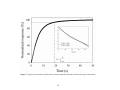
Sensor lag was determined by subjecting the sensors to a near instantaneous
alteration in dissolved oxygen concentration, and collecting sensor readings until a
constant measurement was observed (Vandu et al., 2004; Philichi and Stenstrom, 1989).
The sensor was first equilibrated in a conically shaped beaker (500 mL) continuously
sparged with N2 provided using a gas cylinder. The sensor was then rapidly transferred to
a beaker (1000 mL) continuously stirred using a stir bar and magnetic stirrer. The
dissolved oxygen concentration was maintained at saturation by continuous sparging of
air using an air pump. The sensor dynamics was obtained by monitoring the dissolved
oxygen concentration every 0.2 s for a period of 1 min.
Important. It should be ensured that no gas build-up exists under the membrane
of the sensor. This was achieved by placing the stirrer bar away from the center touching
the glass of the flask.
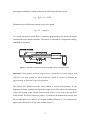
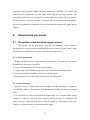
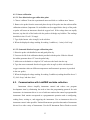
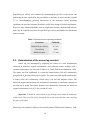
Sensor lag was assumed to follow a first-order dynamics (Philichi and Stenstrom, 1989;
16