1
USER
INSTRUCTION
MANUAL
-WINCH
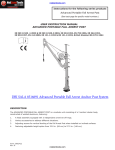
Manually Operated Winch for the
Lifting of Personnel
Suitable for Frequent Raising /
Lowering of Personnel
Directive 2006/42/EC
GLOBESTOCK
MILE OAK INDUSTRIAL ESTATE, MAESBURY ROAD,
OSWESTRY, SHROPSHIRE SY10 8GA
TEL: 01691 654966 FAX: 01691 661726
G-Winch - For the Raising and Lowering of Personnel
USER INSTRUCTIONS
Page
Contents
1.
Important Notice
1
2.
G-Winch for Lifting of Personnel
2
2.1
Anchorage Requirements
2
3.
Inspection Before Use
3
4.
Considerations for Use
3, 4
5.
Setup for Use
4
5.1
6.
Attaching to the G-Tripod
Inspection & Maintenance
5, 6
7
6.1
Periodic Examination
7
6.2
Service & Re-Certification
7
6.3
Cleaning, Storage and Transportation
7
Examination Record
Rear Inside Cover
Specifications
Rear Cover
Date: 15.4.2011
-0-
G-Winch - For the Raising and Lowering of Personnel
1.
IMPORTANT NOTICE
READ EQUIPMENT LABELS AND ‘USER INSTRUCTIONS’ BEFORE USING
THIS PRODUCT.
BEFORE USING THIS EQUIPMENT IT IS ESSENTIAL THAT USERS ARE
FULLY AWARE OF HOW THE EQUIPMENT OPERATES, WHERE IT
SHOULD BE USED, WITH A PREDETERMINED ACTION PLAN FOR BOTH
THE USE AND RECOVERY SHOULD AN EMERGENCY ARISE.
This product has been developed to enable the safe entry of personnel into a
restricted access or confined space. Recommended use is in conjunction with a GSaver II fall arrest and retrieval device, to protect against potential falls occurring
during use. The G-Saver II also provides a backup retrieval system for use in an
emergency or an unforeseen occurrence.
This equipment is for use where other means of access are not practical.
When in use please observe the Maximum Working Load of both the G-Winch
model and the anchorage device or structure. The person raised or lowered should
never be left to work alone. There must always be another person present to
supervise and operate the G-Winch.
Both the person being raised/lowered and the equipment operator should be
adequately trained.
PRIOR TO USE:
A formal ‘Risk Assessment’ should be carried out, considering use and
the emergency rescue procedure.
Users should be fully conversant with the operation of the equipment.
The ‘Before Use Checks’ should be performed (see section 3 –
Inspection Before Use).
Verify that the maximum weight to be lifted is within the maximum
working load of all equipment to be used.
Date: 15.4.2011
-1-
G-Winch - For the Raising and Lowering of Personnel
2. G-Winch for the Lifting of Personnel
The G-Winch is a personnel winch fitted with a maximum of 50 metres of wire
rope. For confined space use and for the routine raising & lowering of personnel.
For Example: lifting personnel through areas of restricted access. It can be
attached to the G-Tripod or similar EN795 anchorage device. It can be used where
regular lifting is required.
The G-Winch is recommended for use in conjunction with a Fall Arrest and
Retrieval device such as the GSaver II.
This system then
incorporates EN360 fall protection,
with an additional safety line to
rescue the user in the event of an
unforeseen occurrence.
Use in this manner provides the
maximum level of safety possible.
There are two modes of operation.
• Normal personnel use, as
shown, in the picture. Gear
Ratio 1:8.9
• The winding arm can be fitted
to the shaft at the other side,
providing a fast mode for
quickly winding cable in or out.
This should only be used when
a person is not attached to the
G-Winch.
Figure 1.
The G-Winch has an anti-run brake
to prevent the person supported or
load from falling to the ground should the winch operator release the winding arm.
The mechanism provides an easy winding action making personnel lifting easy.
The G-Winch is tough and durable, with a long working life.
2.1 Anchorage Requirements
Use of an EN795 anchor device, such as the G-Tripod is recommended.
Suitable brackets are available. In any case the structure must be of adequate
strength or rating to accommodate the weight lifted. Beware of anchorages
designed for materials handling, they generally have lower strength
requirements than should be used for lifting people.
Custom brackets used to adapt the G-Winch to fit an anchorage structure must
be of adequate strength. If in any doubt contact your supplier or the
manufacturer for advice.
Date: 15.4.2011
-2-
G-Winch - For the Raising and Lowering of Personnel
3. Inspection Before Use
Before using the G-Winch inspect as follows.
Inspection
1.
2.
3.
4.
5.
6.
With the G-Winch mounted on an EN795 anchorage device such as the GTripod. Inspect the mounting brackets.
With the winding arm removed from the winch, lift and hold up the pawl so
as to disengage the anti-run brake. Pull wire rope off the drum, releasing the
pawl. The Anti-Run brake should engage and lock firmly preventing further
rope from being pulled off the drum.
Attach the winch arm. Check that it is firmly held in place by the locking
screw. Rotate the winch arm to spool rope onto the drum. An audible
clicking should be made by the pawl to confirm the correct functioning of the
anti-run brake.
Inspect the entire system for any signs of damage, wear or malfunction.
Inspect the wire rope. No kinks, broken strands or excessive wear should be
observed.
Ensure the rope’s safety hook is free of damage and functions correctly, the
gate locks positively.
Before operating and During Use of the G-Winch visually check the
equipment and the path of the wire rope to ensure no fouling. The person raised /
lowered and the winch operator both need to be vigilant before and during use. It
is then safe to rotate the winding arm.
4. Considerations for Use
•
•
•
•
•
•
•
•
Do not Exceed the Maximum working load of the G-Winch model.
Should any doubt arise about the safe condition of this device DO NOT USE.
Return to Globestock or a Globestock authorised servicing agency for
assessment, service and re-certification, before further use
The G-Winch weighs approximately 21kg. Manual handling and attaching to the
G-Tripod should be performed by 2 people.
This equipment must be used by at least two people, one to operate the winch as
the other is lowered / raised.
The G-Winch operator should maintain communication at all times with the
person being lowered / raised.
The G-Winch may only be used by trained or otherwise competent persons.
Personnel Protective Equipment should be worn when using this equipment. For
Example: Gloves, Safety Glasses, safety shoes, etc.
Wear gloves to protect your hands when inspecting or handling the wire rope.
Date: 15.4.2011
-3-
G-Winch - For the Raising and Lowering of Personnel
•
•
•
•
•
•
•
•
•
•
During a lifting operation keep hands clear of the rope drum, as the winch line
pulled onto the drum can trap and cause injury to fingers.
The G-Winch should only be used within the temperature range of -15˚ to 60˚
centigrade. If the intended use is outside of this range then consult supplier or
manufacturer for guidance.
The G-Winch is recommended for use in conjunction with a Fall Arrest and
Retrieval device such as the G-Saver II. This provides a secondary safety line,
with fall protection and emergency retrieval, ensuring maximum safety of the
person being raised or lowered
Ensure the path of travel of the person to be raised or lowered, is free of
obstructions.
Attach the rope’s safety hook directly to the person’s body harness attachment
point or the connection point on the carrier.
Do not allow slack cable during use. This cable may tangle or foul, hindering the
safe retrieval of the user and it may make it possible for the user to fall, causing
fatal injury.
Do not allow the rope safety line to pass over sharp edges, electrical items/cables.
Do not allow the rope safety line to become frayed or to kink as this weakens the
rope.
A clearly understood, predetermined action plan should be in place and
implemented in the event of an emergency.
Do not disengage the Anti-Run Brake while the G-Winch is under load.
5. Setup for Use
If in any doubt please contact either a specialist or Globestock for advice.
Connect the G-Winch to a suitable anchorage such as an EN795 device. The GTripod is the ideal anchorage device. The additional use of a G-Saver II provides
an additional safety line, giving the maximum level of safety.
The equipment should be inspected and setup in a safe area. All pre-use checks
must be completed before the assembly can then be moved into place by two or
more people, so that it is ready for use. Perform a final visual inspection, and the
equipment is ready to use.
Before operating the G-Winch visually check the path of the wire rope and the
equipment to ensure no fouling. Check with the user to ensure he/she is ready. It
is then safe to rotate the winding arm.
Date: 15.4.2011
-4-
G-Winch - For the Raising and Lowering of Personnel
5.1 Attaching to the G-Tripod
(See Figure 2, Page 6)
1.
The G-Tripod should be opened up and set down on it’s feet at the
lowest setting.
2.
Lay the G-Winch next to one of the side legs of the G-Tripod and lay the
G-Saver II next to the fixed leg.
3.
Pull back the G-Winch’s pawl and hold, so the anti-run brake is
temporarily disconnected. Pull 3 metres of rope off the drum.
4.
Fit the rope through the pulley assembly, then attach the pulley assembly
to the Anchorage point underneath the Tripod head. Ensure the screw
gate of the karabiner is securely locked.
5.
Fit the rope of the G-Saver II, over the pulley on top of head of the GTripod, and secure.
6.
Raise the G-Tripod to the required height. Take the first leg and extend
it to the first intermediate setting. Then take the second leg, extend it to
the desired height and repeat with the third leg. Finally adjust the first
leg so all legs are at the same height.
7.
Attach the G-Saver II to the upper fixed leg of the G-Tripod, as shown
in the picture, figure 2.
8.
With the G-Winch on the ground, unscrew the mounting bracket lever
arms, so that the winch is ready to fit to the G-Tripod.
9.
Attaching the G-Winch to the G-Tripod is best performed by two
people. Lift together, the G-Winch onto the top of the tripod leg.
10. One person holds the winch in place, with the weight of the winch
supported by the tripod leg. The other person fastens the brackets to
hold the winch onto the leg.
11. With the brackets loose, the winch is rotated around the leg so that it is
on the underside, in line with the path of the rope and the pulley. Both
brackets are then securely tightened.
12. Both the ropes hanging at the centre of the tripod can be attached back to
their respective devices, taking up slack wire rope.
13. The Access System can then be visually inspected before moving into
place over the access hole.
Date: 15.4.2011
-5-
G-Winch - For the Raising and Lowering of Personnel
Figure 2. – Attaching to the G-Tripod
G-Tripod
Pulley
Assembly
G-Saver II
G-Winch
Date: 15.4.2011
-6-
G-Winch - For the Raising and Lowering of Personnel
6.
Inspection & Maintenance
Like all safety critical complex mechanical devices, the G-Winch requires regular
inspection and maintenance to ensure that the unit functions safely and correctly.
Repairs or servicing should never be carried out on site or in the field. Do not
tamper with or modify the unit.
6.1
Periodic Inspection
The G-Winch should be periodically inspected by a competent person at least
once in every 6 months dependant upon the frequency of use and the operating
environment. The ‘Inspection Record’ found on the page opposite in this
booklet, outlines the main examination criteria. On passing this detailed
inspection the record opposite can be completed, signed off and the unit returned
for use. Any observed faults must be rectified. If necessary or in any doubt,
return the G-Winch for service, test and re-certification.
6.2
Service, Test & Re-Certification
The G-Winch must be returned for servicing annually or if any doubt should
arise concerning the units condition. Globestock or a Globestock approved
servicing agency can be used for this. On completion of a service and retest, a
new Test Certificate will be issued which validates the unit for a further year of
use.
6.3
Cleaning, Storage and Transportation
The G-Winch’s exterior may be cleaned using warm water with a mild detergent.
It should then be allowed to dry.
In order to maintain the wire rope safety line, remove any soiling. Apply a little
light oil to a cloth. Hold the cloth around the rope, allowing the rope to pass
through the cloth. This will leave the rope lightly oiled.
The unit should be stored in a clean, dry, chemical free environment.
When transporting the G-Winch, it should be boxed or retained to prevent damage
or deterioration.
Date: 15.4.2011
-7-
Anti-Run
Brake
Karabiner
Cable
Function
Case /
Housing
Serial No:
Manufacture Date:
DATE SIGN
Mechanism locks when cable pulled
out (10kg force )
Pawl is free from damage
Clicking sound as handle is turned
Pawl moves freely / is unobstructed
General Condition
Free of excessive corrosion
Free of warp/damage & cracks
Fasteners present & secure
S.W.L present
Serial Number present & legible
Smooth action as handle turned
Rope Drum rotates freely
No broken stands or kinks
Free of severe corrosion
Thimble present
Anchor plate secure
Gate functions freely
Swivel action operates
Free of damage & corrosion
INSPECTION RECORD CARD
G-WINCH
cation.
& RecertifiService
Record of
Issue No: 001
Date: 15.4.2011