1
Step 2. Enter the Target Annual
Oyster Sales
large enough to be deployed directly to grow-out. Mortality in the medium-scale budget includes both nursery
and grow-out-associated mortality. Seed, in this case,
starts much smaller. It is assumed the medium-scale user
would have adequate experience in nursery and grow-out
to minimize mortality. Experience plays an important
part in the mortality rate. To keep oyster mortality low,
it is critical to provide enough gear and labor to maintain
adequate stocking densities throughout the process. Trying to get by with too much product in too little gear is a
common rookie mistake and will result in mortalities that
can exceed 50 percent.
Open the Oyster Crop Budget worksheet by selecting that
tab at the bottom of the screen and enter “Target annual
oyster sales” in the upper, right-hand cell shaded in blue
with a diagonal line hatch. This single entry will produce
revenues and costs for a representative farm vetted by
industry. However, if the user knows his or her costs or
revenues are different than those for the representative
farm, changes should be made to reflect this information
by using the steps below.
Percent of Total Oysters Harvested –
Year 1 and Year 2
Step 3. Adjust Key Assumptions
Key assumptions are located in the box at the top left
of the budget worksheet and are shaded in maroon with
a diagonal line hatch. These variables drive the budget
worksheet, and changes will result in changes to the budget calculations. The variables are explained below.
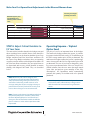
Both budgets assume 20 percent of the surviving crop
will be harvested in Year 1, with the remaining 80 percent harvested in Year 2. The majority of the Virginia
culture industry uses triploid (sterile) oyster seed, which
grows faster than diploids (natural) and does not diminish
in quality with seasonal spawning. The typical grow-out
timeline for triploids is 12 to 18 months from planting
versus the 24 to 36 months it takes diploids. Timing of
seed purchases, environmental site conditions, farm
management, and marketing strategy all play a factor in
the percentage ready for harvest in Year 1. As production increases, seed purchases are typically staggered
throughout the season; therefore, the crop is at different
stages of growth.
Average Market Price
The budgets assume the half-shell market oysters are sold
to a distributor at $0.25 per oyster.1 It is reasonable to
expect a higher price if product is sold at retail at the farm
gate or in nearby markets. These budgets don’t cover
such marketing costs. When production increases, it is
likely a larger percentage of products will be sold through
a dealer/distributor.
Average wholesale price reported by industry in the 2011 Virginia
Shellfish Aquaculture Crop Reporting Survey (Virginia Institute of
Marine Science/Virginia Sea Grant Marine Extension Program).
1
Some farms report that a percentage of the crop may not
be ready for market until Year 3. This is not accounted
for in these budgets but may occur with triploid culture
and would certainly be the case if the grower were using
diploids. If product is held into Year 3, it is even more
crucial to ensure enough gear is purchased to account for
the additional oysters on the farm.
Oyster Mortality Rates
Oyster mortality rates vary year to year and are dependent on a variety of factors that are both husbandrybased (experience) and environmental. Some examples
to consider are quality of seed, stocking densities in both
nursery and grow-out, and weather events. A rate of 50
percent mortality was chosen for both production scales
because of industry recommendations. While the mortality rate of an experienced farmer can be less than 50
percent, experienced industry participants say prudence
requires limited optimism when it comes to mortality. A
mortality rate of more than 50 percent is not uncommon.
The small-scale budget mortality rate only considers
grow-out-associated mortality because seed purchased is
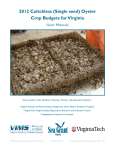
Photo courtesy of Mike Oesterling, VASG
www.ext.vt.edu
6