1
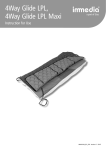
4Way Glide LPL,
4Way Glide LPL Maxi
Manual English
Version 3 · 2012
Illustrations
Illustration 1
Illustration 2
Illustration 3
Illustration 4
Illustration 5
Illustration 6
Illustration 7
Illustration 8
Illustration 9
Illustration 10
Illustration 11
Illustration 12
Illustration 13
Illustration 14
Illustration 15
3
2
Contents
Heading
Page
1.
General/Intended use............................................................................4
2.
Practical handling..................................................................................5
3.
Notice/Materials/Cleaning.....................................................................6
4.
Size/Combinations................................................................................7
5.
Service Information...............................................................................8
3
General
Thank you for choosing an Etac product.
To avoid accidents and injury when moving and handling
the products, read the manual carefully.
The person described as "the client" in this user manual is
the person who is lying or sitting on the product. The carer
or carers are the people who manoeuvre the product.
This symbol appears alongside the text in
the manual. It draws the reader's attention
to points at which there may be a risk to the
health and safety of the client or carer.
x
x
x
x
x
x
x
x
x
The information given in this manual, including recommendations, combinations and sizing, does not apply to
special orders and modifications. If the customer makes
adjustments, repairs or combinations not predetermined
by Etac, the Etac CE certification and Etac warranty will
be voided. If in doubt, please contact Etac.
Warranty: Two-year warranty on material and manufacturing defects, provided that the product is used correctly.
The products comply with the standards applicable for
Class 1 products in the European Council Directive MDD
93/42/EEC on medical devices.
Batch no:
Production year
At Etac we strive to improve our products all the time and
therefore we reserve the right to make changes to products without prior warning. All measurements given on
illustrations and similar material are for guidance only and
Etac cannot be held liable for errors and defects.
For further information on the Etac transfer range, see
www.etac.com.
x
The product can be scrapped in accordance with national
Running number
Washing
Iron
Never leave on the floor
Max. weight
Handwash
Do not dryclean
Warning
The product can be
scrapped in accordance
with national regulations
Wipe off
Do not bleach
Read the User Manual
Manufacturer
Tumbledry
Risk of sliding down
Batch no./Lot no.
Class 1 - European Council
Directive MDD 93/42/EEC
on medical devices
Intended use
The 4Way Glide LPL is a glide system which makes it easy
for carers to move and position a client on a bed.
5
4
Practical handling
Positioning
Place the 4Way nylon sheet with locking system on the
bed. The "this side up” label should be at the head end
(Illustration 1). Lock the glide system so that the non-slip
material is visible.
Fit the 4Way Glide LPL. If required, fit the corner straps
around the mattress corners at the foot end (Illustration 2).
Position the client in the bed.
The product can be positioned under the client if he/she is
not permanently bedridden - use the same method as for
changing sheets.
Use
To unlock the glide system: One carer on each side grasps
the functional handles attached to the glide mattress
hanging at the foot end and pulls them slowly upwards
towards the head end (Illustration 3). When the carers
feel resistance, they must stop pulling. Then one carer
grasps the functional handles on the opposite side of the
glide system, and the other carer helps pull the locking
system up past the hip area (Illustration 4). The carers
then do the same on the opposite side. The glide system
is now unlocked and the client can be moved in all directions by pulling on the functional handles at the shoulders
and hips (Illustration 5).
Unlock the glide mattress (Illustrations 3 and 4). The carer
grasps the straps under the client at the shoulders (and
hips, if necessary) and then slowly pulls the client upwards
using weight transference (Illustration 11).
Raising the bedhead
Lock the glide mattress by pulling the functional handles
towards the foot end. This can be done by both carers at
one time (Illustration 6). The bedhead can now be raised,
without the client sliding down. If reduced freedom of
movement in the upper body is required in the seated position, you can lock the glide system at both sides at the
shoulders by fitting corner straps around the mattress.
When the carers have finished turning the client, the glide
system must be relocked (Illustration 6).
The "5 smiles" technique
To ensure the most comfortable position (seated or lying),
it is imperative that the carers remove any tension on the
skin occurring when the client's head or feet are raised.
Loosen the shoulder blades (Illustration 13) one at a time.
Loosen the legs (Illustration 14) one at at time. Finally, the
carers ensure that the client's pillow is positioned correctly
– remove the pillow, shake/plump and replace.
If possible, bend the client's legs (Illustration 7).
The carers can then move the client into the side position
using weight transference (Illustration 8).
Alternative turning method
Attach the functional handles of the 4Way Glide LPL to
the lift. The client can be turned into the side position by
raising the lift. The carers can either push down on the
glide mattress or pull on the handles, turning the client in
the middle of the bed (Illustration 9).
Seated position
Once the carer has ensured that any tension on the skin
is released, the carer can support the client in the seated
position with positioning wedges or pillows
(Illustration 15).
Positioning
If the client is to remain in the side position after bath/
care, the client's back (or other parts of the body) can be
supported using a positioning wedge or pillow
(Illustration 10).
After moving the client, it will often be beneficial to
smooth the glide system under the client. To do this, pull
diagonally on the corners, preferably one layer at a time
(Illustration 12).
Sliding down
5
Notice
Special features
Always check the product before use and after washing.
Never use a defective product. If the product shows signs
of wear-and-tear, it must be scrapped.
Read these instructions carefully.
It is important that carers receive instruction in manual handling. Etac offers advice and training for carers. For further
information, contact Etac.
Always use the correct manual handling techniques
Remember to use the client's resources.
To ensure that the client feels safe and that every manual
handling is smooth, always plan the manual handling in
advance.
If in any doubt - please contact Etac.
There is a risk that the user may slide off. Never
leave the user alone on the edge of the bed.
Never leave a 4Way Glide LPL or nylon sheet on
the floor.
Never leave the user on the glide system
unless the guard rail is up.
Always lock the glide system when you have com-
pleted the transfer.
Do not use the 4Way as a sling.
Always make a risk assessment, and secure that the 4Way system can be used at the individual cli-
ent and in combination with other devices that it is safe for the client and caregivers.
To reduce sliding to the side if the head end is elevated fit the corner straps around the bed mattress.
Materials
Top side: 65% polyester and 35% cotton (green) or 100% polyurethane (grey).
Fill: 100% polyester (fibre). Backside: 100% polyester. Handles: polyester.
Cleaning
The product should be checked regularly, preferably each
time it is used, and especially after wash.
Check that there is no damage to seams or fabric.
Never try to repair a product yourself.
Never use a defective product.
Washing instructions:
Do not use fabric softener.
Can be wiped off with disinfectant (polyurethane surface).
7
6
Articles
Article no.
Description
Size (cm)
IM140/200LPL
Glide mattress with non-slip locking system, cotton/polyester, green
W140 x L200
IM140/200LPLG
Glide mattress with non-slip locking system, polyurethane, grey
W140 x L200
IM180/200LPL
Glide mattress with non-slip locking system, green, Maxi
W180 x L210
IM4300
4wayGlide (3xLock) (Set: IM140/200 LPL + IM85/2003LPL)
IM4309
4wayGlide (1xLock) (Set: IM140/200 LPL + IM85/200LPLNS)
Combinations
Article no.
Description
Size (cm)
IM53NS
Positioning wedge with non-slip cover
W30 x H20 x L53
IM53/80NS
Positioning wedge with non-slip cover
W30 x H20 x L80
IM140/200PU
Waterproof cotton sheet
W140 x L210
IM85/2003LPL
Nylon sheet with 3 x non-slip locking system
B85 x L200
IM85/200LPL
Nylon sheet with non-slip locking system
B85 x L200
IM85/200LPLNS
Nylon sheet with non-slip along edge + non-slip locking system
W85 x L200
IM110/200LPLNS
Nylon sheet with non-slip + non-slip locking system, Maxi
W110 x L200
7
Service Information
Pre-use check of Etac manual transfer aids
First inspection:
•
•
•
•
Is the packaging intact?
Read the label on the packaging and check the article no. and product description
Check that Short Instruction is enclosed – updated User Manual/Instruction for use can be downloaded
from www.etac.com or contact your Etac Customer Service or the local distributor.
Check the label on the product - does it include article no., product description, lot/batch no., cleaning
instructions and supplier name?
Periodic Inspection:
•
•
•
•
Make sure that your Manual transfer system always is in a perfect condition.
After wash – always check materials, stitching, handles, buckles.
If the product shows signs of wear and tear, it must be removed from service immediately.
Lot no/Batch no:
x
x
x
x
x
x
x
x
x
x
Production year
Running number
Visual inspection/Check the product:
Ensure that the materials, seams, stitching, handles, buckles are intact/faultless.
Mechanical load or stress/Test handles:
Draw hard in the handles in opposite directions and control the material, seams and stitching.
Test buckles:
Lock the buckle and draw in opposite directions, control the buckle and the stitching.
Stability test:
Try to bend the product verify that it feels firm, stable and solid.
Test low/high friction:
Place the product on a firm surface or a bed, place your hands on the material and test the friction by pushing your
hands down into the product.
Low friction – slides effortlessly
High friction – no sliding/moving
Check always:
Manual transfer aids with handles, straps and buckles:
Manual transfer aids for sitting and lying transfer:
Manual transfer aids with high or low friction:
The product can be
scrapped in accordance
with national regulations
Read the
User Manual
If in doubt, please contact Etac Customer Service or local distributor for more information and guidance.
For more information about training and the use of these products, contact the Etac transfer experts – www.etac.com.
Class 1 - European Council
Directive MDD 93/42/EEC
on medical devices
8
Etac Sverige AB
Box 203, 334 24 Anderstorp, Sweden
Tel +46 371-58 73 00
Fax +46 371-58 73 90
[email protected] www.etac.se
Etac AB (export)
Box 203, 334 24 Anderstorp, Sweden
Tel +46 371-58 73 30
Fax +46 371-58 73 90
[email protected] www.etac.com/exp
Etac AS
Pb 249, 1501 Moss, Norway
Tel +47 815 69 469
Fax +47 69 27 09 11
[email protected] www.etac.no
Etac A/S
Egeskovvej 12, 8700 Horsens, Denmark
Tel +45 79 68 58 33
Fax +45 75 68 58 40
[email protected] www.etac.dk
Etac GMBH
Bahnhofstraße 131, 45770 Marl, Germany
Tel +49 236 598 710
Fax +49 236 598 6115
[email protected] www.etac.de
Etac Holland BV
Fluorietweg 16a, 1812RR Alkmaar, The Netherlands
Tel +31 72 547 04 39
Fax +31 72 547 13 05
[email protected] www.etac.com