1
YMC USER'S MANUAL
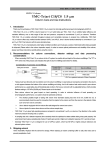
Column Care and Use Instructions
Meteoric Core series
Meteoric Core C18, Meteoric Core C18 BIO, Meteoric Core C8
1. Introduction
Thank you for purchasing a Meteoric Core series column for high-performance/ultra-high-performance liquid chromatography
(HPLC/UHPLC). Meteoric Core is core-shell silica based reversed phase column suitable for ultrafast analysis with high resolution.
Meteoric Core series columns, which are manufactured under highly controlled conditions, must pass a series of stringent tests
before being accepted for shipment. (Please refer to the column inspection report). To ensure optimal performance and durability
of the column, please read these instructions carefully before using this column.
2. Specifications
Packing material
Particle Pore size
size (μm) (nm)
Meteoric Core C18
Meteoric Core series
Meteoric Core C18 BIO
2.7
Meteoric Core C8
※The style of column endfitting is Parker style. (Port depth: ca 2 mm/0.09 inch)
C%
Usable
pH range
8
7
1.5 – 10.0
16
5
1.5 – 10.0
8
5
1.5 – 9.0
Usable
pressure
(MPa)
60
Column
Tubing and connector
Port depth
3. Recommendations for column connections, detector settings, and data processing considerations
・ Tubing must have flat ends and must bottom out in the column endfitting. Tubing must be connected to the column correctly to
avoid creating a void between the column frit and tubing, which can cause a leak and result in poor column performance (e.g. peak
tailing, loss of theoretical plate number).
・ The extra column volume has a great impact on band spreading. To minimize the influence of band spreading on chromatographic
performance, especially when using columns in 2.1 mm I.D., the LC system should be optimized as described below.
▸
The shortest possible length of tubing with narrow inner diameters (tubing less than 0.15 mm, 0.006 inch I.D. is
recommended) should be used for the connection from the injector to the column and from the column to the detector.
Make sure not to have a void in the connection.
▸
▸
Use a detector equipped with low-volume flow cell designed for the narrow bore column.
Use an injector for the narrow bore column and a low-volume sample loop.
・ A sampling rate and a detector response (time constant) should be optimized to acquire more than 10 data points across a peak.
We recommend a sampling rate of about 10 points per second or higher and a detector response of 0.1 s or faster to detect the
earliest eluting sharp peak properly.
4. Shipping solvent
Indicated in the COLUMN INSPECTION REPORT. Replace with this solvent for storage. When replacing a mobile phase
containing buffer salts/additives, extra care must be taken to prevent salt precipitation.
(UM140221AE) 1/2
YMC USER'S MANUAL
5. Mobile phase
・ The correct direction of the solvent flow is indicated by an arrow on the column identification label.
・ Aqueous or non-aqueous solvent can be used as a mobile phase. Repetitive replacement among solvents with large difference
in polarities might degrade the column performance. Common organic solvents such as acetonitrile, methanol and
tetrahydrofuran (THF) are recommended for regular use. When using THF as a mobile phase, be mindful of the solvent
resistance of your system and tubing (PEEK parts are especially unsuitable for use with THF).
・ Recommendations of pH for column use are shown in the specifications table in section 2. When using the column at pH near
the upper or lower limit, the column lifetime will shorten under certain conditions by temperature and mobile phase composition.
6. Column cleaning (general method)
・ Flush the column with solution containing a higher ratio of organic solvent for washing out the compounds that are strongly
retained in the column after using mobile phases not containing buffer salts/additives. Usable concentration of organic solvent is
up to 100%. A cleaning solution containing THF might be effective when removing highly hydrihobic (lipid-soluble) substances
that are adsorbed onto the gel.
・ When using mobile phase containing buffer salts/additives, first replace with a water/organic solution containing no buffer
salts/additives (A ratio of water to organic solvent should be set at the same proportions as a mobile phase). Then flush the
column in accordance with the method described above. Mobile phase containing about 50 mM or less buffer salts/additives
can be replaced directly with 60% acetonitrile aqueous solution.
・ Flushing with 100% water after using the column around the pH limit might shorten the column lifetime. Flush the column with
water/organic solution as described above, such as 60% acetonitrile aqueous solution.
・ Once macromolecules such as proteins or polysaccharides are adsorbed onto the gel, they are hardly removed, even if
solvents with high eluting capability are used.
7. Other environments
・ To prevent exposure of the column to excessive pressure, the sample solution should be filtered through a 0.2 μm membrane or
smaller to remove particulates. We recommend using a pre-column filter to prevent the column frit from being clogged with
samples.
・ Mind for low sample loadability at operation in consideration of its small specific surface area, about 80% of conventional fully
porous silica based packing material in the same dimensional column. The sample loadability is proportional to the specific
surface area.
YMC Karasuma-Gojo Bldg., 284 Daigo-cho, Karasuma Nishiiru Gojo-dori, Shimogyo-ku,
Kyoto 600-8106, Japan
TEL +81-75-342-4515 FAX +81-75-342-4550
URL:www.ymc.co.jp
E-Mail:[email protected]
(UM140221AE) 2/2