1
INTRODUCTION
GENERAL
Use the ECO Xtreme to:
1. Recover, clean, and store refrigerant for reuse.
2. Pull a vacuum on an Air Conditioning System.
3. Accurately charge an Air Conditioning System with R134a refrigerant.
FUNCTIONAL DESCRIPTION
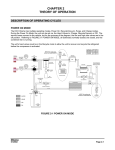
Recovery: Recovers refrigerant from a vehicle’s air conditioning system. Refrigerant gas enters the ECO
Xtreme separator through the service hoses. The unit traps oil and solid contaminants at the bottom of the
separator assembly. The compressor pulls refrigerant gas from the top of the separator and through the Master
Filter/Drier. The Master Filter/Drier removes water from the refrigerant. The compressor then compresses the
refrigerant to a high-pressure gas that enters the condenser.
A continuously running fan blows air across the condenser to remove heat and condense the high-pressure gas
into a refrigerant liquid. The liquid flows out of the Condenser then collects in the recovery tank. Recovery rate
is about one pound per minute (depending on temperature). A low side pressure gauge is use to determine if
the recover cycle is complete. When the low side gauge reaches 15” of vacuum the recovery cycle is complete.
The unit displays the amount of refrigerant recovered by pressing <AMOUNTS> and displaying the TARE
weight.
NOTE
THIS UNIT COMES IN TWO (2) MODELS: EEAC316 (NO SEPARATE VACUUM PUMP, USES
COMPRESSOR FOR VACUUM SOURCE) AND THE EEAC318 (HAS A SEPARATE VACUUM
PUMP)
Vacuum: After opening a vehicle's air conditioning system, it can't immediately be recharged. First, evacuate
the system (pull it into a deep vacuum). By pulling the vehicle’s Air Conditioning System into a deep vacuum
the moisture can be removed. Evacuating the system also removes the non-condensable gases (AIR)
remaining in the system. In the vacuum function, non-condensable gas enters the suction separator through
both service hoses. The gas proceeds down to the compressor (or vacuum pump, see Note, above), and out
the pressure side of the compressor (or vacuum pump, see Note, above). The unit then expels the noncondensable gas into the atmosphere.
Off: When the unit is not is use, the Recovery Tanks hand valves should be set to the OFF position. The OFF
position will prevent flow in the recovery and vacuum modes.
Charge: The ECO Xtreme uses an electronic scale to measure refrigerant. A temperature probe is wrapped
around the recovery tank to monitor the temperature. Charging occurs when the operator hooks up the Red and
Blue hoses from the unit to a vehicle. With refrigerant in the recovery tank, opening the blue valve allows flow to
the service hoses. The ECO Xtreme charges until pressures equalize between the vehicle and the recovery
tank. Starting the vehicle, closing the high (Red) side and drawing in the remaining amount is part of normal
operation.
Refer to Appendix C, User’s Manual for a complete Operating Description.
Effective
01/2002
Page i
INTRODUCTION
ELECTRONIC SAFETY PRECAUTIONS
!
THIS UNIT MUST BE PLUGGED IN TO A PROPER AC OUTLET
FOR UNIT TO OPERATE CORRECTLY. REFER TO UNIT ID PLATE
LOCATED ON BACK OF UNIT. EXTENSION CORDS ARE NOT
RECOMMENDED, BUT IF AN EXTENSION CORD MUST BE USED,
USE A CORD THAT IS LESS THAN 50 FEET WITH A 16 AWG, OR
ABOVE 50 FEET AND LESS THAN 100 WITH A 14 AWG.
When working on this tester, keep three points in mind:
•
Tester voltages refer to the "return" (white) side of the AC line. Yet sometimes outlet wiring is reversed. In
that case, electrical neutral connects to the "hot" side of the line. The tester operates normally, but the main
processing board floats 115VAC above safety ground. Assume that points inside the tester chassis are
at 115VAC; observe all safety precautions. If you make measurements with grounded test equipment, use
an isolation transformer. An oscilloscope is an example of such test equipment.
•
ECO Xtreme units are susceptible to power line spikes and noise. You must connect the equipment to
safety ground, otherwise, the ECO Xtreme’s surge suppressers can't clip power line spikes properly. Does
your machine do "strange things" or exhibit intermittent problems? Check for a proper ground at the
machine and the power outlet. If you're using an extension cord, then check that, too. It must be
constructed of at least 16 gauge wire and under 50 feet long.
•
Schematic voltages refer to the "return" side of the line, not safety ground. When measuring voltage, use
the white wire on the line power terminal block as ground. Don't use the third, center safety ground
terminal. Another place to access ground is at the shield. The black wire in the shielded transducer cables
also connects to the ground return.
REFRIGERANT SAFETY PRECAUTIONS
!
USE STANDARD REFRIGERANT HANDLING
SAFETY PROCEDURES WHEN PERFORMING INSTALLATION
ALWAYS WEAR SAFETY GOGGLES, DON'T SPILL OR TOUCH
LIQUID REFRIGERANT, AVOID FLAMES, AND EXCESSIVE HEAT.
USE ONLY IN WELL VENTILATED AREA.
When handling refrigerant, you must follow proper precautions. Refrigerant is extremely evaporative. Exposure
to liquid refrigerant can result in frostbite. Always use appropriate safety precautions while testing, operating,
servicing or transferring refrigerant.
•
WEAR SAFETY GOGGLES. (0001-5005) When servicing or operating the tester, always wear safety
goggles.
•
DON'T SPILL OR TOUCH LIQUID REFRIGERANT. If your skin contacts liquid Refrigerant, you can
develop frostbite. Evaporating refrigerant removes latent heat from whatever it contacts. Use an empty
reclaim tank to release charged hoses where applicable and open all fittings slowly to release pressure.
Operate testing and service valves according to applicable instructions. If skin comes into contact with
liquid refrigerant, treat the skin for frostbite.
Page ii
Effective
01/2002
INTRODUCTION
REFRIGERANT SAFETY PRECAUTIONS continued...
•
AVOID FLAMES. Under normal conditions, refrigerant is non-toxic. Yet an open flame reacts with
refrigerant, producing phosgene gas. This is a well-known fumigant and highly toxic poison. NO
SMOKING! A cigarette becomes hot enough to cause this reaction.
•
AVOID EXCESSIVE HEAT. Within a refrigerant container, pressure rises with heat. Store containers
upright, out of the sun and away from heat vents.
•
VENTILATION. Adequate ventilation is essential for several reasons. Refrigerant gas displaces air. Large
quantities of refrigerant in a confined space can cause suffocation. When refrigerant levels in the air are
high, leak detection is difficult. Keep the ECO Xtreme in a well ventilated area.
HANDLING MOS IC’S AND OTHER STATIC SENSITIVE DEVICES
Most integrated circuits are high impedance devices. This characteristic makes them susceptible to damage by
electrostatic charges. Large electrostatic charges tend to build up in low humidity environments. If you provide
a discharge path through the IC, you may damage the IC.
To prevent needless failures, employ these techniques when handling static-sensitive devices:
•
Until circuit boards are ready for use, keep them in their static-protective packaging.
•
Never remove or insert boards when the machine is under power.
•
The correct board removal procedure is as follows:
•
−
When you're repairing equipment, it must be grounded.
−
Wear your anti-static wrist strap. Connect it to the equipment chassis or nearest available
ground. (Field Service Kits include a wrist strap and grounding cord.)
−
Neutralize static voltage differences! Touch the chassis, or any metal part of the equipment.
−
Always grasp the board from two opposite edges with your forefingers.
−
Place removed boards on a grounded static-dissipative mat (part of the field service kit).
When inserting boards into the equipment:
−
Remove the board from the original packaging on static dissipative material. If you must ship a
defective board, save packaging material for reuse.
−
Be sure to remove power from the tester. When installing the replacement board, follow above
steps.
−
Pack defective boards in a shielded bag. Return the bag in the reusable container.
•
Packing IC chips, or other static-sensitive devices: Use conductive foam or an equivalent, anti-static
material with adequate physical protection.
•
Avoid unnecessary contact with internal components.
•
Avoid setting boards on static-prone insulating surfaces such as paper, glass, rubber or plastic.
•
Beware of static generated by friction when...
−
Wearing silk or nylon garments.
−
Walking on carpets.
−
Scuffing shoes with rubber soles.
Effective
01/2002
Page iii
INTRODUCTION
SERVICE GUIDELINES
!
USE STANDARD ANTI-STATIC PROCEDURES
WHILE PERFORMING THESE INSTRUCTIONS
•
BEFORE REPLACING circuit boards, verify that the main power supply operates within specifications.
•
VERIFY that board connectors are fully seated.
•
NEVER remove boards or disconnect a connector with the power on!
•
MAKE SURE that you completely understand what the tester does. (If it works, you can't fix it!) Refer to the
ECO Xtreme User's Manual, application notes, and flow diagrams.
•
CONSULT the Service Bulletin Binder. It may identify and explain how to correct the problem.
•
BE CAREFUL when handling circuit boards! Wear an anti-static wrist strap.
•
WHEN TRANSPORTING circuit boards, use anti-static bags.
NOTE
Page iv
Relative humidity has a direct effect on static charge buildup. As humidity decreases, static
buildup usually increases.
Effective
01/2002