1
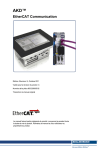
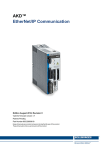
AKD™
EtherCAT Communication
Edition: E, October 2011
Valid for Hardware Revision C
Part Number 903-200005-00
Original Documentation
Keep all manuals as a product component during the life span of the product.
Pass all manuals to future users and owners of the product.
Record of Document Revisions:
Revision
-, 11/2009
Remarks
Beta launch version
-, 12/2009
Minor formatting changes
A, 07/2010
FBUS.PARAM04 added, part number added, page format, release information
B, 10/2010
Setup for KAS added
C, 01/2011
HW Rev. C
D, 04/2011
WoE, corrections
E, 10/2011
Flexible mapping, cover page layout
Hardware Revision (HR)
Hardware Revision
A
C
Firmware
M_01-03-zz-zzz
WorkBench
1.3.0.zzzzz
Remarks
Start revision
≥ M_01-03-00-011
≥ 1.3.0.zzzzz
STO certified
≥ M_01-05-xx-yyy
≥ 1.5.0.zzzzz
PROFINET RT released
EtherCAT is a registered trademark and patented technology, licensed by Beckhoff Automation GmbH”
PROFINET is a registered trademark of PROFIBUS and PROFINET International (PI)
Ethernet/IP is a registered trademark of ODVA, Inc.
Ethernet/IP Communication Stack: copyright (c) 2009, Rockwell Automation
EnDat is a registered trademark of Dr. Johannes Heidenhain GmbH
HIPERFACE is a registered trademark of Max Stegmann GmbH
SIMATIC is a registered trademark of SIEMENS AG
WINDOWS is a registered trademark of Microsoft Corporation
AKD is a registered trademark of Kollmorgen™ Corporation
Current patents:
US Patent 5,646,496 (used in control card R/D and 1 Vp-p feedback interface)
US Patent 5,162,798 (used in control card R/D)
US Patent 6,118,241 (used in control card simple dynamic braking)
Technical changes which improve the performance of the device may be made without prior notice!
Printed in the United States of America
This document is the intellectual property of Kollmorgen™. All rights reserved. No part of this work may be
reproduced in any form (by photocopying, microfilm or any other method) or stored, processed, copied or distributed by electronic means without the written permission of Kollmorgen™.
2
Kollmorgen™ | October 2011
AKD EtherCAT | Table of Contents
Table of Contents
1 General
5
1.1 About this Manual
6
1.2 Target Group
6
1.3 Symbols used
7
1.4 Abbreviations Used
8
9
2 Safety
2.1 Safety Instructions
10
2.2 Use as directed
10
2.3 Prohibited use
10
3 Installation and Setup
11
3.1 Safety Instructions
12
3.2 EtherCAT Onboard
13
3.2.1 LED functions
13
3.2.2 Connection technology
13
3.2.3 Network Connection Example
13
3.3 EtherCAT activation with AKD-CC models
14
3.4 Guide to Setup
15
3.5 Setup via TwinCAT NC/PTP System Manager
15
3.5.1 Scan devices
16
3.5.2 Select the device
16
3.5.3 Scan for boxes
17
3.5.4 Add Slaves to NC tasks
17
3.5.5 Enable the network configuration
18
3.5.6 Enable the axis and move the axis
19
3.6 Setup WorkBench over TwinCAT
20
3.6.1 TwinCAT and WorkBenchconfiguration
21
3.6.2 Connecting to a drive using WorkBench
22
3.6.3 Configuring and enabling a drive
25
3.7 Setup via KAS IDE
26
4 EtherCAT Profile
27
4.1 Slave Register
28
4.2 AL Event (Interrupt Event) and Interrupt Enable
29
4.2.1 Interrupt Enable Register (Address 0x0204:0x0205)
29
4.2.2 AL Event Request (Address 0x0220:0x0221)
30
4.3 Phase Run-Up
31
4.3.1 AL Control (Address 0x0120:0x0121)
31
4.3.2 AL Status (Address 0x0130:0x0131)
31
4.3.3 AL Status Code (Address 0x0134:0x0135)
32
4.3.4 EtherCAT communication phases
32
4.4 CANopen over EtherCAT (CoE) Status Machine
33
4.4.1 Status Description
33
4.4.2 Commands in the Control Word
34
Kollmorgen™ | October 2011
3
AKD EtherCAT | Table of Contents
4.4.3 Status Machine Bits (status word)
4.5 Fixed PDO Mappings
36
4.6 Flexible PDO Mappings
37
4.6.1 Example: Free PDO Mapping
38
4.7 Supported Cyclical Setpoint and Actual Values
41
4.8 Supported Operation Modes
41
4.9 Adjusting EtherCAT Cycle Time
42
4.10 Maximum Cycle Times depending on operation mode
42
4.11 Synchronization
43
4.11.1 Synchronization behavior with distributed clocks (DC) enabled
43
4.11.2 Synchronization behavior with distributed clocks (DC) disabled
43
4.12 Latch Control Word and Latch Status Word
44
4.13 Mailbox Handling
45
4.13.1 Mailbox Output
46
4.13.2 Mailbox Input
47
4.13.3 Example: Mailbox Access
48
4.14 Fieldbus Parameters
5 Index
4
35
Kollmorgen™ | October 2011
49
51
AKD EtherCAT | 1 General
1 General
1.1 About this Manual
6
1.2 Target Group
6
1.3 Symbols used
7
1.4 Abbreviations Used
8
Kollmorgen™ | October 2011
5
AKD EtherCAT | 1 General
1.1 About this Manual
This manual, AKD EtherCAT Communication, describes the installation, setup, range of functions, and software
protocol for the EtherCAT AKD product series. All AKD EtherCAT drives have built-in EtherCAT functionality;
therefore an additional option card is not required.
A digital version of this manual (pdf format) is available on the CD-ROM included with your drive. Manual updates
can be downloaded from the Kollmorgen™ website.
Related documents for the AKD series include:
l
l
l
l
AKD Quick Start (also provided in hard copy). This guide provides instructions for basic drive setup and
connection to a network.
AKD Installation Manual (also provided in hard copy for EU customers). This manual provides instructions
for installation and drive setup.
AKD Parameter and Command Reference Guide. This guide provides documentation for the parameters
and commands used to program the AKD.
AKD CANopen Communication. This manual includes setup information for the CAN interface and
describes the CANopen profile.
Additionally, an EtherCAT XML file, entitled AKD EtherCAT Device Description, describes the drive SDO and
PDO. This file is available on the Kollmorgen™ website:
http://www.kollmorgen.com/website/com/eng/products/drives/ac_servo_drives/akd_drives_akd_software_
tab.php
1.2 Target Group
This manual addresses personnel with the following qualifications:
l
Installation: only by electrically qualified personnel.
Setup: only by qualified personnel with extensive knowledge of electrical engineering
and drive technology
l
Programming: Software developers, project-planners
l
The qualified personnel must know and observe the following standards:
l
l
ISO 12100, IEC 60364 and IEC 60664
National accident prevention regulations
During operation there are deadly hazards, with the possibility of death, severe
injury or material damage. The operator must ensure that the safety instructions in
this manual are followed. The operator must ensure that all personnel responsible
for working with the servo drive have read and understand the manual.
6
Kollmorgen™ | October 2011
AKD EtherCAT | 1 General
1.3 Symbols used
Warning Symbols
Symbol
Indication
Indicates a hazardous situation which, if not avoided, will result in death or serious
injury.
Indicates a hazardous situation which, if not avoided, could result in death or serious
injury.
Indicates a hazardous situation which, if not avoided, could result in minor or moderate injury.
Indicates situations which, if not avoided, could result in property damage.
This is not a safety symbol.
This symbol indicates important notes.
Drawing symbols
Symbol
Description
Symbol
Description
Signal ground
Diode
Chassis ground
Relays
Protective earth
Relays switch off
delayed
Resistor
Normal open contact
Fuse
Normal closed contact
Kollmorgen™ | October 2011
7
AKD EtherCAT | 1 General
1.4 Abbreviations Used
Abbreviation Meaning
8
AL
Application Layer: the protocol that directly used by the process entities.
Cat
Category – classification for cables that is also used in Ethernet.
DC
Distributed Clocks Mechanism to synchronize EtherCAT slaves and master
DL
Data Link(=Layer 2). EtherCAT uses Ethernet, which is standardized as IEEE 802.3.
FPGA
Field Programmable Gate Array
FTP
File Transfer Protocol
HW
Hardware
ICMP
Internet Control Message Protocol: Mechanisms for signaling IP errors.
IEC
International Electrotechnical Commission: The international standards
IEEE
Institute of Electrical and Electronics Engineers, Inc.
LLDP
Link Layer Discovery Protocol
MAC
Media Access Control
MII
Media Independent Interface: Standardized interface Ethernet controller <-> routing equipment.
MDI
Media Dependant Interface: Use of connector Pins and Signaling.
MDI-X
Media Dependant Interface (crossed): Use of connector Pins and Signaling with crossed lines.
OSI
Open System Interconnect
OUI
Organizationally Unique Identifier – the first 3 Bytes of an Ethernet-Address, that will be assign to
companies or organizations and can be used for protocoll identifiers as well (e.g. LLDP)
PDI
Physical Device Interface: set of elements that allows access to ESC from the process side.
PDO
Process Data Object
PDU
Protocol Data Unit: Contains protocol information transferred from a protocol instance of transparent data to a subordinate level
PHY
Physical interface that converts data from the Ethernet controller to electric or optical signals.
PLL
Phase Locked Loop
PTP
Precision Time Protocol in accordance with IEEE 1588
RSTP
Rapid Spanning Tree Protocol
RT
Real-time, can be run in Ethernet controllers without special support.
RX
Receive
RXPDO
Receive PDO
SNMP
Simple Network Management Protocol
SPI
Serial Peripheral Interface
Src Addr
Source Address: Source address of a message.
STP
Shielded Twisted Pair
TCP
Transmission Control Protocol
TX
Transmit
TXPDO
Transmit PDO
UDP
User Datagram Protocol: Non-secure multicast/broadcast frame.
UTP
Unshielded Twisted Pair
ZA ECAT
Access mode EtherCAT
ZA Drive
Acces mode drive
Kollmorgen™ | October 2011
AKD EtherCAT | 2 Safety
2 Safety
2.1 Safety Instructions
10
2.2 Use as directed
10
2.3 Prohibited use
10
Kollmorgen™ | October 2011
9
AKD EtherCAT | 2 Safety
2.1 Safety Instructions
During operation there are deadly hazards, with the possibility of death, severe injury or
material damage. Do not open or touch the equipment during operation. Keep all covers and
cabinet doors closed during operation. Touching the equipment is allowed during installation
and commissioning for properly qualified persons only.
l
l
l
During operation, drives may have uncovered live components, depending on their
level of enclosure protection.
Control and power connections may be live, even though the motor is not rotating.
Drives may have hot surfaces during operation. Heat sink can reach temperatures
above 80°C.
Electronic equipment can fail. The user is responsible for ensuring that, in the event of a failure of the servo amplifier, the drive is set to a state that is safe for both machinery and personnel, for instance with the aid of a mechanical brake.
Drives with servo amplifiers and EtherCAT are remote-controlled machines. They can start
to move at any time without previous warning. Take appropriate measures to ensure that the
operating and service personnel is aware of this danger.
Implement appropriate protective measures to ensure that any unintended start-up of the
machines cannot result in dangerous situations for personnel or machinery. Software limitswitches are not a substitute for the hardware limit-switches in the machine.
Install the drive as described in the Installation Manual. Never break any of the electrical connections to the drive while it is live. This can result in destruction of the electronics
Do not connect the Ethernet line for the PC with the set up software to the EtherCAT interface X5/X6. The set up Ethernet cable must be connected to the service interface on X11
2.2 Use as directed
Drives are components that are built into electrical plants or machines and can only be operated as integral components of these plants or machines. The manufacturer of the machine used with a drive must generate a risk
assessment for the machine and take appropriate measures to ensure that unforeseen movements cannot cause
personnel injury or property damage.
l
l
Observe the chapters "Use as directed” and "Prohibited use" in the AKD Installation Manual.
The EtherCAT interface serves only for the connection of the AKD to a master with EtherCAT connectivity.
2.3 Prohibited use
Other use than that described in chapter “Use as directed” is not intended and can lead to personnel injuries and
equipment damage. The drive may not be used with a machine that does not comply with appropriate national
directives or standards. The use of the drive in the following environments is also prohibited:
l
l
l
potentially explosive areas
environments with corrosive and/or electrically conductive acids, alkaline solutions, oils, vapors, dusts
ships or offshore applications
The connectors X5 and X6 of the AKD EtherCAT drive may not be used for any ethernet protocol except EtherCAT (CoE, Can over EtherCAT).
10
Kollmorgen™ | October 2011
AKD EtherCAT | 3 Installation and Setup
3 Installation and Setup
3.1 Safety Instructions
12
3.2 EtherCAT Onboard
13
3.3 EtherCAT activation with AKD-CC models
14
3.4 Guide to Setup
15
3.5 Setup via TwinCAT NC/PTP System Manager
15
3.6 Setup WorkBench over TwinCAT
20
3.7 Setup via KAS IDE
26
Kollmorgen™ | October 2011
11
AKD EtherCAT | 3 Installation and Setup
3.1 Safety Instructions
Never disconnect any electrical connections to the drive while the drive is live. There is a
danger of electrical arcing with damage to contacts and serious personal injury. Wait at
least seven minutes after disconnecting the drive from the main supply power before touching potentially live sections of the equipment (e.g. contacts) or undoing any connections.
Capacitors can still have dangerous voltages present up to 7 minutes after switching off the
supply power. To be sure, measure the voltage in the DC Bus link and wait until it has fallen
below 40 V.
Control and power connections can still be live, even if the motor is not rotating.
Electronic equipment can fail. The user is responsible for ensuring that, in the event of a failure of the servo amplifier, the drive is set to a state that is safe for both machinery and personnel, for instance with the aid of a mechanical brake.
Drives with servo amplifiers and EtherCAT are remote-controlled machines. They can start
to move at any time without previous warning. Take appropriate measures to ensure that
the operating and service personnel is aware of this danger.
Implement appropriate protective measures to ensure that any unintended start-up of the
machines cannot result in dangerous situations for personnel or machinery. Software limitswitches are not a substitute for the hardware limit-switches in the machine.
Install the drive as described in the Installation Manual. The wiring for the analog setpoint
input and the positioning interface, as shown in the wiring diagram in the Installation
Manual, is not required. Never break any of the electrical connections to the drive while it is
live. This action can result in destruction of the electronics.
The drive's status must be monitored by the PLC to acknowledge critical situations. Wire
the FAULT contact in series into the emergency stop circuit of the installation. The emergency stop circuit must operate the supply contactor.
Use WorkBench to alter drive settings. Any other alterations will invalidate the warranty.
Because of the internal representation of the position-control parameters, the position controller can only be operated if the final limit speed of the drive does not exceed:
rotary
at sinusoidal² commutation: 7500 rpm
at trapezoidal commutation: 12000 rpm.
linear
at sinusoidal² commutation: 4 m/s
at trapezoidal commutation: 6.25 m/s
All the data on resolution, step size, positioning accuracy etc. refer to calculatory values.
Non-linearities in the mechanism (backlash, flexing, etc.) are not taken into account. If the
final limit speed of the motor must be altered, then all the parameters that were previously
entered for position control and motion blocks must be adapted.
12
Kollmorgen™ | October 2011
AKD EtherCAT | 3 Installation and Setup
3.2 EtherCAT Onboard
Connection to the EtherCAT Network via X5 (in port) and X6 (out port).
3.2.1 LED functions
The communication status is indicated by the built-in LEDs.
Connector LED#
Name
X5
LED1 IN port Link
LED2
X6
RUN
LED3 OUT port Link
LED4
Function
ON = active
OFF= not active
ON = running
OFF = not running
ON = active
OFF = not active
-
-
3.2.2 Connection technology
You can connect to the EtherCAT network using RJ-45 connectors.
3.2.3 Network Connection Example
Kollmorgen™ | October 2011
13
AKD EtherCAT | 3 Installation and Setup
3.3 EtherCAT activation with AKD-CC models
AKD-CC drive models are Drives, which support EtherCAT and CAN fieldbus types within one common software. These CC drive models allow selecting a fieldbus support by setting the DRV.TYPE parameter to a certain
value. CC drive models are delivered with EtherCAT set active. If you must change a drive from CANopen to
EtherCAT, the DRV.TYPE parameter must be changed
1. by software: connect the PC to the AKD and change the parameter DRV.TYPE in the WorkBench terminal screen (see DRV.TYPE parameter documentation) or
2. by hardware: with the rotary switches S1 & S2 at the front and the button B1 on the top side of the Drive.
The following steps are needed for changing the fieldbus type from CAN to EtherCAT with the rotary switches.
1. Set the rotary switches on the front side of the AKD to the value of 89.
Set S1 to 8 and S2 to 9
2. Press the button B1 for about 3 seconds (starts DRV.NVSAVE).
The seven segment display shows En during the process of changing DRV.TYPE to EtherCAT.
Do not switch off the 24[V] power supply while the seven segment shows En!
3. Wait until the display goes back to the original state, now the drive is prepared for EtherCAT.
4. Power cycle the drive by switching the 24 V power supply off and then on again.
The seven segment display shows Er (Error) in case that the DRV.TYPE instruction
failed. In this case please power cycle the drive and contact the Kollmorgen™ customer support for further help.
14
Kollmorgen™ | October 2011
AKD EtherCAT | 3 Installation and Setup
3.4 Guide to Setup
Only professional personnel with extensive knowledge of control and drive
technology are allowed to setup the drive.
Make sure that any unintended movement of the drive cannot endanger
machinery or personnel.
1. Check assembly/installation. Check that all the safety instructions in the product manual for the drive and
this manual have been observed and implemented. Check the setting for the station address and baud
rate.
2. Connect PC,start WorkBench. Use the setup software WorkBench to set the parameters for the drive.
3. Setup basic functions. Start up the basic functions of the drive and optimize the current, speed and position controllers. This section of the setup is described in the in the online help of the setup software.
4. Save parameters. When the parameters have been optimized, save them in the drive.
3.5 Setup via TwinCAT NC/PTP System Manager
Before you set up the drive, make sure the following have been completed:
l
l
l
l
l
l
The AKD is configured with WorkBench and the servomotor is able to move
A correctly configured EtherCAT card is present in the master.
TwinCAT software from Beckhoff (NC/PTP-Mode setup) is installed. Install first the TwinCAT System
Manager, restart your PC, then install the option package NC/PTP-Mode.
The XML description of the drive is available (the XML file on the CD-ROM or on the Kollmorgen™ website).
An AKD EtherCAT slave is connected to the EtherCAT master PC.
The TwinCAT system manager resides in Config-Mode. The current mode of the system manager is displayed of the bottom right side of the TwinCAT main-screen window.
Copy the XML description of the drive to the TwinCAT system (usually to the folder c:\TwinCAT\IO\EtherCAT)
and restart the TwinCAT system since TwinCAT analyzes all device description files during start-up.
The following example explains the automatic EtherCAT network setup. The network setup can also be done
manually; please refer to the TwinCAT manual for more details.
Kollmorgen™ | October 2011
15
AKD EtherCAT | 3 Installation and Setup
3.5.1 Scan devices
First ensure that the EtherCAT master is physically connected to the EtherCAT AKD. Create a new (empty)
project. Right click I/O-Devices and scan for the devices. An example is included in the EtherCAT network card,
which is plugged into the PC.
A pop-up window informs you that not all devices can be detected by the TwinCAT software.
Click OK to continue.
3.5.2 Select the device
TwinCAT must be able to find the EtherCAT network card. An EtherCAT slave must be connected to the network
card; otherwise TwinCAT will find a real-time EtherNET card instead of the EtherCAT card. Press the OK button.
16
Kollmorgen™ | October 2011
AKD EtherCAT | 3 Installation and Setup
3.5.3 Scan for boxes
Click Yes to allow TwinCat to scan for boxes. A box is an alias for a slave device and is always used in Beckhoff
software products.
3.5.4 Add Slaves to NC tasks
TwinCAT should now have identified the AKD according to the Device Description file. TwinCAT next asks if the
slaves should be connected to NC tasks. Click Yes to continue. An NC task can, for example, contain a PLC
program, which can be programmed by the user.
Kollmorgen™ | October 2011
17
AKD EtherCAT | 3 Installation and Setup
3.5.5 Enable the network configuration
butConfirm that the AKD appears in the device tree. Next, enable the network configuration Press first the
ton in order to generate the mappings, afterwards press the
button in order to let TwinCAT check the configuration and use finally the
button in order to step into run-mode.
Confirm afterwards that TwinCAT is allowed to jump into run-mode.
18
Kollmorgen™ | October 2011
AKD EtherCAT | 3 Installation and Setup
3.5.6 Enable the axis and move the axis
The Axis can be enabled by a mouse-click on the Set button within the Online window inside of each Axis, see
also the next picture.
Afterwards a pop-up window appears.
The following setting enables the drive and allows command values in both directions.
Afterwards the motor should move in positive or negative direction as soon as the clicks on the following yellow
buttons within the Online window:
Kollmorgen™ | October 2011
19
AKD EtherCAT | 3 Installation and Setup
3.6 Setup WorkBench over TwinCAT
This chapter describes a quick start guide for a user to be able to setup a WorkBench over TwinCAT system and
be able to make a motor spin under that system.
This chapter does not give any specific details on TwinCAT system or WorkBench alone but is giving guidelines
and information on how TwinCAT master and WorkBench works together.
Main steps in configuring a WorkBench over TwinCAT system are:
1. TwinCAT and WorkBench configuration
2. Connecting to a drive using WorkBench
3. Configuring and enabling a drive
20
Kollmorgen™ | October 2011
AKD EtherCAT | 3 Installation and Setup
3.6.1 TwinCAT and WorkBenchconfiguration
The EtherCAT network must be setup and managed using TwinCAT System Manager. To be able to connect to a
drive and enable it, the drive must be loaded under the I/O Devices node in TwinCAT System Manager and axis
must be added to NC - Configuration as shown in"Setup via TwinCAT NC/PTP System Manager" (=> p. 15) .
In order to connect to the drives using WorkBench, the drives must be either in Pre-Op, Safe-Op or Op state.
State machine for a drive can be accessed from the Online tab for the corresponding drive under the I/O Configuration → I/O Devices → Device [x] → Drive [x] node (see screenshot below).
Installation process for WorkBench is the same process as normal, except that it must be installed on the same
machine as TwinCAT. Communication to the drive is done thru TwinCAT master and it's not possible to connect
WorkBench to the master remotely.
Kollmorgen™ | October 2011
21
AKD EtherCAT | 3 Installation and Setup
3.6.2 Connecting to a drive using WorkBench
In order to connect to a drive, a TwinCAT device must be added in WorkBench. The start page of WorkBench
can be used to do this. First, the type of drive (Online - TwinCAT) must be specified. Then, a list of available
drives will be provided.
The information provided for a drive are it's name, status, Net ID and Port number. After selecting a drive from the
list, clicking on the "Connect" button will create a device in the left frame of WorkBenchand connect the device.
22
Kollmorgen™ | October 2011
AKD EtherCAT | 3 Installation and Setup
The name, Net ID and port number are information comming from the TwinCAT master configuration file (the name
may be different than the drive name returned by the DRV.NAME command). While the status is an indicator that
tells if there is already a device created within WorkBench which is already connected to that particular drive.
Using TwinCAT System Manager, the drive name and port number can be found in the General and EtherCAT tab
respectively for the corresponding drive under the I/O Configuration → I/O Devices → Device [x] → Drive [x] node.
Kollmorgen™ | October 2011
23
AKD EtherCAT | 3 Installation and Setup
The Net ID can be found in the EtherCAT tab in the I/O Configuration → I/O Devices → Device [x] node.
It is important to understand that these information are comming from the TwinCAT master and it's configuration
file but not from the drive itself. Thus, if the TwinCAT configuration is not reflecting the actual network configuration,you may have a drive listed in WorkBench which is not be powered up or even connected in the EtherCAT network, or you have a drive powered up and connected to the TwinCAT network but not shown in the
WorkBench list.
24
Kollmorgen™ | October 2011
AKD EtherCAT | 3 Installation and Setup
3.6.3 Configuring and enabling a drive
Once connected with WorkBench, a drive can be configured using all normal functionnalities of WorkBench.
The only operation that is not possible to do using WorkBench over TwinCAT is the download of a new firmware
in the drive. Downloading a new firmware in the drive must be performed using File over EtherCAT (FoE) feature
of TwinCAT server.
If the cyclic communication of the TwinCAT master is enabled, it is possible that
some commands sent by WorkBench using the ASCII channel are overwirtten by
the TwinCAT master. Typically, the drive enable command will have no effect if
sent from WorkBench because the control word is usually mapped.
Using TwinCAT, enabling the drive can be done with the following procedure:
1. Under NC Configuration → Axes → Axis [x] node, choose the Online tab.
2. Press the Set button within the Enabling section.
3. In the pop-up dialog box, check the Controller checkbox to enable the drive (or un-check to disable the
drive) and press on the OK button.
Kollmorgen™ | October 2011
25
AKD EtherCAT | 3 Installation and Setup
3.7 Setup via KAS IDE
If you are using a Kollmorgen Automation Suite (KAS) system, the AKD setup is completely integrated into the
KAS Integrated Development Environment (IDE), as shown below:
For further information on the setup for a KAS system, see the following sections in the KAS documentation:
l
l
26
KAS IDE User Manual: See section 4.2.3 Add and Configure Drive.
KAS Online Help: See Using the KAS IDE> Creating a Project> Step 3 - Add and Configure Drive.
Kollmorgen™ | October 2011
AKD EtherCAT | 4 EtherCAT Profile
4 EtherCAT Profile
4.1 Slave Register
28
4.2 AL Event (Interrupt Event) and Interrupt Enable
29
4.3 Phase Run-Up
31
4.4 CANopen over EtherCAT (CoE) Status Machine
33
4.5 Fixed PDO Mappings
36
4.6 Flexible PDO Mappings
37
4.7 Supported Cyclical Setpoint and Actual Values
41
4.8 Supported Operation Modes
41
4.9 Adjusting EtherCAT Cycle Time
42
4.10 Maximum Cycle Times depending on operation mode
42
4.11 Synchronization
43
4.12 Latch Control Word and Latch Status Word
44
4.13 Mailbox Handling
45
4.14 Fieldbus Parameters
49
Kollmorgen™ | October 2011
27
AKD EtherCAT | 4 EtherCAT Profile
4.1 Slave Register
The table below gives the addresses of individual registers in the FPGA memory. The data is provided in littleendian format, with the ’least significant byte’ occupying the lowest address. A detailed description of all registers and FPGA memory locations is available in the “EtherCAT Slave Controller” description of the EtherCAT
user organization (www.EtherCAT.org).
Address
Length
(Byte)
Description
0x0120
2
AL Control
R/W
R/O
0x0130
2
AL Status
R/O
R/W
0x0134
2
AL Status Code
R/O
R/W
0x0204
2
Interrupt Enable Register
R/O
R/W
0x0220
2
AL Event (IRQ Event)
R/W
R/O
0x0800
8
Sync Manager 0 (Mail Out Control Register)
R/W
R/O
0x0808
8
Sync Manager 1 (Mail In Control Register)
R/W
R/O
0x0810
8
Sync Manager 2 (Process data Output Control Register)
R/W
R/O
0x0818
8
Sync Manager 3 (Process data Input Control Register)
R/W
R/O
0x0820
8
Sync Manager 4
R/W
R/O
0x0828
8
Sync Manager 5
R/W
R/O
0x0830
8
Sync Manager 6
R/W
R/O
0x0838
8
Sync Manager 7
R/W
R/O
0x0840
8
Sync Manager 8
R/W
R/O
0x1100
Max. 64
ProOut Buffer (Process data Output, setpoints ECAT)
R/W
R/O
0x1140
Max. 64
ProIn (Process data Input, act. values ECAT)
R/O
R/W
0x1800
512
Mail Out Buffer (Object Channel Buffer ECAT,
byte-length is specified in the device description file)
R/W
R/O
0x1C00
512
Mail In Buffer (Object Channel Buffer Drive,
byte-length is specified in the device description file)
R/O
R/W
* ZA ECAT = Access mode EtherCAT
* ZA Drive = Access mode drive
28
Kollmorgen™ | October 2011
ZA
ZA
ECAT* Drive*
AKD EtherCAT | 4 EtherCAT Profile
4.2 AL Event (Interrupt Event) and Interrupt Enable
Communication between the drive and the EtherCAT FPGA can be interrupt-driven. The interrupt enable register
and the AL event register are responsible for the EtherCAT interface interrupt functionality.
There are two events which lead also to a HW interrupt within the drive, the EEPROM emulation event and the
SyncManager 2 event. The actual values of the drive (SyncManager 3 data) are written without any AL event
request during each HW IRQ, e.g. triggered by a SyncManager 2 event. The Mailbox exchange between the
master and the AKD is completely handled by polling the AL event register within the background task of the drive.
The drive activates individual EtherCAT interface events when the corresponding bit of the interrupt enable register is set to 1. When it is set to 0, the hardware interrupts for the specific events are deactivated.
4.2.1 Interrupt Enable Register (Address 0x0204:0x0205)
Bit
ZA
ZA
Drive ECAT Description
Parameter
Address
AL Control Event
0x204
0
R/W
R/O
Activation of AL control event for phase run-up
-
0x204
1
R/W
R/O
Reserved
Sync0 DC Distributed
Clock
0x204
2
R/W
R/O
Activation of distributed clock (DC) sync 0 interrupts for entire communication
Sync1 DC Distributed
Clock
0x204
3
R/W
R/O
Activation of distributed clock (DC) sync 1 interrupts for entire communication
SyncManager activation
register change
0x204
4
R/W
R/O
Activation of ‘SyncManager activation register
change’ IRQ.
EEPROM emulation
event
0x204
5
R/W
R/O
Activation of the EEPROM emulation interrupts.
-
0x204
3 to 7 R/W
R/O
Reserved
Sync Manager 0 Event
(Mail Out Event)
0x205
0
R/W
R/O
Activation of output event mailbox (SDO, Sync
Manager 0) for object channel.
Sync Manager 1 Event
(Mail In Event)
0x205
1
R/W
R/O
Activation of input event mailbox (SDO, Sync Manager 1) for object channel.
Sync Manager 2 Event
(Pro Out Event)
0x205
2
R/W
R/O
Activation of output event process data (PDO,
card's cyclical setpoints)
Sync Manager 3 Event
(Pro In Event)
0x205
3
R/W
R/O
Activation of input event process data (PDO,
drive's cyclical actual values)
-
0x205
4 to 7 R/W
R/O
Reserved
Kollmorgen™ | October 2011
29
AKD EtherCAT | 4 EtherCAT Profile
4.2.2 AL Event Request (Address 0x0220:0x0221)
When the relevant bit of the AL event request register is set to 1, the EtherCAT interface tells the drive which
event it should process by the AKD.
Bit
ZA
ZA
Drive ECAT Description
Parameter
Address
AL Control Event
0x220
0
R/O R/W Processing of AL control event for phase run-up
Sync0 Distributed
Clock (DC) Event
0x220
2
R/O R/W Processing of a distributed clock (DC) event
Sync1 Distributed
Clock (DC) Event
0x220
3
R/O R/W Processing of a distributed clock (DC) event
SyncManager acti0x220
vation register change
4
R/O R/W The content of the SyncManager activation register has been changed.
EEPROM emulation
event
0x220
5
R/O R/W Processing of an EEPROM emulation event in
order to identify the AKD within the network.
-
0x220
6 to 7 R/O R/W Reserved
Sync Manager 0 Event 0x221
0
R/O R/W Mailbox request (SDO, Sync Manager 0) for
object channel.
Sync Manager 1 Event 0x221
1
R/O R/W Mailbox response (SDO, Sync Manager 1) for
object channel.
Sync Manager 2 Event 0x201
2
R/O R/W Process data output (PDO, card's cyclical setpoints)
Sync Manager 3 Event 0x201
3
R/O R/W Process data input (PDO, drive's cyclical
actual values)
Sync Manager 4 –
Sync Manager 7 Event 0x221
4 to 7 R/O R/W Reserved
Sync Manager 8 –
Sync Manager 15
Event
30
0x222
0…7 R/O R/W Reserved
Kollmorgen™ | October 2011
AKD EtherCAT | 4 EtherCAT Profile
4.3 Phase Run-Up
The AL control, AL status and AL status code registers are responsible for communication phase run-up (also
referred to as EtherCAT status change), for current status display and for any fault messages. The drive
responds to every EtherCAT interface transition request made by the AL control register via the AL Status and
AL Status Code registers. Any fault messages are displayed in the AL status code register.
A status change within the AL control register is polled within the AKD, which means that an AL control event
does not lead to a HW interrupt within the drive.
4.3.1 AL Control (Address 0x0120:0x0121)
Parameter
ZA
ZA
Drive ECAT Description
Address
Bit
0x120
3 to 0
R/O
W/O 0x01: Init Request
Acknowledgement
0x120
4
R/O
W/O 0x00: No fault acknowledgement
0x01: Fault acknowledgement (positive edge)
Reserved
0x120
7 to 5
R/O
W/O -
Applic. specific
0x120 15 to 8 R/O
W/O -
Status
0x02: PreOperational Request
0x03: Bootstrap Mode Request
0x04: Safe Operational Request
0x08: Operational Request
4.3.2 AL Status (Address 0x0130:0x0131)
Parameter
Status
Address
0x130
Bit
ZA
ZA
Drive ECAT Description
3 to 0 W/O R/O 0x01: Init
0x02: PreOperational
0x03: Bootstrap Mode
0x04: Safe Operational
0x08: Operational
Status change
0x130
4
W/O R/O 0x00: Acknowledgement
0x01: Error, e.g. forbidden transition
Reserved
0x130
Applic. specific
0x130 15 to 8 W/O R/O -
7 to 5 W/O R/O -
Kollmorgen™ | October 2011
31
AKD EtherCAT | 4 EtherCAT Profile
4.3.3 AL Status Code (Address 0x0134:0x0135)
Parameter
Address
Bit
ZA Drive
Status
ZA ECAT Description
0x134
7 to 0
W/O
R/O
See table below
Status
0x135
7 to 0
W/O
R/O
See table below
Code
Description
Current Status
(Status change)
Resulting Status
0x0000
No error
All
Current Status
0x0011
Invalid requested state change
I -> S, I -> O, P -> O, Current Status + E
O -> B, S -> B, P -> B
0x0017
Invalid sync manager configuration I -> P, P -> S
Current Status + E
No other codes are supported.
4.3.4 EtherCAT communication phases
INIT:
Initialization, no communication. EEPROM emulation will be activated.
PRE-OP:
Mailbox active, slave parameterization and startup parameters
SAVE-OP:
Cyclical actual values are transferred and the drive tries to synchronize.
OPERATIONAL:
Cyclical setpoints are processed, torque enable can be activated
and the drive must be synchronized.
Individual communication transitions
AL Control
Transition (Bit 3 to 0) Description
32
(IB)
0x03
-
(BI)
-
-
(IP)
0x02
AKD reads the SyncManager 0 & 1 configuration and verifies the value of the startaddress and the length. The AKD prepares itself for handling SyncManager 0 events.
(PI)
0x01
-
(PS)
0x04
AKD reads the SyncManager 2 & 3 configuration and verifies the value of the startaddress and the length.
(SP)
0x02
-
(SI)
0x01
-
(SO)
0x08
The SnycManager 2 hardware interrupt will be enabled by the drive.
(OS)
0x04
Deactivation of SyncManager 2 hardware interrupt.
(OP)
0x02
Deactivation of SyncManager 2 hardware interrupt..
(OI)
0x01
Deactivation of SyncManager 2 hardware interrupt.
Kollmorgen™ | October 2011
AKD EtherCAT | 4 EtherCAT Profile
4.4 CANopen over EtherCAT (CoE) Status Machine
The status machine for the control and status words corresponds to the CANopen status machine in accordance
with DS402. CANopen control and status words are captured in every instance of fixed PDO mapping (see chapter entitled ‘Fixed PDO Mapping‘, page ).
4.4.1 Status Description
Status
Description
Not Ready to Switch
On
The drive is not ready to switch on; the controller has not indicated readiness for
service. The drive is still in the boot phase or in fault status.
Switch On Disable
In 'Switch On Disable' status, the amplifier cannot be enabled via the EtherCAT
interface, because (for example) there is no connection to a power source.
Ready to Switch On
In 'Ready to Switch On' status, the drive can be enabled via the control word.
Switched On
In 'Switched On' status, the amplifier is enabled, but the setpoints of the EtherCATinterface are not yet transferred. The amplifier is idle, and a positive edge in bit 3 of
the control word activates setpoint transfer (transition to 'Operation Enable' status).
Operation Enable
In this status, the drive is enabled and setpoints are transferred from the EtherCAT
interface.
Quick Stop Active
The drive follows a quick stop ramp.
Fault Reaction Active The drive responds to a fault with an emergency stop ramp.
Fault
A fault is pending, the drive is stopped and disabled.
Kollmorgen™ | October 2011
33
AKD EtherCAT | 4 EtherCAT Profile
4.4.2 Commands in the Control Word
Bit assignment in the control word
Bit Name
Bit
Name
0
Switch on
8
Pause/halt
1
Disable Voltage
9
reserved
2
Quick Stop
10
reserved
3
Enable Operation
11
reserved
4
Operation mode specific
12
reserved
5
Operation mode specific
13
Manufacturer-specific
6
Operation mode specific
14
Manufacturer-specific
7
Reset Fault (only effective for faults)
15
Manufacturer-specific
Commands in the control word
Command
Bit 7
Bit 3
Bit 2
Bit 1
Bit 0
Fault Reset Enable Operation Quick Stop Disable Voltage Switch on Transitions
Shutdown
X
X
1
1
0
2, 6, 8
Switch on
X
X
1
1
1
3
Disable Voltage
X
X
X
0
X
7, 9, 10, 12
Quick Stop
X
X
0
1
X
7, 10, 11
Disable Operation
X
0
1
1
1
5
Enable Operation
X
1
1
1
1
4, 16
Fault Reset
1
X
X
X
X
15
Bits labeled X are irrelevant. 0 and 1 indicate the status of individual bits.
Mode-dependent bits in the control word
The following table shows the mode-dependent bits in the control word. Only manufacturer-specific modes are
supported at present. The individual modes are set by Object 6060h Modes of operation.
Operation mode
No. Bit 4
Bit 5
Bit 6
Profile Position Mode (pp)
01h new_setpoint
change_set_
immediately
absolute/relative
Profile Velocity Mode (pv)
03h reserved
reserved
reserved
Profile Torque Mode (tq)
04h reserved
reserved
reserved
Homing Mode (hm)
06h homing_operation_start reserved
reserved
Interpolated Position Mode (ip)
07h
reserved
reserved
reserved
reserved
Cyclic synchronous position mode 08h reserved
Description of the remaining bits in the control word
Bit 8: (Pause) If Bit 8 is set, then the drive halts (pauses) in all modes. The setpoints (speed for homing or jogging, motion task number, setpoints for digital mode) for the individual modes are retained.
Bit 9,10: These bits are reserved for the drive profile (DS402).
Bit 13, 14, 15: These bits are manufacturer-specific, and reserved at present.
34
Kollmorgen™ | October 2011
AKD EtherCAT | 4 EtherCAT Profile
4.4.3 Status Machine Bits (status word)
Bit assignment in the status word
Bit Name
Bit Name
0
Ready to switch on
8
Manufacturer-specific (reserved)
1
Switched on
9
Remote (always 1)
2
Operation enable
10
Target reached
3
Fault
11
Internal limit active
4
Voltage enabled
12
Operation mode specific (reserved)
5
Quick stop
13
Operation mode specific (reserved)
6
Switch on disabled
14
Manufacturer-specific (reserved)
7
Warning
15
Manufacturer-specific (reserved)
States of the status machine
Bit 6
switch on
disable
Bit 5
quick
stop
Bit 3
fault
Bit 2
operation
enable
Bit 1
switched
on
Bit 0
ready to
switch on
Not ready to switch on
0
X
0
0
0
0
Switch on disabled
1
X
0
0
0
0
Ready to switch on
0
1
0
0
0
1
Switched on
0
1
0
0
1
1
Operation enabled
0
1
0
1
1
1
Fault
0
X
1
0
0
0
Fault reaction active
0
X
1
1
1
1
Quick stop active
0
0
0
1
1
1
State
Bits labeled X are irrelevant. 0 and 1 indicate the status of individual bits.
Description of the remaining bits in the status word
Bit 4: voltage_enabled The DC-link voltage is present if this bit is set.
Bit 7: warning There are several possible reasons for Bit 7 being set and this warning being produced. The reason for this warning can be revealed by using the Object 20subindex manufacturer warnings.
Bit 9: remote is always set to 1, i.e. the drive can always communicate and be influenced via the RS232 - interface.
Bit 10: target_reached This is set when the drive has reached the target position.
Bit 11: internal_limit_active This bit specifies that a movement was or is limited. In different modes, different
warnings cause the bit to be set.
Kollmorgen™ | October 2011
35
AKD EtherCAT | 4 EtherCAT Profile
4.5 Fixed PDO Mappings
Various ready-to-use mappings can be selected for cyclic data exchange via SDO’s of the object 0x1C12 and
0x1C13. Using object 0x1C12 subindex 1 (Sync Manager 2 assignment), a fixed mapping for the cyclic command values can be set with the values 0x1701, 0x1702, 0x1703,0x1720 to 0x1724. Using object 0x1C13 subindex 1 (Sync Manager 3 assignment), a fixed mapping for the cyclic actual values can be set via the data
0x1B01, 0x1B20 to 0x1B24.
The following sequence describes how to select the fixed command value mapping 0x1701 via SDO’s:
1. SDO write access to object 0x1C12Sub0 Data:0x00
2. SDO write access to object 0x1C12Sub1 Data:0x1701
3. SDO write access to object 0x1C12Sub0 Data:0x01
The following fixed mappings are supported:
Position interface:
0x1701 Position command value (4 bytes), Control word (2 bytes), total (6 bytes)
0x1720 Control Word (2 bytes), Interpolated position command value (4 bytes),
Latch control word (2 bytes), Torque feed forward (2 bytes), Digital outputs (2 bytes)
0x1721 Interpolated position command value (4 bytes), Control Word (2 bytes),
Torque feed forward (2 bytes)
0x1722 Control word (2 byte), Interpolated position command value (4 bytes),
Latch control word (2 bytes), Torque feed forward (2 bytes), Digital outputs (2 bytes),
max. torque (2 bytes)
0x1723 Control word (2 bytes), Interpolated position command value (4 bytes),
Latch control word (2 bytes), Torque feed forward (2 bytes), Digital outputs (2 bytes),
Reset of changed input information (2 bytes)
0x1724 Target position for cyclic synchronous position mode (4 bytes), Control word (2 byte),
Torque feed forward (2 bytes)
0x1B01 Position actual value (4 bytes), Status word (2 bytes), total (6 bytes)
0x1B20 Position actual internal value ( 4 bytes), 2nd position feedback position (4 bytes), velocity actual value
(4 bytes), digital inputs (4 bytes), following error (4 bytes), latch position positive (4 bytes), status word
(2 bytes), torque actual value (2 bytes), latch status (2 bytes), analogue input value (2 bytes)
0x1B21 Position Actual Internal Value (4 bytes), Status word (2 bytes)
0x1B22 Position actual internal value ( 4 bytes), 2nd position feedback position (4 bytes), velocity actual value
(4 bytes), digital inputs (4 bytes), following error (4 bytes), latch position negative (4 bytes), status
word (2 bytes), torque actual value (2 bytes), latch status (2 bytes), analogue input value (2 bytes)
0x1B23 Position actual internal value ( 4 bytes), 2nd position feedback position (4 bytes), velocity actual value
(4 bytes), digital inputs (4 bytes), following error (4 bytes), latch position positive / negative (4 bytes),
status word (2 bytes), torque actual value (2 bytes), latch status (2 bytes), analogue input value (2
bytes)
0x1B24 Position actual value (4 bytes), status word (2 bytes)
Velocity interface:
0x1702 Velocity command value (4 bytes), Control word (2 bytes), total (6 bytes)
0x1B02 Position actual value (4 bytes), Status word (2 bytes), total (6 bytes)
Torque interface:
0x1703 Torque command value (2 bytes), Control word (2 bytes)
36
Kollmorgen™ | October 2011
AKD EtherCAT | 4 EtherCAT Profile
4.6 Flexible PDO Mappings
In addition to the fixed PDO - mapping the so-called flexible mapping of real-time obects is possible.
The configuration is similar to the described sequence for the fixed mappings:
1. The mapping selection is cleared (write 0 to object 0x1C12 sub 0 and 1C13 sub 0)
2. As the AKD - implementation is based on CANopen the real-time data are build from up to 4 PDOs with 8
bytes in both directions. These PDOs are built in the same way as in a CAN-drive with the objects 0x1600
- 0x1603 and 0x1A00 - 0x1A03. Unused PDOs must be cleared with writing 0 to the subindex 0.
3. SDO write access to object 0x1C12 sub 1 .. 4 with the PDOs (0x1600 .. 0x1603), that should be used in
receive direction of the AKD (set point values).
4. SDO write access to object 0x1C13 sub 1 .. 4 with the PDOs (0x1A00 .. 0x1A03), that should be used in
transmit direction of the AKD (actual values).
5. SDO write access to the objects 0x1C12 sub 0 and 0x1C13 sub 0 with the number of mapped PDOs in
this direction.
See an example in chapter "Flexible PDO Mappings" (=> p. 37) .
The cyclically used data are visible in the PDO-assignment window for the Inputs and Outputs of the Sync Managers. Default setting are the fixed PDOs 0x1701 and 0x1B01 (visible contents when selected in the PDO list).
If the free mapping is required, the PDO configuration check box must be checked and changed.
Kollmorgen™ | October 2011
37
AKD EtherCAT | 4 EtherCAT Profile
4.6.1 Example: Free PDO Mapping
For the free mapping of the Outputs the fixed mapping 0x1701 has to be switched off and up to 4 free-mappable
PDOs (0x1600-0x1603) can be used instead. The maximum number of bytes for each of these PDOs is 8.
==========>
After that the default mapping of e.g. the PDO 0x1600 can be extended:
A list of possible objects for the mapping will be shown and a new entry can be chosen.
In this case the setpoint for the interpolated position
mode is selected.
38
Kollmorgen™ | October 2011
The same is valid for the Tx-PDO-direction.
Here the value of the actual internal position is selected.
AKD EtherCAT | 4 EtherCAT Profile
This results in the startup-SDO-list for this sample free-mapped-configuration.
If this shall be used in the NC, the interpolation set point position has to be linked from the axis to the NC-axis.
Kollmorgen™ | October 2011
39
AKD EtherCAT | 4 EtherCAT Profile
After doing this configuration the mapping can be activated as seen before in this document:
Now the NC-screen should show a position in the online window, which changes a bit in the last digits.
After enabling the power stage with the All-button, the drive can be moved via the jog-buttons or via the functions
in the function menu.
40
Kollmorgen™ | October 2011
AKD EtherCAT | 4 EtherCAT Profile
4.7 Supported Cyclical Setpoint and Actual Values
Supported cyclical setpoint values
Name
CANopen object
number
Data
type
Description
Position command value
0x60C1 sub 1
INT32
Interpolation data record in IPmode
Velocity command value
0x60FF sub 0
INT32
CANopen control-word
0x6040 sub 0
UINT16 CANopen control word.
Latch Control word
0x20a4 sub 0
UINT16
Torque feed forward
0x60B2 sub 0
INT16
Digital outputs
0x60FE sub 1
UINT32
Supported cyclical actual values
Name
CANopen object
number
Data
type
Description
Position actual internal value 0x6063 sub 0
INT32
Velocity actual value
0x606c sub 0
INT32
CANopen status-word
0x6041 sub 0
UINT16 CANopen status word.
Second position feedback
2050 sub 0
INT32
Digital inputs
60FD sub 0
UINT32
Following error actual value
60F4 sub 0
INT32
Latch position positive edge 20a0 sub 0
INT32
Torque actual value
6077 sub 0
INT16
Latch status
20A5 sub 0
UINT16
Analog input value
3470 sub 0
INT16
4.8 Supported Operation Modes
CANopen mode of operation AKD mode of operation
Description
Profile velocity
DRV.OPMODE 2
DRC.CMDSOURCE 1
0x6060Sub0 Data: 3
In this mode of operation the EtherCAT master
sends cyclic velocity command values to the AKD.
Interpolated position
DRV.OPMODE 2
DRV.CMDSOURCE 1
0x6060Sub0 Data: 7
In this mode of operation the EtherCAT master
sends cyclic position command values to the AKD.
These command values are interpolated by the AKD
according to the fieldbus sample rate.
Homing mode
DRV.OPMODE 2
DRV.CMDSOURCE 0
0x6060 sub 0 data : 6
In this mode an AKD-internal homing can be done.
Kollmorgen™ | October 2011
41
AKD EtherCAT | 4 EtherCAT Profile
4.9 Adjusting EtherCAT Cycle Time
The cycle time to be used in the drive for the cyclical setpoints and actual values can either be stored in the
FBUS.SAMPLEPERIOD parameter in the amplifier or configured in the startup phase.
This takes place via SDO mailbox access to CANopen objects 60C2 subindex 1 and 2.
Subindex 2, known as the interpolation time index, defines the power of ten of the time value (e.g. -3 means 10-3 or
milliseconds) while subindex 1, known as interpolation time units, gives the number of units (e.g. 4 means 4 units).
You can run a 2 ms cycle using various combinations. For example,
Index = -3, Units = 2
or
Index = -4, Units = 20 etc.
The FBUS.SAMPLEPERIOD parameter is counted in multiples of 62.5us microseconds within the device. This
means, for example that 2 ms equates to FBUS.SAMPLEPERIOD value of 32.
4.10 Maximum Cycle Times depending on operation mode
The minimum cycle time for the drive is largely dependent on the drive configuration (second actual position
value encoder latch functionality enabled and so on)
Interface Cycle time AKD
Position ≥ 0.25 ms (≥ 250 µs)
42
Velocity
≥ 0.25 ms (≥ 250 µs)
Torque
≥ 0.25 ms (≥ 250 µs)
Kollmorgen™ | October 2011
AKD EtherCAT | 4 EtherCAT Profile
4.11 Synchronization
On all drives, the internal PLL is theoretically able to even out an average deviation of up to 4800 ppm in the cycle
time provided by the master. The drive checks once per fieldbus cycle a counter within the drive internal FPGA,
which is cleared by a Sync0 (Distributed clock) event. Depending of the counter value, the drive extends or
decreases the 62.5 µs MTS signal within the drive by a maximum of 300 ns.
The theoretical maximum allowed deviation can be calculated by using the following formula:
The synchronization functionality within the drive can be enabled via setting bit 0 of the FBUS.PARAM02 parameter to high. Therefore FBUS.PARAM02 must be set to the value of 1. Furthermore the distributed clock functionality must be enabled by the EtherCAT master in order to activate cyclic Sync0 events.
4.11.1 Synchronization behavior with distributed clocks (DC) enabled
When the EtherCAT master enables distributed clocks, a distributed clock (DC) event is created in the AKD
once per fieldbus cycle. An assigned 62.5 µs real-time task in the AKD monitors the elapsed time between the
DC events and the AKD System time and extends or reduces the 62.5 µs strobe to the CPU as necessary.
The following fieldbus parameters are used for the synchronization feature:
1. FBUS.SYNCDIST = Expected time delay of the AKD PLL-code to the DC event.
2. FBUS.SYNCACT = Actual time delay of the AKD PLL-code to the DC event.
3. FBUS.PLLTHRESH = Number of consecutive successful synchronized PLL cycles of the AKD before
the Drive is considered as synchronized.
4. FBUS.SYNCWND = Synchronization window in which the AKD is considered to be synchronized. The
Drive is considered synchronized as long as the following statement is true is true for
FBUS.PLLTHRESH consecutive cycles:
FBUS.SYNCDIST-FBUS.SYNCWND < FBUS.SYNCACT < FBUS.SYNCDIST+FBUS.SYNCWND
Example with a 4kHz fieldbus sample rate:
Explanation:
The red-marked 62.5[µs] real-time task displays the AKD 62.5 µs real-time task within one fieldbus cycle which
is responsible for calling the AKD PLL-code. The time delay (1) shows the actual delay to the previous DC event,
which is ideally close to the adjusted FBUS.SYNCDIST parameter. Depending on (1) the AKD slightly extends
or reduce the 62.5[µs] IRQ generation of the high-priority real-time task in order to either increase or decrease the
measured time delay to the DC event (1) for the next PLL cycle. The time distance (2) shows the 62.5[µs] ±
x[ms] realtime task of the AKD.
4.11.2 Synchronization behavior with distributed clocks (DC) disabled
The AKD fieldbus synchronization algorithm is similar to that used by Distributed Clocks. The difference is that
the AKD synchronizes to a SyncManager2 event instead of the DC event. A SyncManager2 event is created
when the EtherCAT Master sends a new package of command values to the drive while the network is in the
Operational state. This occurs once per fieldbus cycle.
Kollmorgen™ | October 2011
43
AKD EtherCAT | 4 EtherCAT Profile
4.12 Latch Control Word and Latch Status Word
Latch Control word (2 Byte)
Bit
Value (bin)
Value (hex) Description
0
00000000 00000001
zz01
Enable extern latch 1 (positive rise)
1
00000000 00000010
zz02
Enable extern latch 1 (negative rise)
2
00000000 00000100
zz04
Enable extern latch 2 (positive rise)
3
00000000 00001000
zz08
Enable extern latch 2 (negative rise)
4
5-7
8-12
Reserve
00000001 00000000
01zz
Read external latch 1 (positive rise)
00000010 00000000
02zz
Read external latch 1 (negative rise)
00000011 00000000
03zz
Read external latch 2 (positive rise)
00000100 00000000
04zz
Read external latch 2 (negative rise)
13-15
Reserve
Latch Status word (2 Byte)
Bit
Value (bin)
Value (hex) Description
0
00000000 00000001
zz01
External latch 1 valid (positive rise)
1
00000000 00000010
zz02
External latch 1 valid (negative rise)
2
00000000 00000100
zz04
External latch 2 valid (positive rise)
3
00000000 00001000
zz08
External latch 2 valid (negative rise)
00000001 00000000
z1zz
Acknowledge value external latch 1 (positive rise)
00000010 00000000
z2zz
Acknowledge value external latch 1 (negative rise)
00000011 00000000
z3zz
Acknowledge value external latch 2 (positive rise)
4
5-7
8-11
44
Reserve
00000100 00000000
z4zz
Acknowledge value external latch 2 (negative rise)
12-15 00010000 00000000
1zzz
Zustand Digital Input 4
00100000 00000000
2zzz
Zustand Digital Input 3
01000000 00000000
4zzz
Zustand Digital Input 2
10000000 00000000
8zzz
Zustand Digital Input 1
Kollmorgen™ | October 2011
AKD EtherCAT | 4 EtherCAT Profile
4.13 Mailbox Handling
With EtherCAT, acyclical data traffic (object channel or SDO channel) is called mailbox. This system is based
around the master:
Mailbox Output:
The master (EtherCAT controller) sends data to the slave (drive). This is essentially a (read/write) request from
the master. Mailbox output operates via Sync Manager 0.
Mailbox Input:
The slave (drive) sends data to the master (EtherCAT controller). The master reads the slave's response. Mailbox input operates via Sync Manager 1.
Timing diagram
The timing diagram illustrates the mailbox access process:
1. The EtherCAT master writes the mailbox request to the mail-out buffer.
2. On the next interrupt, the EtherCAT interface activates a Sync Manager 0 event (mailbox output event) in
the AL event register.
3. The drive reads 16 bytes from the mail-out buffer and copies them to the internal mailbox output array.
4. The drive identifies new data in the internal mailbox output array and performs an SDO access to the
object requested by the EtherCAT interface. The response from the drive is written to an internal mailbox
input array.
5. The drive deletes all data in the internal mailbox output array so that a new mailbox access attempt can be
made.
6. The drive copies the response telegram from the internal mailbox input array to the mail-in buffer of the
EtherCAT interface.
Kollmorgen™ | October 2011
45
AKD EtherCAT | 4 EtherCAT Profile
4.13.1 Mailbox Output
An interrupt by the EtherCAT-interface with a Sync Manager 0 - Event starts a Mailbox Output Process. A 1 in
the Mail Out Event-Bit of the AL Event register signalizes the drive, that the EtherCAT-interface wants to send a
Mailbox message and that it has already stored the required data in the Mail Out Buffer. Now 16 Byte data are
read by the drive with the IRQ process. The bytes are defined as follows
Address 0x1800
0
1
2
3
4
Address 0x180F
5
6
7
8
9
CAN over EtherCAT specific data
(CoE Header)
Byte 0
Length of the data (Low Byte)
Byte 1
Length of the data (High Byte)
Byte 2
Address (Low Byte)
Byte 3
Address (High Byte)
Byte 4
Bit 0 to 5: Channel
Bit 6 to 7: Priority
Byte 5
Bit 0 to 3: Type
10
11
12
13
14
15
CAN specific data
(standard CAN SDO)
1 = Reserved: ADS over EtherCAT
2 = Reserved: Ethernet over EtherCAT
3 = Can over EtherCAT…)
Bit 4 to 7: Reserved
Byte 6
PDO Number (with PDO transmissions only, Bit 0 = LSB of the PDO number, see Byte 7 for MSB)
Byte 7
Bit 0: MSB of the PDO number, see Byte 6
Bit 1 to 3: Reserved
Bit 4 to 7: CoE specific type 0: Reserved
1: Emergency message
2: SDO request
3: SDO answer
4: TXPDO
5: RxPDO
6: Remote transmission request of a TxPDO
7: Remote transmission request of a RxPDO
8…15: reserved
Byte 8
Byte 9
Control-Byte in the CAN telegram:
write access:
0x23=4Byte, 0x27=3Byte, 0x2B=2Byte, 0x2F=1Byte
read access:
0x40
Low Byte of the CAN object number (Index)
Byte 10 High Byte of the CAN object number (Index)
Byte 11 Subindex according to CANopen Specification for the drive
Byte 12 Data with a write access (Low Byte)
Byte 13 Data with a write access
Byte 14 Data with a write access
Byte 15 Data with a write access (High Byte)
The drive answers every telegram with an answer in the Mailbox Input buffer.
46
Kollmorgen™ | October 2011
AKD EtherCAT | 4 EtherCAT Profile
4.13.2 Mailbox Input
The drive answers every CoE telegram with a 16 byte answer telegram in the Mailbox Input buffer. The bytes are
defined as follows:
Address 0x1C00
0
1
2
3
4
Address 0x1C0F
5
6
7
8
CAN over EtherCAT specific data
(CoE Header)
Byte 0
Length of the data (Low Byte)
Byte 1
Length of the data (High Byte)
Byte 2
Address (Low Byte)
Byte 3
Address (High Byte)
Byte 4
Bit 0 to 5: Channel
Bit 6 to 7: Priority
Byte 5
Bit 0 to 3: Type
9
10
11
12
13
14
15
CAN specific data
(standard CAN SDO)
1 = Reserved: ADS over EtherCAT
2 = Reserved: Ethernet over EtherCAT
3 = Can over EtherCAT…)
Bit 4 to 7: Reserved
Byte 6
PDO Number (with PDO transmissions only, Bit 0 = LSB of the PDO number, see Byte 7 for MSB)
Byte 7
Bit 0: MSB of the PDO number, see Byte 6
Bit 1 to 3: Reserved
Bit 4 to 7: CoE specific type
0: Reserved
1: Emergency message
2: SDO request
3: SDO answer
4: TXPDO
5: RxPDO
6: Remote transmission request of a TxPDO
7: Remote transmission request of a RxPDO
8…15: reserved
Byte 8
Control-Byte in the CAN telegram:
write access OK:
0x60
read access OK + length of answer: 0x43 (4 Byte), 0x47 (3 Byte), 0x4B (2Byte), 0x4F (1Byte)
error with read- or write access:
Byte 9
0x80
Low Byte of the CAN object number (Index)
Byte 10 High Byte of the CAN object number (Index)
Byte 11 Subindex according to CANopen Specification for Kollmorgen™ drive
Byte 12 Data (Low Byte)
Byte 13 Data
error code Fehlercode according to CANopen Specification in
case of an error
Byte 14 Data
data value of the object in case of successfull read access
Byte 15 Data (High Byte)
Kollmorgen™ | October 2011
47
AKD EtherCAT | 4 EtherCAT Profile
4.13.3 Example: Mailbox Access
In the example below, PDOs 0x1704 are mapped (see Chapter # “Fixed PDO Mappings”):
The master sends this mailbox output message:
Byte 0
0x0A The next 10 Bytes contain data (Byte 2 to Byte 11)
Byte 1
0x00
The next 10 Bytes contain data (Byte 2 to Byte 11)
Byte 2
0x00
Address 0
Byte 3
0x00
Address 0
Byte 4
0x00
Channel 0 and Priority 0
Byte 5
0x03
CoE Object
Byte 6
0x00
PDO Number 0
Byte 7
0x20
PDO Number 0 and SDO-Request
Byte 8
0x2B 2 Byte write access
Byte 9
0x12
SDO-Object 0x1C12
Byte 10 0x1C SDO-Object 0x1C12
Byte 11 0x01
Subindex 1
Byte 12 0x04
Data value 0x00001704
Byte 13 0x17
Data value 0x00001704
Byte 14 0x00
Data value 0x00001704
Byte 15 0x00
Data value 0x00001704
The drive returns the following message:
Byte 0
0x0E The next 14 Bytes contain data (Byte 2 to Byte 15)
Byte 1
0x00
The next 14 Bytes contain data (Byte 2 to Byte 15)
Byte 2
0x00
Address 0
Byte 3
0x00
Address 0
Byte 4
0x00
Channel 0 and Priority 0
Byte 5
0x03
CoE Object
Byte 6
0x00
PDO Number 0
Byte 7
0x20
PDO Number 0 and SDO-Answer
Byte 8
0x60
Successful write access
Byte 9
0x12
SDO-Object 0x1C12
Byte 10 0x1C SDO-Object 0x1C12
48
Byte 11 0x01
Subindex 1
Byte 12 0x00
Data value 0x00000000
Byte 13 0x00
Data value 0x00000000
Byte 14 0x00
Data value 0x00000000
Byte 15 0x00
Data value 0x00000000
Kollmorgen™ | October 2011
AKD EtherCAT | 4 EtherCAT Profile
4.14 Fieldbus Parameters
The AKD holds several fieldbus-specific, general purpose parameters. Some of them contain the following EtherCAT relevant data:
l
l
l
FBUS.PARAM02: This parameter activates the synchronization feature of the AKD. The DC feature
must be activated in order to allow the AKD to get synchronized with the master. A value of 1 enables the
drive internal PLL functionality, a value of 0 deactivates this feature.
FBUS.PARAM03: This parameter contains the Configured Station Alias address of the AKD. An EEPROM emulation write access to the Configured Station Alias address forces the AKD to store the drive
parameters automatically using the DRV.NVSAVE command.
FBUS.PARAM04: This parameter enables (1) or disables(0) the synchronization supervision of the CANOpen or EtherCAT fieldbus.
Default values for this parameter are as follows:
CANopen drive: disabled (0)
EtherCAT drive: enabled (1)
Synchronization supervision is active when FBUS.PARAM 04 = 1 and the first CANOpen Sync message
or first EtherCAT frame is received. When more than three CANOpen sync messages or seven EtherCAT frames have not been received and the drive is enabled, fault F125 (“Synchronization lost“), occurs.
Kollmorgen™ | October 2011
49
AKD EtherCAT | 4 EtherCAT Profile
This page intentionally left blank.
50
Kollmorgen™ | October 2011
AKD EtherCAT | 5 Index
Synchronization
5 Index
T
Target group
TwinCAT
A
Abbreviations
AL Event
8
29
6
15
U
Use as directed
C
CANopen over EtherCAT
Control Word Commands
Cycle Time
Adjust
Max.Values
Cyclical Values
43
33
34
10
W
Workbench over TwinCAT
20
42
42
41
E
EtherCAT onboard
EtherCAT Proflie
13
27
F
Fieldbus
Fieldbus Parameters
49
49
I
Interrupt Event
29
K
KAS IDE
26
L
Latch Words
44
M
Mailbox
45
O
Operation Modes
41
P
PDO Fixed Mapping
PDO Flexible Mapping
Phase run-up
Prohibited Use
36
37
31
10
S
Safety Instructions
Electrical Installation
General
Setup
Slave Register
Status Machine
Status Word
Symbols used
12
10
15
28
33
35
7
Kollmorgen™ | October 2011
51
Sales and Service We are committed to quality customer service. In order to serve in the most effective way, please contact your
local sales representative for assistance.
If you are unaware of your local sales representative, please contact us. Europe
Kollmorgen Customer Support Europe
Internet
E-Mail
Tel.: Fax: www.kollmorgen.com
[email protected]
+49(0)2102 - 9394 - 0
+49(0)2102 - 9394 - 3155
North America
Kollmorgen Customer Support North America
Internet
E-Mail
Tel.: Fax: www.kollmorgen.com
[email protected]
+1 - 540 - 633 - 3545
+1 - 540 - 639 - 4162