1
DELTA MODULATION
ACHIEVEMENTS: an introduction to the basic delta modulator; to observe
effects of step size and sampling clock rate change; slope overload
and granular noise.
PREREQUISITES: some exposure to the principles of delta modulation in
course work
ADVANCED MODULES: DELTA MODULATION UTILITIES, WIDEBAND
TRUE RMS METER
PREPARATION
principle of operation
Delta modulation was introduced in the 1940s as a simplified form of pulse code
modulation (PCM), which required a difficult-to-implement analog-to-digital
(A/D) converter.
The output of a delta modulator is a bit stream of samples, at a relatively high rate
(eg, 100 kbit/s or more for a speech bandwidth of 4 kHz) the value of each bit
being determined according as to whether the input message sample amplitude has
increased or decreased relative to the previous sample. It is an example of
differential pulse code modulation (DPCM).
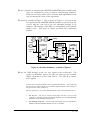
block diagram
The operation of a delta modulator is to periodically sample the input message, to
make a comparison of the current sample with that preceding it, and to output a
single bit which indicates the sign of the difference between the two samples. This
in principle would require a sample-and-hold type circuit.
De Jager (1952) hit on an idea for dispensing with the need for a sample and hold
circuit. He reasoned that if the system was producing the desired output then this
output could be sent back to the input and the two analog signals compared in a
comparator. The output is a delayed version of the input, and so the comparison is
in effect that of the current bit with the previous bit, as required by the delta
modulation principle.
122 - D1
Delta modulation