1
WSTP 4.1 Manual
8
2. GENERAL BACKGROUND ON MOTOR SKILLS LEARNING
Education can include one or more of three domains – knowledge, skills and attitudes. All three are
relevant to wheelchair skills training. However, in this Manual, we will focus primarily on motor
skills. A motor skill is one that is voluntary, observable, has been learned and has a goal. Motor
skills have been classified on the basis of the size of the muscle groups involved (gross versus fine),
on the basis of whether they are discrete tasks or more continuous ones, and on the basis of how
stable the environment is (open versus closed).
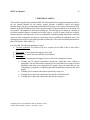
In the context of the WSP, there are three components of the education process – objectives,
curriculum and evaluation. These are conceptually linked in the “circle of education”. Evaluation
provides a baseline and a means of identifying goals and objectives. The curriculum is used to
accomplish the objectives. This is followed by re-evaluation, to determine if the objectives have
been fully met. If not, the objectives are reviewed and, if appropriate, the cycle continues.
The issues presented in Section 3 are based on the extensive motor-skills-learning literature and on
our own experience with the WSP. The motor skills literature is extensive, with over 500 Englishlanguage papers published per year. Section 3 is not intended to be a treatise for researchers. It is our
attempt to synthesize the aspects of this literature that are most relevant to the learning of wheelchair
skills. We have attempted to express these principles in language that the average educated, but not
necessarily professional, trainer and learner might understand. For those seeking a more scholarly
and thorough source, we suggest Richard A. Magill’s excellent textbook (Motor Learning and
Control: Concepts and Applications. 9th Edition. McGraw-Hill, New York, 2011). Although there is
a great deal of scientific evidence underlying these principles, the principles themselves are fairly
simple. We strongly believe that trainers and/or learners who understand and apply the principles
summarized in Section 3 will be more effective than those who do not.
In addition to the general principles summarized in Section 3, more specific “training tips” are
included with the individual skills later in Section 7. These have been derived from a number of
excellent sources in the rehabilitation and wheelchair literature, as well as from our own experience.
Originally approved for distribution and use: March 14, 2008
Current edition: WSTP Version 4.1.49, April 11, 2012.