1
Brix/RI-Chek
CLEANING PRECAUTIONS:
1. Never use any harsh cleaning agents that will damage the
instrument.
2. Strong solvents should never be used. Such chemicals will
deteriorate the prism seal and attack individual component parts of the instrument which will adversely affect or destroy the
instrument.
User Guide
CALIBRATION:
INTRODUCTION:
We at Reichert Analytical Instruments would like to extend our
appreciation to you for purchasing this refractometer. It is our mission
to provide a quality product at a very competitive price to our end
users and we feel this instrument will prove its value time and again
to you.
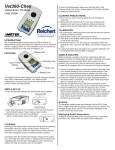
Sample Well
FEATURES:
5 Character
LCD
Read Key
Calibrate Key
Scale Key
Battery Door
SIMPLE SET UP:
1. Insert the included batteries with positive side facing outward.
1. Be sure that the measuring surface and well are clean as outlined under the “Cleaning” section.
2. Apply distilled water to the measurement surface.
3. Allow time for the distilled water sample to temperature equilibrate to that of the instrument.
4. Press and hold the “CAL” key until CAL is displayed. While still holding the “CAL” key press the “READ” key and then release both keys.
5. A series of dashed lines will appear and successful calibration will be indicated when the word END is displayed.
SAMPLE ANALYSIS:
Before analyzing a sample, it should be noted that to attain the
greatest accuracy the refractometer should be calibrated at the same
temperature as the envirnoment that it will be used in. As an
example; if the environment that the instrument is being used in
changes by five degrees, then the instrument should be re-calibrated.
1. Inspect the glass measuring surface and well to be sure that there is no residue remaining from a previous sample analysis. If the
measuring surface and well does not appear to be clean, then refer to the cleaning section of this user guide before proceeding.
2. Extract the sample to be tested and apply adequate sample to the sample well to completely cover the glass measuring surface. Minimum sample size is 0.3 mL.
3. Allow the sample time to reach the same temperature as the instrument. Failure to do so will result in inaccurate measurement.
4. Press the “READ” key and note the displayed value and the
position of the annuciator. The annunciator should be located below the fluid scale that you are attempting to attain a reading for.
If the position of the annunciator is not located under the desired scale, then press the “SCALE” key until the annuciator position indicates the correct scale.
SCALES:
2. Align small mark found on the battery cover with mark found on
the instrument body and insert cover as shown above.
3. Rotate the cover in the clock wise direction
until it is in the position shown to the right.
To change the reading scale between Brix-TC, RI-TC and RI, press
the “SCALE” key to toggle through those choices. The annuciator
displayed on the screen denotes the active scale.
Displaying Actual Temperature:
To display the temperature at the measuring surface, momentarily
press the “CAL” button while the sample value is displayed.
AUTOMATIC TEMPERATURE COMPENSATION:
CLEANING:
Cleaning of the measurement surface and well should be performed
immediately after each sample reading. Never immerse the
instrument in any liquid. When the measurement surface and well
have been completely cleaned no residue should be present.
To properly clean the sample well and glass measurement surface
use a mild soap and water solution or Isopropyl Alcohol followed by
a distilled water rinse and then thoroughly dry with a soft lint and
residue free cloth or a product such as Kimwipes®.
To clean the refractometer’s body use a soft cloth with a mild
cleaning solution like window cleaner applied to the cloth and follow
by wiping the instrument dry.
Automatic temperature compensation corrects readings over a range
of temperatures. As an example: Samples taken within the working
temperature range of the instrument are corrected to a reference
temperature of 20 degrees C. Temperature correction is essential
because refractive index varies inversely with temperature. This feature is used in lieu of temperature control of the prism and sample.
For this feature to be effective however it is necessary to allow the
sample to temperature equilibrate to the ambient temperature of the
prism. Without allowing for temperature equilibration of the sample
the read values will not be accurate since the sample will be in a
state of temperature and refractive index change.
The built in temperature compensation mode is based on the temperature coefficients of sucrose per the ICUMSA scales. When readings
are taken in the nD-TC scale, the values will only be valid for water
soluable solutions.
TEMPERATURE COEFFICIENT CALCULATIONS:
For non-sucrose based samples, should you need to temperature
correct the value, visit our web site at www.reichertai.com. Please
download a copy of “Temperature Coefficient Calculation and Temperature Correction” found under the “APPLICATION” section of our
site.
ERROR CODES:
Err01 - No sample present. Add sample.
Err02 - Inadequate sample. Add additional sample.
Err03 - Sample exceeds the refractive index reading range.
Err04 - Sample temperature has not equilibrated. Allow more time for temperature equilibration.
Err05 - Excessive ambient light. Cover sample well when reading.
Err06 - Excessive ambient light. Cover sample well when reading.
Err07 - Positive calibration error. Re-calibrate with distilled water.
Err08 - Negative calibration error. Re-calibrate with distilled water.
Err09 - Poor sample condition. Sample may not be able to be read.
Err10 - Sample type may not be able to be read.
Err12 - Index of sample is out of range of instrument.
Err5X - For any errors in this series contact Reichert Analytical
Instruments for technical assistance.
BATTERY CONDITION:
The following display examples represent either a low battery condition or an extremely low battery condition where the instrument will
no longer operate properly. In either case the batteries should be
promptly replaced.
Battery condition low.
Replace Batteries.
Battery condition extremely low.
Replace Batteries.
SPECIFICATIONS:
Catalog 13940000
RI Range - 1.3330 - 1.4465, Accuracy +/- 0.0002
BRIX Range - 0 - 62%, Accuracy +/- 0.2%
Auto Temperature Compensation - 20o C RI and BRIX
Calibration - Distilled Water
Prism - Glass
Illumination - 589nm LED
Dimensions - 54 x 27 x 100 mm / 2.13 x 1.06 x 3.9 inches
Power - 2 AAA Batteries, included.
Battery life - 10,000 readings, Auto Off Sleep Mode.
Ratings - IP65 Dustproof/Water Resistant, CE, RoHS, and WEEE compliant.
Reading Modes - Brix-TC = Percent sucrose in aqueous solution at 20 Degrees C.
RI-TC = Refractive index temperature corrected to 20 degrees C.
RI = Refractive index
Warranty - One year against manufacturing defects. Evidence of tampering voids warranty.
Reichert Analytical Instruments
3362 Walden Ave
Depew, NY 14043
USA
Toll Free: 888-849-8955
Phone: 716-686-4500
email: [email protected]
www.reichertai.com
Reichert GmbH
Hubertusstrasse 2
D-82229 Seefeld
Germany
Tel: +49-8152-993530
ISO-9001 Certified
13940000-101 REV E