1
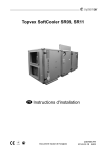
Complete cooling unit for DVCompact
DVCompact Softcooler 20-DVCompact
Softcooler 80
Installation and Service
Document in original language
-EN_GB
04-02-2014 A001
Contents
1 Declaration of Conformity ........................................................................................................... 1
2 Warnings................................................................................................................................... 2
3 Description of DVCompact Softcooler.......................................................................................... 3
3.1 DVCompact Softcooler Cooling section.............................................................................. 3
3.1.1 Batteries................................................................................................................. 3
3.1.2 Compressor(s)........................................................................................................ 3
3.1.3 Refrigerant ............................................................................................................. 3
3.1.4 Control panel and automatic controls........................................................................ 4
4 Function principle....................................................................................................................... 4
4.1 Function and content ........................................................................................................ 4
4.2 Other regulation ............................................................................................................... 5
5 Installation................................................................................................................................. 5
5.1 Assembly......................................................................................................................... 7
6 Positions and placement ............................................................................................................ 8
6.1 Positioning of compressors ............................................................................................... 8
7 Electrical connection .................................................................................................................. 8
7.1 Rotational direction of compressor(s)................................................................................. 9
8 Commissioning .......................................................................................................................... 9
8.1 Before start-up ................................................................................................................. 9
8.2 Control of DVCompact Softcooler ......................................................................................10
8.2.1 General ..................................................................................................................10
8.2.2 Power control .........................................................................................................10
8.2.3 Power limitation ......................................................................................................10
8.3 Forms of temperature regulation........................................................................................10
8.4 Other DX functions ...........................................................................................................10
9 Service and maintenance ...........................................................................................................11
9.1 Cooling-technical maintenance..........................................................................................11
9.2 Electronic expansion valve................................................................................................11
9.3 Other maintenance ...........................................................................................................11
10 Troubleshooting .......................................................................................................................12
10.1 Diagrams .......................................................................................................................12
10.2 Settings .........................................................................................................................12
10.2.1 High exhaust temperature or insufficient air volumes ...............................................12
10.3 Electrical faults ...............................................................................................................13
10.4 Faults in cooling technology ............................................................................................13
1 Declaration of Conformity
Manufacturer
Systemair AB
Industrivägen 3
SE-739 30 Skinnskatteberg SWEDEN
Office: +46 222 440 00 Fax: +46 222 440 99
hereby confirms that the following products:
Air handling units
DVCompact Softcooler 20
DVCCompact Softcooler 25
DVCompact Softcooler 30
DVCompact Softcooler 40
DVCompact Softcooler 50
DVCompact Softcooler 60
DVCompact Softcooler 80
(The declaration applies only to product in the condition it was delivered in and installed in the facility in accordance
with the included installation instructions. The insurance does not cover components that are added or actions
carried out subsequently on the product)
Comply with all applicable requirements in the following directives
• Machinery Directive 2006/42/EC
• Low Voltage Directive 2006/95/EC
• EMC Directive 2004/108/EC
The following harmonized standards are applied in applicable parts:
EN ISO 12100-1
Safety of machinery – Basic concepts, general principles for design – Part 1: Basic
terminology, methodology
EN ISO 12100-2
Safety of machinery – Basic concepts, general principles for design – Part 2:
Technical principles
EN ISO 14121-1:2007
Safety of machinery – Risk assessment – Part 1: Principles
EN 13857
Safety of machinery – Safety distances to prevent hazard zones being reached
by upper or lower limbs
EN 60 335-1
Household and similar electrical appliances – Safety Part 1: General requirements
EN 60 335-2-40
Safety of household and similar electrical appliances - Part 2-40: Particular
requirements for electrical heat pumps, air-conditioners and dehumidifiers
EN 50 106
Safety of household and similar appliances – Particular rules for routine tests
referring to appliances under the scope of EN 60 335-1 and EN 60967
EN 60 529
Degrees of protection provided by enclosures (IP Code)
EN 61000-6-2
Electromagnetic compatibility (EMC) – Part 6-2: Generic standards – Immunity for
industrial environments
EN 61000-6-3
Electromagnetic compatibility (EMC) – Part 6-3: Generic standards – Emission
standards for residential, commercial and light-industrial environments
The complete technical documentation is available.
Skinnskatteberg, 31-08-2012
Mats Sándor
Technical Director
Complete cooling unit for DVCompact
Installation and Service
1
Systemair AB
2 Warnings
Danger
The cooling unit can cause personal injury if installed or used incorrectly. Read the documentation for
the product carefully before it is installed or commissioned.
• Inspection doors must always be closed and locked with the corresponding key when the voltage is
on. Under no circumstances may the box be left with the door unlocked.
• Any work on the product should be carried out by knowledgeable and authorised service personnel.
• When carrying out work/service on the cooling circuit(s), the power must be disconnected, and the
work only performed by authorised personnel.
• Delivery pipes are hot during and after operation, and contact with bare skin may cause burn injuries.
• The refrigerant for this cooling unit is R410A and cannot be replaced with any other type of refrigerant
without written approval from the supplier.
• The refrigerant must under no circumstances be released into the environment.
• As the refrigerant is heavier than air, the refrigerant may displace the air and cause asphyxiation in
unfavorable conditions.
Warning
There may be serious mechanical, electrical, noise or vibration hazards associated with using the
equipment contained in the unit. In order to reduce the risk of these hazards, it is absolutely necessary
to observe all regulations that apply to safety, installation, operation and maintenance.
For safety reasons, only personnel with relevant technical competence may perform installation work.
The installation instructions supplied must be followed.
The unit is not to be taken into operation before all protective devices are in place and function tested.
Any air intake and air exhaust must be protected with grilles.
No maintenance work may be carried out and no inspection doors may be opened before the unit is
switched off and isolated from the power supply. You must ensure that rotating parts have stopped and
the electrical battery’s heating rods have cooled.
Service switches are locked to prevent unauthorised start-up during maintenance work. Where
condensation water needs to be drained away, correct connection to the drain must ensure this. The
installer must equip the unit with operating and maintenance instructions.
These safety regulations only apply to products supplied by Systemair LT. It is the installer’s
responsibility to carry out a comprehensive safety assessment of the unit, as well as preparing safety
regulations so that that user is able to secure the unit such that it does not cause harm to people,
animals, material or environment. If there is any doubt about how to interpret the regulations covering
safety, installation, operation and maintenance, it is of the utmost importance that advice is sought
from Systemair LT or its distributors.
Complete cooling unit for DVCompact
Installation and Service
2
Systemair AB
3 Description of DVCompact Softcooler
3.1 DVCompact Softcooler Cooling section
The DVCompact Softcooler cooling section is a complete unit with integrated cooling. In other words,
all electrical and pipe work is completed at the factory. The enclosures are in the same design as the
DVCompact unit series, i.e. 50 mm Rockwool in a sandwich construction consisting of two aluzinc 185
steel plates. (Corrosion class C4.)
On the front of DVCompact Softcooler there is a large door for easy access to the components. There is
also an integrated window and control panel door for easy access and inspection during operation. The
sections come in seven different sizes and 12 power variants, all DVCompact compatible.
3.1.1 Batteries
The batteries are already fitted in the box with all pipe connections complete. Evaporator and condenser
batteries are mounted on the same side in the box, so that the piping between the batteries is tidy and
service-friendly in terms of access during a service. The batteries fit the unit’s cross-section and use
all available area in the air flow. This ensures low speed and low decrease in pressure. Carry-over of
condensation is thus eliminated.
The DX battery is placed in a drip tray to drain condensation. The tray has an external connection for a
drain trap.
Caution
It is important that the supplied drain trap with ball is fitted before commissioning.
3.1.2 Compressor(s)
From size DVCompact Softcooler 20 and up to DVCompact Softcooler 50 (Power variant 1) a
frequency-controlled compressor is supplied. On the largest variants, from DVCompact Softcooler 50
(Power variant 2) toDVCompact Softcooler 80, two compressors are supplied: one frequency-controlled
and one fixed level. The compressor types used are Scroll compressors from Copeland.
3.1.3 Refrigerant
The refrigerant used for DVCompact Softcooler is R410A. This is initially filled at the factory, and the
relevant quantity is indicated on the cooling section. A long-term test is carried out with a vacuum to
ensure that the cooling circuits are completely free of leaks before refilling with R410A.
Complete cooling unit for DVCompact
Installation and Service
3
Systemair AB
3.1.4 Control panel and automatic controls
The automatic controls cabinet is supplied as an integrated part of the cooling box, with a door for
inspection and service work. This is possible to access during normal operating conditions for the unit.
There are also nipples for refilling and checking the pressures in the cooling circuits. The cabinet is
equipped with an approved control panel lock and must only be opened by authorised personnel. The
frequency converter is positioned in the unit section that allows reading through a window in the door.
4 Function principle
2
1
7
6
8
9
10
5
3
4
10
4.1 Function and content
The main components of the cooling system are:
1. Condenser battery
2. Evaporator battery
3. Compressor
4. High pressure switch
5. Low pressure switch
6. Electronic expansion valve
7. Filter drier
8. Sight glass
9. Ball valve
10.Angle valves
Complete cooling unit for DVCompact
Installation and Service
4
Systemair AB
The cooling process is either carried out using one compressor or with two, of which one is
frequency-controlled. When required, one of the compressors starts so that the refrigerant is compressed
and transported to the condenser; the refrigerant is cooled in the condenser using extract air and then
takes on liquid form. The (R410A) then continues to the expansion valve, and reduces pressure and
temperature over that, before continuing to the evaporator (DX battery). The liquid evaporates in the DX
battery and simultaneously cools the external air. The refrigerant then moves on to the suction side of the
compressor and the process is repeated. If there is a greater need for cooling, the second compressor
starts, following an equivalent process.
4.2 Other regulation
DVCompact Softcooler is always equipped with a frequency-controlled compressor, i.e. the cooling effect
is adapted to the need, either due to variable (low) air volumes or variable (low) outdoor temperatures,
or a combination of these. This ensures a more stable operation and energy-saving cooling in relation
to ON/OFF solutions. The frequency converter allows a compressor regulation range of between 30
and 60 Hz; this gives a cooling effect capacity regulation of 50%. Regulation of the compressor(s) is
thus as follows:
At a given outdoor temperature and when there is a need for cooling in the premises, a start signal will
be given to the frequency converter (pot. free) from the cooling outlet on the automatic controls. The
compressor starts and regulates quickly up to 60 Hz before it immediately begins to adjust the frequency
downwards as required from the control (0–10 V signal). When there is an increasing cooling need, the
compressor gears up to the maximum, before the next compressor gets the start signal.
The frequency-controlled compressor will then sink to a minimum and sit and regulate accurately
according to the cooling need.
For all functions linked to the forms of regulation and settings, see chapter 8 in this document.
In case of alarm, either from the pressostats or frequency converter, an indication will be given in the unit
display: Operating fault cooling.
In case of alarm, see chapter 10 in this document.
5 Installation
Note:
These installation instructions are only a supplement to the DVCompact installation instructions; see
our website.
DVCompact Softcooler cooling box is either supplied with fitted legs or on a pallet, depending on size.
Be particularly aware that the cooling section may have a high centre of gravity if the compressor is
positioned at the top of the cooling section.
Complete cooling unit for DVCompact
Installation and Service
5
Systemair AB
When lifting with forklift trucks or pallet jacks, ensure that the forks go under the entire length of the box,
otherwise the underside of the box may be damaged. When using a crane, straps must be secured to legs
or any pallets; it is important that the straps do not slip during lifting.
Caution
As for all equipment with electrical components, it is important that the cooling section is not stored
outdoors. Water and condensation may, in the worst case, lead to full short circuit and breakdown when
the power is connected. If the unit must be stored outdoors, ensure that it is protected against rain and
allow air to circulate to prevent condensation.
Complete cooling unit for DVCompact
Installation and Service
6
Systemair AB
5.1 Assembly
Fitting of the cooling section to other units is carried out using disc-lock, and assembly fittings for the
largest; see details in the installation instructions for the unit.Parts for assembly are supplied with the unit
and are found with other parts (drain trap, handle, etc.) in a box. It is important to make sure that the
packing between the parts is in place and wires/plugs are not crushed. Snap-on connectors can also be
connected together at the same time.
For service/inspection, a minimum measurement is required in front of the unit, corresponding to the door
width of the box. When replacing batteries, a measurement corresponding to the depth of the unit is
required. It is important to make sure that the back edge of the unit is not in contact with the wall in order
to avoid transferring noise/vibrations.
Fit the handle supplied.
Also remember to fit the drain trap supplied. This is equipped with a water trap so that the height from the
drain to the floor is taken care of with either the supplied feet or base frame.
Caution
It is important to make sure that the unit is completely level after installation, so that the condensation
water is drained from the tray. It is also important that the cooling section is not tilted more than 30°
during the entire transportation and installation process.
Complete cooling unit for DVCompact
Installation and Service
7
Systemair AB
6 Positions and placement
DVCompact Softcooler must always be placed on the warm side of the rotor. In other words, the cooling
section has to be placed between the rotor box and supply air fan box. DVCompact Softcooler is produced
in four positions: supply air down, right and left, and supply air up, right and left.
See below for variations:
Supply air down (cooling section marked)
Supply air left
Supply air right
Supply air up
Supply air left
Supply air right
6.1 Positioning of compressors
The compressor(s) always end up in the exhaust section. This is a great benefit as you then have good
access to the compressors from the filter side, regardless of the position of the unit.
7 Electrical connection
All electrical work requires a qualified electrician. DVCompact Softcooler is delivered completely wired,
which means that the electrician is only required for connection to the mains. DVCompact Softcooler
is delivered in all sizes, with an external safety switch, which cuts all phases and power supply when
switched off. This is the connection point for the electrician. The safety switch is not fixed in place on
delivery due to transport. The safety switch must be fitted on the front of the large cooling units, and on the
roof of the smaller ones. Wires from the cooling section are routed to the safety switch.
Warning
Make sure that the voltage in the building is checked against the marking on the unit.
Voltage is either 3-phase 230 V or 3-phase 400 V. An N-conductor must be used with 400 V. Connection
is made for Cu wire; when feeding with AI, an AI/Cu transition is used. Depending on local rules
and regulations, correctly dimensioned earth-fault switches must also be used on power circuits for
DVCompact Softcooler. Earth-fault switches must be at least 100mA, and one attribute must be adapted
to frequency converter operation (EMC-filter must be removed).
Complete cooling unit for DVCompact
Installation and Service
8
Systemair AB
7.1 Rotational direction of compressor(s)
Caution
When connecting power, it is important that an electrician first checks that the phases are in the right
place. It is only necessary to check this on Softcooler Compact with two compressors; here the phase
guard ensures that the compressor works in the right direction. This can be checked easily after the
power has been connected by seeing whether the phase guard has triggered relay output at point 11
and 14, or that relay 7k02 has kicked in. This relay must always be “in” when the power supply is
connected. Phases are switched if this does not happen.
On DVCompact Softcooler with one compressor, the rotational direction of the compressor is taken care of
using a frequency converter and rotational direction is independent of the phases of the main switch.
An electrician must also check the snap-on connectors between unit sections are in place. These are
checked simply by opening doors and checking that all plugs are fitted between the modules.
Note:
Unit, DVCompact Softcooler and any electrical batteries are made for separate power supply, which is
basically sensible considering that these are high currents and require cables with a large cross-section.
However, if desirable, it is possible to pull one main cable out and divide conduits at the unit. Dimensioning
of the conduit can also be drawn according to either the unit + electrical battery or unit + DVCompact
Softcooler, or according to which has the greatest power. This is possible as there is never simultaneous
acceleration for the electrical battery and cooling.
8 Commissioning
8.1 Before start-up
• Power and snap-on connectors in place.
• Correct voltage connected.
• Safety switches and fuses on.
• Visual check of the unit, no loose objects, everything electric connected.
• Drain trap fitted.
Complete cooling unit for DVCompact
Installation and Service
9
Systemair AB
8.2 Control of DVCompact Softcooler
The DVCompact Softcooler cooling section is controlled as needed from the regulator on the unit.
DVCompact is supplied with a Corrigo E28 regulator. Functions for control of DVCompact Softcooler are
set in the regulator at the factory. Similarly, there are settings that shall and must be carried out on
commissioning. These settings can be made with the supplied control display, or by connecting to a PC
and using E-tool, which is a free PC configuration tool. This can be downloaded from our website.
Note:
This document refers only to the overview of possible functions and settings that apply to cooling.
Detailed descriptions of how you find these functions are available in the “Operating and maintenance”
instructions for the unit.
8.2.1 General
Control unit E28 (UC) senses the temperature via the extract temperature sensor (ETS) and then keep
the set extract temperature by sequense controlling the compressor (CPR), heat exchanger (HE) and
hot water-/electrical heater (HWL/H, ELH). The temperature sensor in the supply air (SS) is min. and
max. limiting the supply air temperature.
8.2.2 Power control
The compressor (CPR) are step-less controlled between, in the frequence converter (FC), set minimum
and maximum frequency.
8.2.3 Power limitation
The frequency converter (FC) is continouously sensing the condensing pressure via the high pressure
sensor (HPS) and gradually slows down the speed of the compressor (CPR), if the pressure exceeds
the set limiation value. This is done to avoid a high pressure alarm.
8.3 Forms of temperature regulation
It can be good to start with which form of regulation you require. Here are the possible forms of regulation
from which you can choose:
• Extract air control (factory standard)
• Cascade room temperature control (room control)
1
• Outdoor temperature-controlled exchange between room control and supply air control.
1
Outdoor temperature-controlled exchange between extract air control and supply air control.
1.
One or two room sensors must be mounted
These functions can be chosen freely. Constant supply air control must not be used during cooling. All
required set points for temperature are set according to the selected form of regulation.
8.4 Other DX functions
• Blocking of DX using the outdoor temperature.
• Blocking machines when there is low fan acceleration e.g. low airflow.
• Own set point for minimum supply air with active DX.
• Exchange control form using outdoor temperature.
• Delayed connection and disconnection of DX machines.
• Option for setting of P and I time for temperature.
Complete cooling unit for DVCompact
Installation and Service
10
Systemair AB
With sensible selection of functions and set points you ensure problem-free operation and cooling on
demand, thanks to the compressor frequency control. Demand control also ensures that you do not have
to activate the uneconomical compensation with rotors that some single ON/OFF compressors need
to maintain the minimum temperature.
9 Service and maintenance
Warning
Before you begin maintenance, make sure that the voltage to the unit is switched off. All maintenance
must be carried out by authorised personnel. All maintenance and service relating to cooling technology
must be carried out by an authorised cooling company.
9.1 Cooling-technical maintenance
An annual inspection, service and check of the cooling technology is required. This needs to be carried
out more often in relation to any special conditions to which the unit is exposed. This is a requirement
for the warranty conditions to be valid.
Suggestions for checks may include:
• Drain trap and draining from tray.
• Any abnormal noises from the compressor(s).
• Loose clamps for fastening pipes and components.
• Oil leaks from pipes or compressor(s).
• General cleaning, vacuuming and if necessary washing using detergent.
• Any corrosion on soldering or pipes.
• Checking for leaks in the cooling circuit.
• Connection of manometer for reading pressure.
• Any refilling with refrigerant R410A.
• Visual checks in sight glass.
• Any replacement of dry filters.
A manometer can be connected from the control panel during operation to achieve normal operating
conditions. Detailed written reports must be made and handed to the person responsible for keeping a log.
9.2 Electronic expansion valve
The expansion valve is one of the most important components of the cooling system. This is adjusted at
the factory and superheating lies between 4–6 K.
Warning
If there are any leaks in the refrigerant circuit, Systemair must be contacted for further handling.
9.3 Other maintenance
DVCompact Softcooler does not require any maintenance other than the annual service. During this
service, things to be checked in addition to the cooling technology should include:
• Tightening of clamps in the cabinet.
• Measuring power consumption.
• Cleaning.
Complete cooling unit for DVCompact
Installation and Service
11
Systemair AB
• Review settings and set points.
• Check vibration dampers.
Warning
Frequency converters must not be touched normally. Converter settings are made at the factory, and it
is important that the parameters are not changed without consultation with Systemair. This could have
critical consequences for compressors and the warranty may be invalidated.
Also see the more detailed maintenance instructions supplied with the unit. All technical data for
DVCompact Softcooler is supplied and is stuck to the inside of the control panel cabinet. The test diagram
from the factory, instructions for installation, maintenance and operation, connection diagram and other
documents are also supplied with the unit in a plastic wallet.
10 Troubleshooting
10.1 Diagrams
For troubleshooting use the supplied connection diagram;.
Potential faults are divided into four main categories in practice:
• Incorrectly set parameters and set points on commissioning.
• Insufficient air volume or abnormally high exhaust temperatures.
• Electrical faults.
• Faults in the cooling technology.
As a starting point, it is sensible to begin with the first two categories.
10.2 Settings
See chapter 8 for all setting options for cooling. It may, for example, be the outdoor temperature that is
preventing the cooling machine kicking in.
To be able to localise the fault easily, ensure that there is a cooling need by turning down the desired
exhaust/room temperature. After a while the k4.6 relay or k4.7 relay should kick in. (Cooling levels 1
and 2.) If they do not, there is a setting that is preventing the regulator from kicking in the cooling. See
“DVCompact Operating and maintenance”. Also check that the analogue output (0–10 V) increases with
the cooling need. If the relay(s) kick in, but the compressor does not start, the fault is located in the cooling
box or cabling between this and the unit cabinet.
10.2.1 High exhaust temperature or insufficient air volumes
Check the technical calculations for the unit and see which air volumes the unit is calculated for. The
problem that may occur is that the condenser cannot get rid of the excess heat, and the high-pressure
pressostat trips. Increase the set air volume, or with variable air volumes (VAV) block cooling when
there is low fan acceleration. This is a setting that can be made on the control. The temperature of the
exhaust is, as a starting point, dimensioned for max. 254 °C to the condenser; at higher temperatures the
cooling capacity is gradually reduced by the control to avoid that the unit is stopped by the high-pressure
pressostat. Significantly higher temperatures can lead to problems. The same problem solution as above.
Also activates summer-night cooling to bring down the temperature in the building using cool night air so
that the building has a low indoor temperature in the morning. This is also sensible in terms of energy use
instead of loading the cooling machines with full acceleration on start-up in the morning.
Complete cooling unit for DVCompact
Installation and Service
12
Systemair AB
10.3 Electrical faults
If the k4.6 relay and possibly k4.7 relay have been triggered in the unit cabinet, but the compressor(s) do
not start, check the cabling and that the snap-on connectors between the unit sections are connected.
The control for the cooling equipment is located in the cooling box; check that operation/alarm relay 7k02
kicks in. This should kick in when voltage is switched on. If this does not kick in, the fault is located
in the following:
• High-pressure pressostat.
• Low-pressure pressostat.
• Fault output on converter.
High-pressure pressostats and low-pressure pressostats have an automatic reset. Also check whether
there are any fault alerts in the converter display; see the manual supplied for this. If the relay has kicked
in, and there is still no operation, check the start relay(s) for the compressor(s); these are marked 7k01
and 7k2. These kick in according to cooling need, and follow the named relays in the unit cabinet (k4.6
and k4.7). Check the relay and cabling to these in the event of faults. If they kick in and the compressor(s)
do not operate see chapter 10.4.
10.4 Faults in cooling technology
Important
Before carrying out any work on the cooling technology within the warranty period, Systemair must be
contacted first, if necessary with any requests for covering costs.
Only authorised cooling companies may carry out work on the cooling circuit. A manometer should be
connected and the pressure checked. The temperatures of the different processes are also checked.
Typical faults may be:
Compressor cuts out at low-pressure pressostat:
• Not enough refrigerant
• Insufficient air volume
• Electronic expansion valve defect
• Pressostat defect
Cuts out at high-pressure pressostat:
• Too much refrigerant
• High exhaust air temperature
• Pressostat defect
Freezing of evaporator:
• Electronic expansion valve defect
• Not enough air to the battery
A leak search is to be carried out when leaks are suspected, and during the annual inspection.
Complete cooling unit for DVCompact
Installation and Service
13
Systemair AB
lastpage
Systemair AB reserves the right to make changes and improvements to the contents
of this manual without prior notice.
Systemair AB
Industrivägen 3
SE-739 30 Skinnskatteberg, Sweden
Phone +46 222 440 00
Fax +46 222 440 99