1
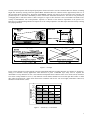
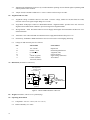
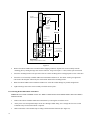
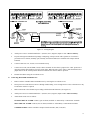
Figure 16 – Wiring Diagram
4.
Attach power wires to terminal identified as + (Positive) and - (Negative) Input 12 VDC. Observe Polarity.
5.
For protection against unauthorized openings or tampering, a tamper switch with a separate set of contacts is
provided. Form C contacts (normally open, normally closed and common) are available at the Tamper Switch
terminals.
6.
Connect remote test wire, if used, to Test terminal on strip.
7.
Connect wires to HI, LO and GND, if used, at Slave terminals. Set the “Phase” jumper to the “OFF” position or if
using the external clock (SMC10) set to the proper phase. When the unit is in the “Slave” mode the channel select
jumper must be in the external position. Refer to Technical Note 454 for SMC10 operation.
8.
Reinstall the radome using the six radome screws.
E. Connecting Model 300B-33252R Receiver
1.
Remove radome of Model 300B-33252R Receiver by removing the six-radome screws.
2.
Insert power wires and alarm circuit wires through conduit fitting. Leave enough slack in wires so that Receiver may
be tilted after radome is replaced.
3.
Make connections to the terminal strip according to labeled terminal functions. (See Figure 16.)
4.
Attach power wires to terminal identified as + (Positive) and - (Negative) Input 12VDC. Observe Polarity.
5.
Attach alarm circuit wires as follows:
CLOSED CIRCUIT ALARM: contacts (open on alarm) available at “Alarm Relay” COM and NC terminals.
OPEN CIRCUIT ALARM: contacts (close on alarm) available at “Alarm Relay” COM and NO terminals.
TAMPER ALARM: contacts available at Tamper Switch terminals. (NO, COM, NC).
15