1
54
Basics
Chapter 2
Intrinsic (Random) Noise Sources
Random noise finds its way into experiments in a variety of ways. Good experimental
design can reduce these noise sources and improve the measurement stability and
accuracy.
There are a variety of intrinsic noise sources which are present in all electronic signals.
These sources are physical in origin.
Johnson Noise
Every resistor generates a noise voltage across its terminals due to thermal fluctuations in
the electron density within the resistor itself. These fluctuations give rise to an opencircuit noise voltage,
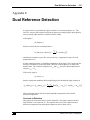
Vnoise (rms) = 4kTR∆f
where k=Boltzmann's constant (1.38x10⁻²³ J/K), T is the temperature in kelvins (typically
300 K), R is the resistance in ohms, and ∆f is the bandwidth in hertz. ∆f is the equivalent
noise bandwidth of the measurement.
Since the input signal amplifier in the SR865 has a bandwidth of approximately 3 MHz,
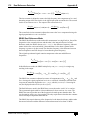
the effective noise at the amplifier input is Vnoise = 220√R nVrms or 1.1√R μV pk–pk.
This noise is broadband and if the source impedance of the signal is large, can determine
the required Input Range of the lock-in.
The amount of noise measured by the lock-in is determined by the measurement
bandwidth. Remember, the lock-in does not narrow its detection bandwidth until after the
phase sensitive detectors. In a lock-in, the equivalent noise bandwidth (ENBW) of the
low pass filter (time constant) sets the detection bandwidth. In this case, the measured
noise of a resistor at the lock-in input, typically the source impedance of the signal, is
simply
Vnoise (rms) = 0.13 R ENBW nV
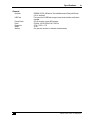
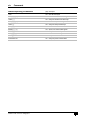
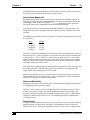
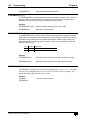
where R is in ohms and ENBW is in hertz. The ENBW is determined by the time
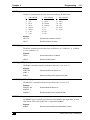
constant (T) and slope as shown below (for normal RC type filters).
Slope
6 dB/oct
12 dB/oct
18 dB/oct
24 dB/oct
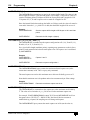
SR865 DSP Lock-in Amplifier
ENBW
1/(4T)
1/(8T)
3/(32T)
5/(64T)