1
REPLACING A BURNT-OUT DIVIDER WINDOW MOTOR
By David Chrestenson, Oswego, IL
Goshawk Society
determined by reversing the ground and
positive between the two wires.
While restoring my 1937 25/30 Hooper
limousine, GRP72, I discovered that the power
lift of the divider window was inoperative.
Taking off the wood panel displayed a solidly
built electric motor, and a wiring board with
terminals and two relays. A three-way switch
(off, raise, and lower) operated the
arrangement. Closer examination showed that
the switch operated the two relays, one for each
direction, used to carry the current required for
the motor.
The motor, manufactured by
Klaxon, was built solidly enough to survive a
drop from a space station, but had burnt out.
What to do?
After drawing several
complicated schemes using relays, wiring
boards etc to make the 2-wire motor work, I
was browsing the web for a battery cutoff
switch, and by sheer serendipity found the ideal
solution. It was a black box designed to open
and close trunk lids and the like on street rods.
It carried the full motor current load, and
eliminated all the complications.
The unit is made by Hotronics.
For
specifications and a more complete description,
go to http://www.hotronicsproducts.com/, and
search for “Motor Control with Limit
Switches”. The cost was only $89.
As the quote for rewinding neared four digits,
an alternative was necessary. After some
serious thinking, a trip to the local auto
junkyard located an old Chrysler two-door with
power windows. I bought the lift motors from
each window; one for use, and the other as
backup if the other was burnt out. These were
about half the size of the original, and needed
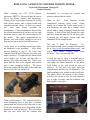
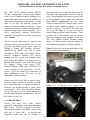
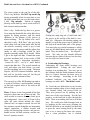
only a new mounting bracket. The photo
shows the original Klaxon unit on the right, and
the new Chrysler one on the left.
I wired the unit in, using a terminal strip to
avoid hard wiring in the box to the motor (in
case either the motor controller or the motor
itself failed, so the unit would be easy to
replace). It still took less space than the
original motor and does the job admirably. The
final installation was as neat as one could wish.
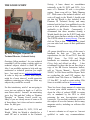
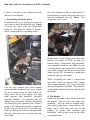
The photo shows the bottom of the divider,
with the new motor on the left, the controller
just to right of center, and the terminal strip
high up and to the right.
Then a problem arose. The original had three
wires emanating from it, one was a common
ground and the relays fed the plus side to one
of the two remaining wires, depending on the
direction of rotation desired. The new motor
had just two wires, and the rotation was
3