1
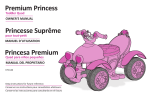
Princess
Scooter
KT1024WM
User Guide
Do Not Return to
Store. Call toll free
(877)741-6154
for assistance and
replacement parts.
Questions? Comments?
Missing Parts? Contact Us:
www.kidtraxtoys.com
(877) 741-6154
3 yrs
50 lbs
3 años 22.7kg
Visit Disney Princess at
DisneyPrincess.com
ADULT
ASSEMBLY
REQUIRED.
Spanish User Guide included.
Gu’a del usuario en espa–ol incluida.
©2008 Disney
All Rights Reserved.
Made in CHINA
www.kidtraxtoys.com
(877) 741-6154
Styles and colors may vary
Distributed by Pacific Cycle, Inc.,
4902 Hammersley Road, Madison, WI 53711, USA.
About Your New Electric Scooter
Thank you for purchasing this Electric Scooter. Kid Trax wants your child to enjoy this
product for years to come. Keep these points in mind as you read this guide:
s Scooter is recommended for children 3 and up. Maximum weight is
50 lbs. (22.7 kg).
s ADULT SUPERVISION REQUIRED!
s Battery must be charged prior to first use (see pages 4-5).
s Front wheel must be assembled properly (see page 6).
s Children must follow safety rules for riding (see page 9).
s Read and explain operating instructions to your child (see pages 10-11).
s ADULTS ONLY: Recharge battery according to directions (see pages 4-5) and
maintain battery (see page 12).
WARNING
FOR THE SAFETY OF YOUR CHILD, PLEASE READ ALL WARNINGS
AND ASSEMBLY/USE INSTRUCTIONS. KEEP THIS GUIDE FOR FUTURE
REFERENCE.
s ADULT ASSEMBLY REQUIRED. The product contains small parts,
which are for adult assembly ONLY. Keep small children away when
assembling.
s ALWAYS remove protective material and poly bags and dispose before
assembly.
CAUTION
s Park the Scooter indoors or cover it with a tarp to protect it from
wet weather. DO NOT leave vehicle in sun for long periods of time or
fading may occur. Store in shade or cover with tarp.
s DO NOT drive the Scooter in loose dirt, sand or fine gravel, which
could damage moving parts, motors or the electrical system, which
could void the warranty.
s DO NOT wash the Scooter with a hose. DO NOT wash the Scooter
with soap and water. DO NOT drive the Scooter in rainy or snowy
weather. Water will damage the motor, electrical system and battery.
Service and Repairs
s DO NOT return this product to the place of purchase.
s Lay out and identify all parts before assembly. If any parts are missing, call Pacific Cycle,
Inc. Consumer Relations at (877) 741-6154, or visit our web site at www.kidtraxtoys.com.
s Include the model number and manufacture date, found underneath the Scooter’s
body and a brief description of the part.
s If your Scooter needs service or repairs, call Pacific Cycle, Inc. Consumer Relations at
(877) 741-6154 for an authorized service center.
2
Parts List
C
F
B
G
D
A
M
L
K
H
E
N
I
J
NOTE: Date code is located on
bottom of product.
A Scooter Body
B Carrier Box
C Screws (4)
-Located in the Carrier Box
D Nuts (4)
E Charger
F Mirrors (right and left)
G Mirror Nuts (2)
H Front Wheel
I Hubcaps (2)
J Axle (with washers and nut attached)
K Large Washer (2)
L Small Lock Washer (2) -Loose on Axle
M Nut (2)
N Wrenches (2)
Tools Needed:
s Phillips head screwdriver
s Flat head screwdriver (to access battery)
s Two wrenches included (to secure front wheel)
3
Charge Battery Before Assembly
YOU MUST CHARGE THE 6-VOLT BATTERY FOR A “FULL” 24 HOURS PRIOR TO
ASSEMBLY. FAILURE TO CHARGE THE BATTERY AS DIRECTED WILL CAUSE
PERMANENT DAMAGE TO THE BATTERY AND VOID YOUR WARRANTY.
AFTER EACH USE, OR ONCE A MONTH MINIMUM, CHARGE THE BATTERY
FOR A “FULL” 16 HOURS. DO NOT LEAVE THE BATTERY ON THE CHARGER
FOR MORE THAN 30 HOURS. READ THE FOLLOWING WARNINGS BEFORE
CHARGING THE BATTERY.
WARNING
s PREVENT FIRE AND ELECTRIC SHOCK:
- Use ONLY battery and charger provided by manufacturer. Use of
the wrong type of battery for charger could cause a fire or
explosion.
- DO NOT use the battery or charger for any other product. Overheating,
fire or explosion could occur.
- NEVER modify the electric circuit system. Alterations could cause
a shock, fire or explosion.
- DO NOT allow any type of liquid on the battery or its components.
- Explosive gases are created during charging. DO NOT charge near heat
or flammable materials. Charge in a well-ventilated area ONLY.
- Charge the battery in a dry area ONLY.
s4()302/$5#4contains or emits chemical’s known to the state of
California to cause cancer or birth defects or other reproductive harm.
s$/./4open the battery. Battery contains lead acid and other materials
that are toxic and corrosive.
sDO NOT open the charger. Exposed wiring and circuitry inside case may
cause electric shock.
s/.,9!$5,43may handle or charge the battery. NEVER allow a child to
handle or charge the battery. Battery is heavy and contains lead acid
(electrolyte).
sDO NOT drop the battery. Permanent damage to the battery could occur
or cause serious injury.
s"EFORECHARGINGTHEBATTERYCHECKFORWEARORDAMAGETOTHEBATTERY
charger and the connectors. DO NOT charge the battery if any damage to
parts has occurred. Replace with manufacturer’s parts ONLY.
s$/./4allow the battery to drain completely. Recharge the battery after
each use or once a month if not used regularly.
sDO NOT charge battery upside down.
sALWAYS secure the battery with the bracket. Battery can fall out and
injure a child if vehicle tips over.
4
Charge Battery Before Assembly
ONLY AN ADULT CAN CHARGE AND RECHARGE THE BATTERY.
NOTE: It is not necessary to remove the battery from the vehicle for charging. However,
if the adapter cord will not safely reach a 120-volt wall outlet, the
battery can be removed for charging (see page 13).
Connect Charger to Battery
1
2
3
Use a flat head screwdriver to
unlock the screw at the back of
the seat. Lift seat (Figure1).
11
Unplug the engine connector
from the battery (Figure 2).
2
Plug the charger connector into
the battery (Figure 3).
33
Use ONLY the 6-volt charger
included with the Scooter
(Input: AC120V-, 0.25A, 60Hz
Output: DC 6.0V,0.8A).
4
Plug the charger into a standard
120-volt wall outlet (Figure 4).
The charger may feel warm
during charging. This is normal
and not a cause for concern.
4
4
Disconnect Charger from Battery
1
2
3
4
Unplug the charger from the wall outlet.
Unplug the charger connector from the battery.
Plug the engine connector into the battery.
Position the seat over the battery. Lower the seat hook into
the hole (at front of seat). Lock seat screw (Figure 1).
1
Hook
5
Assemble the Scooter
Attach Front Wheel
1
Hubcaps: Slide the longer post of the
hubcaps into each side of the
wheel (Figure 1).
1
1a
Axle with Nut and Washers
Turn Scooter upside down. Slide the
wheel with hubcaps in wheel mount,
aligning the holes. Slide axle through
wheel mount and center of the wheel
(Figure 1a).
Place the large washer, followed by the
lock washer and nut onto the axle
(Figure 1b). Tighten the nut using two
wrenches. NOTE: Use a second wrench
to prevent the axle from turning.
WARNING
• ALWAYS use two wrenches to
tighten the front wheel.
• DO NOT finger-tighten the nuts.
6
1b
2 Adjustable Wrenches
Assemble the Scooter
Attach Mirrors
2
Place mirror in slot on the handlebar. Locate the
hole on bottom of handlebar (Figure 2). Using a
small Phillips head screwdriver, guide the nut up the
channel and secure the threaded end of mirror.
Repeat for other mirror.
2
Screw Driver
Attach Carrier Box
3
Open carrier box and locate the
four screws and nuts on bottom
of carrier box. Remove the nuts
from the screws.
3
Place the carrier box on the
carrier rack, aligning the four
holes (Figure 3).
Place a nut on the tip of your
finger and hold it inside a hole at
the bottom of the carrier rack.
Using a Phillips head screwdriver,
secure a screw to the nut.
Repeat on other 3 holes.
Carrier Rack
Nut
7
Using the Scooter
WARNING
PREVENT INJURIES AND DEATHS:
s NEVER LEAVE CHILD UNATTENDED. ALWAYS keep child
in view when child is in vehicle. Direct adult supervision is
REQUIRED.
s NEVER use in roadways, near cars, on or near steep
inclines or steps, swimming pools or other bodies of
water.
s ALWAYS wear shoes.
s KEEP FEET ON FOOT PLATES WHEN IN MOTION.
s ALWAYS sit on the seat.
s NEVER allow more than one (1) rider on the Scooter.
s This Electric Scooter is for children age 3 and up.
s Maximum weight is 50 lbs. (22.7 kg). DO NOT overload the Scooter. DO NOT tow
anything behind the Scooter. Damage to the motor or gears could occur, which could
void the warranty.
Adult Supervision Required!
s Your child will enjoy many happy hours riding this Electric Scooter. You, as the
responsible adult, MUST supervise your child riding in the Scooter!
s Your young child’s judgment skills are still developing, and they may be tempted to
drive the Scooter into unsafe areas or in an unsafe manner. ALWAYS watch to see
where your child is going, and that they handle the vehicle safely.
s Read the “Rules for Safe Riding” (page 9) out loud to your child and their playmates,
and INSIST they follow the rules.
s Point out all the parts of the dashboard, the foot pedal and the shifter to your child.
Use the diagrams on pages 10 and 11 to find the parts on the Scooter.
s Show your child how to safely operate the Scooter (pages 10 and 11).
s To prevent unsupervised riding in the Scooter, disconnect or remove the battery (see
page 13).
8
Rules for Safe Riding
READ THESE RULES ALOUD TO YOUR CHILD AND THEIR PLAYMATES AND
MAKE SURE THEY UNDERSTAND THEM!
• ALWAYS DRIVE THE SCOOTER WITH AN ADULT WATCHING.
• RIDER must be 3 years of age or older.
• ALWAYS sit on the seat.
• ALWAYS wear shoes.
• KEEP FEET ON FOOT PLATES WHEN IN MOTION.
• ONLY one rider on the Scooter. If more children ride on the side, front or back, they
may fall off, block the driver’s view or cause the Scooter to tip over. Serious injury
could occur! Also, the Scooter may be overloaded, which could damage the motor or
gears (weight maximum of 50 lbs. (22.7 kg)).
• DO NOT drive near full-sized, motorized vehicles. It is DANGEROUS to drive the
Scooter on driveways, streets or alleys that are used by full-sized motorized vehicles.
The Scooter is small and may be out of sight to the driver of a full-sized car.
• DRIVE ONLY ON LEVEL GROUND! The Scooter will operate best on concrete or
other firm surfaces.
• NEVER drive near water! DO NOT drive toward a swimming pool, creeks or a pond!
Drowning could occur.
• DO NOT drive DOWN a steep slope. The Scooter may go too fast, causing it to tip
over or slip.
• DO NOT drive UP a steep slope. The motor may stop and the Scooter could roll
backward and go too fast, causing it to tip over.
• DO NOT drive near drop-offs, such as steps or decks. The Scooter could tip over.
• Keep hands, hair and clothes AWAY from moving parts, such as the wheels or the
motor. Serious injury could occur.
• DO NOT drive near flammable vapors, such as gasoline, paint thinner or liquid
wax that are usually stored in the garage. The Scooter’s electric switch will spark
when first turned on or when turned off and could cause an explosion or fire! Keep
flammable products tightly sealed and stored away from the Scooter.
• DO NOT drive the Scooter in rainy or snowy weather. Water will damage the motor,
electrical system and battery. Poor traction may cause the Scooter to slip or the
wheels to spin, which could cause the power to shut down (see thermal fuse
information in Battery Maintenance, page 12).
• DO NOT drive the Scooter in loose dirt, mud, sand or fine gravel, which can
damage moving parts, motors or the electrical system. Poor traction could cause the
Scooter to slip or the wheels to spin, which could cause the power to shut down (see
thermal fuse information in Battery Maintenance, page 12).
9
Get to Know Your Scooter Before Driving
Dashboard
D
A
E
G
B
F
F
C
A Power switch - Turn the power switch to the ON (I) position. The power switch must
be turned on in order to drive the Scooter and for the headlights and extra sounds to
function.
B Forward/Reverse Switch - Toggle switch forward to drive forward or back to drive
in reverse.
C Foot Pedal - The foot pedal controls forward/reverse motion.
To Stop - Release the foot pedal, and the Scooter will stop.
NOTE: When the foot pedal is released, the Scooter will coast slightly before
coming to a complete stop.
D Music and Motor - To hear music and flash the left turning signal, press the left
side of the button. To hear the engine and flash the right turning signal, press the
right side of the button. These features stop after button is released.
E Ignition and Horn Button - To hear the ignition, press the left side of the button.
To “honk the horn,” push the right side of the button; headlight will flash.These
features stop after button is released.
F Steering - Turn the Scooter to the left or right by rotating handlebars. Use both
hands.
G Battery lndicator Button - To determine if the battery needs recharging, press
and hold the Battery Indicator Button. One, two or three Iights will illuminate,
indicating the level of power in the battery:
green, yellow, red = fully charged
yellow, red = partially charged
red = needs to be recharged
10
How to Drive Your Scooter
Forward
1
Turn the power switch on. A
2
Make sure right button is set to the forward position. B
3
Press down on the foot pedal, and the Scooter will go forward at 2-1/2 mph. C
4
Release the foot pedal, and the Scooter will stop. NOTE: When the foot pedal is
released, the Scooter will coast slightly before coming to a complete stop.
Reverse
IMPORTANT! The Scooter MUST come to a complete stop before shifting into
reverse. Damage to the gears and motor WILL occur.
1
Release the foot pedal to stop the Scooter.
2
Push the right button to the reverse position.
3
Press down on the foot pedal, and the Scooter will go in reverse at 2-1/2 mph.
4
Release the foot pedal, and the Scooter will stop. NOTE: When the foot pedal is released,
the Scooter will coast slightly before coming to a complete stop.
NOTE: Always shut off power when climbing on or off Scooter.
11
Battery Maintenance
IMPORTANT! READ AND UNDERSTAND THE WARNINGS ABOUT THE 6-VOLT
BATTERY ON PAGE 4.
• ADULTS ONLY: After each use, or once a month minimum, charge the battery for a
“full” 16 hours. DO NOT leave the battery on the charger for more than 30 hours. See
pages 4-5 for recharging instructions.
• Low battery signal will sound when the battery is running low on power. A “beeping”
sound will interrupt the “engine running” sound until the battery is recharged. See
pages 4-5 for recharging instructions.
• The 6-volt battery will eventually lose the ability to hold a charge. Depending on the
amount of use, and varying conditions, the battery should operate for one to three
years.
• DO NOT leave the battery in the Scooter for long periods of time unused. Battery
may drain completely, causing permanent damage. Disconnect the engine connector
from the battery.
• ADULTS ONLY: Handle the battery with care. DO NOT drop the battery.
Permanent damage to the battery could occur.
• If the battery is removed from the Scooter and stored, DO NOT store the battery
where temperatures are over 75ºF (24ºC) or under -10ºF (-24ºC).
• Please store the battery on a wood surface to avoid cement floor surface discharge.
Always wipe the battery clean with a dry cloth prior to storage. You will still need
to charge your battery once each month (16 hours) during long storage periods to
ensure battery life.
• If the battery leaks or has completely discharged, it is no longer usable. Remove
the battery according to the instructions on page 13 and place it in a plastic bag.
See page 14 for disposal directions. Replace the battery with a 6-volt battery ONLY.
See page 17 to reorder parts.
• If the battery leaks, DO NOT allow acid from the battery to contact skin or eyes. If
this happens, call your physician immediately. Flush with cool water for 15 minutes.
• If the battery leaks, DO NOT ingest acid. If this happens, call your physician
immediately. Give water, milk of magnesia or egg whites. DO NOT induce vomiting.
• The 6-volt battery features a thermal fuse with a reset fuse in the engine connector
that will automatically trip and cut all power to the Scooter if the motor, electrical
system or battery is overloaded. The fuse will reset and power will be restored after
approximately 15 seconds. To avoid losing power, follow these guidelines:
- DO NOT overload the Scooter. Maximum weight allowed: 50 lbs. (22.7 kg).
- DO NOT tow anything behind the Scooter.
- DO NOT drive up steep slopes.
- DO NOT drive into fixed objects, which may cause the wheels to spin, causing
the motor to overheat.
- DO NOT drive in very hot weather; components may overheat.
- DO NOT allow water or other liquids to come in contact with the battery or
other electrical components.
- DO NOT tamper with the electrical system. Doing so may create a short,
causing the fuse to trip.
If the thermal fuse trips repeatedly during normal use, your Scooter may need repair.
Call Pacific Cycle, Inc. Consumer Relations at (877) 741-6154 for an authorized
service center.
12
Removing the Battery
It may be necessary to remove the battery for recharging, storage or replacement.
ONLY AN ADULT MAY REMOVE THE BATTERY.
1
2
3
Use a flat head screwdriver to unlock
the two screws at the back of the seat.
Lift seat.
1
Unplug the engine connector from
the battery.
2
Use a Phillips screwdriver to remove
the screw from the battery bracket.
Remove and set aside the bracket
and screw. Lift the battery from its
compartment.
3
Battery
Bracket
ONLY AN ADULT MAY HANDLE
THE BATTERY. DO NOT drop the
battery. Permanent damage could
occur.
Replacing the Battery
ONLY AN ADULT MAY HANDLE THE BATTERY.
1 Lower the battery into its compartment. Replace the battery bracket on the
battery. Insert the screw into the battery bracket and
turn clockwise. Do not overtighten!
1
2 Plug the engine connector into the battery.
Hook
3 Position the seat over the battery.
4 Lower the seat hook into the hole (at front of seat).
Lock seat screw (Figure 1).
13
Battery Disposal
• The 6-volt battery will eventually lose the ability to
hold a charge. Depending on the amount of use,
and varying conditions, the battery should operate
for one toContains
three years.
If the battery will not
lead-acid. Must be recycled or disposed
recharge,ofyou
must
obtain
a new
6-volt battery.
properly. For further
information,
please
....... contains lead acid (electrolyte)
• The 6-voltcallbattery
and must be disposed of properly and legally.
• DO NOT throw the battery away with your regular household trash! It is illegal in
most areas to incinerate lead acid batteries or dispose of them in landfills.
• If you must dispose of an exhausted battery, take it to a federally or state-approved
lead acid battery recycler, such as an authorized service center or your local automotive
battery retailer. Call Pacific Cycle, Inc. Consumer Relations at (877) 741-6154 for an
authorized service center. Your local waste collection service may offer additional
information about the disposal of lead acid batteries in your area. In the states of
Florida and Minnesota, it is illegal to dispose of a lead acid battery in the municipal
waste stream.
Maintaining Your Scooter
• Periodically check to make sure the seat screw and wheel nuts are tight. Make sure the
battery bracket is securely in place and the plastic parts are not cracked or broken.
• Occasionally use a lightweight oil to lubricate moving parts such as wheels and the
steering linkages.
• Park the Scooter indoors or cover it with a tarp to protect it from wet weather.
• Keep the Scooter away from sources of heat, such as stoves and heaters. Plastic parts
may melt.
• ADULTS ONLY: Recharge the battery after each use. Recharge the battery at least
once a month when the Scooter is not being used. See pages 4-5 for instructions
about recharging the battery.
• DO NOT wash the Scooter with a hose. DO NOT wash the Scooter with soap and
water. DO NOT drive the Scooter in rainy or snowy weather. Water will damage the
motor, electrical system and battery.
• Clean the Scooter with a soft, dry cloth. To restore shine to plastic parts, use a nonwax furniture polish. DO NOT use car wax. DO NOT use abrasive cleaners.
• DO NOT drive the Scooter in loose dirt, sand or fine gravel, which could damage
moving parts, motors or the electrical system.
• Kid Trax recommends that you take your Scooter to an authorized service
center for periodic maintenance and service. Call Pacific Cycle, Inc. Consumer
Relations at (877) 741-6154 for an authorized service center.
14
Troubleshooting Guide
Having problems with your Scooter? Read through this troubleshooting guide for
solutions to common problems. If you still experience problems, call Pacific Cycle, Inc.
Consumer Relations at (877) 741-6154 for an authorized service center.
PROBLEM: The Scooter does not run.
1
POSSIBLE CAUSE: The battery may be low on power.
• After each use, or once a month minimum, charge the battery for a “full” 16
hours. DO NOT leave the battery on the charger for more than 30 hours. See
pages 4-5 for recharging warnings and instructions.
2
POSSIBLE CAUSE: Thermal fuse has tripped.
• The 6-volt battery features a thermal fuse with a reset fuse in the engine
connector that will automatically trip and cut all power to the Scooter if the
motor, electrical system or the battery is overloaded. The fuse will reset and
power will be restored after approximately 15 seconds. See page 14 for tips to
avoid tripping the thermal fuse.
3 POSSIBLE CAUSE: Engine connector or wires are loose.
• Make sure the engine connector is firmly plugged into the battery. If you find loose
wires around the motor, call Pacific Cycle, Inc. Consumer Relations at (877) 741-6154
for an authorized service center.
4 POSSIBLE CAUSE: Battery is dead.
• Have you properly maintained the battery according to the directions? Is the
battery old? Your battery may need to be replaced. Refer to the Battery
Maintenance instructions on page 14.
5 POSSIBLE CAUSE: Electrical system is damaged.
• Water may have corroded the system, or loose dirt, gravel or sand might
have jammed the switch. Call Pacific Cycle, Inc. Consumer Relations at (877) 741-6154
for an authorized service center.
6 POSSIBLE CAUSE: Motor is damaged.
• The Scooter needs professional repair. Call Pacific Cycle, Inc. Consumer
Relations at (877) 741-6154 for an authorized service center.
PROBLEM: The 6-volt battery will not recharge.
1
POSSIBLE CAUSE: Engine connector or adapter connector is loose.
• Make sure the engine connector and the adapter connector is firmly plugged into
the battery.
2
POSSIBLE CAUSE: Charger is not plugged in.
• Make sure the charger is plugged into the wall outlet and the power flow to the
outlet is on.
15
Troubleshooting Guide
PROBLEM: The Scooter does not run very long.
1
POSSIBLE CAUSE: Battery may be undercharged.
• You may not be charging the battery long enough. After each use, or once a month
minimum, charge the battery for a “full” 16 hours. DO NOT leave the battery on
the charger for more than 30 hours. See pages 4-5 for recharging warnings and
instructions.
2
POSSIBLE CAUSE: Battery is old.
• The 6-volt battery will eventually lose the ability to hold a charge. Depending on the
amount of use, and varying conditions, the battery should operate for one to three
years. Replace the battery with a new 6-volt battery. See page 17 to reorder parts.
PROBLEM: Battery buzzes or gurgles when charging.
1
This is normal and not a cause for concern. It may also be silent when charging,
which is also normal.
PROBLEM: Charger feels warm when recharging battery.
1
This is normal and not a cause for concern.
PROBLEM: The Scooter runs sluggishly or beeping occurs.
1
POSSIBLE CAUSE: Battery needs recharging.
• After each use, or once a month minimum, charge the battery for a “full” 16
hours. DO NOT leave the battery on the charger for more than 30 hours. Low
battery signal will sound when the battery is running low on power. See pages 4-5
for recharging warnings and instructions.
2
POSSIBLE CAUSE: Battery is old.
• The 6-volt battery will eventually lose the ability to hold a charge. Depending on
the amount of use, and varying conditions, the battery should operate for one to
three years. Replace the battery with a new 6-volt battery. See page 17 to reorder
parts.
3
POSSIBLE CAUSE: Scooter is overloaded.
• Maximum weight is 50 lbs. (22.7 kg). DO NOT overload the Scooter. DO NOT
tow anything behind the Scooter. ONLY one rider at a time.
4
POSSIBLE CAUSE: Driving in harsh conditions.
• Drive only on level ground. The Scooter will operate best on concrete or other firm
surfaces. DO NOT drive up or down steep slopes, in mud or on loose dirt or gravel.
PROBLEM: Difficulty Shifting into forward or reverse
1
16
POSSIBLE CAUSE: Trying to shift while the Scooter is moving.
• The Scooter MUST come to a complete stop before shifting into reverse and
back into forward. Damage to the gears and motor WILL occur.
Troubleshooting Guide
PROBLEM: Loud grinding or clicking noises coming from
motor or gear box.
1
POSSIBLE CAUSE: Gears are stripped or broken.
• The Scooter needs professional repair. Call Pacific Cycle, Inc. Consumer
Relations at (877) 741-6154 for an authorized service center.
PROBLEM: Scooter needs a push to go forward.
1
POSSIBLE CAUSE: Poor contact of wires or connectors.
• Make sure the engine connector is firmly plugged into the battery. Check for loose
wires around the motor and reconnect if necessary.
2
POSSIBLE CAUSE: “Dead spot” on motor.
• A “dead spot” means the electric power is not being delivered to the terminal
connection. The Scooter needs professional repair. Call Pacific Cycle, Inc.
Consumer Relations at (877) 741-6154 for an authorized service center.
Replaceable Parts
•
•
•
•
•
•
Seat
Carrier box
6-volt battery
Power adapter (charger)
Mirrors
Front wheel and axle
To order parts call (877) 741-6154. Have ready the model number and manufacture
date, found underneath the Scooter’s body and a brief description of the part.
FCC Information
This device complies with part 15 of the FCC Rules. Operation is subject to the following two conditions
This device complies with part 15 of the FCC Rules. Operation is subject to the following two conditions (1)
this device may not cause harmful interference, and (2) this device must accept any interference received,
including interference that may cause undesired operation.
This equipment has been tested and found to comply with the limits for a Class B digital device, pursuant
to Part 15 of the FCC rules. These limits are designed to provide reasonable protection against harmful
interference in a residential installation. This equipment generates, uses and can radiate radio frequency
energy and, if not installed and used in accordance with the instructions, may cause harmful interference to
radio communications. However, there is no guarantee that interference will not occur in a particular
installation. If this equipment does cause harmful interference to radio or television reception, which can be
determined by turning the equipment off and on, the user is encouraged to try to correct the interference
by one or more of the following measures:
•
•
•
Reorient or relocate the receiving antenna.
Increase the separation between the equipment and the receiver.
Consult the dealer or an experienced radio/TV technician for help.
17
One-Year Limited Warranty
Six-month Limited Warranty on Battery
Pacific Cycle, Inc. Inc. (PC) warrants this product to the original retail purchaser
as follows:
The vehicle (except for the 6-volt battery) is warranted against defective materials or
workmanship for one year from the date of original purchase. The 6-volt battery is
warranted against defective materials or workmanship for six months from the date of
original purchase. An original receipt is required to validate your warranty. PC will, at
its option, provide replacement parts or replace this product. PC reserves the right to
substitute if the part or model has been discontinued.
To make a claim under this warranty you may contact us at
[email protected]; write to Kid Trax Consumer Relations Department,
Kid Trax Toys, PO Box 344 Olney, IL 62450 or call 1-877-741-6154 from 8am to 5pm
Monday thru Friday CST. Proof of purchase is required, and shipping charges are the
responsibility of the consumer.
Warranty Limitations:
This warranty does not include damages which arise from accident, misuse, abuse,
neglect or other causes not arising out of defects in materials or workmanship, nor does
it cover damages arising out of service by other than an authorized PC service center.
For personal use only. Not for commercial use.
Limitation of Damages:
The warranty and remedies as set forth are exclusive and in lieu of all others, oral or
written, express or implied. In no event will PC or the dealer selling this product be
liable to you for any damages, including incidental or consequential damages, arising
out of the use or inability to use this product. Some states do not allow limitations
as to the exclusion or limitation of incidental or consequential damages, so the above
limitations may not apply to you.
Limitation of warranties and other warranty terms and state law rights:
Any implied warranties, including implied warranties of the merchantability and
fitness for a particular purpose, shall be limited to the duration and terms of the
express written warranty. Some states do not allow limitations as to how long an
implied warranty lasts, so the above limitations may not apply to you. This warranty
gives you specific legal rights, and you may have other rights, which vary from state
to state. Neither PC nor the dealer selling this product authorized any person to
create for it any other warranty, obligation or liability in connection with this product.
18
Princess
Scooter
KT1024WM
Guía del usuario
Do Not Return to
Store. Call toll free
(877)741-6154
for assistance and
replacement parts.
¿Preguntas? ¿Comentarios?
¿Piezas faltantes?
Póngase en contacto
con nosotros:
www.kidtraxtoys.com
(877) 741-6154
3 yrs
50 lbs
3 años 22.7kg
Visit Disney Princess at
DisneyPrincess.com
SE REQUIERE
QUE UN
ADULTO
ARME EL
VEHÍCULO.
Spanish User Guide included.
Gu’a del usuario en espa–ol incluida.
©2008 Disney
All Rights Reserved.
Made in CHINA
www.kidtraxtoys.com
(877) 741-6154
Styles and colors may vary
Distributed by Pacific Cycle, Inc.,
4902 Hammersley Road, Madison, WI 53711, USA.
Acerca de su nueva motocicleta
Gracias por adquirir la motocicleta a batería Motocicleta. Kid Trax desea que su niño
disfrute de este producto durante años por venir. Tenga en cuenta estos
puntos al leer esta guía:
s La motocicleta es para niños de 3 años de edad en adelante.
Peso máximo: 50 libras (22,7 kg).
s SE REQUIERE LA SUPERVISIÓN DE UN ADULTO.
s Se debe cargar la batería antes de usar el producto por primera vez (consulte las
páginas 4-5).
s Se debe armar correctamente la rueda delantera (consulte la página 6).
s Los niños deben seguir las reglas de seguridad al usarlo (consulte la página 9).
s Lea y explique las instrucciones de operación a su niño (consulte las páginas 10-11).
s ADULTOS EXCLUSIVAMENTE: Vuelva a cargar la batería de acuerdo con las instrucciones
(consulte las páginas 4-5) y dé mantenimiento a la batería (consulte la página 12).
ADVERTENCIA
PARA SEGURIDAD DE SU NIÑO, LEA TODAS LAS ADVERTENCIAS Y LAS
INSTRUCCIONES DE ARMADO/USO. CONSERVE ESTA GUÍA PARA
REFERENCIA FUTURA.
s SE REQUIERE QUE UN ADULTO ARME EL VEHÍCULO. El producto contiene
partes pequeñas que son para uso y EXCLUSIVO. del adulto que arme el
vehículo. Mantenga alejados a los niños pequeños cuando arme el vehículo.
s SIEMPRE quite el material protector y las bolsas de plástico y deshéchelos
antes de armar el vehículo.
PRECAUCIÓN
s Estacione la motocicleta en el interior o cúbrala con una lona para
protegerla del clima húmedo. NO deje el vehículo al sol durante largos
períodos, pues podrán ocurrir decoloraciones. Guarde el vehículo a la
sombra o cúbralo con una lona.
s NO conduzca la motocicleta sobre tierra suelta, arena o grava fina, lo
cual podría dañar las partes móviles, los motores o el sistema
eléctrico, lo que podría invalidar la garantía.
s NO lave la motocicleta con manguera. NO lave la motocicleta con agua
y jabón. NO conduzca la motocicleta en clima lluvioso o con nieve. El
agua dañará el motor, el sistema eléctrico y la batería.
Servicio y reparaciones
2
s NO devuelva este producto al lugar donde lo compró.
s Disponga e identifique las piezas antes de armar el vehículo. Si faltan piezas, comuníquese
con Pacific Cycle, Inc. Consumer Relations al (877) 741-6154, o visite nuestra página
web en www.lkidtraxtoys.com.
s Incluya el número de modelo y la fecha de fabricación que se encuentran bajo la carrocería
de la motocicleta, así como una breve descripción de la pieza.
s Si su motocicleta necestia servicio o reparación, llame a Pacific Cycle, Inc. Consumer
Relations al (877) 741-6154 donde le informarán acerca del centro de servicio autorizado.
Lista de piezas
C
F
B
G
D
A
M
L
H
K
E
I
N
J
NOTA: El código de fecha se encuentra
en la parte inferior del producto.
A Carrocería
B Compartimiento de transporte
C Tornillos (4)
-Situados en el compartimiento de transporte
D Tuercas (4)
E Cargador
F Espejos (derecho e izquierdo)
G Tuercas del espejo (2)
H Rueda delantera
I Tazas (2)
J Eje (con arandelas y tuerca adosada)
K Arandelas grandes (2)
L Arandelas pequeñas de bloqueo (2) -Suelta en el eje
M Tuercas (2)
N Llave (2)
Herramientas necesarias:
s Destornillador Phillips
s Destornillador plano (para acceder a la batería)
s Se incluyen dos llaves (para ajustar la rueda delantera)
3
Cargue la batería antes de armar el vehículo
DEBE CARGAR LA BATERÍA DE 6 VOLTIOS DURANTE 24 HORAS “COMPLETAS”
ANTES DE ARMAR EL VEHÍCULO. EL NO CARGAR LA BATERÍA COMO SE
INDICA CAUSARÁ DAÑOS PERMANENTES EN LA BATERÍA Y ANULARÁ LA
GARANTÍA. DESPUÉS DE CADA USO —O AL MENOS UNA VEZ AL MES—,
CARGUE LA BATERÍA POR 16 HORAS “COMPLETAS”. NO DEJE LA BATERÍA EN
EL CARGADOR POR MÁS DE 30 HORAS. LEA LAS ADVERTENCIAS SIGUIENTES
ANTES DE CARGAR LA BATERÍA.
ADVERTENCIA
• EVITE INCENDIOS Y DESCARGAS ELÉCTRICAS:
- Use SÓLO la batería y el cargador provisto por el fabricante. Usar una
batería incorrecta para el cargador podría provocar un incendio o
explosión.
- NO use la batería o el cargador para ningún otro producto. Puede ocurrir
sobrecalentamiento, incendio o explosión.
- NUNCA modifique el sistema del circuito eléctrico. Las
modificaciones podrían provocar una descarga eléctrica, incendio o
explosión.
- NO permita que ningún tipo de líquido entre en contacto con la batería o
sus componentes.
- Se crean gases explosivos al cargar la batería. NO cargue la batería cerca
de fuentes de calor o materiales inflamables. Cargue en un área bien
ventilada EXCLUSIVAMENTE.
- Cargue la batería en un área seca EXCLUSIVAMENTE.
• NO abra la batería. La batería contiene ácido de plomo y otros materiales
que son tóxicos y corrosivos.
• NO abra el cargador. El cableado expuesto y los circuitos dentro de la caja
podrían causar una descarga eléctrica.
• EXCLUSIVAMENTE LOS ADULTOS pueden manipular o cargar la batería.
NUNCA permita que un niño manipule o cargue la batería. La batería es
pesada y contiene ácido de plomo (electrolito).
• NO deje caer la batería. Se pueden causar daños permanentes a la batería o
causar lesiones severas.
• Antes de cargar la batería, revise que no exista desgaste o daños en la
batería, el cargador, y los conectores. NO cargue la batería si las piezas han
sufrido daños. Reemplace SÓLO con piezas del fabricante.
• NO permita que la batería se descargue por completo. Vuelva a cargar la
batería después de cada uso o una vez al mes si no se usa con regularida.
• NO ccargue la batería si está cabeza abajo.
• SIEMPRE asegure la batería con el soporte. La batería puede caerse y
lesionar a un niño si el vehículo se voltea.
4
Cargue la batería antes de armar el vehículo
ÚNICAMENTE UN ADULTO PUEDE CARGAR O VOLVER A CARGAR LA BATERÍA.
NOTA: No es necesario quitar la batería del vehículo para cargarla. Sin embargo, si el
cable del adaptador no llega con seguridad a una toma de corriente de 120 voltios, la
batería se puede quitar para cargarla (consulte la página 13).
Conecte el cargador a la batería
1
2
3
Use un destornillador plano para
retirar el tornillo en la parte
posterior del asiento. Levante el
asiento (Figura 1).
1
Desenchufe el conector del motor
de la batería (Figura 2).
2
Enchufe el conector del cargador
en la batería (Figura 3).
3
Use SÓLO el cargador de 6 voltios
incluido con la motocicleta
(Entrada: CA 120 V, 0.25 A, 60 Hz
Salida: CC 6.0 V, 0.8 A).
4
Enchufe el cargador en un
tomacorriente de pared común de
120 voltios (Figura4).
4
El cargador podría calentarse un
poco durante la carga de la batería.
Esto es normal y no debe ser
motivo de preocupación.
Desconecte el cargador de la batería
1
2
3
4
1
Desenchufe el cargador del tomacorriente de la pared.
Desenchufe el conector del cargador de la batería.
Gancho
Enchufe el conector del motor en la batería.
Coloque el asiento sobre la batería. Baje el gancho del asiento
hasta el orificio (en el frente del asiento). Trabe el tornillo del
asiento (Figura 1).
5
Armado de la motocicleta
Coloque la rueda delantera
1
Tazas: Deslice la espiga más larga
de las tazas en cada lado de la
rueda (Figura 1).
Voltee la motocicleta hacia arriba.
Deslice la rueda con las tazas en el
montaje de la rueda, y alinee los
orificios. Deslice el eje por el
montaje y por el centro de la rueda
(Figura 1a).
1a
Coloque en el eje la arandela más
grande, y luego la más pequeña de
bloqueo y la tuerca (Figura 1b). Ajuste
la tuerca usando dos llaves inglesas.
NOTA: Utilice la segunda llave para
impedir que el eje gire.
1b
ADVERTENCIA
• Use SIEMPRE dos llaves inglesas
paa ajustar la rueda delantera.
• NO ajuste las tuercas con los
dedos.
6
1
Eje con tuerca y arandelas
2 llaves inglesas
Armado de la motocicleta
Coloque los espejos
2
Coloque el espejo en la ranura del manubrio. Ubique el
orificio en la parte inferior del manubrio (Figura 2).
Usando un destornillador Phillips pequeño, introduzca la
tuerca por el canal y enrósquela en el extremo roscado del
espejo. Repita la operación con el otro espejo.
2
Destormillador
Coloque la caja de transporte
3
Abra la caja de transporte y
ubique los cuatro tornillos y
tuercas en su parte inferior.
Separe las tuercas de los tornillos.
3
Coloque la caja sobre el sorporte
de la caja, alineando los cuatro
orificios (Figura 3).
Colóquese una tuerca en la punta
del dedo y sujétela contra uno de
los orificios en la parte inferior
del soporte de la caja. Con un
destornillador Phillips, enrosque
un tornillo en la tuerca. Repita la
operación con los 3 orificios
restantes.
Soporte de la caja
Tuerca
7
Uso de la motocicleta
ADVERTENCIA
EVITE LESIONES Y MUERTES:
s NUNCA DEJE A LOS NIÑOS SIN SUPERVISIÓN.
SIEMPRE mantenga al niño a la vista cuando esté en el
vehículo. La supervisión directa de un adulto es
OBLIGATORIA.
s NUNCA lo use en caminos, cerca de automóviles o
pendientes inclinadas o escaleras, albercas o en otros
cuerpos de agua.
s SIEMPRE use calzado.
s DEBEN MANTENERSE LOS PIES SOBRE LOS PEDALES
CUANDO EL EQUIPO ESTÉ EN MOVIMIENTO.
s SIEMPRE siéntese en el asiento.
s NUNCA permita que haya más de una (1) persona
mientras se conduce la motocicleta.
s La motocicleta es para niños de 3 años de edad en adelante.
s El peso máximo es 50 libras (22.7 kg). NO sobrecargue la motocicleta. NO
remolque nada detrás de la motocicleta. Se pueden causar daños permanentes al
motor o a los engranajes, lo que podría invalidar la garantía.
¡Se requiere la supervisión de un adulto!
s Su niño disfrutará de muchas horas felices al usar la motocicleta Motocicleta
Usted, como adulto responsable, DEBE super visar a su niño cuando use la
motocicleta.
s Las habilidades de buen juicio de su niño aún se están desarrollando y podrían
sentirse tentados a conducir la motocicleta en áreas que no son seguras o de una
manera que no es segura. SIEMPRE vigile a dónde va su niño y que pueda conducir el
vehículo con segurida.
s Lea las “Reglas para conducir con seguridad” (página 9) en voz alta a su niño y a sus
compañeros de juego, e INSISTA en que sigan las reglas.
s Señale a su niño todas las partes del tablero de instrumentos, el pedal y la palanca de
velocidades. Use los diagramas en las páginas 10 y 11 donde encontrará las piezas de
la motocicleta.
s Muestre a su niño cómo operar la motocicleta con seguridad (páginas 10 y 11).
s Para prevenir que se use la motocicleta sin supervisión, desconecte o quite la batería
(consulte la página 13).
8
Reglas para conducir con seguridad
LEA ESTAS REGLAS EN VOZ ALTA A SU NIÑO Y A SUS COMPAÑEROS DE JUEGO Y
ASEGÚRESE DE QUE LAS ENTIENDEN.
• SIEMPRE SE DEBE CONDUCIR LA MOTOCICLETA BAJO LA SUPERVISIÓN DE UN
ADULTO.
• El conductor DEBE tener como mínimo 3 años de edad.
• SIEMPRE siéntese en el asiento.
• SIEMPRE use calzado.
• DEBEN MANTENERSE LOS PIES SOBRE LOS PEDALES CUANDO EL EQUIPO ESTÉ
EN MOVIMIENTO.
• SÓLO un conductor en la motocicleta. Si hubiera más niños en los costados, el frente o la
parte trasera de la motocicleta en movimiento, podrían caerse, bloquear la visión del
conductor o causar que la motocicleta se vuelque, y provocar heridas de gravedad. Asimismo,
conducir la motocicleta con más de un conductor podría sobrecargarla y dañar el motor o los
engranajes (peso máximo: 50 libras [22.7 kg])
• NO la conduzca cerca de vehículos motorizados de tamaño normal. Es PELIGROSO
conducir la motocicleta en entradas de automóviles, calles o callejones donde circulen
vehículos motorizados de tamaño normal. La motocicleta es pequeña y podría no ser vista
por el conductor de un automóvil de tamaño normal.
• ¡CONDUZCA SOBRE TERRENO PLANO EXCLUSIVAMENTE! La motocicleta funcionará
mejor sobre concreto u otras superficies firmes.
• ¡NUNCA conduzca cerca del agua! ¡NO la dirija hacia albercas, arroyos o estanques!
Alguien podría ahogarse.
• NO conduzca hacia ABAJO en pendientes muy inclinadas. La motocicleta podría ir
demasiado aprisa, lo que causaría una volcadura o deslizamiento.
• NO conduzca hacia ARRIBA en pendientes muy inclinadas. El motor podría detenerse y la
motocicleta podría rodar hacia atrás e ir demasiado aprisa, lo que causaría una volcadura.
• NO conduzca cerca de caídas como escalones o plataformas. La motocicleta podría volcarse.
• Mantenga las manos, el cabello y la ropa alejados de las partes móviles, como las ruedas
o el motor. Pueden ocurrir lesiones severas.
• NO conduzca cerca de vapores inflamables, como gasolina, adelgazante de pintura o cera
líquida que normalmente se almacenan en el garaje. El interruptor eléctrico de la
motocicleta creará una chispa al encenderlo por primera vez o al apagarlo, y podría causar
una explosión o incendio. Mantenga los productos inflamables firmemente cerrados y
almacénelos lejos de la motocicleta.
• NO conduzca la motocicleta en clima lluvioso o con nieve. El agua dañará el motor, el
sistema eléctrico y la batería. La tracción deficiente podría causar que la motocicleta se
deslice o que las ruedas derrapen, lo que podría interrumpir la alimentación eléctrica
(consulte la información acerca del fusible térmico en la sección Mantenimiento de la
Batería, página 12).
• NO conduzca la motocicleta sobre tierra suelta, lodo, arena o grava fina, lo cual podría
dañar las partes móviles, los motores o el sistema eléctrico. La tracción deficiente podría
causar que la motocicleta se deslice o que las ruedas derrapen, lo que podría interrumpir la
alimentación eléctrica (consulte la información acerca del fusible térmico en la sección
Mantenimiento de la Batería, página 12).
9
Familiarícese con la motocicleta antes de conducirla
Tablero de instrumentos
D
A
E
G
B
F
F
C
A Interruptor de encendido – Coloque el interruptor en la posición ON (encendido).
Este interruptor debe estar encendido para que la motocicleta, las luces delanteras y
los sonidos funcionen.
B Interruptor de avance/retroceso – Empuje el interruptor hacia delante para
avanzar, o hacia atrás para retroceder.
C Acelerador – El acelerador controla el movimiento de avance y retroceso.
Para detenerse – Suelte el acelerador y la motocicleta se detendrá.
NOTA: Al soltar el acelerador, la motocicleta disminuirá la velocidad gradualmente
hasta detenerse por completo.
D Música y motor – Para oír música y encender la luz direccional izquierda, pulse la
parte izquierda del botón. Para oír el motor y encender la luz direccional derecha,
pulse la parte derecha del botón. Estas funciones se desactivan cuando se deja de
pulsar el botón.
E Encendido y botón de bocina – Para oír el encendido, pulse la parte izquierda del
botón. Para “tocar la bocina”, pulse la parte derecha del botón; la luz delantera se
encenderá. Estas funciones se desactivan cuando se deja de pulsar el botón.
F Dirección – Gire la motocicleta a la izquierda o a la derecha girando el manubrio.
Conduzca utilizando ambas manos.
G Presionado el botón - Para determinar si la batería necesita volverse a cargar,
mantenga presionado el botón del indicador. Se iluminarán una, dos o tres luces,
indicando el nivel de carga de la batería:
verde, amarillo, rojo = completamente cargada
amarillo, rojo = cargada parcialmente
rojo = necesita volverse a cargar
10
Cómo conducir la motocicleta
Avance
1
Coloque el interruptor de encendido en ON (encendido). A
2
Asegúrese de que el botón derecho esté en posición de avance. B
3
Apriete el acelerador, y la motocicleta avanzará a 2.5 mph. C
4
Suelte el acelerador y la motocicleta se detendrá. NOTA: Cuando se suelta el
acelerador, la motocicleta disminuirá la velocidad gradualmente hasta detenerse
por completo.
Retroceso
¡IMPORTANTE! La motocicleta DEBE detenerse por completo antes de pasar a
marcha atrás. De lo contrario, SE PRODUCIRÁN daños en los engranajes y el motor.
1
Suelte el acelerador para detener la motocicleta.
2
Pulse el botón derecho para dar marcha atrás.
3
Apriete el acelerador y la motocicleta retrocederá a 2.5 mph.
4
Suelte el acelerador y la motocicleta se detendrá.
NOTA: Cuando se suelta el acelerador, la motocicleta disminuirá la velocidad
gradualmente hasta detenerse por completo.
NOTA: Siempre apague la motocicleta al subirse o bajarse de la misma.
11
Mantenimiento de la batería
IMPORTANTE: LEA Y COMPRENDA LAS ADVERTENCIAS ACERCA DE LA BATERÍA DE 6
VOLTIOS EN LA PÁGINA 4.
• ADULTOS EXCLUSIVAMENTE: Después de cada uso —o al menos una vez al mes—, cargue la
batería por 16 horas “completas”. NO deje la batería en el cargador por más de 30 horas.
Consulte las páginas 4-5 donde encontrará información acerca de cómo volver a cargar la
batería:
• Sonará una señal de batería baja cuando la batería no tenga suficiente energía. Un “pitido”
interrumpirá el sonido de “motor en funcionamiento” hasta que la batería se vuelva a cargar.
Consulte las páginas 4-5 donde encontrará instrucciones para volver a cargar la batería.
• La batería de 6 voltios eventualmente perderá la habilidad de conservar la carga. Dependiendo
de la cantidad de uso y de diversas condiciones, la batería debería operar durante uno a tres
años.
• NO deje la batería en la motocicleta sin usar durante largos períodos. La batería podría
descargarse por completo, lo cual causaría daños permanentes. Desconecte el conector de la
batería del conector del motor.
• ADULTOS EXCLUSIVAMENTE: Manipule la batería con cuidado. NO deje caer la batería. Se
pueden causar daños permanentes a la batería.
• Si se quita la batería de la motocicleta y se almacena, NO la almacene en lugares con
temperaturas superiores a 24 °C (75 °F) o inferiores a -24 °C (-10 °F).
• Guárdelas sobre una superficie de madera para evitar fugas sobre pisos de cemento. Antes de
guardarlas, limpie siempre las baterías con un paño seco. Aunque mantenga las baterías
guardadas, las deberá cargar una vez al mes (durante 16 horas) durante períodos prolongados
de almacenamiento para asegurar la vida útil de las mismas.
• Si la batería tiene fugas o se descarga por completo, ya no podrá usarse. Quite la batería de
acuerdo con las instrucciones en la página 13 y colóquela en una bolsa de plástico. Consulte la
página 14 donde encontrará instrucciones acerca de cómo desechar la batería. Reemplace la
batería con una batería de 6 voltios EXCLUSIVAMENTE. Consulte la página 17 para pedir
piezas adicionales.
• Si la batería tiene fugas, NO permita que el ácido de la batería entre en contacto con la piel o
los ojos. Si esto ocurre, llame a su médico de inmediato. Enjuague con agua fría durante 15
minutos.
• Si la batería tiene fugas, NO ingiera el ácido. Si esto ocurre, llame a su médico de inmediato.
Administre agua, leche de magnesia o clara de huevo. NO induzca el vómito.
• La batería de 6 voltios incluye un fusible térmico con un fusible de restablecimiento en el
conector del motor que automáticamente se activará y cortará la alimentación eléctrica a la
motocicleta si el motor, el sistema eléctrico o la batería se sobrecargan. El fusible se restablecerá
y la alimentación eléctrica se recuperará después de aproximadamente 15 segundos. Para evitar
pérdida de alimentación eléctrica, siga estas instrucciones:
- NO sobrecargue la motocicleta. Peso máximo permitido: 130 libras (59 kg).
- NO remolque nada detrás de la motocicleta.
- NO conduzca cuesta arriba en pendientes muy inclinadas.
- NO conduzca contra objetos fijos que puedan causar que las ruedas derrapen y el motor
se sobrecaliente.
- NO conduzca en clima muy caliente; los componentes se podrían sobrecalentar.
- NO permita que el agua u otros líquidos entren en contacto con la batería u otros
componentes eléctricos.
- NO altere el sistema eléctrico. Hacerlo podría crear un cortocircuito, lo cual causaría que
el fusible se activara.
Si el fusible térmico se activa repetidamente durante el uso normal, la motocicleta
podría necesitar reparaciones. Llame a Pacific Cycle, Inc. Consumer Relations al (877) 741-6154
donde le informarán acerca del centro de servicio autorizado.
12
Cómo retirar la batería
Tal vez deba retirar la batería para recargarla, guardarla o reemplazarla.
SÓLO UN ADULTO PUEDE RETIRAR LA BATERÍA.
1
Use un destornillador plano para
retirar los dos tornillos en la parte
posterior del asiento.
1
Levante el asiento.
2
3
Desenchufe el conector del motor de
la batería.
2
Con un destornillador Phillips, retire
el tornillo del soporte de la batería.
Retire y aparte el soporte y el tornillo.
Levante la batería del
compartimiento.
3
Soporte de
la batería
SÓLO UN ADULTO PUEDE
MANIPULAR LA BATERÍA. NO
deje caer la batería ya que ello
podría causar daños permanentes.
Mantenimiento de la batería
SÓLO UN ADULTO PUEDE MANIPULAR LA BATERÍA.
1 Baje la batería del compartimiento. Vuelva a colocar el soporte en la batería.
Introduzca el tornillo en el sorporte y gírelo en el sentido
de las agujas del reloj. ¡No apriete demasiado!
1
2 Desenchufe el conector del cargador de la batería.
3 Enchufe el conector del motor en la batería.
Gancho
4 Coloque el asiento sobre la batería. Baje el gancho del asiento
hasta el orificio (en el frente del asiento). Trabe el tornillo del
asiento (Figura 1).
13
Cómo desechar la batería
• La batería de 6 voltios eventualmente perderá la
habilidad de conservar la carga. Dependiendo de
la cantidad de uso y de diversas condiciones, la
batería debería
funcionar durante uno a tres años.
Contains lead-acid. Must be recycled or disposed
Si la batería
no
se puede
volver
a cargar, please
debe
of properly.
For further
information,
obtener una
batería nueva de 6 voltios.
call .......
• La batería de 6 voltios contiene ácido de plomo (electrolito) y se debe desechar de
forma apropiada y legal.
• ¡NO tdeseche la batería con la basura normal de su hogar! Es ilegal en la mayoría de
las áreas incinerar baterías de ácido de plomo o eliminarlas en basureros municipales.
• Si debe desechar una batería agotada, llévela a un centro autorizado federal o estatal
de reciclado de baterías de ácido de plomo, como un centro de servicio autorizado o
su distribuidor local de baterías de automóvil. Llame a Pacific Cycle, Inc.
Consumer Relations al (877) 741-6154 donde le informarán acerca del centro de
servicio autorizado. Su servicio local de recolección de desperdicios le podría ofrecer
información adicional acerca de la eliminación de baterías de ácido de plomo en su
área. En los estados de Florida y Minnesota, es ilegal eliminar baterías de plomo en el
sistema municipal de desperdicios.
Mantenimiento de su motocicleta
• Compruebe periódicamene que los tornillos del asiento y las tuercas de las ruedas
estén apretados. Asegúrese de que el soporte de la batería esté asegurado en su
posición y que las piezas de plástico no estén agrietadas o rotas.
• Ocasionalmente use aceite ligero para lubricar las piezas móviles como ruedas y
acoplamientos de la dirección.
• Estacione la motocicleta en el interior o cúbrala con una lona para protegerla del
clima húmedo.
• Mantenga la motocicleta alejada de fuentes de calor, como estufas y calentadores.
Las piezas de plástico se podrían derretir.
• ADULTOS EXCLUSIVAMENTE: Vuelva a cargar la batería después de cada uso.
Vuelva a cargar la batería por lo menos una vez al mes cuando la motocicleta no esté
en uso. Consulte las páginas 4-5 donde encontrará instrucciones acerca de cómo
volver a cargar la batería.
• NO wash the Scooter with a hose. NO lave la motocicleta con agua y jabón. NO
conduzca la motocicleta en clima lluvioso o con nieve. El agua dañará el motor, el
sistema eléctrico y la batería.
• Limpie la motocicleta con un paño suave y seco. Para restaurar el brillo de las piezas
de plástico, use líquido sin cera para pulir muebles. NO use cera para automóvil. NO
use limpiadores abrasivos.
• NO conduzca la motocicleta sobre tierra suelta, arena o grava fina, lo cual podría
dañar las partes móviles, los motores o el sistema eléctrico.
14
• Kid Trax recomienda que lleve periódicamente su motocicleta a un centro de servicio
autorizado para mantenimiento y servicio. Call Pacific Cycle, Inc. Consumer
Relations al (877) 741-6154 donde le informarán acerca del centro de servicio
autorizado.
Guía para solucionar problemas
¿Tiene problemas con la motocicleta? Lea esta guía para solucionar problemas
comunes. Si los problemas continúan, llame a Pacific Cycle, Inc. Consumer Relations
al (877) 741-6154 donde le informarán acerca del centro de servicio autorizado.
PROBLEMA: La motocicleta no funciona.
1
CAUSA POSIBLE: La batería puede tener poca carga.
• Después de cada uso, o al menos una vez al mes, cargue la batería por 16 horas
“completas”. NO deje la batería en el cargador por más de 30 horas. Consulte las
páginas 4-5 para ver las advertencias e instrucciones de recarga.
2
CAUSA POSIBLE: El fusible térmico se ha activado.
• La batería de 6 voltios incluye un fusible térmico con un fusible de
restablecimiento en el conector del motor que automáticamente se activará y
cortará la alimentación eléctrica a la motocicleta si el motor, el sistema eléctrico o
la batería se sobrecargan. El fusible se restablecerá y la alimentación eléctrica se
recuperará después de aproximadamente 15 segundos. Consulte la página 14 para
ver recomendaciones sobre cómo evitar la activación del fusible térmico.
3 CAUSA POSIBLE: Los conectores o cables del motor están sueltos.
• Asegúrese de que el conector del motor esté bien enchufado en la batería. Si
encuentra cables flojos alrededor del motor, llame a Pacific Cycle, Inc.
Consumer Relations al (877) 741-6154 donde le informarán acerca del centro de
servicio autorizado.
4 CAUSA POSIBLE: La batería está “muerta”.
• ¿Ha prestado el debido mantenimiento a la batería, según las instrucciones? ¿La
batería es vieja? Es probable que deba reemplazarla. Consulte las instrucciones
sobre Mantenimiento de la Batería en la página 14.
5 CAUSA POSIBLE: El sistema eléctrico está dañado.
• Es posible que el agua haya corroído el sistema, o que el interruptor se haya
trabado debido al contacto con tierra suelta, grava o arena. Llame a Pacific Cycle, Inc.
Consumer Relations al (877) 741-6154 donde le informarán acerca
del centro de servicio autorizado.
6 CAUSA POSIBLE: El motor está dañado.
• La motocicleta necesita reparación profesional. Llame a Pacific Cycle, Inc.Consumer
Relations al (877) 741-6154 donde le informarán acerca del centro de
servicio autorizado.
PROBLEMA: La batería de 6 voltios no puede recargarse.
1
CAUSA POSIBLE: El conector del motor o del adaptador está suelto.
• Asegúrese de que el conector del motor y del adaptador esté bien enchufado en la
batería.
2
CAUSA POSIBLE: El cargador no está enchufado.
• Asegúrese de que el cargador esté enchufado al tomacorriente de pared y que
reciba alimentación eléctrica.
15
Guía para solucionar problemas
PROBLEMA: La motocicleta no funciona durante mucho tiempo.
1
CAUSA POSIBLE: La batería podría tener poca carga.
• Tal vez no haya cargado la batería el tiempo suficiente. Después de cada uso, o al
menos una vez al mes, cargue la batería por 16 horas “completas”. No deje la
batería en el cargador por más de 30 horas. Consulte las páginas 4-5 para ver las
advertencias e instrucciones de recarga.
2
CAUSA POSIBLE: La batería es vieja.
• La batería de 6 voltios eventualmente perderá la habilidad de conservar la carga.
Dependiendo de la cantidad de uso y de diversas condiciones, la batería debería
funcionar durante uno a tres años. Reemplácela con una batería nueva de 6
voltios. Consulte la página 17 para pedir piezas adicionales.
PROBLEMA: La batería “zumba” o “gorgotea” al cargarla.
1
Esto es normal y no debe ser motivo de preocupación. De igual forma, puede no
hacer ruido alguno al cargarla, lo cual también es normal.
PROBLEMA: El cargador se calienta un poco al recargar la batería.
1
Esto es normal y no debe ser motivo de preocupación.
PROBLEMA: La motocicleta funciona lentamente o emite un pitido.
1
CAUSA POSIBLE: La batería necesita recarga.
• Después de cada uso, o al menos una vez al mes, cargue la batería por 16 horas
“completas”. No deje la batería en el cargador por más de 30 horas. Cuando la
batería tenga poca carga, sonará la señal de carga baja. Consulte las páginas 4-5
para ver las advertencias e instrucciones de recarga.
2
CAUSA POSIBLE: La batería es vieja.
• La batería de 6 voltios eventualmente perderá la habilidad de conservar la carga.
Dependiendo de la cantidad de uso y de diversas condiciones, la batería debería
funcionar durante uno a tres años. Reemplácela con una batería nueva de 6
voltios. Consulte la página 17 para pedir piezas adicionales.
3
CAUSA POSIBLE: La motocicleta está sobrecargada.
• Peso máximo: 50 libras (22.7 kg). NO sobrecargue la motocicleta. NO remolque
nada detrás de la motocicleta. SÓLO una persona a la vez.
4
CAUSA POSIBLE: Conducción en condiciones extremas.
• Conduzca sobre terreno plano exclusivamente. La motocicleta funcionará mejor
sobre concreto u otras superficies firmes. NO conduzca hacia arriba o hacia abajo
en pendientes muy inclinadas, ni sobre lodo, tierra suelta o grava.
PROBLEMA: Dificultad para engranar hacia adelante o atrás.
1
16
CAUSA POSIBLE: Se intenta cambiar el engranaje con la motocicleta en movimiento.
• La motocicleta debe detenerse por completo antes de pasar a marcha atrás y a
velocidad lenta o rápida. De lo contrario, SE PRODUCIRÁN daños en los
engranajes y el motor.
Guía para solucionar problemas
PROBLEMA: El motor o la caja de engranajes emiten chirridos
o ruidos.
1
CAUSA POSIBLE: Los engranajes están dañados o rotos.
• La motocicleta necesita reparación profesional. Llame a Pacific Cycle, Inc.
Consumer Relations al (877) 741-6154 donde le informarán acerca del centro de
servicio autorizado.
PROBLEMA: Es necesario empujar la motocicleta para que avance.
1
CAUSA POSIBLE: Contacto deficiente de los cables o conectores.
• Asegúrese de que el conector del motor esté bien enchufado en la batería. Verifique
si hay cables sueltos alrededor del motor y vuelva a conectarlos si fuera necesario.
2
CAUSA POSIBLE: “Punto muerto” en el motor.
• Un “punto muerto” significa que no llega alimentación eléctrica a la conexión del
terminal. La motocicleta necesita reparación profesional. Llame a Pacific Cycle, Inc.
Consumer Relations al (877) 741-6154 donde le informarán acerca del
centro de servicio autorizado.
Piezas reemplazables
•
•
•
•
•
•
Asiento
Compartimiento de transporte
Batería de 6 voltios
Adaptador eléctrico (cargador)
Espejos
Rueda delantera y eje
Para pedir piezas, llame al (877) 741-6154. Tenga a mano el número de modelo y la
fecha de fabricación, situados debajo de la carrocería de la motocicleta, y una breve
descripción de la pieza.
Información de FCC
Este dispositivo cumple con lo establecido en la Parte 15 de las Reglamentaciones de la Comisión Federal de
Comunicaciones (FCC). La operación está sujeta a las siguientes dos condiciones: (1) este dispositivo no
puede causar interferencias perjudiciales, y (2) este dispositivo debe aceptar toda interferencia recibida, incluso
aquéllas que puedan provocar un funcionamiento inadecuado.
Este equipo ha sido probado y se ha determinado que cumple con los límites para dispositivos digitales de
Clase B, de acuerdo con la Parte 15 de las Reglamentaciones de la FCC. Estos límites han sido diseñados para
proporcionar una protección razonable contra interferencias perjudiciales en una instalación residencial. Este
equipo genera, utiliza y puede irradiar energía de radiofrecuencia y, si no se ha instalado y utilizado conforme a
las instrucciones, puede causar interferencias perjudiciales en la recepción de señales de radio y televisión.
Sin embargo, no existe garantía alguna de que no se producirán interferencias en una instalación particular. Si
este equipo causa alguna interferencia en la recepción de las señales de radio y televisión, se ruega al usuario
que trate de corregirla tomando una o más de las siguientes medidas:
• Reoriente o traslade la antena de recepción.
• Aumente la separación entre el equipo y el receptor.
• Consulte al distribuidor o a un técnico de radio y televisión con experiencia.
17
Garantía limitada de un año
Garantía limitada de seis meses para la batería
Pacific Cycle, Inc. (PC) garantiza este producto al comprador minorista original como
sigue:
El vehículo (excepto por la batería de 6 voltios) está garantizado contra defectos en los
materiales o la mano de obra durante un año a partir de la fecha original de compra. La
batería de 6 voltios está garantizada contra defectos en los materiales o la mano de
obra durante seis meses a partir de la fecha original de compra. Se requiere el
comprobante original de compra para validar la garantía. PC proporcionará, a su
criterio, piezas de repuesto o reemplazará el producto. PC se reserva el derecho de
hacer sustituciones si la pieza o el modelo se han descontinuado.
Para presentar una reclamación bajo esta garantía, puede comunicarse con nosotros en
[email protected]; escribir a Kid Trax, Consumer Relations Department,
Kid Trax Toys, PO Box 344 Olney, IL 62450,o llamar al 1-877-741-6154 de 8am to5pm
Monday thru Friday CST. Se requiere comprobante de compra y los gastos de
embarqueson responsabilidad del consumidor.
Limitaciones de la garantía:
Esta garantía no incluye daños originados por accidente, uso indebido, abuso,
negligencia u otras causas que no sean por defectos en el material o la mano de obra, ni
cubre daños originados por darle servicio a través de otros que no sean los centros de
servicio autorizado PC. Sólo para uso personal. Para uso no comercial.
Limitación de daños:
Las garantías y recursos según se han establecido son exclusivas y reemplazan cualquier
otra garantía, escrita, verbal, expresa o implícita. Bajo ninguna circunstancia PC o el
distribuidor que vende este producto será responsable legalmente hacia usted de ningún
daño, incluidos daños incidentales o consecuenciales que surjan del uso o de la
incapacidad de usar este producto. Algunos estados no permiten limitaciones en cuanto
a la exclusión o limitación de daños incidentales o consecuenciales, por lo que es
posible que las limitaciones precedentes no sean aplicables en su caso.
Limitación de las garantías y otros términos de la garantía y derechos de la
ley estatal:
Toda garantía implícita, incluidas las garantías implícitas de comerciabilidad e
idoneidad para un propósito en particular, se limitará a la duración y a los términos de
la garantía expresa por escrito. Algunos estados no permiten limitaciones respecto a la
duración de una garantía implícita, por lo que es posible que las limitaciones anteriores
no sean aplicables en su caso. Esta garantía le otorga derechos legales específicos y
además podría tener otros derechos, que varían de estado a estado. Ni PC ni el
distribuidor que vende este producto autorizan a ninguna persona a crear ninguna otra
garantía, obligación o responsabilidad legal en conexión con este producto.
18