1
CB RADIO
AE 5290 XLS
Anleitung
User Manual
Instrucciones
Aide-mémoire
Manuale Operativo
2
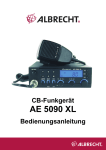
CB-Funkgerät
AE 5290 XLS
Bedienungsanleitung
Inhaltsverzeichnis
Einführung ............................................................................................................................................ 3 Lieferumfang ..................................................................................................................................... 3 Montage des Funkgeräts .................................................................................................................. 4 Stromversorgung .............................................................................................................................. 4 Die Bedeutung der Sicherung im Stromkabel ................................................................................... 5 Betrieb über Netzteil am 230 V-Stromnetz ....................................................................................... 5 Antennenanschluss........................................................................................................................... 6 Einbauvorschriften der Fahrzeughersteller ....................................................................................... 6 Rechtliche Hinweise ............................................................................................................................. 6 CE-Kennzeichnung ........................................................................................................................... 6 Hinweise zur Entsorgung von Elektronikschrott ................................................................................ 7 Sicherheits-Hinweise ........................................................................................................................ 7 Bedienung ............................................................................................................................................ 8 Frontansicht ...................................................................................................................................... 8 Länder-Programmierung durchführen ............................................................................................... 9 Umprogrammieren eines bereits programmierten Geräts................................................................. 9 Einstellen der Hintergrundbeleuchtung ........................................................................................... 10 Empfang mit dem AE5290 XLS.......................................................................................................... 10 Einschalten/Lautstärke einstellen ................................................................................................... 10 Kanal einstellen............................................................................................................................... 10 Manuelle Rauschsperre (Squelch) und Automatiksquelch (ASQ) .................................................. 11 Wahl der Modulationsart: AM oder FM ? ........................................................................................ 11 Senden mit dem AE5290 XLS............................................................................................................ 12 Zusatzfunktionen Ihres AE5290 XLS ................................................................................................. 12 Bis zu 5 Kanäle speichern und abrufen .......................................................................................... 12 Suchlauf (Scan) .............................................................................................................................. 13 Kanal-Suchlauf über alle Kanäle ..................................................................................................... 13 Suchlauf stoppen ............................................................................................................................ 13 Kanal-Suchlauf über die Memory- Kanäle ...................................................................................... 14 Externe Anschlüsse ........................................................................................................................... 14 Mikrofonbuchse MIC ...................................................................................................................... 14 Externes S-Meter ............................................................................................................................ 15 Externer Lautsprecher .................................................................................................................... 15 Problemlösungen („Reset“) ............................................................................................................. 15 Europäische Gewährleistung und Service ...................................................................................... 15 Albrecht Gerätepass AE 5290 XLS ............................................................................................... 16 2
Einführung
Herzlichen Glückwunsch zu Ihrem neuen CB-Funkgerät AE5290 XLS.
Sie haben ein in vielen europäischen Ländern einsetzbares CB-Funkgerät von Albrecht
erworben, was Sie entsprechend dem Land, in dem Sie Ihr AE5290 XLS benutzen möchten,
programmieren können.
Da die neuen europäischen Bestimmungen, die mittlerweile überall in der EU gelten, auch von Ihnen
als Benutzer erwarten, dass Sie sich mit den Benutzungsregeln vertraut gemacht haben, bevor Sie
Ihr Gerät zum ersten Mal benutzen, möchten wir Sie dringend bitten, diese Bedienungsanleitung
durchzulesen und insbesondere nur die Programmierung zu benutzen, die für Ihr Land vorgesehen
ist.
Ihr neues CB-Funkgerät hat folgende Features:
•
•
•
•
•
•
•
•
•
•
•
•
•
•
•
40 Kanäle FM / 4 Watt (Programmierung 40 FM für alle EU Staaten * + IS, CH, FL, N),
80 Kanäle FM / 4 Watt, (Programmierung 80/40 für D, CZ und SK) 80 Kanäle AM Empfang,
40 Kanäle AM Senden 4 Watt
40 Kanäle FM / 4 Watt, sowie 40 Kanäle AM, 4 Watt (Internationale Programmierung 40/40 für
alle europäischen Länder, die AM erlauben)
40 Kanäle FM / 4 Watt, sowie 40 Kanäle AM, 4 Watt (Programmierung Polen)
Einstellbarer SQUELCH (Rauschsperre) + Automatiksquelch ASQ
Kanalwahl mit Drehknopf am Gerät und UP/DOWN-Tasten am Mikrofon
Memo-Funktion mit fünf Kanalspeichern, beliebig mit AM- und FM-Kanälen belegbar
Multifunktions-LCD-Anzeige
Suchlauf für alle Kanäle oder wahlweise für Memory-Kanäle
2 farbige Hintergrundbeleuchtung, umschaltbar + Mixed Mode (blau bei Empfang, rot bei Senden)
6-polige Mikrofonbuchse, auch für Selektivruf, Daten- und Gateway- PC Betrieb
Anschluss für externes S-Meter
Anschluss für externen Lautsprecher
automatische Speicherung der Einstellungen bis zum nächsten Einschalten, auch ohne
Spannungsversorgung
Anmerkung * : Speziell für Länder, die zum Zeitpunkt der Drucklegung noch keine umschaltbaren
Geräte erlauben, liefern wir auf Anfrage eine Version, bei der die Länderumschaltung technisch
blockiert ist (z.Zt. Österreich).
Lieferumfang
Ihr AE5290 XLS wird betriebsbereit mit folgendem Zubehör geliefert.
•
•
•
•
Mobilhalterung
Stromversorgungskabel mit Sicherung
Handmikrofon
Befestigung für Handmikrofon
3
Montage des Funkgeräts
Sie können Ihr AE5290 XLS entweder im Auto oder auch Zuhause als Feststation betreiben. Für die
Montage als Mobilstation im Auto liegt eine Mobilhalterung bei. Montieren bzw. stellen Sie das Gerät
so auf, dass es möglichst keiner direkten Sonneneinstrahlung ausgesetzt wird, da das zu erhöhter
Erwärmung und damit zu einer geringeren Lebensdauer führen kann. Die Montage sollte auch nicht
in der Nähe einer Heizung erfolgen. Montieren Sie das Gerät im Auto so, dass es möglichst wenig
Erschütterungen ausgesetzt ist.
Die Mobilhalterung befestigen Sie mit beiliegenden, selbstschneidenden Schrauben an
Armaturenbrett, Rahmentunnel oder einer anderen geeigneten Stelle. Montieren Sie Ihr Gerät
keineswegs dort, wo bei einem evtl. Autounfall das Gerät Verletzungen hervorrufen könnte
(ausreichende Beinfreiheit ist bei der Montage unbedingt notwendig). Achten Sie darauf, dass Sie bei
der Montage keine evtl. dahinter liegenden Leitungen beschädigen!
Schieben Sie dann das Funkgerät in die Mobilhalterung ein. Fixieren Sie es mit den großen
Rändelschrauben (die beiliegenden Unterlegscheiben aus Kunststoff benutzen!) fest im gewünschten
Betrachtungswinkel.
Auf Wunsch ist eine DIN-Schacht-Halterung als Zubehör lieferbar.
Die Mikrofonhalterung montieren Sie ebenfalls mit den beiliegenden Schrauben an einem Ort, den
Sie gut erreichen können.
Stromversorgung
Die Stromversorgung wird über das mitgelieferte 2-adrige Kabel vorgenommen. Es ist mit einem
verwechslungssicheren Stecker zum Anschluss an die rückseitige Buchse DC 13,8 V sowie mit einer
im Kabel eingeschleiften Sicherung (2 Ampere) ausgestattet. Im Fahrzeug ergeben sich die
folgenden Anschlussmöglichkeiten:
Direkter Stromanschluss an Batterie oder Dauer-Plus
Das Funkgerät lässt sich immer ein – und ausschalten, unabhängig vom Zündschlüssel. Verbinden
Sie das rote Kabel des Stromversorgungskabels mit dem Pluspol der Stromversorgung (also eine
Stelle in der Fahrzeugverdrahtung, wo dauernd 12 V anliegen) und das schwarze Kabel mit dem
Minuspol.
Wir empfehlen dringend, wo immer möglich, das Funkgerät im PKW direkt an die Fahrzeugbatterie
anzuschließen. Der direkte Anschluss an die Batterie bringt Ihnen meist die stabilste
Betriebsspannung und den optimalen Schutz gegen Störgeräusche im Empfang und auch auf der
Sendermodulation. Im LKW benutzen Sie bitte den vom Hersteller für CB Funk vorgesehenen 12 V
Anschluss an dem oft schon vorgerüsteten Spannungswandler 24 V auf 12 V. Ist bei 24 V
LKW’s kein Spannungswandler vorhanden, so empfehlen wir einen der verschiedenen Wandler aus
dem Albrecht Zubehörprogramm, die auch über die sonst üblichen Grenzen CB tauglich funkentstört
sind.
Die modernen Fahrzeug-Stromnetze sind so komplex, dass bei Anschluss an anderen Punkten (wie
z.B. Autoradio-Anschlussklemmen oder Zigarettenanzünder) unter ungünstigen Umständen
Störungen auftreten können. Diese Äußern sich als Prasseln oder „Singen“ bei Empfang, in
hartnäckigen Fällen auch bei Senden als typische „Lichtmaschinengeräusche“.
Wenn Sie den vorgeschlagenen direkten Anschluss an die Batterie nicht vornehmen können,
probieren Sie bitte den bestmöglichen Anschlusspunkt vor der endgültigen Montage aus. Es gibt auch
Fälle, wo es besser ist, die Masse (Minus-) Verbindung über die Karosserie anstelle den direkten
Batteriekontakt vorzunehmen, in jedem Falle hilft ausprobieren!
Funkgerät über Zündschlüssel geschaltet
Hierbei wird Ihr Funkgerät automatisch bei Abziehen des Zündschlüssels mit ausgeschaltet.
Damit beim Ausschalten der Zündung die letzte Einstellung des Funkgeräts und die MemoProgrammierung nicht verloren gehen, hat Ihr Funkgerät EEPROM Speicher, der auch bei fehlender
Betriebsspannung die Einstellungen Ihres Funkgeräts speichert, sodass ein spezieller DauerplusAnschluss (wie früher üblich) nicht mehr notwendig ist.
4
Verbinden Sie in diesem Fall den roten Anschlussdraht mit der geschalteten Spannung hinter dem
Zündschloss (das ist zum Beispiel in den meisten Fahrzeugen die Stelle, wo auch der
Zigarettenanzünder angeschlossen ist).
Masseanschluss (Minus) des Funkgeräts
Die schwarze Leitung verbinden Sie mit der Minusseite der Batterie oder mit einem guten
Massekontakt am Motorblock oder einem zentralen Masseanschluss. Ein Masseanschluss über
Blechschrauben an der Karosserie bringt nicht immer störungsfreien Betrieb. Sollten Sie von der
Lichtmaschine verursachte Störgeräusche hören (drehzahlabhängiges Pfeifen oder Singen), kann es
hilfreich sein, den jeweils besten Masseanschluss durch Ausprobieren zu finden.
Die Bedeutung der Sicherung im Stromkabel
Die Sicherung im Stromkabel soll Ihr Funkgerät vor ernsten Beschädigungen bei technischen Fehlern
oder falschem Anschluss schützen. Wenn eine Sicherung durchbrennt, hat dies immer eine Ursache.
In den meisten Fällen liegt z.B. Falschpolung vor und die im Gerät eingebaute Schutzdiode hat
angesprochen.
Kommt es aus irgendwelchen Gründen zu einem Kurzschluss im Inneren des Gerätes, brennt durch
den erhöhten Strom die Sicherung durch und vermeidet größeren Schaden.
Falls eine Sicherung tatsächlich einmal durchbrennen sollte: Suchen und beseitigen Sie die Ursache
dafür und tauschen Sie dann die durchgebrannte Sicherung gegen eine gleichartige (maximal 2 bis 5
A kann verwendet werden) Ersatzsicherung aus.
Reparieren Sie bitte niemals eine durchgebrannte Sicherung mit Silberpapier oder Alufolie! Bei
mehrmals durchbrennender Sicherung geben Sie Ihr Funkgerät bitte zur Reparatur zu Ihrem
Fachhändler oder direkt zur Servicestelle von Albrecht.
Hinweise besonders für LKW-Fahrer
Die höchste zulässige Betriebsspannung des Funkgerätes beträgt 15 V. Diese Spannung darf
keinesfalls überschritten werden! Die Senderstufen Ihres AE5290 XLS sind elektronisch stabilisiert.
Eine Erhöhung der Leistung durch übermäßige Betriebsspannung ist daher unmöglich. Bei solchen
Versuchen riskiert man nur einen schweren Gerätedefekt, aber keine Leistungserhöhung! Trucker
sollten darauf achten, Ihr Funkgerät niemals direkt an 24 Volt anzuschließen. Bei 24 Volt ist ein
geeigneter Spannungswandler erforderlich. Da im LKW ab Werk sehr oft Spannungswandler auch für
andere Geräte, z.B. Handy, Fernseher, Autoradio bereits eingebaut sind, sollte man den
Stromverbrauch des CB-Funkgeräts mit ca. 1.5 bis 2 A einkalkulieren. Die besonders kompakten und
verlustarmen Schaltwandler mit CE- oder „e“ Zeichen sind zwar nach den EU-Bestimmungen entstört,
dies reicht aber sehr oft nicht für ungestörten CB-Empfang aus.
Probleme lassen sich nicht in allen Fällen ohne Ausprobieren ausschließen. Wichtig ist, dass die
Funkantenne soweit wie möglich von anderen Antennen und von der Wandlerverdrahtung entfernt
montiert wird und eine gute Massefläche hat. Im Gegensatz zu Handy- und Radioantennen können
die üblichen CB-Antennen nicht auf Kunststoffflächen montiert werden. Für CB-Funk ist die
Masseverbindung besonders wichtig. Sofern der LKW noch einen metallischen Spiegelhalter hat,
kann der Antennenfuß über einen Winkelhalter dort befestigt werden, nicht aber z.B. auf einem GFKDach oder Kunststoff- Windabweiser. Besteht keine Möglichkeit, die Antenne auf einem leitfähigen
Untergrund zu montieren, können CB-Geräte nur mit Spezial-Antennenangeschlossen werden. Eine
„massefreie (groundless) “ Antenne GL-27 ist für Kunststoffkarosserien unter Artikel-Nr. 6351
lieferbar.
Betrieb über Netzteil am 230 V-Stromnetz
Betreiben Sie Ihr Funkgerät zu Hause nur über ein spezielles CB-Funk-Netzteil mit Stabilisierung,
welches mindestens 1.5 - 2 Ampere bei 12 -13.8 Volt Gleichspannung abgeben kann. Ein gut
geeignetes Netzteil von Albrecht ist Artikel-Nr. 4744. Unstabilisierte Netzteile oder AutobatterieLadegeräte sind ungeeignet und dürfen keinesfalls benutzt werden. Dank des jetzt im AE5290 XLS
5
eingebauten Speicher-EEPROM bleibt auch beim Abschalten des Netzteils die letzte Einstellung
beliebig lange erhalten.
Das rote Kabel sollte mit dem Plus (+) Anschluss des Netzteiles, der schwarze Anschluss mit der
Minus (-) Klemme des Netzteils verbunden werden.
Antennenanschluss
Schließen Sie Ihre CB-Antenne an der Buchse ANT auf der Rückseite Ihres AE5290 XLS an. Diese
Antenne muss auf den CB-Funkbereich abgestimmt sein, damit Sie höchstmögliche Reichweite
erzielen können. Benutzen Sie ein Stehwellenmessgerät zur Kontrolle und zum Einstellen der
Antenne. Stimmen Sie die Antenne auf bestes Stehwellenverhältnis auf einem mittleren Kanal ab.
Wenn Sie 80 Kanäle benutzen, optimieren Sie auf Kanal 1, bei 40 Kanälen auf Kanal 20 und für LKW
Fahrer empfehlen wir generell den Kanal 9.
Auf diesem Kanal sollten Sie ein Stehwellenverhältnis von etwa 1.5 erreichen. Selbst wenn das
Stehwellenverhältnis sich auf dem obersten (Kanal 40) und untersten Kanal (1 oder 41) auf bis zu
SWR = 2 verschlechtert, ist Ihre Antenne immer noch geeignet. Zeigt das Stehwellenmessgerät einen
Wert im roten Bereich an (SWR > 3), dann gehen bereits mehr als 25 % der Sendeleistung durch
Anpassungsverluste verloren. Ein schlechtes SWR kann aber auch ein Zeichen für einen Defekt in
Antenne, Kabel, oder einen Kurzschluss im Antennenstecker sein! Ansonsten können Sie aber auch
Ihre Antenne auf dem Kanal optimieren, den Sie vorwiegend benutzen.
Es gibt auch breitbandige Antennen im Fachhandel, bei denen keine Abstimmung notwendig ist.
Stehwellenmessgeräte gibt es preiswert im Fachhandel, wie Albrecht SWR 30, Artikel-Nr. 4412.
Übrigens: Auch wenn Ihr AE5290 XLS hat eine besonders widerstandsfähige Endstufe hat, die
selbst Fehlanpassungen von SWR= 3 verkraftet, sollten Sie trotzdem nie ohne Antenne senden !
Einbauvorschriften der Fahrzeughersteller
Wenn Sie ein Funkgerät in ein Fahrzeug einbauen, beachten Sie bitte die Werkshinweise der KFZHersteller zum Einbau von Funkgeräten. Bei neueren Fahrzeugen haben die Hersteller das Recht,
Einbaustellen für Funkanlagen und insbesondere für die Antennen vorzuschreiben. Bei mit
elektronischen Steuerungen ausgerüsteten Autos kann der fehlerhafte Einbau eines Funkgeräts
durchaus Störungen im Bordcomputer oder anderen Teilen des Motormanagements hervorrufen.
Sollte Ihr KFZ Hersteller solche Vorschriften herausgegeben haben und Sie halten sich nicht daran,
können Sie unter Umständen die Betriebserlaubnis Ihres Fahrzeugs riskieren! Fragen Sie Ihren
Fahrzeughändler oder -Hersteller im Zweifelsfall.
Rechtliche Hinweise
CE-Kennzeichnung
Dieses Gerät mit der nach der R&TTE Direktive vorgeschriebenen
Kennzeichnung versehen:
Das CE Zeichen bedeutet, daß das Funkgerät die grundlegenden
Anforderungen der neuen europäischen Bestimmungen erfüllt. Die
sogenannte R&TTE Direktive hat alle früheren nationalen Zulassungen in der EU endgültig abgelöst
und regelt auch das Inverkehrbringen und die Benutzung von Funkanlagen. So ist der Besitz und der
Handel mit ordnungsgemäß gekennzeichneten Geräten wie dem AE5290 XLS innerhalb der EU und
einigen nicht EU-Staaten, die die R&TTE Direktive anerkennen, überall erlaubt, während es für die
Benutzung von Funkanlagen noch je nach Programmierung und Land zur Zeit noch
unterschiedliche Regelungen gibt. Für den CB-Funk bedeutet dies: Die technischen Normen EN
300 433-2 V.1.3.1 sind zwar europaweit harmonisiert, jedoch noch nicht die Benutzung bestimmter
Modulationsarten und Kanalzahlen. Die neueste CEPT Entscheidung ECC DEC(11)03, die FM und
AM mit 4 Watt, sowie SSB mit bis zu 12 Watt erlaubt, ist zwar seit Sommer 2011 in Kraft, muss aber
in einigen Ländern jeweils noch in nationales Recht umgesetzt werden, sodass sich je nach Region
noch Verzögerungen ergeben können, ab wann Sie in den jeweiligen Ländern AM mit 4 Watt
6
(anstelle 1 Watt früher) tatsächlich schon benutzen dürfen. Bitte erkundigen Sie sich im Zweifelsfall
bei den nationalen Behörden oder auf unserer Service-Homepage nach der jeweils neuesten CB
Länderliste.
Außer in Italien, Spanien und der Schweiz ist der CB Funk bereits überall anmelde- und gebührenfrei
(in den genannten Ländern dürfen allerdings Durchreisende aus anderen Ländern Ihren CB Funk
bereits frei benutzen). In der Schweiz entfällt die Anmeldepflicht ab 2013. Solange es noch irgendwo
in Europa Einschränkungen oder Sonderregelungen gibt, ist es den Herstellern vorgeschrieben,
neben dem CE Zeichen noch das "Aufmerksamkeitszeichen" anzubringen. Die Hersteller wurden
verpflichtet, die Benutzer deutlich auf der Verpackung und in der Anleitung darüber zu informieren,
was beim Benutzen der Geräte zu beachten ist.
Das AE5290 XLS erfüllt neben den für CB Funkgeräte harmonisierten europäischen Funk-Standards,
Normen und Direktiven auch die Normen der EN 60 950-1: 2006 (zweite Ausgabe) für die elektrische
Sicherheit. Das Gerät sendet keine schädlichen Funkstörungen aus und ist auch umgekehrt
einstrahlungsfest, wenn es entsprechend dieser Bedienungsanleitung benutzt wird. Dies ist im
Allgemeinen dann der Fall, wenn Sie an die Mikrofonbuchse, die Lautsprecherbuchse, den S- MeterAnschluss und die Stromversorgungsbuchse keine längeren Leitungen als 3 m anschließen.
Die mehrsprachige Original-Konformitätserklärung finden Sie abgedruckt mit allen Einzelheiten und
Unterschrift am Ende der englischen Anleitung und auf unserem Internetserver. Diese kann sich
jederzeit inhaltlich ändern, da die CB Bestimmungen sich noch in einem EU-weiten
Harmonisierungsprozess befinden. Aus diesem Grunde veröffentlichen wir den jeweils neuesten
Stand unserer Konformitätserklärungen im Original und mit den Bestimmungen kombiniert als
Gerätepässe im Internet unter
http://www.service.alan-electronics.de
in den Rubriken Konformitätserklärungen und Gerätepässe.
Bitte laden Sie sich von dort ggf. neuere Ausgaben herunter und nehmen Sie besonders den
Gerätepass auf Reisen bitte mit.
Hinweise zur Entsorgung von Elektronikschrott
Die neue europäische WEEE Direktive regelt das Entsorgen und das Recycling von
Elektro- und Elektronikschrott. Damit das von der Industrie finanzierte
Entsorgungssystem funktioniert, sollten Sie, wenn einmal Ihr AE 5290 XLS entsorgt
werden sollte (was wir nicht hoffen wollen!), Ihr Gerät nicht in die Haushaltsmülltonne
werfen, sondern bei den kommunalen Sammelstellen abgeben. Dort stehen Container
für kostenlose Abgabe bereit!
Das Zeichen mit der durchgestrichenen Mülltonne auf dem Typenschild soll Sie daran
erinnern!
Sicherheits-Hinweise
Elektromagnetische Wellen, wie sie von Radiosendern, Handy’s und Funkgeräten abgestrahlt
werden, können empfindliche andere elektronische Geräte in unmittelbarer Nähe beeinflussen.
Vorsichtshalber empfehlen wir daher Personen mit Herzschrittmachern, vor den ersten CB-FunkGehversuchen sich über die Störfestigkeit Ihres Herzschrittmachers zu informieren. Obwohl meistens
die im CB-Funk benutzten Leistungen unbedenklich sind, schadet es sicher nichts, wenn Sie
vorsichtshalber bei Ihrem Arzt nachfragen. Bedenken Sie bitte, dass Sie sich, besonders bei
Mobilbetrieb, ja in unmittelbarer Nähe einer Sendeantenne aufhalten. Wenn Ihr Arzt oder der
Hersteller eines Herzschrittmachers Schutzabstände zur Antenne vorschlagen sollte, halten Sie diese
bitte ein! Senden Sie nicht ohne angeschlossene Antenne und berühren Sie niemals die Antenne,
während Sie senden!
Beim Funkbetrieb in Fahrzeugen hat die Verkehrssicherheit selbstverständlich absoluten Vorrang!
Auch wenn Sprechfunkgeräte, wie Ihr CB-Gerät, vom so genannten „Handyverbot“ in Deutschland
ausgenommen sind, Sie also auch Ihr AE 5290 XLS während der Fahrt vom Gesetz her gesehen
benutzen dürfen, sollten Sie jedoch nur dann zum Mikrofon greifen, wenn die Verkehrssituation es
7
gestattet! Bitte beachten Sie, dass in vielen anderen Ländern (z.B. in Spanien) bei Sprechfunkgeräten
keine Ausnahmeregeln gelten. Als Fahrer eines Fahrzeugs dürfen Sie dort kein Funkgerät während
der Fahrt bedienen. Erkundigen Sie sich bitte vor Fahrten in andere Länder über die dortigen
Vorschriften!
Bedienung
Frontansicht
Lautstärke
Squelchregler
und
ASQ-Schalter
Ein / Aus
Kanalschalter
AM-FM-Schalter
Suchlauf-Scan
Programmierung
Speicherkanäle
LC Display
FM-Mode
SpeicherplatzNummer
Memory Mode
Kanal
S/PWR Meter
8
Rückansicht
Ext. S-MeterBuchse
Typenschild
Hintergrund-Beleuchtungsfarbe
Blau - Blau (RX) Rot (TX) - Rot
Ext.LautsprecherBuchse 4-8 Ohm
Buchse für DC
Stromkabel 13.2 V
Länder-Programmierung durchführen
Nach dem Auspacken sollten sie vor der ersten Nutzung die Länderprogrammierung von
Kanalzahl und Modulationsart vornehmen. Drücken Sie hierzu bei ausgeschaltetem Gerät die SCAN Taste und schalten dann Ihr Gerät ein. Lassen Sie jetzt erst die Taste wieder los. Im Display
erscheint jetzt die Multimodeanzeige 01 bis 05. Mit dem Kanalschalter haben Sie nun die
Möglichkeit, den für Ihr Land entsprechenden Code einzustellen. Die für Ihren Standort zutreffende
Einstellung entnehmen Sie bitte der nachfolgenden Tabelle (siehe auch Rechtliche Hinweise). Mit
einem erneutem Ein- und Ausschalten bestätigen Sie Ihre Auswahl.
Solange Sie nicht wissen, welche
Norm in Ihrem Land oder
Gastland gilt, benutzen Sie bitte
die 40 FM Einstellung (3), bis Sie
die zutreffenden Informationen
haben.
Diese FM Einstellung ist überall zugelassen. Beachten Sie auch unseren „Gerätepass“, den wir im
Internet ständig aktualisieren. Sie finden die jeweils neuesten Unterlagen unter
http://www.hobbyradio.de
Multi Mode
Kanäle
Power
Modulation
01
80 FM, 40 AM 4W/4W FM/AM fur D, CZ und SK
02 = 04
40 FM, 40 AM 4W/4W FM/AM neue EU Norm
03
40 FM
4W
FM
05
40FM, 40 AM 4W/4W FM/AM (nur Polen)
Da dieses Gerät in den meisten Fällen von Truckern benutzt wird, ist die werkseitige Einstellung vor
Auslieferung 02 = 40 Kanäle FM und 40 Kanäle AM voreingestellt. Diese Programmierung ist in
allen Ländern zulässig, in denen neben FM auch AM zulässig ist, also auch in Deutschland.
Umprogrammieren eines bereits programmierten Geräts
Wenn erforderlich, kann das Gerät auch jederzeit (z.B. beim Grenzübertritt) erneut umprogrammiert
werden. Eine Einstellung bleibt immer solange erhalten, bis das Gerät beim nächsten Mal
umprogrammiert wird. Auch das Abtrennen der Stromleitung verändert nicht die Programmierung!
* Für einige Länder, (z.Zt. Österreich) in denen Geräte mit Länderumschaltern nicht benutzt werden
dürfen, gibt es auf Anfrage auch eine Version ohne von außen zugängliche Umschaltmöglichkeit.
9
Diese arbeiten nur mit der bei Lieferung vorhandenen festen Einstellung, die nur im Service geändert
werden kann.
Einstellen der Hintergrundbeleuchtung
Sie haben die Auswahl zwischen zwei verschiedenen Farben der Hintergrundbeleuchtung, rot oder
blau.
•
•
Zum Umschalten legen Sie den Schalter auf der Rückseite entsprechend um.
In Mittelstellung arbeitet die Anzeige zweifarbig: bei Empfang blau und beim Drücken der
Sendetaste rot.
Nehmen Sie die Einstellung bitte vor, bevor Sie Ihr Gerät festschrauben oder in einen DIN
Einbauschacht einsetzen!
Empfang mit dem AE5290 XLS
Einschalten/Lautstärke einstellen
Der Ein- und Ausschalter ist mit
Einschalten:
•
dem Lautstärkeregler VOLUME (Lautstärke) kombiniert. Zum
Regler VOLUME (Lautstärke) aus Stellung OFF etwas nach rechts drehen.
Das Display und die Tasten werden beleuchtet. Dann die gewünschte Lautstärke einstellen.
Kanal einstellen
•
Mit dem Kanalwähler - dem großen Knopf auf der rechten Seite stellen Sie den gewünschten
Kanal ein.
Der aktuelle Kanal wird auf dem Display rechts angezeigt.
Sie können den gewünschten Kanal auch mit den auf-ab-Tasten auf der Vorderseite des Mikrofons
einstellen:
•
Linke oder rechte Seite der Taste kurz drücken, um einen Kanal nach oben oder unten zu
schalten.
• Entsprechende Tastenseite länger drücken, um fortlaufend die Kanäle nach oben oder unten zu
wechseln. (siehe Display)
Auf der abgestuften Balkenanzeige im LCD-Anzeigefeld können Sie ablesen, wie stark das
empfangene Signal etwa ist.
Die Skalierung unter der Balkenanzeige (S1 bis +30) bietet eine Orientierung für einen
Empfangsrapport in den Stufen S1 bis S9+30dB. Die Bezeichnung der S-Meter-Angaben ist genormt:
S1 bedeutet ein schwaches, gerade eben lesbares Signal, S 9 bedeutet ein gutes Signal mit etwa
100 µV Antennenspannung, und S 9 + 30 bedeutet quasi " Vollanschlag".
10
Manuelle Rauschsperre (Squelch) und Automatiksquelch (ASQ)
Besonders in FM stört das Rauschen auf einem freien Kanal. Mit der manuellen Rauschsperre
(engl. „Squelch“) können Sie dieses Rauschen unterdrücken - aber auch Signale, die zu schwach
für einen ordentlichen Empfang sind, oder Signale, die Sie gar nicht hören wollen.
•
Mit dem Regler Squelch (Rauschsperre) stellen Sie die Signalstärke ein, ab der ein Signal
den Lautsprecher öffnet:
•
Je weiter Sie den Regler nach rechts drehen, desto stärker muss ein Signal sein, um im
Lautsprecher hörbar zu werden.
Die Einstellung auf höchste Ansprechempfindlichkeit nehmen Sie auf einem freien Kanal vor:
•
Stellen Sie mit dem Kanalwähler oder den Mikrofon-Tasten einen freien Kanal ein, auf dem
auch keine Signalanzeige erfolgt.
•
Drehen Sie dann den Regler Squelch (Rauschsperre) vorsichtig so weit nach rechts, bis das
Rauschen gerade verschwindet.
ASQ Einstellung: Eine ähnliche, hochempfindliche Einstellung, die nahezu jedes empfangswürdige
Signal durchlässt und Geräusche automatisch sperrt, ist die Automatik-Squelcheinstellung ASQ.
Dazu drehen Sie den Squelch Regler ganz nach links- Sie hören den Umschalter an einem
deutlichen Knacken.
Jetzt bleibt der Lautsprecher auf einem freien Kanal ausgeschaltet, aber er schaltet schon beim
Empfang sehr leiser Signale wieder ein. Die richtige Rauschsperreneinstellung ist später auch sehr
wichtig für den automatischen Suchlauf – mit „offener“ Rauschsperre kann der Suchlauf nicht
arbeiten!
Wahl der Modulationsart: AM oder FM ?
Der traditionelle CB-Funk begann in den USA mit 23 Kanälen und der klassischen Modulationsart
AM, wie es im Amateurfunk, Seefunk und bei kommerziellen Stationen in den 50er Jahren üblich war.
Heute findet man AM noch im Mittelwellen-, Kurzwellenrundfunk und beim Flugfunk. Im
kommerziellen Funk findet man heute nur noch FM und bei Kurzwellen-Weitverkehr SSB
(Einseitenband-AM). In Europa griffen die Behörden schon früh restriktiv beim CB-Funk ein und
wollten die traditionelle AM Modulation durch die nach damaliger Einschätzung störungsfreiere FMModulation ersetzen. Trotz allem hielten besonders die LKW Fahrer an den CB-Traditionen fest und
benutzen bis heute die Amplitudenmodulation, die bei den weniger störenden LKW-Dieselmotoren
tatsächlich einige Vorteile gegenüber FM aufweisen konnte: Einen nicht so aggressiven Klang und
das geringere Rauschen auf unbenutzten Kanälen bei Empfang - verglichen mit FM.
Die jahrelangen Forderungen der CB-Funker blieben nicht unerhört
Die neue EU Normung und auch die CEPT (Die Kommission der Europäischen Fernmeldebehörden)
haben berücksichtigt, dass AM für den CB Funk nicht nur die traditionelle Betriebsart ist. Fast 30
europäische Staaten (Juli 2012) haben bereits AM und die Weitverkehrsbetriebsart SSB wieder
erlaubt, sogar anmelde- und gebührenfrei (nur in der Schweiz, Italien und in Spanien müssen
Einwohner noch CB Gebühren zahlen, während Gäste vorübergehend frei funken dürfen), weil sich
die befürchteten Störungen durch AM nicht mehr zeigten, denn auch bei den früheren
"Sorgenkindern", den Stereoanlagen und Videorecordern, hat sich die Störfestigkeit in den letzten
Jahren enorm verbessert.
Mit der Funktionstaste AM / FM können Sie zwischen AM und FM wählen, falls Ihr Funkgerät auf
40/40 oder 80/40 Kanäle programmiert ist. Haben Sie AM gewählt, können Sie auf den für
Deutschland zusätzlich freigegebenen Kanälen 41 – 80 zwar in AM empfangen, aber nicht senden
11
(im Display erscheint Er = Error), auf den Kanälen 1-40 ist Senden und Empfangen möglich. Bei
Geräten, wo nur FM programmiert ist, ist die Taste AM/FM ohne Funktion.
Bitte beachten Sie die oben erwähnten Einschränkungen beim Senden auf den Kanälen 41-80. Im
Zweifelsfalle schalten Sie bitte auf FM um.
Senden mit dem AE5290 XLS
Im CB-Funk gilt der alte Grundsatz: Erst hören, dann sprechen.
Haben Sie sich einen Kanal ausgesucht, auf dem Sie mit einem Partner ein Funkgespräch starten
wollen, hören Sie erst mal eine Weile "in den Kanal hinein", ob er überhaupt frei ist! Oder Sie fragen
einfach, ob der Kanal frei ist!
Mit der großen Sendetaste seitlich am Mikrofon (auch PTT-Taste genannt von Push-To-Talk)
schalten Sie zwischen Empfangen und Senden um:
•
PTT-Taste drücken, um zu senden
•
Taste wieder loslassen, um auf Empfang zurückzuschalten.
Sprechen Sie bitte nicht zu laut in das Mikrofon! Die Erfahrung zeigt, dass die meisten CB-Anfänger
viel zu laut in die Mikrofone sprechen. Das Sprechen mit PTT-Taste sollten Anfänger erst kurz üben:
da der Sender auch einen kleinen Augenblick zum Einschalten braucht, drücken Sie erst die Taste,
dann fangen Sie nach einer halben Sekunde an zu sprechen. Sind Sie mit Ihrer Durchsage fertig,
lassen Sie bitte die Taste los. Jetzt können Sie auf die Antwort der Gegenseite warten!
Zusatzfunktionen Ihres AE5290 XLS
Bis zu 5 Kanäle speichern und abrufen
Mit Ihrem AE5290 XLS können Sie fünf häufig gebrauchte Kanäle in AM oder FM speichern. Mit der
Taste MEMO können Sie jederzeit von dem von Ihnen vorher eingestellten Kanal (Normaler
Kanalwahl-Mode) auf die 5 programmierbaren Memo-Kanäle (MEMO-Mode) umschalten und zurück:
Umschalten vom Kanalschalter auf bereits programmierte Memo-Kanäle
•
•
•
Drücken Sie kurz auf die MEMO Taste. Im Display erscheint neben der Kanalnummer eine
der Speicherplatznummern (1 bis 5).
Sie können jetzt entweder mit dem Kanalwähler, oder mit den up/down-Tasten am Mikrofon
einen dieser 5 Memorykanäle einstellen.
Ein kurzer Druck auf die Memo-Taste schaltet wieder zurück auf die normale Auswahl mit
dem Drehschalter.
Werkseitig wurden einige Kanäle zu Testzwecken bereits programmiert, wir empfehlen die folgenden
Kanäle zu benutzen:
•
•
Kanal 1: empfohlener Anrufkanal in FM
Kanal 9: internationaler Anruf- und Notrufkanal: speziell in Deutschland wird dieser Kanal in
AM auch von allen LKW-Fahrern benutzt.
Dies bedeutet: Hier hören besonders viele Stationen zu. Man hat im "Falle eines Falles" große
Chancen, auf diesem Kanal gehört zu werden. Auch zum Anrufen anderer Stationen, von
denen Sie wissen, dass diese auf Kanal 9 hörbereit sind, können Sie auf Kanal 9 einen Anruf
starten. Rufen Sie dort die gewünschte Station. Sobald der Kontakt hergestellt ist, vereinbaren
Sie einen freien Kanal für Ihr Gespräch- und schon ist Kanal 9 wieder frei für andere Anrufe.
12
Natürlich funktioniert ein Notrufkanal nur, wenn dort möglichst viele Stationen auf Empfang
sind. Hören auch Sie daher möglichst oft diesen Kanal ab- die MEMO-Taste hilft Ihnen dabei.
•
Kanal 19 Trucker-Kanal in Frankreich, Spanien und Italien (in AM, erreichbar über die 40/40
oder 80/40 Programmierung)
•
•
Kanal 4 empfohlener Anrufkanal in AM in Deutschland
Kanal 40 (Anrufkanal in der Schweiz)
Programmieren von eigenen Memory- Kanälen
Sie können jeden der 5 Memorykanäle auf beliebige andere internationale Kanäle je nach Stellung
des Länder-Umschalters (z.B. Privatkanäle oder Clubkanäle) einstellen: Da die deutschen Kanäle 4180 nicht in den internationalen Schalterstellungen erreicht werden können, können diese deutschen
Kanäle 41-80 nur auf der deutschen Schalterstellung abgespeichert und erreicht werden.
•
•
•
•
•
Schritt 1 : wählen Sie im normalen Kanalwahl-Mode den gewünschten Kanal (und ggf. die
Modulationsart AM oder FM)
Schritt 2:
drücken Sie die MEMO-Taste so lange (etwa 2 Sekunden), bis eine
Speicherplatznummer (1 bis 5) neben der Kanalnummer im Display erscheint. Links erscheint
ME
Schritt 3: wählen Sie mit dem Kanalschalter die gewünschte Speicherplatznummer (1 bis 5)
Schritt 4: drücken Sie kurz MEMO zur Speicherung
Schritt 5: um in den Normal-Mode zurückzukommen, betätigen Sie einmal den Kanalschalter
oder eine Kanalwahltaste am Mikrofon
Damit ist Ihr Kanal gespeichert und bleibt im Memory erhalten, solange Sie nicht einen anderen Kanal
auf dem betreffenden Speicherplatz programmieren. Die Speicherung geht auch bei
Stromunterbrechungen über längere Zeit nicht verloren.
Hinweis: Bereits belegte Speicherplätze werden durch das erneute Speichern gelöscht und mit dem
neuen Kanal überschrieben. Die Betriebsart AM oder FM wird mit abgespeichert. Beim Wechsel der
Länderprogrammierung bleiben programmierte Memorykanäle erhalten.
Suchlauf (Scan)
Das AE5290 XLS bietet Ihnen einen Suchlauf über alle Kanäle oder die Memorykanäle. Es werden
dann die entsprechenden Kanäle nacheinander aufgerufen und auf ihre Aktivität überprüft. Wird auf
dem Kanal ein Signal empfangen, das die mit Regler SQUELCH eingestellte Schwelle überschreitet,
so bleibt der Suchlauf für ca. 5 Sekunden zum Reinhören stehen und startet dann wieder
automatisch. Schaltet das Empfangssignal hingegen innerhalb dieser fünf Sekunden ab oder fällt
unter die eingestellte Squelch- Schwelle, so startet der Suchlauf mit einer kleinen Verzögerung sofort
wieder.
Kanal-Suchlauf über alle Kanäle
•
Starten Sie den Suchlauf mit SCAN.
Suchlauf stoppen
•
Taste SCAN kurz drücken.
Im Anzeigefeld erlischt SCAN, der Suchlauf ist gestoppt, das Gerät arbeitet auf dem zuletzt
angezeigtem Kanal.
13
•
Auch mit einem kurzen Antippen der PTT-Taste am Mikrofon schalten Sie den Suchlauf aus
und verbleiben auf dem aktuellen Kanal.
Kanal-Suchlauf über die Memory- Kanäle
•
Drücken sie die Scan Taste einfach etwas länger- nun startet der Suchlauf nur über die 5
Memorykanäle.
Externe Anschlüsse
Mikrofonbuchse MIC
Die 6-polige Mikrofonbuchse ist nach der bekannten Albrecht-Norm beschaltet, die auch den
Empfehlungen der Gesellschaft Deutscher CB-Funk-Hersteller (GDCH-Norm) entspricht.
PIN 1
PIN 2
PIN 3
PIN 4
PIN 5
PIN 6
Mikrofon-Audio ca. 2.5 mV / 1000 Ohm
PTT-RX (Empfangskontakt, = Lautsprechermasse)
PTT-TX (Sendekontakt)
Kanalwahl (Up / Down) Taster für UP über 22kOhm nach PIN 6, Taster für Down
gegen Masse
Masse, Abschirmung
12 V für Verstärkermikrofon, Selektivruf etc, kann max. 100 mA Strombelastung
abgeben
Die Mikrofonbuchse ist zulässig für den Anschluss beliebiger Mikrofone, auch mit Selektivruf, für
Datenübertragung und auch für PC-Soundkartenanschluss. Die Kabellänge am Mikrofonanschluss
darf bis zu 3 Metern betragen (geschirmtes Kabel erforderlich).
Datenübertragung und Gatewaybetrieb
An der Mikrofonbuchse können Sie anstelle des serienmäßig mitgelieferten Elektret-Handmikrofons
auch andere Mikrofone und Zubehör (siehe unter „Externe Anschlüsse“) anschließen:
In einigen Ländern dürfen Sie auch Zusatzgeräte für die Datenübertragung (z.B. Packet Radio) dort
anschließen. Allerdings ist diese Art von Datenübertragung nur auf bestimmten Kanälen und nur für
Hobby-Anwendungen erlaubt. Die folgenden Kanäle sind in Deutschland neben Sprache auf für
Datenübertragung erlaubt:
Datenübertragungskanäle: Kanäle 6, 7, 24, 25, 40, 41, 52, 53, 76 und 77
Damit wurden in Deutschland die Möglichkeiten, CB Funk über das Internet zu verknüpfen, erweitert.
Sogenannte Sprach-Gateways sind wie automatische Relaisstationen, sie sind CB Stationen, die von
engagierten CB Funkern betrieben werden und einen Zugang zum Internet haben.
Die
Sprachsignale, die die Gateways aufnehmen, werden über das Internet zu anderen Systemen (wie
Gesprächsrunden über e-QSO –Server oder auch direkt zu anderen CB Stationen) weitergeleitet und
an anderen Orten wieder ausgestrahlt und umgekehrt. Wenn Sie also auf einen Sprach-Gateway
schalten, dann können Sie über Ihr CB Gerät Kontakt zu anderen Stationen aufnehmen, die entweder
direkt im Internet an den Gesprächsrunden teilnehmen oder selbst wiederum über CB Funk an
entfernten Orten teilnehmen. Dazu wurden in Deutschland die Kanäle 11, 29, 34, 39, 61, 71, 80
freigegeben. Wenn Sie also Gesprächsrunden auf einem dieser Kanäle hören sollten, wundern Sie
sich nicht über die scheinbar großen Entfernungen der Teilnehmer an den Gesprächsrunden
untereinander: Sie können mit Ihrem Gerät daran problemlos teilnehmen!
Bitte benutzen Sie den in Deutschland freigegebenen Kanal 40 nicht für Packet Radio, wenn
Sie sich innerhalb der Funkreichweite zur Schweiz befinden- dort ist Kanal 40 der Anrufkanal!
14
Externes S-Meter
Ihr AE5290 XLS bietet auf der Rückseite eine Anschlussmöglichkeit für ein externes S-Meter zur
Anzeige der relativen Empfangs-Signalstärke. (Buchse "S-Meter"). Mit einem externen S-Meter, bei
CB-Funkern sehr beliebt bei Funksignal-Suchfahrten, sind oft genauere Aussagen als über die
Balkenanzeige möglich. Ihr Fachhändler kann Ihnen verschiedene externe S-Meter anbieten. Ein
externes S-Meter muss einen 2.5 mm Mono-Klinkenstecker haben, bei dem der Innenleiter positiv
angeschlossen ist.
Externer Lautsprecher
Ist Ihr eingebauter Lautsprecher nicht mehr zugänglich, weil Sie das Gerät in eine Konsole eingebaut
haben, oder ist er vielleicht nicht laut genug für Ihre Umgebung? Ihr AE 5290 XLS hat eine 3.5 mm
Mono-Klinkenbuchse auf der Rückseite, an die Sie einen externen Funklautsprecher anschließen
können. Bei Einstecken des Steckers schaltet sich der eingebaute Lautsprecher automatisch aus. Ein
externer Lautsprecher muss 4 oder 8 Ohm Impedanz haben. Das Albrecht Zubehörprogramm bietet
eine Reihe geeigneter Funklautsprecher.
Problemlösungen („Reset“)
Sollte sich das Funkgerät einmal nicht so verhalten, wie Sie es gewohnt sind, kann evtl. durch eine
Störung von außen (z.B. über das Bordnetz) der Mikroprozessor blockiert sein.
In solchen Fällen können Sie einen „Reset“ durchführen: Trennen Sie das Gerät einfach für einige
Sekunden von der Stromversorgung (Stecker ziehen oder Sicherung herausnehmen). Schalten Sie
wieder ein und versuchen es erneut. Hilft das nicht, versuchen Sie eine neue Länderprogrammierung.
Probleme können auch auftreten, wenn eine nicht stabile Stromversorgung vorhanden ist.
Europäische Gewährleistung und Service
Entsprechend den europäischen Gewährleistungsregeln gewährt der Verkäufer Ihnen auf ein neues
Gerät zwei Jahre gesetzliche Gewährleistung. Falls ein Fehler bei Ihrem Gerät auftreten sollte,
wenden Sie sich bitte an den Fachhändler (oder unseren Servicepartner) und geben Sie Ihre
Kaufquittung als Garantienachweis und eine möglichst ausführliche Fehlerangabe mit ab. Sie
erleichtern unseren Technikern Ihre Arbeit sehr, wenn Sie evtl. Fehler ausführlich beschreiben – nur
dann haben Sie Gewähr, dass Fehler auch mit Sicherheit gefunden und beseitigt werden!
Servicehotline (dieser Service gilt nur für in Deutschland gekaufte Geräte):
Telefon
e-mail
01805 012204 (14 cent/Minute, max. 42 cents/minute aus Mobilnetzen)
[email protected]
PST- professional support technologies
Breitscheider Weg 117 a
Ratingen
Bevor Sie ein vermeintlich defektes Gerät zurückschicken, sollten Sie unbedingt unsere
Servicehotline anrufen oder per e-mail kontaktieren. Die Erfahrung zeigt, dass die meisten Probleme
sich in einem Gespräch bereits lösen lassen, weil es sich erfahrungsgemäß um Verständnisfragen
handelt.
Auch kann Ihnen unsere Hotline die für Sie günstigste und schnellste Reparaturanschrift
nennen, falls eine Rücksendung notwendig werden sollte.
Falls Sie Ihr Gerät in einem anderen Land gekauft haben, wenden Sie sich bitte an ihren lokalen
Händler, bei dem Sie das Gerät erworben haben.
Homepage:
Service-Download
www.alan-electronics.de
www.albrecht-online.de
www.service.alan-electronics.de
© Alan Electronics GmbH (Juli 2012)
Daimlerstr. 1 k D - 63303 Dreieich
15
Albrecht Gerätepass AE 5290 XLS
Sowohl die internationale Standard Version als auch (je nach Verkaufsland) fest programmierte Version dieses Geräts
entsprechen den neuesten europäischen R&TTE Richtlinien und den harmonisierten technischen Normen. Das Gerät wurde
notifiziert in allen Ländern und kann entsprechend der Tabelle (Stand Juli 2012) benutzt werden:
Land
Erlaubte Betriebsarten
Benutzungsbedingungen
Betrieb nur mit Einschränkungen, Anmeldung bzw. Genehmigung
Österreich
Italien und San Marino
40 FM - geplante AM
Freigabe ist zwar zugesagt, aber
Termine wurden noch nicht
veröffentlicht
40 FM und 40 AM (4W)
Schweiz
40 FM und 40 AM (4W)
Spanien
40 FM und 40 AM (4W)
Belgien
Tschechische
Republik, Slowakische
Republik
Dänemark
Finnland
Frankreich
Deutschland
40FM und 40 AM (4W)
80 FM und 40 AM
Frei für alle Benutzer
Frei für alle Benutzer. In SK ist der Freigabetermin für AM
zwar geplant, aber noch nicht veröffentlicht
40 FM
40 FM und 40 AM *
40 FM and 40 FM (4W)
80 FM und 40 AM (4W)
Großbritannien
Griechenland
Zypern, Ungarn,
Island, Malta
Irland
40 FM , AM geplant
40 FM, 40 AM (4W)
40 FM, 40 AM (4W)
40 FM
40 FM und 40 AM *
Italien
40FM und 40 AM (4 W)
Kroatien
Niederlande
40 FM und 40 AM (4W)
40/40 und 40 FM *
Norwegen, Estland,
Luxemburg, Polen,
Portugal, Slowenien
Bulgarien, Lettland,
Litauen, Rumänien
40 FM und 40 AM (4 W)
Frei für alle Benutzer
Frei für alle Benutzer
Frei für alle Benutzer
Frei für alle Benutzer, ausgenommen als ortsfeste Station auf
den Kanälen 41-80 in bestimmten Grenzregionen
Frei für alle Benutzer
Frei für alle Benutzer
Frei für alle Benutzer
Frei für alle Benutzer
Frei für alle Benutzer, noch kein Termin bekannt, ab wann AM
mit 4 Watt benutzt warden darf.
Frei für alle Besucher aus anderen Ländern während der
Reise
Frei für alle Benutzer
Frei für alle Benutzer. Es ist noch nicht geklärt, ob und wann
AM 4 Watt in NL benutzt werden darf.
Frei für alle Benutzer
In Österreich ist das Benutzen von Funkgeräten mit einem
Länderumschalter nicht gestattet.(Besitz und Verkauf jedoch
gestattet) Bei der Durchfahrt durch Österreich muss ein
Funkgerät mit Länderumschalter ausgeschaltet bleiben.
In Italien besteht für Bewohner noch eine Anmeldepflicht für
den CB-Funk. Bei der Durchfahrt durch Italien brauchen
ausländische Benutzer jedoch keine Genehmigung.
Bewohner der Schweiz benötigen bis Ende 2012 eine
Genehmigung und müssen regelmäßige Gebühren zahlen.
Für ausländische Besucher ist der CB Funk frei. (Circulation
Card empfohlen).
Bewohner Spaniens benötigen noch eine anmelde- und
gebührenpflichtige Genehmigung, Ausländische Besucher
können ihre Geräte frei benutzen.
Benutzung ohne Anmeldung und Genehmigung erlaubt
Spanien
Sweden
Schweiz und
Liechtenstein
40 FM und 40 AM (1W). *
* AM 4 W geplant, aber noch
nicht veröffentlicht
40FM und 40 AM (4W)
40 FM und 40 AM *
40 FM und 40 AM (4W)
Frei für alle Benutzer
Frei für alle Besucher aus anderen Ländern während der
Reise (Circulation Card empfohlen)
Frei für alle Benutzer
Frei für alle Besucher aus anderen Ländern während der
Reise
Wichtiger Hinweise: Bitte respektieren Sie die Einschränkungen mit * in einigen Ländern. Dort ist die
Umstellung von AM 1 W auf 4 W zwar geplant, aber noch nicht in den offiziellen Amtsbättern veröffentlicht.
Keine Gewähr für korrekte Wiedergabe der nationalen 4W AM- Bestimmungen, da die CEPT Norm ECC
DEC(11)03 noch in der Implementierungsphase ist!
16
CB RADIO
AE 5290 XLS
OPERATING MANUAL
Index
Important note
Introduction
Accessories included
Safety Precautions
Front view
LC Display
Rear view
Country switching procedure
Installation of the radio
Power supply
Antenna connection
Operation
Before switching on
Switching on and adjusting volume
Selecting the operating channel
Field intensity meter (S-meter)
Manual adjustable Squelch and Auto-Squelch ASQ
AM / FM mode switch
Special interest channels
MEMO modus
Channel scan
Transmitting and correct use of microphone
External sockets
External loudspeaker
External S-meter
Microphone socket
Service and Warranty information
Technical Details
Service contacts
Declaration of Conformity
Albrecht Radio Passport
2
3
3
3
4
4
4
5
5
6
7
8
8
8
8
8
8
9
9
10
10
11
12
12
12
12
12
13
14
14
15
16
Important Note
Your Albrecht AE 5290 XLS corresponds to the latest European CB standards (2012). As a
unique feature, it has a country switch which allows selecting the operation mode according
to the country, where you intend to use the radio. Please make sure that you use the country
switching procedure for the correct setting after first installation!
Introduction
Your new Albrecht CB Radio AE 5290 XLS, developed and manufactured in accordance with
the latest new European CB regulations, offers you:
• 40 channels FM only with 4 Watt
or
• 80 channels FM / 4 Watt / 80 AM receive /40 channels AM transmit / 4 Watt or
• 40 channels FM / 4 Watt / 40 channels AM 4 Watts according to EU standard or
• 40 channels FM / 4 Watt / 40 channels AM / 4 Watt
(Poland setting)
• Standard manually adjustable Squelch + Automatic-Squelch ASQ
• Channel selection knob on the radio set and UP/DOWN buttons on the
microphone
• 5 freely programmable memory positions for stored stations
• Channel scan up and down the frequencies or over the memory channels
• Multifunction LCD display with 2 colour switching (switch on rear side)
• 6-pin microphone socket, suitable for amplifier microphones, selective calling
systems, data transmission accessories or PC sound card connection
• Socket for external S-meter
• Socket for external loudspeaker
Please read this operating manual through carefully. This will enable you to make use of all
the functions your new CB Radio has to offer as soon as possible.
Accessories included
Your AE 5290 XLS comes operational with the following accessories:
• mobile mount
• 2 knurled screws for the mobile mount
• 2 rubber washers for the mobile mount
• DC plug-in power cable with looped-in fuse (2-5 A)
• Electret hand-held microphone with pre-amplifier and UP/DOWN buttons
• microphone hanger
• various screws to fasten the radio and microphone fixing devices
• User manual with circuit diagram and Radio Passport
3
Safety Precautions
People with pacemakers are recommended as a precaution to consult their doctor before
operating the CB radio. Not all types of pacemakers are sufficiently protected from radiation
from a nearby transmitter, so do not assume it is safe to start operation without checking!
Please remember that you are in the immediate vicinity of a transmitting aerial, particularly
when used as a mobile. If your doctor, or the manufacturer of the pacemaker, has
recommended keeping a certain safe distance from the aerial, then please follow their
instructions!
Do not transmit without connecting the aerial and never touch the aerial during transmission!
Please also take road safety into account! CB Radio (even when only receiving, particularly
when volume is turned up) can divert your attention from the road! Road safety is of course
to be given priority! Therefore only use your ALBRECHT AE 5290 XLS when the traffic
situation enables it to be used safely.
Front view
ReceiveVolume
Squelch & ASQ
Channel switch
Memo-Channels
ON / OFF
AM-FM-switch
Scan-switch
LC Display
FM-Mode
Memory
Location
Memory Mode
Channel
4
S/PWR Meter
Rear view
Socket for
external S-meter
Brand plate with country list
Antenna socket
50 Ohms
PL-259 Standard
Illumination switch for Display
Blue - Blue (RX) Red (TX) - Red
External speaker
4- 8 Ohms, min. 2 W
DC power cable
socket 13.2 V
Country switch setting before installation
Programming to another country code
Multi Mode
Channel
01
80 FM / 40 AM
02 = 04
40 FM / 40 AM
03
40 FM
05
40 FM /40 AM
Power
4W/4W
4W/4W
4W
4W/4W
Modulation
FM/AM
FM/AM New EU Standard
FM only
FM/AM (only Poland)
This is possible at
any time, even
after
installation
and when the radio
is in use.
The procedure is the same like your first setting.
Before you install your new CB radio, you should select the country setting according to the
local authority requirements. Because this radio is used in most cases by truck drivers in
central and Western Europe, it comes programmed with the factory setting to 40/40
channels. If you are in a country where this setting should not be allowed, please use the
Mode 03 on the table, 40 FM. Please consult our Radio Passport (see the chapter “Legal
Issues” later in this manual).The new European CB rules are just in an implementation
phase- it will take some time until all countries will have the new regulations adopted. For a
certain time, some countries will still require 1 W power on AM until regulations are updated.
80/ 40 (01) German setting: 80 channels FM / 4 Watt, 80 AM receive, 40
channels AM / 4 Watt. You can operate the radio free of licence or
charges in this switch position in Germany. Only in certain border
regions use of this radio as base station, transmitting on channels 41 to
80 in FM, is not allowed or you need a special licence for this
application.
In Czech Republic 80/40 switch position is allowed, in Slowakia it is
announced to allow AM again, but not yet published. Until publishing
the new rules there, please use only FM on CH 1-40 and CH 70-80
40/40 (02) 40 channels FM / 4 Watt, 40 channels AM / 4 Watt. Latest European
Standard EN 300 433-2 V.1.3.1, CEPT ECC DEC(11)03, not yet
applied in all countries. In Italy and Spain inhabitants still need to have
5
a CB licence (while free for travellers), in Switzerland only up to end of
2012, while it is already free of charges and licence in other countries,
like Belgium, Bulgaria, Croatia, Cyprus, Czech Republic, Estonia,
France, Finland, Germany, Greece, Hungary, Latvia, Liechtenstein,
Lithuania, Luxembourg, Norway, Netherlands, Poland, Portugal,
Romania, Sweden, Slovak Republic and Slovenia. This country code is
the same as former Spanish code (04)
40 FM (03) 40 channels FM / 4 Watt (former “CEPT” settings with 40 Channels FM
according to EN 300 135-2). This mode can be used in almost all
European countries. For details see the latest issue of our “Radio
Passport”).
40/40 (05)
like E, but with Poland frequency system, only allowed in Poland
Austria has still restrictions to use radios with country switches. The legislation will change
soon, but before it is published, it is not allowed to use our CB radio there. On request we
can deliver a model version with blocked country switch.
Re- Programming to another country code
This is possible at any time, you only need to
•
•
•
•
•
Switch off the radio
Switch the radio on again, while keeping the SCAN button pressed
Release the Scan button. In the display a country code between 01 and 05 will appear.
Select the country code by rotary channel switch
Switch the radio off and on again.
Notes: the country setting code remains stored until you may change it later, even if power
connection should be interrupted, there will be no memory loss.
Installation of the radio
You can either operate your ALBRECHT AE 5290 XLS in the car or at home as a base
station. For installation as a mobile station in the car, a mobile mount device is enclosed.
Mount the set in such a way that it is not exposed to direct sunlight if possible, as this would
lead to an increase in the temperature and can decrease the (set’s) working life. The set
should also not be installed near a heater. Mount the set in such a way that it is exposed to
as little vibration as possible.
The mobile fixing device should be attached to the dashboard, the tunnel slot or to any other
suitable place using the enclosed tapping screws. Do not install the set in a place where it
could cause injuries in the case of an accident (be careful to ensure free leg movement).
Take care not to damage any underlying wires during installation!
Then insert the radio into the fixing device. Secure the set with the large knurled screws
(using the enclosed plastic washers) firmly at the required angle.
Also mount the microphone fixing device using the enclosed screws in an easily-accessible
place.
In order to prevent interference to the vehicle electronics from transmission in the vehicle,
please make sure to take any mounting instructions from the vehicle manufacturer for radios
and antennas into account. For truck installation, we supply a special DIN size mounting kit
as optional accessory.
6
Power supply
Your AE 5290 XLS receives power from the 2 pin plug-in cable.
The red and black wires in the cable are for the power supply. Since the radio has now a
permanent storage via EEPROM, it is no more necessary to connect any + wire to
permanent DC supply. The cable has a looped-in fuse.
You can choose from various methods when connecting to the power supply (red and black):
Example 1 : permanent connection to 12 Volts
The channel last tuned into and the 5 stored stations are maintained after switching
off; the set can be switched on and off at any time using the volume / on/off switch.
Connect up the red wire to the positive pole on the vehicle battery (or elsewhere in
the vehicle’s electrical system with permanent plus) or to a 12 volt power unit.
Connect up the black wire to the negative pole on the vehicle battery or the power
unit or to a well-conductive part of the car body.
Example 2 : connection via ignition switch
The set should be automatically switched on and off with the ignition. All stored
stations should be kept in memory.
Attach the red wire to a part of the vehicle electrical system which is connected with
the ignition switch.
Note for all connecting methods
For EMC reasons, the cable used to connect to the power supply should be no longer than 3
metres.
If you wish to operate your set at home from the mains supply then please only use a
stabilized power pack with at least 2 amps permanent current-carrying capacity. Under no
circumstances should you use a car battery charger, or a simple DC power supply as they
are provided for camping cooling devices, as these are not stabilized and during open circuit
reach such high voltage levels that your radio set could be destroyed.
In any case, please set the country switch on the rear side to the correct country position
before You plug in the DC cable! Do not change country switch position while radio is still
connected to power supply.
If in base station use it is important to you that the stored stations are kept even after
switching off and on again, then please do not switch the external power supply power unit
off when you switch your set off for a short time. Only use the on/off switch on the set itself.
Never repair a blown fuse (we recommend values between 2 and 5 A) with silver
paper or with aluminium foil! If the fuses keep blowing, then please give your radio
set to your servicing dealer to be repaired or hand it in to Albrecht’s service station.
The maximum allowed voltage variation for this radio is up to 15.6 volts. Never
exceed this voltage under no circumstances! The transmitting stages for your
AE5290 XLS are electronically stabilized, and therefore it is impossible to increase
output by means of excessive supply voltage. Such attempts may lead to serious
damage to the radio set but will never increase output power!
7
Antenna connection
Connect your CB antenna to the ANT socket on the rear side of your ALBRECHT CB-Radio.
Most CB antennas must be tuned to best radiation during installation to give highest effective
communication range. CB specialists do that job with a standing wave meter to check and
adjust the aerial. Tune the aerial to the best standing wave ratio (SWR) on an intermediate
channel e.g. using Channel 1 in 80/40 mode (26.965 MHz) or Channel 20 in all other modes.
On this channel you should attain a SWR of approx. 1.5 or less. If the SWR deteriorates on
the highest (Channel 40) and lowest (Channel 41) channels up to a value of 2.5, then your
aerial is still acceptable. SWR above 3 is too bad for good communication range. A bad SWR
may also indicate that there is perhaps an installation error or missing ground. Problems may
be caused through missing ground, especially in boats and motor homes with fiber glass
body. For these cases, Albrecht offers a special “groundless” antenna like Albrecht GL 27
(order No. 6351).
Some antennas, like “Gamma II” are broadbanded and do not need any retuning
during installations.
Even if your AE 5290 XLS has a particularly robust transmitter high-level
stage which can even withstand mismatching of SWR=3, you should still
never transmit without an antenna!
Operation
Before switching on
• Turn SQUELCH control left , but do not turn so much that the ASQ switch “clicks”
Switching on and adjusting volume
The on/off switch is combined in the VOLUME control. To switch on:
• Turn VOLUME control from OFF position slightly right. LC display and buttons are
illuminated. Then turn further until desired volume is reached.
Selecting the operating channel
On the radio set:
• With the channel knob You can continuously select channels. The present channel is
displayed.
On the microphone:
• Press the ∧ or ∨ button on the microphone briefly, to switch up or down a channel.
• Press the respective button longer to run up or down through the channels. The present
channel is displayed.
Field intensity meter (S-meter)
On the graded bar display You can see approximately how strong the receiving signal is.
The scale under the bar display (S1 to +30) helps with orientation for an input signal in the
stages S1 to S9+30dB.
Please note: the field intensity meter only registers a signal when the muting control has
opened.
8
Adjusting manual SQUELCH or using ASQ
Particularly in FM, noise can be a nuisance on a free channel. With the adjustable muting
control (SQUELCH) You can suppress this noise - but also signals which are too weak to be
received properly.
This is how to adjust the signal strength required to switch on the loudspeaker, using the
SQUELCH control knob:
The further the control knob is turned to the right, the stronger a signal has to be in order to
be audible through the loudspeaker.
In order to adjust the set to be the most sensitive to incoming signals, switch to a free
channel:
• Use the rotary switch or the microphone buttons to find a free channel, where no
signal is displayed.
• Then turn the SQUELCH control carefully to the right until the noise just about
disappears.
ASQ – Automatic Squelch: You can obtain the most sensitive signal reception as well by
using the ASQ automatic squelch system. Simply turn the Squelch knob fully counter
clockwise, until it “clicks” . The system now detects automatically the noise on the channel
and opens the speaker when finding a reasonable receiving signal. The effect is similar as if
You would always re-adjust the manual squelch to the most sensitive trigger level.
Now the loudspeaker stays off when on a free channel but it switches back on when
receiving even very faint signals.
The muting adjustment is particularly important during channel
scanning. In this mode the point to which the set is adjusted decides
whether scanning is stopped at the signal or not. Therefore you should
test the various muting settings for various signal strengths and get to
know this function.
AM / FM mode switch
In the two programming modes 40/40 and 80/40, FM modulation is available on all channels,
but AM transmitting only on the 40 international channels. On these channels you can switch
between AM and FM using the function button AM / FM. The display shows either AM or FM
accordingly.
When you switch on the set the first time it operates on FM.
Please note that in 80/40 mode, on channels 41-80 it is possible to receive in AM, but
transmitting in AM is not possible (forbidden). If your radio is set to AM and you choose a
channel between 41 and 80, the radio will show Er (error) if you press PTT and try to
transmit.
The AM-FM switch has no function in 40 FM position of country switch or in a restricted FM
version for Austria or in FM only mode.
Special interest channels
There are some channels which have been established for certain purposes:
Channel 1
Channel 9
Call channel in FM (Germany only)
Call and emergency channel, in Germany particularly this
channel is also used by all truck drivers in AM.
9
This means: a large number of stations are listening in. If the
worst comes to the worst (e.g. in case of accident etc.) there is a
good chance that someone will be listening.
To call other stations, who you know are listening in on channel 9, you can also use this
channel. Call up the desired station on channel 9. As soon as contact has been made, agree
on a free channel for your conversation and then channel 9 will be free again for other calls.
An emergency channel can of course only work if as many stations as possible are listening
in. Therefore listen in to this channel as often as possible!
Channel 19
Data Channels
Gateways
Channel 40
Trucker channel on AM in France, Spain and Italy
6, 7, 24, 25, 40, 41, 52, 53, 76, 77 (Germany)
11, 29, 34, 39, 61, 71, 80 (allowed in Germany)
Calling channel (in Switzerland)
MEMO Modus
Using the MEMO button you can switch at any time from the present channel (normal
channel modus) to the 5 programmable stored stations (MEMO modus) and switch back
again.
Recall stored stations
•
•
•
After briefly pressing the MEMO button, the number of the memory position will appear
with the appropriate channel.
Now you can programme these 5 stored numbers using either the rotary knob or the ∧ ∨
buttons on the microphone.
If you briefly press the MEMO button again the set switches back to normal modus: the
stored number disappears from the display and you again will be able to see the number
of the channel last used.
The manufacturer has pre-programmed your AE5290XLS for some commonly-used
channels:
•
•
Channel 1
Channel 9
recommended call channel on FM
international emergency and call channel
In Germany particularly this AM channel is also used by all truck drivers. This means: a large
number of stations are listening in. If the worst comes to the worst (e.g. in case of accident
etc.) there is a good chance that someone will be listening.
To call other stations, who you know are listening in on channel 9, you can also use this
channel. Call up the desired station on channel 9. As soon as contact has been made, agree
on a free channel for your conversation and then channel 9 will be free again for other calls.
An emergency channel can of course only work if as many stations as possible are listening
in. Therefore listen in to this channel as often as possible; the MEMO button will help you.
• Channel 19: Trucker channel in France, Spain and Italy.
• Channel 4:
recommended call channel on AM in Germany
• Channel 40 recommended calling channel in Switzerland
10
Programming Memo locations
You can re-programme each of the 5 numbers of the memory positions to any desired
channel (e.g. private channels or club channels):
• Choose when in normal modus the desired channel.
• Press the MEMO button (for around 2 seconds) until a memory position number
(1 to 5) appears next to the channel number and ME appears on the display.
• Using the channel switch choose the desired memory position number (1 to 5).
• Briefly press the MEMO button to save the number. To return to normal modus
turn the channel switch once, or one of the channel selection buttons on the
microphone.
Now the station is saved and will be stored.
Please note that the German channel numbers 41 to 80 can only be
stored and recalled when the country switch is in the position for 80/40
(Germany). Channels 41-80 do not appear in other country settings.
After changing any country settings, the previously stored memory
channels are not reset and remain as before.
Channel scan
Your AE 5290 XL has an automatic channel scan, which can be used for all channels and for
the stored channels.
First choose the mode of operation (normal channel modus or MEMO modus).
Adjust the muting control to the point at which the receiver should open (see also ‘Adjusting
squelch’).
Start channel scan
•
•
Briefly press the button SCAN.
SCAN appears on the display and the channel scan starts almost immediately by
scanning all the channels down the frequencies.
• The scan is stopped at each signal worth receiving and you can listen in to the
conversation.
If you leave the set alone it will re-start the scan after about 5 seconds and continue to
search for channels in use.
Stop channel scan
You can stop the scan at any time by pressing the SCAN button a second time.
• Pressing the transmission button will also automatically stop the scan modus.
Change direction of scan
As a special function of the AE 5290 XLS you can also change the direction in which
scanning takes place:
• Press the ∨ button on microphone during the scan or turn the rotary knob slightly to the
left: the scan direction will change, i.e. from higher to lower channel numbers.
Start MEMO scan
•
•
Press the button SCAN longer, about 2 seconds.
Now the memory channels appear on the display and the scanner will only check the 5
memory channels for activity.
11
Transmitting and correct use of microphone
With the transmission button (Push To Talk) on the side of the microphone you can switch
between receiving and transmitting:
• Press PTT button to transmit.
The display shows TX .
• Release PTT button again to switch back to receiving.
When the transmission PTT button is depressed, you can speak from a distance of about 510 cm into the microphone. The modulation amplifier of your AE 5290 XSL is sensitive
enough and enables you in most cases to speak with even more distance, depending on how
loud your voice is. An automatic regulator ensures that your partner always hears your signal
at the same volume.
It is best to test the best distance from the microphone for yourself with the help of another
station.
External sockets
External loudspeaker
Depending on the surrounding noise, it can be advisable to hook up an external loudspeaker.
Usual commercial radio loudspeakers with 4-8 ohms impedance and 2-4 W minimum output
can be plugged in.
The cable can be up to 3 metres long. For car loudspeakers, make sure to use a two-pin 3.5
mm jack plug and ensure that none of the loudspeaker connections are connected to the
vehicle chassis.
External S-meter
Your AE 5290 XLS has an external S-Meter socket on the rear side, which allows you to
connect up an external S-Meter to show the relative signal strength. This gives more exact
information than the bar display. Please ask your distributor about external S-meters. The Smeter should be installed near the radio set using a cable no longer than 3 metres. You need
a 2.5 mm jack plug to connect it up. The polarity is positive, i.e. the positive pole of the Smeter is connected to the inner pin, and the negative pole is on the outside.
Microphone socket
The 6-pole microphone socket on the front side is wired according to the well-known Albrecht
specifications, which also meet the recommendations issued by the German manufacturers
of CB radios.
Apart from the hand microphone included in the package, you can also hook up other
microphones and accessories.
The microphone socket has been tested and is suitable for nearly all kind of microphones,
even those with amplifiers or selective calling devices. According to the latest regulations you
are also allowed to plug in data modems or connecting cables to PC sound cards to enable
data transmission or audio gateway functions via internet. However, this type of data transfer
is only permitted on certain channels and only for non-commercial use.
12
Service and Warranty information
Troubleshooting
Check at first the power supply and the fuse(s). A problem max be caused through power
supply, when no light appears after switching on. If the unit works in a strange way,
disconnect the power supply cable, while the radio remains switched on, wait some time
(minimum 10 seconds), and then reconnect power again. If this does not help, try a reset by
performing a new country switching procedure.
Check the microphone and antenna connector. We think you cannot do more in case of a
problem. Please ask your dealer or consult our service hints in the Internet. If you should
return the radio to Your dealer for repair, do not forget to describe the problem as exactly as
possible.
European 2 years warranty
The distributor, dealer or retail shop where you bought the radio warrants to the original retail
purchaser of this product that should this product or any part of it, under normal use and
conditions, be proven defective in material or workmanship within 2 years from the date of
original purchase, such defect(s) will be repaired or replaced with new or reconditioned
product without charge for parts and repair labour. To obtain repair or replacement within the
terms of this warranty, the product is to be delivered with proof of warranty coverage (e.g. a
copy of your sales receipt), specification of defect(s), to the distributor, dealer or his
authorised repair centre.
Liability for communications range of this product is disclaimed. The warranty does not apply
to any product or part there of which, has suffered or been damaged through alteration,
improper installation, mishandling, misuse, neglect, accident, or by removal or defacement of
the factory serial number label(s). The warranty does not apply to accessory parts or
problems caused through not authorized or not recommended accessories like other than the
supplied microphone, external antennas, external power supplies and over-voltage caused
through external power supplies, lightning or over-voltage defects via antenna or other
cables, broken or damaged acrylic glass windows and cabinet parts.
Please contact the dealer or person where you have purchased your CB radio. If you have
bought your radio in Germany, you may as well contact our German service partner directly.
Where to find service hints and service documentation
The complete technical documentation is updated regularly. You can download the latest
versions of user manuals, technical documents and conformity declaration, as well as service
hints or FAQ’s any time from our server under
http://www.service.alan-electronics.de
If you should have a problem, please have a look to the service hints or frequently asked
questions (FAQ) before you send Your CB radio back to the service centre.
Technical enquiries (only for radios sold in Germany)
Phone Hotline
e-mail:
01805-012204 (14 cents/ Min, mobile up to 42 cents/min)
[email protected]
In any case, please contact our Hotline before you return any radio. The Hotline can tell you
the nearest and most convenient service repair partner address for your radio!
For radios sold outside of Germany please contact your local distributor!
13
Technical Details
Microphone socket wiring
Packet Radio
Pin 1
Pin 2
Pin 3
Pin 4
Pin 5
Pin 6
Pin 1
Low frequency microphone
PTT-RX (on ground for reception)
PTT-TX (on ground for transmitting)
up/down
Ground
12 volt for pre-amplifier etc.
Transmitter
Transmitting power
Pin 2
Pin 3
Pin 5
Audio input
transmitter
Audio output
reception
PTT
Ground
4 Watt FM
4 Watt AM
2.5 mV at 1 kOhm
-90 dBc = 4 nW
2.0 kHz
90%
Modulation sensitivity
Harmonic and spurious radiations
Max. frequency deviation
AM modulation degree
Receiver
Sensitivity (FM) (SINAD)
Sensitivity (AM) (SINAD)
Adjacent channel selection
Audio output power
better + 3dbμV EMK for 20 dB
better + 3dbμV EMK for 12 dB
better 66 dBμV EMK
more than 2 Watt to 8 Ohm load
More than 4 Watt to 4 Ohm load
14
Declaration of Conformity
We hereby declare that our product: / Wir erklären hiermit, dass unser Produkt
CB-Radio Albrecht AE 5290 XLS
satisfies all technical regulations applicable to the product within the scope of EU Council
Directives, European Standards and national frequency applications:/ alle technischen
Anforderungen im Geltungsbereich der EU Richtlinien, europäischer Normen und nationaler
Frequenzanwendungen einhält:
73/23/EEC, 89/336/EEC, 2004/108/EG and 99/5/EC
EN 300 135-2 V.1.2.1 / EN 300 433-2 V.1.3.1
EN 301 489-1 V.1.8.1, EN 301 489-13 V.1.2.1, EN 60 950-1: 2006 second edition
All essential radio test suites have been carried out. /
Alle für das Produkt vorgeschriebenen Funktestreihen wurden durchgeführt.
Alan Electronics GmbH
Daimlerstr. 1 k
D- 63303 Dreieich
This declaration is issued under our sole responsibility. Basing on not yet fully harmonised
frequency applications, the CB radio may be used only in listed countries according to
selected channel programming and according to the still existing national restrictions for AM
+ FM, if such should still apply.
Diese Erklärung wird unter unserer alleinigen Verantwortung abgegeben. Dieses Funkgerät
darf wegen der noch nicht überall harmonisierten Frequenzanwendungen in AM + FM in
einigen Ländern nur eingeschränkt oder gar nicht betrieben werden, entsprechend den noch
geltenden nationalen Regelungen.
Alan Electronics GmbH declare, bajo su responsabilidat, que este aparato cumple con
lo dispuesto en la Directiva 99/05/CE, del Parlamento Europeo y del Consejo de 9 de
marzo de 1999, transpuesta a la legislacion espanola mediante el Real Decreto
1890/2000, de 20 de noviembre.
Point of contact/Ansprechpartner: Dipl.-Phys. Wolfgang Schnorrenberg
Place and date of issue:
Lütjensee, 13.7. 2012
(Signature)
Dipl.-Phys. Wolfgang Schnorrenberg
Alan Electronics GmbH
© Alan Electronics GmbH, July 2012
www.alan-electronics.de
http://www.service.alan-electronics.de
15
ALBRECHT RADIO PASSPORT AE 5290 XLS
This international standard version and the versions of this CB radio without country switch (available on
request) comply to the latest European regulations (R&TTE directive and European harmonised standards) and
has been notified in the countries according to following table: (as of July 2012).
Important Note: Please respect the licence conditions in the below listed countries and do not use the radio
without licence, where necessary. For travelling with your radio, we recommend to provide a copy of this Radio
Passport together with the radio. The new European ECC / CEPT decision ECC DEC(11)03 is in the
implementation process- we cannot give any indication how many countries still apply restrictions on using AM
with 4 Watts at the date, when we issued this Radio Passport.
Country
Country switch position
Licence and operating conditions
Operation only with restrictions or individual licence
Austria
40 FM
Austria does not yet accept radios with country
switches, please do not use in Austria or ask Your
dealer for a limited version without country switch.
Licence and charges for residents for all kind of CB
radios, travellers may use 40 FM / AM free during
their stay in Italy.
Licence and monthly charges for residents of
Switzerland until end of 2012. In Liechtenstein use is
already free.
Licence and regular charges for residents
Italy
40 FM and 40 AM up to 4 Watt
Switzerland and
Liechtenstein
40 FM and 40 AM up to 4 Watt
Spain
40 FM and 40 AM up to 4 Watt
Belgium
Czech Republic
Denmark
Finland
France
Germany
40FM and 40 AM (4 Watt)
80/40 switch position
40 FM
40/40 and 40 FM*
40/40 and 40 FM
80 FM 4 W and 40 AM 4 W
Great Britain (UK)
Greece
Hungary,
Cyprus,
Slovenia, Croatia
Iceland
Ireland
Italy
Malta
Netherlands
Norway,
Estonia,
Luxembourg, Poland
and Portugal
Bulgaria, Latvia,
Lithuania,
Romania,Sweden
Spain
40 FM , AM in preparation
40 FM, 40 AM 4W
40 FM, 40 AM 4 W
Free for all users
Free of licence and charges for all users
Free of licence and charges for all users
Free of licence and charges for all users
Free of licence and charges for all users
Free of licence and charges for all users except in
some border regions for base stations using channels
41-80
Free of licence and charges for all users
Free of licence and charges for all users
Free of licence and charges for all users
40 FM
40 FM and 40 AM *
40FM, 40 AM up to 4 Watt
40 FM
40/40 and 40 FM *
40 FM and 40 AM, 4 W
Free of licence and charges for all users
Free of licence and charges for all users
Free of licence and charges only for travellers
Free of licence and charges for all users
Free of licence and charges for all users
Free of licence and charges for all users
40 FM and 40 AM *
Free of licence and charges for all users
40 FM and 40 AM up to 4 Watt
Free of licence and charges for travellers (Circulation
Card recommended)
Free of licence and charges for all users
Operation without licence and charges allowed
Slovac Republic
Switzerland and
Liechtenstein
80 FM and 40 AM 4 Watt
Announced, not yet published
40 FM and 40 AM up to 4 Watt
Free of licence and charges for travellers (Circulation
Card recommended)
Note: Countries with * have not yet allowed 4 Watts in AM, we recommend to use only FM
as long as these countries have not yet published their legal regulations changes.
©2012 Alan Electronics GmbH
16
RADIO CB
AE 5290 XLS
MANUALE OPERATIVO
Nota importante
Il vostro Albrecht AE 5290 XLS corrisponde ai più recenti standard europei CB (2011). Come
caratteristica unica, ha un interruttore paese che permette di selezionare la modalità di
funzionamento a seconda del paese, dove si intende utilizzare la radio. Assicuratevi di
utilizzare la procedura di commutazione paese per l'impostazione corretta dopo la prima
installazione!
40 FM
Questa è l'ex modalità FM, la posizione che è consentita nella maggior parte dei
paesi. Qui la radio lavora sui 40 canali internazionali in modalità FM. Il selettore
di funzione AM / FM sul lato anteriore è disabilitato in questa modalità.
40/40
CEPT / ECC DEC(11)03 = EN 300 433-2: Questa posizione può essere utilizzata
in quei paesi, dove già tutti i 40 canali internazionali possono essere usati in AM
e FM.
80/40
Questa impostazione è consentita solo per essere utilizzata in Germania, CZ e
SK. Le restrizioni sono ancora in vigore nelle regioni di confine ad altri paesi (ad
eccezione della Repubblica Ceca), dove la trasmissione sui canali 41-80 non è
consentita dalle stazioni radio base o solo con una licenza speciale.
Introduzione
La vostra nuova Radio CB Albrecht AE 5290 XLS, sviluppata e prodotta secondo le più
recenti normative CB, vi offre:
• 40 canali FM / 4 watt oppure
• 80 canali FM / 4 Watt / 80 AM in ricezione / 40 canali AM in trasmissione / 4 Watt
oppure
• 40 canali FM / 4 Watt / 40 canali AM / 4 Watt oppure
• 40 canali FM / 4 Watt / 40 canali AM / 4 Watt (impostazione Polonia)
• Manopola di selezione canali sulla radio e pulsanti SU/GIÙ sul microfono
• Scansione dei canali su e giù per le frequenze
• 5 posizioni di memoria liberamente programmabili per le stazioni memorizzate
• Display LCD multifunzione con commutazione a 2 colori (interruttore sul lato
posteriore)
• Presa microfono a 6 pin, adatta per microfoni di amplificatori, sistemi di chiamata
selettiva, accessori per la trasmissione di dati o collegamento alla scheda audio
del PC
• Presa per S-Meter esterno
• Presa per altoparlante esterno
Si prega di leggere attentamente questo manuale operativo. Questo vi permetterà di
utilizzare al più presto possibile tutte le funzioni che la vostra nuova Radio CB ha da offrire.
2
Vista frontale
Interruttore canali
Squelch, ASQ
Volume di ricezione
Canali Memo
ON / OFF
Interruttore AM-FM
Interruttore scansione
Display a cristalli liquidi
Modalità FM
Posizione
di memoria
Modalità di
Memoria
Canale
S/PWR Meter
Vista posteriore
Presa per SMeter esterno
Piastra del marchio con la lista dei paesi
Interruttore di illuminazione per
la visualizzazione Blu - Blu (RX)
Rosso (TX) - Rosso
Presa antenna 50
Ohm PL-259
standard
3
Altoparlante esterno
4 - 8 ohm, min. 2 W
Presa del cavo di
alimentazione DC
13,2 V
Impostazione dell'interruttore paese prima
dell'installazione
Programmazione ad un altro codice di paese
Multimodalità
01
02 = 04
Canale
Potenza
Modulazione
Questo è possibile in
qualsiasi momento, anche
80 FM/ 40 AM 4W/4W FM/AM
dopo
l'installazione
e
40 FM / 40 AM 4W/4W FM/AM nuovo standard quando la radio è in uso.
UE
La procedura è la stessa
03
40 FM
4W
Solo FM
della prima impostazione.
05
40 FM / 40 AM 4W/4W FM/AM (solo Polonia)
Prima di installare la
vostra nuova radio CB, è necessario selezionare l'impostazione del paese a seconda delle
esigenze delle autorità locali. Poiché questa radio è utilizzata nella maggior parte dei casi da
camionisti in Europa centrale e occidentale, arriva programmata con l'impostazione di
fabbrica sui canali 40/40. Se siete in un paese dove questa impostazione non dovrebbe
essere consentita, si prega di utilizzare la modalità 03 sulla tabella, 40 FM. Consultate il
nostro Passaporto Radio (vedere la sezione "Aspetti legali" più avanti in questo manuale). La
nuova normativa europea in materia CB è appena in una fase di attuazione, ci vorrà del
tempo prima che tutti i Paesi avranno adottato i regolamenti.
80/40 (01)
80 canali FM / 4 Watt, 80 AM in ricezione, 40 canali AM / 4 Watt.
È possibile utilizzare la radio senza licenza o altri costi in questa
posizione dell'interruttore in Germania, Repubblica Ceca e in
Slovacchia.
40/40 (02)
EU 40 canali FM / 4 Watt, 40 canali AM. Ultima norma europea EN
300 433-2, non ancora applicata in tutti i paesi. In Italia, Spagna e
Svizzera gli abitanti hanno ancora bisogno di avere una licenza CB
(mentre per i viaggiatori l'uso è libero), mentre l'uso è già senza oneri e
licenza in: B, BG*, CH, CY, CZ, D, E, EST, F, FIN*, FL, GR,
H, HR, I, IRL*, L, LT*, LV*, N, NL*, MC, P, PL, RO*, RSM, S*, SK, SLO
* Prestare attenzione alle diverse normative sulla registrazione e
l'utilizzo in alcuni paesi (si veda Radio Passport)
40 FM (03) 40 canali FM / 4 watt (impostazioni ex "CEPT" con 40 canali FM
secondo EN 300 135-2). Questa modalità può essere utilizzata in quasi
tutti i paesi europei (in Italia, Svizzera e Spagna i residenti hanno
ancora bisogno di una licenza, anche per FM). Per i dettagli vedere
l'ultimo numero del nostro "Passaporto Radio").
40/40 (05)
E 40 canali FM / 4 Watt, 40 canali AM / 4 Watt. Questa impostazione
(codice 05 PL) è consentito solo in Polonia (frequenze della Polonia!)
Alcuni paesi possono avere ancora delle restrizioni per utilizzare le radio con interruttori
paese. Per questi casi forniamo una versione speciale di questa radio (dove l'interruttore
paese è bloccato dalla fabbrica) su richiesta.
4
Ri-programmazione ad un altro codice di paese
Questo è possibile in qualsiasi momento, basta
•
•
•
•
•
Spegnere la radio
Accendere la radio ancora una volta, pur mantenendo premuto il tasto SCAN
Rilasciare il pulsante Scan. Nel display apparirà un codice di paese tra 01 e 05.
Selezionare il codice del paese dall'interruttore canale rotante
Spegnere la radio e riaccenderla.
Note: il codice paese rimane memorizzato fino a quando può cambiare in seguito, anche se
la connessione di alimentazione deve essere interrotta, non vi sarà alcuna perdita di
memoria.
In alcuni paesi, vendiamo questa radio con un codice di paese fisso a seconda delle
esigenze locali. Se avete bisogno un altro codice paese internazionale, ad esempio quando
si guida in Germania, Repubblica Ceca o slovacca, si prega di chiedere al partner di
assistenza autorizzato di attivare l'hardware di commutazione all'interno della radio.
Alimentazione
Il vostro AE 5290 XLS riceve alimentazione dal cavo con spinotto a 2 pin.
I fili rosso e nero nel cavo sono per l'alimentazione. Il cavo ha una fusibile avvolto.
Nota per tutti i metodi di collegamento
Per ragioni di compatibilità elettromagnetica, il cavo usato per collegare alla rete elettrica
deve essere più lungo di 3 metri.
In ogni caso, si prega di impostare l'interruttore del paese sul lato posteriore nella posizione
corretta del paese prima che di collegare il cavo DC! Non cambiare la posizione
dell'interruttore paese mentre la radio è ancora collegata alla rete elettrica.
Collegamento dell'antenna
Anche se il vostro AE 5290 XLS ha uno stadio di alto livello del
trasmettitore particolarmente robusto, che può anche sopportare una
mancanza di corrispondenza di SWR = 3, non si dovrebbe mai
trasmettere senza l'antenna!
Uso
Prima di accendere
•
Girare il controllo SQUELCH a sinistra per quanto possibile
Squelch Rotella Squelch successivamente regole il punto in cui il fastidio scompare
Accensione e regolazione del volume
L'interruttore on/off è unito nel controllo VOLUME. Per accendere:
5
• Passare il controllo VOLUME dalla posizione OFF leggermente a destra. Display LCD e
pulsanti sono illuminati. Poi girare ulteriormente fino al raggiungimento del volume
desiderato.
Selezionando il canale d'uso
Sulla radio:
• Con la manopola dei canali si possono sempre selezionare i canali. Il canale attuale
viene visualizzato.
Sul microfono:
• Premere il pulsante ∧ o ∨ brevemente sul microfono, per passare ad un canale su o
giù.
• Premere il pulsante corrispondente più a lungo per scorrere su e giù attraverso i
canali. Il canale attuale viene visualizzato.
Misuratore di intensità di campo (S-meter)
Sul display a barra graduata è possibile vedere più o meno quanto è forte il segnale di
ricezione.
La scala sotto il display a barra (S1 a +30) aiuta con l'orientamento per un segnale di
ingresso negli stadi da S1 a S9+30 dB.
Attenzione: il misuratore di intensità di campo registra solo un segnale quando il controllo del
silenziamento è aperto.
Regolazione Squelch (silenziamento) e ASQ (Auto Squelch)
Soprattutto in FM, il rumore può essere un fastidio su un canale libero. Con il controllo di
silenziamento (SQUELCH) è possibile eliminare questo rumore - ma anche i segnali che
sono troppo deboli per essere ricevuti correttamente.
Questo è il modo per regolare la potenza del segnale necessaria per accendere
l'altoparlante, utilizzando la manopola di controllo SQUELCH:
Più si gira la manopola di controllo verso destra, più forte deve essere un segnale in modo
da essere udibile attraverso l'altoparlante.
Al fine di regolare l'apparecchio per essere più sensibile ai segnali in arrivo, passare a un
canale libero:
• Utilizzare il selettore o i pulsanti del microfono per trovare un canale libero, in cui
non viene visualizzato alcun segnale.
• Quindi ruotare il comando SQUELCH con attenzione verso destra finché il
rumore quasi sparisce.
Ora l'altoparlante rimane spento quando è su un canale libero, ma si riaccende quando si
ricevono segnali anche molto deboli.
La regolazione di silenziamento è particolarmente importante durante
la scansione dei canali. In questa modalità il punto a cui è regolato
l'apparecchio decide se la scansione viene fermata al segnale o meno.
Pertanto è opportuno verificare le varie impostazioni di silenziamento
con intensità dei segnali diversi e conoscere questa funzione.
•
ASQ Auto Squelch (prima impostazione: completamente antiorario)
6
Interruttore modalità AM / FM
Nelle due modalità di programmazione 40/40 e 80/40, modulazione FM è disponibile su tutti i
canali, ma AM trasmette solo sui 40 canali internazionali. Su questi canali è possibile
passare tra AM e FM utilizzando il pulsante funzione AM - FM. Il display mostra AM o FM di
conseguenza.
Quando si accende l'apparecchio per la prima volta questo funziona su FM.
Si prega di notare che in modalità 80/40, sui canali 41-80 è possibile ricevere in AM, ma la
trasmissione in AM non è possibile (proibita). Se la radio è impostata su AM e si sceglie
un canale tra il 41 e 80, la radio mostrerà Er (errore) se si preme PTT e si cerca di
trasmettere.
L'interruttore AM-FM non ha alcuna funzione in posizione FM 40 dell'interruttore paese o in
una versione ristretta FM per Austria o in modalità solo FM.
Richiamare le stazioni memorizzate
•
•
•
Dopo aver premuto brevemente il pulsante MEMO, il numero della posizione di memoria
apparirà con il canale appropriato.
Ora è possibile programmare questi 5 numeri memorizzati utilizzando la manopola o i
tasti ∧ ∨ del microfono.
Se si preme brevemente il tasto MEMO di nuovo dell'apparecchio ritorna alla modalità
normale: il numero memorizzato scompare dal display e di sarà di nuovo in grado di
visualizzare il numero del canale usato per ultimo.
Il produttore ha già programmato AE 5290 XL per alcuni canali di uso comune:
•
•
Canale 1 canale di chiamata consigliato su FM
Canale 9 canale di emergenza e chiamata internazionale
Programmazione delle posizioni Memo
Si può riprogrammare ciascuno dei 5 numeri delle posizioni di memoria per qualsiasi canale
desiderato (ad esempio canali privati o canali club):
• Scegliere il canale desiderato quando si è nella modalità normale.
• Premere il tasto MEMO (per circa 2 secondi) fino a che un numero di posizione di
memoria (da 1 a 5) appare accanto al numero del canale e ME appare sul
display.
• Utilizzando l'interruttore canale scegliere il numero di posizione di memoria
desiderato (da 1 a 5).
• Premere brevemente il tasto MEMO per salvare il numero. Per tornare alla
normale modalità girare l'interruttore del canale una volta, o uno dei tasti di
selezione dei canali sul microfono.
Ora la stazione è salvata e sarà conservata.
Si prega di notare che i numeri canale tedeschi 41-80 possono soltanto
essere memorizzati e richiamati quando l'interruttore paese è in
posizione per 80/40 (Germania). I canali 41-80 non appaiono in altre
impostazioni di paese. Dopo aver modificato le impostazioni del paese,
i canali di memoria precedentemente memorizzati non vengono
ripristinati e rimangono come prima.
Scansione dei canali
7
AE 5290 XLS è dotato di una scansione automatica dei canali, che può essere utilizzata per
tutti i canali e per i canali memorizzati.
In primo luogo scegliere la modalità di funzionamento (normale modalità canale o modalità
MEMO).
Regolare il controllo di silenziamento fino al punto in cui il ricevitore dovrebbe aprirsi (vedere
anche 'Regolazione squelch').
Avviare la scansione dei canali
•
•
Brevemente premere il tasto SCAN.
SCAN appare sul display e la scansione dei canali inizia quasi immediatamente mediante
la scansione di tutti i canali dalle frequenze più basse.
• La scansione viene interrotta a ogni segnale di ricezione ed è possibile ascoltare la
conversazione.
Se si lascia l'apparecchio da solo questo ri-avvia la scansione dopo circa 5 secondi e
continua a ricercare i canali in uso.
Fermare la scansione dei canali
È possibile interrompere la scansione in qualsiasi momento premendo il tasto SCAN una
seconda volta.
• Premendo il pulsante di trasmissione si ferma anche automaticamente la modalità di
scansione.
Cambiare direzione di scansione
Come funzione speciale del AE 5290 XLS si può anche cambiare la direzione in cui la
scansione avviene:
• Premere il pulsante ∨ sul microfono durante la scansione o girare la manopola
leggermente a sinistra: la direzione di scansione cambierà, cioè dal più alto al più basso
numero di canale.
Avviare la scansione MEMO
•
•
Premere il tasto SCAN più a lungo, circa 2 secondi.
Ora i canali di memoria appaiono sul display e lo scanner controllerà solo i 5 canali di
memoria per una possibile attività.
La trasmissione e l'utilizzo corretto del microfono
Con il pulsante di trasmissione (Push-To-Talk) sul lato del microfono è possibile passare tra
ricezione e trasmissione:
• Stampa il tasto PTT per trasmettere.
Il display mostra TX.
• Rilasciare nuovamente il tasto PTT per tornare alla ricezione.
Prese esterne
Altoparlante esterno
I soliti altoparlanti radio commerciali con impedenza di 4-8 ohm e 2-4 W di uscita minima
possono essere collegati.
S-meter esterno
8
Il vostro AE 5290 XLS è dotato di una presa per S-Meter esterno sul lato posteriore, che
permette di collegare un S-Meter esterno per mostrare la forza relativa del segnale.
Presa microfono
La presa a 6 poli del microfono sul lato anteriore è cablata secondo le note specifiche
Albrecht, che soddisfano anche le raccomandazioni formulate dai produttori tedeschi di radio
CB.
A parte il microfono a mano incluso nella confezione, è possibile anche collegare altri
microfoni e accessori.
Informazioni su Assistenza e Garanzia
Risoluzione dei problemi
Controllare in un primo momento l'alimentazione e il fusibile (o i fusibili). Un problema max è
causato tramite l'alimentazione, quando nessuna luce appare dopo l'accensione. Se l'unità
funziona in modo strano, scollegare il cavo di alimentazione, mentre la radio rimane accesa,
attendere qualche tempo (minimo 10 secondi), e poi ricollegare l'alimentazione di nuovo. Se
questo non risolve il problema, provare un reset eseguendo una nuova procedura di
commutazione paese.
Controllare il microfono e il connettore d'antenna. Pensiamo che non si possa fare di più in
caso di problemi. Chiedere al vostro rivenditore o consultare il nostro servizio di suggerimenti
su Internet. Se si dovesse restituire la radio al rivenditore per la riparazione, non dimenticare
di descrivere il problema il più esattamente possibile.
Garanzia europea di 2 anni
Il distributore, rivenditore o negozio al dettaglio, dove avete acquistato la radio, garantisce
all'acquirente originale di questo prodotto che se dovesse essere provato che questo
prodotto o parte di esso, in condizioni di utilizzo normale, presenti dei difetti di materiale o di
lavorazione entro 2 anni dalla data di acquisto originale, tale difetto (o difetti) sarà riparato o
sostituito con un prodotto nuovo o ricondizionato senza alcun costo per le parti e la
manodopera di riparazione. Per ottenere la riparazione o la sostituzione entro i termini di
questa garanzia, il prodotto deve essere consegnato con la prova di copertura della garanzia
(ad esempio, copia della fattura di vendita), la specificazione del difetto (o dei difetti), al
distributore, al rivenditore, o al suo centro di assistenza autorizzato.
È esclusa la responsabilità per la portata di comunicazione di questo prodotto. La garanzia
non si applica a qualsiasi prodotto o parte del medesimo, che abbia subito modifiche o sia
stato danneggiato attraverso l'alterazione, installazione impropria, maltrattamento, uso
errato, negligenza, incidente, o con la rimozione o deturpazione dell'etichetta (o etichette) col
numero di serie di fabbrica. La garanzia non si applica alle parti accessorie o problemi
causati da accessori non autorizzati o non raccomandati diversi dal microfono in dotazione,
antenne esterne, alimentatori esterni e sovratensione causata da alimentatori esterni, fulmini
o difetti di sovratensione tramite l'antenna o altri cavi, finestre di vetro acrilico rotte o
danneggiate e parti della custodia.
Si prega di contattare il rivenditore o la persona dalla quale avete acquistato la radio CB. Se
avete acquistato la vostra radio in Germania, si può anche contattare direttamente il nostro
partner tedesco di assistenza.
Dove trovare suggerimenti e la documentazione di assistenza
La documentazione tecnica completa viene aggiornata regolarmente. È possibile scaricare le
ultime versioni dei manuali d'uso, documenti tecnici e inoltre la Dichiarazione di Conformità,
così come suggerimenti di assistenza o FAQ in qualsiasi momento dal nostro server su
http://www.service.alan-electronics.de
9
Se avete un problema, siete pregati di dare un'occhiata ai suggerimenti di assistenza o le
domande più frequenti (FAQ) prima di restituire la radio CB al centro di assistenza.
Tecniche richieste (solo per le radio vendute in Germania)
Linea di assistenza
e-mail:
01805-012204 (14 cent/min, cellulare fino a 42 cent/min)
[email protected]
Per le radio vendute al di fuori della Germania contattare il distributore locale
Richieste di assistenza a:
+39 0522 509445
e-mail:
[email protected]
Indirizzo:
CTE International Via R. Sevardi, 7
42124 Reggio Emilia - Italia
Sito web:
www.cte.it
www.midlandradio.eu
Dettagli tecnici
Cablaggio della presa microfono
Packet Radio
Pin 1
Pin 2
Pin 3
Pin 4
Pin 5
Pin 6
Pin 1
Microfono a bassa frequenza
PTT-RX (a terra per la ricezione)
PTT-TX (a terra per la trasmissione)
su/giù
Terra
12 volt per il pre-amplificatore ecc...
Trasmettitore
Potenza di trasmissione
Pin 2
Pin 3
Pin 5
Ingresso audio
trasmettitore
Uscita audio
ricezione
PTT
Terra
4 Watt FM
4 Watt AM
2,5 mV a 1 kOhm
-90 dBc = 4 nW
2,0 kHz
90%
Sensibilità di modulazione
Radiazioni armoniche e spurie
Max. deviazione di frequenza
Grado di modulazione AM
Ricevitore
Sensibilità (FM) (SINAD)
Sensibilità (AM) (SINAD)
Selezione del canale adiacente
Potenza uscita audio
migliore + 3dbμV EMK per 20 dB
migliore + 3dbμV EMK per 12 dB
migliore 66 dBμV EMK
2 Watt ad un carico di 8 Ohm
4 Watt ad un carico di 4 Ohm
Dichiarazione di conformità
10
Si dichiara che il nostro prodotto:
Radio CB Albrecht AE 5290 XLS
soddisfa tutte le norme tecniche applicabili al prodotto nell'ambito delle direttive del Consiglio
dell'Unione europea, le Norme Europee, e le applicazioni nazionali sulla frequenza
73/23/CEE, 89/336/CEE, 2004/108/CE e 99/5/CE
EN 300 135-2 V.1.2.1 / EN 300 433-2 V.1.3.1
EN 301 489-1 V.1.8.1, EN 301 489-13 V.1.2.1, EN 60 950-1: 2006 seconda edizione
Tutti i test radio essenziali sono stati eseguiti.
Alan Electronics GmbH
Daimlerstr. 1 k
D- 63303 Dreieich
La presente dichiarazione viene rilasciata sotto la nostra propria responsabilità. Sulla base
delle applicazioni di frequenza non del tutto armonizzate, la radio CB può essere utilizzata
solo nei paesi elencati in base alla programmazione del canale selezionato. Una licenza
individuale per l'uso di questa radio in AM + FM su 40/40 in CH, E e I è richiesta.
Residenti di Spagna, Svizzera e Italia hanno bisogno di una licenza CB nel loro paese,
mentre i viaggiatori provenienti da altri paesi europei possono utilizzare la loro radio durante
il viaggio in questi paesi senza licenza ed oneri.
Alan Electronics GmbH declare, bajo su responsabilidat, que este aparato cumple con
lo dispuesto en la Directiva 99/05/CE, del Parlamento Europeo y del Consejo de 9 de
marzo de 1999, transpuesta a la legislacion espanola mediante el Real Decreto
1890/2000, de 20 de noviembre.
Punto di contatto / Ansprechpartner: Dipl.-Phys. Wolfgang Schnorrenberg
Luogo e data di pubblicazione:
Lütjensee, 13. 7. 2012
(Firma)
Dipl.-Phys. Wolfgang Schnorrenberg
Alan Electronics GmbH
11
PASSAPORTO RADIO ALBRECHT AE 5290 XLS
Questa versione standard internazionale e la versione solo FM di questa radio CB è conforme alle ultime
normative europee (Direttiva R & TTE e norme armonizzate europee) ed è stata notificata nei paesi in base alla
seguente tabella: (a 07 / 2012), mentre offriamo su richiesta anche speciali versioni nazionali limitate solo per
alcuni paesi, che sono ammessi all'uso solo in questi paesi!
Nota importante: * Si prega di rispettare le condizioni di licenza nei paesi sopra elencati e non utilizzare la
radio senza licenza, dove necessaria. Per viaggiare con la vostra radio, si raccomanda di portare con sé una
copia del vostro documento di licenza del paese d'origine e questo Passaporto Radio insieme con la radio. La
nuova decisione ECC / CEPT europea ECC DEC(11)03 è nel processo di implementazione, non possiamo dare
alcuna indicazione di quanti paesi consentano già il nuovo livello di potenza a 4 Watt in AM. La data di passaggio
ufficiale da parte della CEPT è 07 / 2012, ma la legislazione nazionale può poi prendere in consegna il nuovo
standard di CEPT nei diversi paesi.
Paese
Posizione dell'interruttore
Licenza e condizioni operative
paese
Uso solo con licenza individuale
Austria
40 FM
Italia e San Marino
40 FM e 40 AM (4W)
Svizzera
40 FM e 40 AM (4W)
L'Austria non accetta le radio con gli interruttori
paese, si prega di non utilizzarla in Austria o
rivolgersi al rivenditore per una versione limitata.
Licenza e oneri per i residenti per tutti i tipi di radio
CB, i viaggiatori possono utilizzare 40 FM / AM
gratuitamente durante la loro permanenza in Italia.
Costi di licenza e mensili per i residenti (Æ 12. 2012)
Spagna
40 FM e 40 AM (4W)
Costi di licenza e regolari per i residenti
Uso permesso senza licenza e oneri
Belgio
Repubblica Ceca
Danimarca
Finlandia
Francia
Germania
40 FM e 40 AM (4W)
80 FM e 40 AM (4W)
40 FM
40FM e 40 AM *
40FM e 40 AM (4W)
80FM e 40 AM (4 W)
Gran Bretagna
(UK)
Grecia
Ungheria, Cipro
Islanda, Malta
Irlanda
Italia
Croatia
Paesi Bassi
Norvegia, Estonia,
Lussemburgo,
Polonia,
Portogallo,Slovenia
Bulgaria,
Lettonia, Lituania,
Romania
Spagna
Svezia
Svizzera e
Liechtenstein
40FM
Gratuito per tutti gli utenti
Senza licenza e oneri per tutti gli utenti
Senza licenza e oneri per tutti gli utenti
Senza licenza e oneri per tutti gli utenti
Senza licenza e oneri per tutti gli utenti
Senza licenza e oneri per tutti gli utenti tranne in
alcune regioni di confine per le stazioni base con
canali 41-80
Senza licenza e oneri per tutti gli utenti
40 FM e 40 AM (4W)
40 FM e 40 AM (4 W)
40 FM
40 FM e 40 AM *
40 FM e 40 AM (4W)
40 FM e 40 AM (4W)
40 FM e 40 AM *
40 FM e 40 AM (4W)
Senza licenza e oneri per tutti gli utenti
Senza licenza e oneri per tutti gli utenti
Senza licenza e oneri per tutti gli utenti
Senza licenza e oneri per tutti gli utenti
Senza licenza e oneri solo per i viaggiatori
Senza licenza e oneri per tutti gli utenti
Senza licenza e oneri per tutti gli utenti
Senza licenza e oneri per tutti gli utenti
40 FM e 40 AM *,
Senza licenza e oneri per tutti gli utenti
40 FM e 40 AM (4W)
40 FM e 40 AM *
40 FM e 40 AM (4W)
Senza licenza e oneri per i viaggiatori (
Senza licenza e oneri per tutti gli utenti
Senza licenza e oneri per i viaggiatori
© 2012 Alan Electronics GmbH
12
CB RADIO
AE 5290 XLS
Kurzanleitung
Short Form Operating Manual
Instrucciones breves
Aide-mémoire
Manuale Operativo
Kurzanleitung AE 5290 XLS - Schnell zum Ziel
Die wichtigsten Funktionen auf einen Blick
Länderprogrammierung beim ersten Einschalten oder beim Grenzübertritt
Gerät mit gedrückt gehaltener Taste SCAN einschalten- Taste loslassen- mit Kanalschalter
Ländercode 01-05 auswählen- Gerät aus- und wieder einschalten
Multi Mode
Kanäle
01
80 FM / 40 AM
02 = 04
40 FM / 40 AM
03
05
80/40 (01)
40/40 (02)
40 FM (03)
40/40 (05)
40 FM
40 FM / 40 AM
Power
4W/4W
4W/4W
4W
4W/4W
Modulation
FM/AM
FM/AM neue CEPT Norm
ECC/DEC(11)03
FM
FM/AM (nur Polen)
Deutschland, Tschechien, Slowakei 80 FM TX+RX, 4 Watt
80 AM RX, 40 AM TX+RX, 4 Watt
B, BG*, CH, CY, CZ, D, E, EST, F, FIN*, FL, GR, H, HR, I, IRL*, L, LT*, LV*,
N, NL*, MC, P, PL, RO*, RSM, S*, SK, SLO
alle EU + EWR Länder, jedoch nicht für Österreich - dort ist bis zur
Änderung der nationalen Bestimmungen kein umschaltbares Gerät
gestattet.
AM+FM auf polnischen Frequenzen, nur in Polen erlaubt
Funktionen im täglichen Betrieb
VOLUME
Lautstärke / Stromschalter ganz nach links = leise und aus
SQUELCH
Manuell einstellbare Rauschsperre Zum Unterdrücken schwacher
Signale weiter nach rechts drehen, bis Restrauschen gerade verschwindet.
Weiteres Zudrehen reduziert Ansprechempfindlichkeit.
ASQ
Rauschperrenregler ganz nach links drehen (klickt) Automatische,
geräuschabhängige Rauschsperre: Erlaubt in den meisten Fällen
automatisches Öffnen bei allen empfangswürdigen Signalen mit
höchstmöglicher Empfindlichkeit.
AM / FM
Modulationsart (AM oder FM) aussuchen
CHANNEL
Funkkanal aussuchen
Mikrofon
Zum Senden Sprechtaste drücken und festhalten, bis Sendung beendet.
Sprechabstand: einige cm
MEMO
5 häufig benutzte Kanäle (z.B. 1, 4, 9, 19, 40 oder andere) MEMO kurz
drücken, Speicherplatz 1- 5 wählen. Memorykanal erscheint mit Nummer.
Kanal auswählen - - MEMO 2 sec drücken - - Speicherplatznummer zum
Programmieren mit Kanalwähler auswählen - - MEMO kurz drücken
Memory
SCAN
Kanalsuchlauf ein / aus: SCAN Taste kurz drücken,
MEMO SCAN SCAN-Taste lang drücken (2-3 sec)
Hinweis: die mit * markierten Länder haben zum Zeitpunkt des Drucks dieser Anleitung
noch nicht auf die neue Norm der AM Leistung von 4 Watt umgestellt. Bitte informieren Sie
sich, bevor Sie dort AM benutzen!
Short manual AE 5290 XLS – Fast to the point
The most important functions at a glance
Programming of the desired country setting (before first use or border crossing)
Programming: hold SCAN key and turn on the radio. Select the desired mode for your
country by turning the channel switch (see the following table and radio passport). Switch off
and on radio for storing.
Multi Mode
01
02 = 04
03
05
Channel
80 FM / 40 AM
40 FM / 40 AM
40
40 FM /40 AM
Power
4W/4W
4W/4W
4W
4W/4W
Modulation
FM/AM German Standard
FM/AM New EU Standard
FM only
FM/AM (only Poland)
80/40 (01)
Germany, Czech and Slovak Republics 80 FM TX+RX, 80 AM RX, 40 AM TX
40/40 (02)
B, BG*, CH, CY, CZ, D, E, EST, F, FIN*, FL, GR, H, HR, I, IRL*, L, LT*, LV*,
N, NL*, MC, P, PL, RO*, RSM, S*, SK, SLO
With * marked countries are still in adoption process of 4 W AM instead
of former 1 W AM regulation. Please check available info!
40 FM (03)
For temporary use on travelling in all EU / R&TTE countries except Austria
(no radios with country switches allowed to use until national regulations will
be changed)
40/40 (05)
For Poland only
Functions
VOL/ OFF
Turn radio on, set desired volume (counter clockwise = off-position)
SQUELCH
ASQ
manually adjustable Squelch knob, adjust to the point where noise just
disappears or more clockwise depending on desired sensitivity.
Turn Squelch fully counter clockwise (switch will click): automatic noise
dependent squelch system - ensures always the best possible
receiving sensitivity for CB signals – even from large distance
AM/FM
select the desired modulation
CHANNEL
Select the desired channel (rotary switch or use UP/ DOWN buttons at
microphone)
MIC
hold the PTT- button at the microphone until you finished transmitting
(distance 5cm to 10cm to the mouth)
MEMO
Save MEMO
press MEMO shortly – select channel 1 - 5
press MEMO about 2 seconds (Display shows ME) - select memory
number with channel switch (1 – 5) - press MEMO shortly again
press MEMO shortly to toggle between standard channel switch and
memories
Quit MEMO
SCAN
press SCAN shortly to start or to stop scanning of all channels
MEMO SCAN press SCAN longer to start scanning of the 5 memory channels
Instrucciones breves AE 5290 XLS – Rapidez para la tarea
Un vistazo a las funciones más importantes
Antes de proceder con la programación considere la configuración regional:
Multi Mode
Channel
01
80 FM / 40 AM
02 = 04
40 FM / 40 AM
03
40 FM
05
40 FM /40 AM
80/40 (01)
40/40 (02)
40 FM (03)
40/40 (05)
Power
4W/4W
4W/4W
4W
4W/4W
Modulation
FM/AM
FM/AM ECC DEC(11)03
FM only
FM/AM (only Poland)
D, CZ, SK: 80 CH FM TX+RX, 80 AM RX, 40 AM TX+RX
CEPT / ECC/DEC(11)03: B, BG*, CH, CY, CZ, D, E, EST, F, FIN*, FL, GR,
H, HR, I, IRL*, L, LT*, LV*, N, NL*, MC, P, PL, RO*, RSM, S*, SK, SLO
(* Por favor considere las diversas regulaciones en licencias y tarifas que se
tienen en algunos países).
Para uso temporal en viajes a la mayoría de los países de la Unión
Europea y R&TTE. Para los habitantes de ciertos países aún existe el registro
obligatorio. Por favor considere las diversas regulaciones en licencias.
Polonia
Programación: Mantenga presionadas la tecla SCAN y mientras enciende el aparato.
La pantalla parpadea, con el selector de canales seleccione la configuración regional
01-05 y con Off / On confirme.
Funciones
VOLUME/ON
Ajuste del volumen y encendido del aparato
AM/FM
Selección del tipo de modulación (AM a FM, si activado)
CHANNEL
CHANNEL y UP / DOWN Selección del canal de radio
SQUELCH
Silenciador: para suprimir las señales débiles. Al tope derecho sólo
las señales las señales lo suficientemente más fuertes se dejan pasar.
El mejor ajuste es justo donde el ruido de fondo desaparece.
Auto Squelch - Gire en sentido horario, sólo las señales lo
suficientemente más fuertes se dejan pasar.
ASQ
MIC / PTT
(Enviar) Botón ubicado a un lado del micrófono que se mantiene
oprimido para hablar hasta que concluye la transmisión. La distancia
para hablar es de algunos centímetros.
MEMO
Selección de memoria 1-5, pulse MEMO, seleccione 1-5.
Cambio a la memoria: Seleccione el canal - pulse MEMO y luego
oprima algunos 3 segundos- seleccione el memoria (1-5), pulse
MEMO 1 segundo.
SCAN
Habilitación del barrido de exploración de canales: oprima SCAN por
más de 1 segundo, luego suelte.
MEMO SCAN
Habilitación del barrido de exploración de canales MEMO 1-5: oprima
SCAN por 2-3 segundos, luego suelte.
Aide-mémoire AE 5290 XLS – Droit au but !
Aperçu des fonctions principales
Avant la première mise en service, programmation conforme au code du pays :
Multi Mode Channel
01
80/80(40)
02 = 04
40/40
03
40
05
40/40
Power
4W/1W
4W/4W
4W
4W/4W
Modulation
FM/AM Allemagne
FM/AM CEPT/ECC nouveau
FM only
FM/AM (pour Pologne)
80/40 (01)
Allemagne, CZ et SK: 80 FM TX+RX, 80 AM RX, 40 AM TX+RX
40/40 (02)
CEPT / ECC/DEC(11) 03: B, BG*, CH, CY, CZ, D, E, EST, F, FIN*, FL, GR,
H, HR, I, IRL*, L, LT*, LV*, N, NL*, MC, P, PL, RO*, RSM, S*, SK, SLO
* Veuillez respecter les différentes réglementations en matière d’autorisation
de 4 W AM et de taxes dans certains pays !
40 FM (03)
Pour une utilisation passagère en voyage dans la plupart des pays de l’UE +
Islande, Norvège et Suisse, aucune déclaration n’est nécessaire. Pour les
habitants de certains pays, il existe encore une obligation de déclaration
40/40 (05)
Pologne (seulement)
Programmation : Maintenir la touche SCAN enfoncée et mettre l’appareil en service
pendant ce temps. L’affichage clignote, sélectionner le code de pays avec le sélecteur de
canaux et confirmer avec OFF et ON
Fonctions
VOL / ON
(Lautstärke) Mettre l’appareil en service et régler le volume souhaité
AM /FM
Choisir le type de modulation (AM ou FM, si autorisés)
CH / UP / DN Sélectionner le canal radio
SQUELCH
Silencieux, blocage manuelle de récepteur : Pour étouffer les signaux faibles,
tourner plus loin vers la droite. A la butée de droite, seuls les signaux
suffisamment forts sont transmis. Le meilleur réglage est situé précisément où
le bruit de fond disparaît.
ASQ
Silencieux, blocage automatique de récepteur : tourner « Squelch » plus loin
vers la gauge. Le meilleur réglage pour le signal CB est situé automatique et
le bruit de fond disparaît.
MIC, Emettre Presser la touche de parole latérale sur le microphone et la maintenir
enfoncée jusqu’à la fin de l’émission. Distance par rapport au micro : quelques
cm
MEMO
Sélectionner Memoire : presser MEMO moins de 1 sec, puis sélectionner 1- 5
MEMO
Modifier Memoire : sélectionner Canal, presser MEMO plus de 2-3 sec, puis
sélectionner 1- 5, presser MEMO moins de 1 sec.
SCAN
Phase de recherche du canal SCAN On / Off : presser SC moins de 1 sec,
relâcher
MEMO SCAN Phase de recherche des canaux memoires MEMO SCAN : presser SCAN
plus de 2 - 3 sec
Manuale breve AE 5290 XLS – Subito al punto
Le funzioni più importanti in breve
Programmazione delle impostazioni paese corrispondenti (prima del primo utilizzo)
Programmazione: tenere premuto il tasto SCAN e accendere la radio. Selezionare la
modalità desiderata per il vostro paese ruotando l'interruttore del canale (si veda la tabella
seguente e il radio passport). Spegnere e accendere la radio per il salvataggio.
Multi Mode
01
02 = 04
03
05
Canale
80 FM / 40 AM
40 FM /40 AM
40 FM
40/40
Power
4W/4W
4W/4W
4W
4W/4W
Modulazione
FM/AM
FM/AM (Europa, CEPT)
Solo FM
FM/AM (solo Polonia)
80/40 (01)
D, CZ, SK: 80 FM TX+RX, 80 AM RX, 40 AM TX
40/40 (02)
CEPT / ECC/DEC(11) 03: B, BG*, CH, CY, CZ, D, E, EST, F, FIN*, FL, GR,
H, HR, I, IRL*, L, LT*, LV*, N, NL*, MC, P, PL, RO*, RSM, S*, SK, SLO
* Prestare attenzione alle diverse normative sulla registrazione e l'utilizzo in
alcuni paesi (si veda Radio Passport)
40 FM (03)
Per uso temporaneo in viaggio nella maggior parte dei paesi UE + R&TTE
Nella maggior parte dei casi non è necessaria la registrazione. Controllare le
restrizioni d'uso nel Radio Passport!
40/40 (05)
Solo per Polonia
Funzioni
VOL/ OFF
Squelch
ASQ
AM/FM
CHANNEL
MIC / PTT
PROMEMORIA
Salvare MEMO
Chiudere MEMO
SCAN
MEMO SCAN
(Lautstärke) Accendere la radio, impostare il volume desiderato
(senso antiorario = posizione off)
Rotella Squelch, successivamente regole il punto in cui il fastidio
scompare
Auto Squelch (prima impostazione: completamente antiorario)
selezionare la modulazione desiderata , nessun funzionamento, solo in
FM
Selezionare il canale desiderato (rotella o SU/GIÙ sul microfono)
tenere premuto il pulsante PTT sul microfono finché la trasmissione è
ultimata (distanza da 5 cm a 10 cm dalla bocca)
premere brevemente MEMO – selezionare il canale 1 - 5
premere MEMO per circa 2 secondi (Il display mostra ME) selezionare il numero di memoria con interruttore canale (1 – 5) premere nuovamente brevemente MEMO
premere brevemente MEMO per muoversi tra interruttore canale
standard e memorie
premere brevemente SCAN per avviare o fermare la scansione di tutti
i canali
premere SCAN più a lungo per iniziare la scansione dei 5 canali
memoria