1
����������������
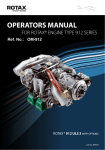
OPERATORS MANUAL
FOR ROTAX® ENGINE TYPE 912 SERIES
Ref. No.: OM-912
ROTAX ® 912 ULS 3 WITH OPTIONS
part no.: 899371
WARNING
Before starting the engine, read the Operator´s Manual, as it contains
important safety relevant information. Failure to do so may result in personal injuries including death. Consult the original equipment manufacturers handbook for additional instructions!
These technical data and the information embodied therein are the property of BRPRotax GmbH&Co. KG, Austria, acc, BGBI 1984 no. 448, and shall not, without prior
written permission of BRP-Rotax GmbH&Co. KG, be disclosed in whole or in part to
third parties. This legend shall be included on any reproduction of these data, in whole
or in part. The Manual must remain with the engine/aircraft in case of sale.
Copyright 2006 © - all rights reserved.
ROTAX® is a trade mark of BRP-Rotax GmbH&Co. KG. In the following document the
short form of BRP-Rotax GmbH&Co. KG = BRP-Rotax is used.
Other product names in this documentation are used purely for ease of identification
and may be trademarks of the respective company or owner.
Approval of translation has been done to best knowledge and judgement - in any case
the original text in german language is authoritative.
1)
2)
3)
4)
5)
6)
7)
8)
9)
Table of contents ............................................................................... 1-3
Index.................................................................................................... 2-1
Introduction ........................................................................................ 3-1
3.1) Remarks..................................................................................... 3-1
3.2) Engine serial number ............................................................... 3-1
Safety .................................................................................................. 4-1
4.1) Repeating symbols................................................................... 4-1
4.2) Safety information .................................................................... 4-2
4.3) Technical documentation ........................................................ 4-5
Index of pages.................................................................................... 5-1
List of amendments ........................................................................... 6-1
Description of design ........................................................................ 7-1
7.1) Type description ....................................................................... 7-2
7.2) Denomination of cylinders: ..................................................... 7-3
Technical data .................................................................................... 8-1
8.1) Dimensions ............................................................................... 8-1
8.2) Weights...................................................................................... 8-1
8.3) Fuel consumption..................................................................... 8-2
8.4) Direction of rotation ................................................................. 8-2
Description of systems ..................................................................... 9-1
9.1) Cooling system ......................................................................... 9-1
9.2) Fuel system ............................................................................... 9-2
9.3) Lubrication system................................................................... 9-3
9.4) Electric system ......................................................................... 9-4
9.5) Propeller gearbox ..................................................................... 9-5
9.5.1)
Hydr. governor for const. speed propeller, vacuum pump: ...... 9-6
10) Operating instructions .................................................................... 10-1
10.1) General limits of operation .................................................... 10-1
10.1.1) Operating speeds and limits (912 UL / A / F)......................... 10-1
10.1.1.1) Performance graphs for stand. conditions (ISA) . 10-3
10.1.1.2) Performance graph for non-standard conditions... 10-4
10.1.2) Operating speeds and limits (912 ULS / S)............................ 10-5
10.1.2.1) Performance graphs for stand. conditions (ISA) ... 10-7
10.1.2.2) Performance graph for non-standard conditions... 10-8
10.2) Operating media ..................................................................... 10-9
10.2.1) Coolant................................................................................... 10-9
10.2.2) Fuel ...................................................................................... 10-10
10.2.3) Lubricants ............................................................................ 10-11
d03925ENIVZ.fm
10.3) Standard operation............................................................... 10-13
10.3.1)
10.3.2)
10.3.3)
10.3.4)
10.3.5)
10.3.6)
Daily checks......................................................................... 10-13
Before engine start............................................................... 10-14
Pre-flight checks .................................................................. 10-15
Engine start.......................................................................... 10-16
Prior to take-off .................................................................... 10-17
Take-off................................................................................ 10-17
Effectivity: 912 Serie
OM Edition 1 / Rev. 0
BRP-Rotax
page 1 - 3
Jan.01/2007
10.3.7) Cruising ............................................................................... 10-18
10.3.8) Engine shut-off .................................................................... 10-18
10.3.9) Cold weather operation ....................................................... 10-18
10.4) Abnormal operation .............................................................. 10-20
10.4.1)
10.4.2)
10.4.3)
10.4.4)
10.4.5)
10.4.6)
Engine stop - Start during flight ........................................... 10-20
Exceeding of max. admissible engine speed ...................... 10-20
Exceeding of max. admissible cyl. head temperature ......... 10-20
Exceeding of max. admissible oil temperature .................... 10-20
Oil pressure below minimum - during flight ......................... 10-20
Oil pressure below minimum - on ground ............................ 10-20
d03925ENIVZ.fm
11) Checks .............................................................................................. 11-1
11.1) Engine preservation ............................................................... 11-1
12) Trouble shooting.............................................................................. 12-1
12.1) Reporting ................................................................................. 12-4
13) Authorized Distributors for ROTAX® Aircraft Engines................. 13-1
Effectivity: 912 Serie
OM Edition 1 / Rev. 0
BRP-Rotax
page 1 - 4
Jan.01/2007
2) Index
A
F
Abnormal operation 10-20
Acceleration (912 UL / A / F) 10-1
Acceleration (912 ULS / S) 10-5
AVGAS 100LL 10-10
Fuel 10-10
Fuel consumption 8-2
Fuel pressure (912 UL / A / F) 10-2
Fuel pressure (912 ULS / S) 10-6
Fuel system 9-2
C
Carburetor 10-14
Certification 7-2
Check of hydraulic propeller governor
10-17
Checks 11-1
Cold start 10-18
Cold weather operation 10-18
Configuration 7-2
Cooling system 9-1
Cruising 10-18
Cylinder head temperature
(912 ULS / S) 10-5
D
Daily checks 10-13
Denomination of cylinders 7-3
Description of design 7-1
Description of systems 9-1
Dimensions 8-1
Direction of rotation 8-2
Documentation (technical) 4-5
d03926ENMIX.fm
Hydr. governor for const. speed propeller 9-6
I
Ignition check 10-17
Ignition unit 9-4
Index of pages 5-1
Introduction 3-1
L
List of amendments 6-1
Lubricants 10-11
Lubrication system 9-3
M
magneto side 7-3
O
E
Electric system 9-4
Engine preservation 11-1
Engine serial number 3-1
Engine shut-off 10-18
Engine start 10-16
Engine start, operating temperature
(912 ULS / S) 10-5
Equipment 8-1
Exceeding of max. admissible cyl. head
temperature 10-20
Exceeding of max. admissible engine
speed 10-20
Exceeding of max. admissible oil temperature 10-20
Exhaust system 10-14
Effectivity: 912 Serie
OM Edition 1 / Rev. 0
H
Oil consumption 10-12
Oil pressure (912 UL / A / F) 10-1
Oil pressure (912 ULS / S) 10-5
Oil pressure below minimum - during
flight 10-20
Oil pressure below minimum - on
ground 10-20
Oil specification 10-11
Oil temperature (912 UL / A / F ) 10-1
Oil temperature (912 ULS / S) 10-5
Oil viscosity 10-12
Operating media 10-15
Operating speeds and limits
(912 UL / A / F) 10-1
Operating speeds and limits
(912 ULS / S) 10-5
Overload clutch 9-5
BRP-Rotax
page 2 - 1
Jan.01/2007
P
Performance (ISA) (912 UL / A / F) 10-1
Performance (ISA) (912 ULS / S) 10-5
Performance data 10-4, 10-8
Performance graphs for stand. conditions (ISA) 10-3, 10-7
power take-off side 7-3
Pre-flight checks 10-15
Propeller gearbox 9-5
Propeller governor 9-6
R
Remarks 3-1
Repeating symbols 4-1
Reporting 12-4
S
Safety 4-1
Safety information 4-2
Speed (912 UL / A / F) 10-1
Speed (912 ULS / S) 10-5
Symbols 4-1
T
Table of lubricants 10-12
Take-off 10-17
Technical data 8-1
Technical documentation 4-5
Throttle response 10-17
Trouble shooting 12-1
Type 7-2
Type description 7-2
V
Vacuum pump 9-6
W
d03926ENMIX.fm
Warming up period 10-17
Weights 8-1
Effectivity: 912 Serie
OM Edition 1 / Rev. 0
BRP-Rotax
page 2 - 2
Jan.01/2007
3) Introduction
Congratulations on your decision to purchase a ROTAX aircraft engine.
Before operating the engine, carefully read this Operator's Manual. The Manual provides you with basic information on the safe operation of the engine.
If any passages of the Manual are not clearly understood or in case of any
questions, please, contact an authorized Distribution- or Service Center for
ROTAX aircraft engines.
We wish you much pleasure and satisfaction flying your aircraft with this
ROTAX engine.
3.1)
Remarks
The purpose of this Operator's Manual is provided to familiarize the owner/
user of this aircraft engine with basic operating instructions and safety information.
For more detailed maintenance, safety and flight information, consult the documentation provided by the aircraft manufacturer and dealer.
For further information on maintenance and spare parts service, contact the
nearest ROTAX distribution Center (see Chapter 13).
3.2)
Engine serial number
On all enquiries or parts orders, always indicate the engine serial number,
as the manufacturer makes modifications to the engine for product improvement. The engine serial number should always be used when ordering parts
to ensure correct part selection prior to shipment.
d03927.fm
The engine serial number is located on the top of the crankcase, magneto
side. See fig. 2.
Effectivity: 912 Serie
OM Edition 1 / Rev. 0
BRP-Rotax
page 3 - 1
Jan.01/2007
d03927.fm
NOTES
Effectivity: 912 Serie
OM Edition 1 / Rev. 0
BRP-Rotax
page 3 - 2
Jan.01/2007
4) Safety
Although the mere reading of these instructions will not eliminate a hazard, the understanding and application of the information herein will promote the proper use of
the engine.
The information and components-/system descriptions contained in this Operator's
Manual are correct at the time of publication. ROTAX however, maintains a policy
of continuous improvement of its products without imposing upon itself any obligation to install them on its products previously manufactured.
ROTAX reserves the right at any time to discontinue or change specifications, designs, features, models or equipment without incurring obligation.
The illustrations in this Manual show the typical construction. They may not represent in full detail or the exact shape of the parts which have the same or similar
function.
Specifications are given in the SI metric system with the USA equivalent in parenthesis. Where precise accuracy is not required, some conversions are rounded off
for easier use.
This document has been translated from the German language and the original
German text shall be deemed authoritative.
4.1)
Repeating symbols
This Manual uses the following symbols to emphasize particular information:
Identifies an instruction which, if not followed, may
cause serious injury including the possibility of
death.
■ CAUTION:
Denotes an instruction which, if not followed, may
severely damage the engine or other component.
◆ NOTE:
Indicates supplementary information which may be
needed to fully complete or understand an instruction.
d03928.fm
▲ WARNING:
Effectivity: 912 Serie
OM Edition 1 / Rev. 0
BRP-Rotax
page 4 - 1
Jan. 01/2007
4.2)
Safety information
▲ WARNING:
Never fly the aircraft equipped with this engine at locations, airspeeds, altitudes, or other circumstances from
which a successful no-power landing cannot be made,
after sudden engine stoppage.
Unless correctly equipped to provide enough electrical
power for night VFR (according latest requirement as
ASTM), the ROTAX 912 UL/ULS/ULSFR is restricted to
DAY VFR only.
- This engine is not suitable for acrobatics (inverted flight, etc.).
- This engine shall not be used on rotorcrafts with an in-flight driven rotor
(e.g. helicopters).
- It should be clearly understood that the choice, selection and use of this
particular engine on any aircraft is at the sole discretion and responsibility
of the aircraft manufacturer, assembler and owner/user.
- Due to the varying designs, equipment and types of aircraft, ROTAX
grants no warranty or representation on the suitability of its engine’s use
on any particular aircraft. Further, ROTAX grants no warranty or representation of this engine’s suitability with any other part, component or
system which may be selected by the aircraft manufacturer, assembler or
user for aircraft application.
- Whether you are a qualified pilot or a novice, complete knowledge of the
aircraft, its controls and operation is mandatory before venturing solo.
Flying any type of aircraft involves a certain amount of risk. Be informed
and prepared for any situation or hazard associated with flying.
A recognized training program and continued education for piloting an
aircraft is absolutely necessary for all aircraft pilots. Make sure you also
obtain as much information as possible about your aircraft, its maintenance and operation from your dealer.
- You should be aware that any engine may seize or stall at any time. This
could lead to a crash landing and possible severe injury or death. For this
reason, we recommend strict compliance with the maintenance and operation and any additional information which may be given to you by your
dealer.
- Select and use proper aircraft instrumentation. This instrumentation is not
included with the ROTAX engine package. Only approved instrumentation may be installed.
Effectivity: 912 Serie
OM Edition 1 / Rev. 1
BRP-Rotax
page 4 - 2
Febr. 01/2008
d02820.fm
- Respect all government or local rules pertaining to flight operation in your
flying area. Fly only when and where conditions, topography, and airspeeds are safest.
- Before flight, ensure that all engine controls are operative. Make sure all
controls can be easily reached in case of an emergency.
- Unless in a run up area, never run the engine with the propeller turning
while on the ground. Do not operate engine if bystanders are close.
- In the interest of safety, the aircraft must not be left unattended while the
engine is running.
- Keep an engine log and respect engine and aircraft maintenance schedules. Keep the engine in top operating condition at all times. Do not operate any aircraft which is not properly maintained or has engine operating
irregularities which have not been corrected.
Since special tools and equipment may be required, engine servicing
should only be performed by an authorized ROTAX engine dealer or a
qualified trained mechanic approved by the local airworthiness authority.
- To eliminate possible injury or damage, ensure any loose equipment or
tools are properly secured before starting the engine.
- When in storage protect the engine and fuel system from contamination
and exposure.
- Certain areas, altitudes and conditions present greater risk than others.
The engine may require carburetor recalibration or humidity or dust/sand
preventative equipment, or additional maintenance may be required.
Consult your aircraft dealer or manufacturer and obtain the necessary information, especially before flying in new areas.
- Never operate the engine and gearbox without sufficient quantities of lubricating oil.
- Periodically verify level of coolant.
- Never exceed maximum rated r.p.m. Allow the engine to cool at idle for
several minutes before turning off the engine.
d03928.fm
- This engine may be equipped with an Airborne vacuum pump. The safety
warning accompanying the vacuum pump must be given to the owner/
operator of the aircraft into which the vacuum pump is installed.
Effectivity: 912 Serie
OM Edition 1 / Rev. 0
BRP-Rotax
page 4 - 3
Jan. 01/2007
d03928.fm
NOTES
Effectivity: 912 Serie
OM Edition 1 / Rev. 0
BRP-Rotax
page 4 - 4
Jan. 01/2007
4.3)
Technical documentation
These documents form the instructions for continued airworthiness of
ROTAX aircraft engines:
- Installation Manual 912 F
- Installation Manual 912 A
- Installation Manual 912 UL
- Installation Manual 912 S
- Operators Manual
- Maintenance Manual 912 Series (Line and Heavy Maintenance)
- Overhaul Manual 912 A / F
- Illustrated Parts Catalog 912 A / F / S / UL / ULS / ULSFR
- Alert Service Bulletins
- Service Bulletins
- Service Instructions
- Service Letters
Any reference to a document refers to the latest edition issued by ROTAX if
not stated otherwise.
◆ NOTE:
The status of Manuals can be determined by checking
the table of amendments of the Manual. The 1st column
of this table is the revision status. Compare this number
to that listed on the ROTAX WebSite: www.rotaxaircraft-engines.com. Updates and current revisions
can be downloaded for free.
The information given in the are based on data and experience that are considered applicable for professionals under normal conditions.
The fast technical progress and variations of installation might render present laws and regulations inapplicable or inadequate.
d03928.fm
The illustrations in this Manual are mere sketches and show a typical arrangement. They may not represent the actual part in all its details but depict
parts of the same or similar function. Therefore deduction of dimensions or
other details from illustrations is not permitted.
Effectivity: 912 Serie
OM Edition 1 / Rev. 0
BRP-Rotax
page 4 - 5
Jan. 01/2007
All necessary documentation is available from the ROTAX Distribution- and
Service Centers (see Chapter 13).
◆ NOTE:
The Illustrations in this Operator´s Manual are stored in
a graphic data file and are provided with a consecutive
irrelevant number.
d03928.fm
This number (e.g. 00277) is of no significance for the
content.
Effectivity: 912 Serie
OM Edition 1 / Rev. 0
BRP-Rotax
page 4 - 6
Jan. 01/2007
5) Index of pages
Chapter
Page
Date
cover page
1-2
1-3
1-4
01 01 2007
01 01 2007
01 01 2007
2
2-1
2-2
01 01 2007
01 01 2007
3
3-1
3-2
01 01 2007
01 01 2007
4
4-1
4-2
4-3
4-4
4-5
4-6
01 01 2007
02 01 2008
01 01 2007
01 01 2007
01 01 2007
01 01 2007
5
5-1
5-2
02 01 2008
01 01 2007
6
6-1
6-2
7
Chapter
Page
Date
10
10-1
10-2
10-3
10-4
10-5
10-6
10-7
10-8
10-9
10-10
10-11
10-12
10-13
10-14
10-15
10-16
10-17
10-18
10-19
10-20
02 01 2008
02 01 2008
01 01 2007
01 01 2007
01 01 2007
02 01 2008
01 01 2007
01 01 2007
01 01 2007
01 01 2007
01 01 2007
01 01 2007
02 01 2008
02 01 2008
02 01 2008
01 01 2007
01 01 2007
01 01 2007
01 01 2007
01 01 2007
02 01 2008
01 01 2007
11
11-1
11-2
01 01 2007
01 01 2007
7-1
7-2
7-3
7-4
01 01 2007
02 01 2008
01 01 2007
01 01 2007
12
8
8-1
8-2
01 01 2007
01 01 2007
12-1
12-2
12-3
12-4
12-5
12-6
01 01 2007
01 01 2007
01 01 2007
01 01 2007
01 01 2007
01 01 2007
13
9
9-1
9-2
9-3
9-4
9-5
9-6
01 01 2007
01 01 2007
01 01 2007
01 01 2007
01 01 2007
01 01 2007
13-1
13-2
13-3
13-4
rear page
02 01 2008
02 01 2008
02 01 2008
01 01 2008
d03929.fm
1
Effectivity: 912 Serie
OM Edition 1 / Rev. 1
BRP-Rotax
page 5 - 1
Febr. 01/2008
d03929.fm
NOTES
Effectivity: 912 Serie
OM Edition 1 / Rev. 0
BRP-Rotax
page 5 - 2
Jan. 01/2007
6) List of amendments
Approval*
The technical content is approved under the authority
of DOA Nr. EASA.21.J.048.
Chapter
Pages
Date
of
modification
Note
of
approval
0
1 to 13
all
01 01 2007
DOA*
1
1
1
1
1
4
5
6
7
10
1
13
4-2
5-1
6-1
7-2
10-1
10-2
10-6
10-13
10-14
10-15
13-1
13-2
13-3
02 01 2008
02 01 2008
02 01 2008
02 01 2008
02 01 2008
02 01 2008
02 01 2008
02 01 2008
02 01 2008
02 01 2008
02 01 2008
02 01 2008
02 01 2008
DOA*
DOA*
DOA*
DOA*
DOA*
DOA*
DOA*
DOA*
DOA*
DOA*
DOA*
DOA*
DOA*
Date of
approval
by authority
Date of
insertion
Marks/
Signature
d02822.fm
Currt
no.
Effectivity: 912 Serie
OM Edition 1 / Rev. 1
BRP-Rotax
page 6 - 1
Febr. 01/2008
d03930.fm
NOTES
Effectivity: 912 Serie
OM Edition 1 / Rev. 0
BRP-Rotax
page 6 - 2
Jan. 01/2007
7) Description of design
4-stroke, 4 cylinder horizontally opposed, spark ignition engine, one central camshaft - push-rods - OHV
Liquid cooled cylinder heads
Ram air cooled cylinders
Dry sump forced lubrication
Dual breakerless capacitor discharge ignition
2 constant depression carburetors
mechanical fuel pump
Prop drive via reduction gear with integrated shock absorber and overload clutch
◆ NOTE:
The overload clutch is installed on all serial production aircraft
engines which are certified and on non-certified aircraft engines
of the configuration 3.
Electric starter (12V 0,6 kW)
Electric starter (12V 0,9 kW), optional
Integrated AC generator with external rectifier-regulator (12V 20A DC)
External alternator (12V 40A DC), optional
Vacuum pump: (only for A1, A2 and A4 possible), optional
d03931.fm
Hydraulic constant speed propeller governor: (for A3 only), optional
Effectivity: 912 Serie
OM Edition 1 / Rev. 0
BRP-Rotax
page 7 - 1
Jan. 01/2007
7.1)
Type description
e.g. ROTAX 912 A 2
◆ NOTE:
The type designation is of the following composition.
Baureihe
(configuration)
Type
(type)
Zulassung
(certification)
ROTAX
02091
Type:
912
...
4-cyl. horizontalle opposed, normal aspirated
engine
Certification:
A
...
certified to JAR 22 (TC No. EASA.E.121)
F, S
...
certified to
FAR 33 (TC No. E00051 EN)
JAR-E (TC No. EASA.E.121)
UL, ULS
...
non-certified aircraft engines
1
...
Prop shaft with flange for fixed prop, P.C.D
100 mm
Configuration:
◆ NOTE:
This configuration is not available any longer and will be replaced by configuration 2.
...
Prop shaft with flange for fixed prop, P.C.D
75 mm, P.C.D 80 mm and 4“ P.C.D
3
...
propeller P.C.D. 75 mm, P.C.D. 80 mm, P.C.D.
4" and drive for hydraulic governor for constant
speed propeller
4
...
Prop flange for fixed pitch propeller P.C.D.
75 mm, P.C.D. 80 mm, P.C.D. 4" and prepared
for retrofit of a hydraulic governor for constant
speed propeller
d02823.fm
2
Effectivity: 912 Serie
OM Edition 1 / Rev. 1
BRP-Rotax
page 7 - 2
Febr. 01/2008
7.2)
Denomination of cylinders:
8
3
Lateral view
fig. 1
00337
Cyl. 1
Cyl. 3
2
magneto side
power take of side
4
1
Top view
7
d03931.fm
6
2
fig. 2
Cyl. 2
Effectivity: 912 Serie
OM Edition 1 / Rev. 0
Cyl. 4
BRP-Rotax
00334
page 7 - 3
Jan. 01/2007
fig. 3
00336
Front view
(1)
engine serial number
(6)
exhaust flange
(2)
CD carburetor
(7)
external alternator
(3)
propeller gear box
(8)
vacuum pump or hydraulic
governor for constant speed
propeller
electric starter
(5)
expansion tank with excess
pressure valve
d03931.fm
(4)
Effectivity: 912 Serie
OM Edition 1 / Rev. 0
BRP-Rotax
page 7 - 4
Jan. 01/2007
8) Technical data
8.1)
8.2)
Dimensions
Description
912 UL / A / F
912 UL / ULS
Bore
79,5 mm (3,13 in)
84 mm (3,31 in)
Stroke
61 mm (2,40 in)
61 mm (2,40 in)
Displacement
1211 mm3 (73,9 in3)
1352 mm3 (82,5 in3)
Compression
ratio.
9,0 : 1
10,5 : 1
Weights
◆ NOTE:
The stated weights are dry weights (without operating
fluids)
with:
electric starter, carburetors, internal
generator, ignition unit and oil tank
without:
exhaust system, radiator, airbox
Weight in kg (lb)
912 UL
912 A
Configuration 2/4
57,1 (126) with
overload clutch
55,4 (122)
without clutch
Configuration 3
57,1
(126)
912 F
57,1
(126)
59,8 (132)
912 ULS
912 S
58,3 (128) with
overload clutch
58,3
(128)
56,6 (125)
without clutch
61 (134)
d03932.fm
Equipment:
External alternator:
.................
3,0 kg (6,6 lb)
Vacuum pump:
.................
0,8 kg (1,8 lb)
Overload clutch:
.................
1,7 kg (3,7 lb)
◆ NOTE:
Effectivity: 912 Serie
OM Edition 1 / Rev. 0
The overload clutch is installed on all certified aircraft
engines and on non-certified aircraft engines of the
configuration 3.
BRP-Rotax
page 8 - 1
Jan.01/2007
8.3)
Fuel consumption
Fuel consumption in l/h (US gal/h)
912 UL / A F
912 ULS / S
at take-off performance
24,0 (6,3)
27,0 (7,1)
at max. continuous performance
22,6 (5,6)
25,0 (6,6)
at 75% ontinuous performance
16,2 (4,3)
18,5 (4,9)
285 g/kWh
(0,47 lb/hph)
285 g/kWh
(0,47 lb/hph)
specific consumtion at max.
continuous performance
8.4)
Direction of rotation
Direction of rotation on propeller shaft: ................ counter clockwise,
looking at p.t.o. side of
engine
◆ NOTE:
Propeller shouldn’t be turned reverse the normal direction of engine rotation.
normal direction of propeller rotation (engine)
d03932.fm
03646
Effectivity: 912 Serie
OM Edition 1 / Rev. 0
BRP-Rotax
page 8 - 2
Jan.01/2007
9) Description of systems
9.1)
Cooling system
See fig. 4.
The cooling system of the ROTAX 912 is designed for liquid cooling of the
cylinder heads and ram-air cooling of the cylinders. The cooling system of
the cylinder heads is a closed circuit with an expansion tank.
The coolant flow is forced by a water pump, driven from the camshaft, from
the radiator to the cylinder heads. From the top of the cylinder heads the
coolant passes on to the expansion tank (1). Since the standard location of
the radiator (2) is below engine level, the expansion tank located on top of
the engine allows for coolant expansion.
The expansion tank is closed by a pressure cap (3) (with excess pressure
valve and return valve). At temperature rise of the coolant the excess pressure valve opens and the coolant will flow via a hose at atmospheric pressure to the transparent overflow bottle (4). When cooling down, the coolant
will be sucked back into the cooling circuit.
◆ NOTE:
Coolant temperatures are measured by means of temperature probes installed in cylinder heads 2 and 3.
Readings are taken on measuring point of the hottest cylinder head, depending on engine installation.
Coolant, see Chapter 10.2.1).
Ausgleichsgefäß / expansion tank
3
1
4
Überlaufgefäß /
overflow bottle
2
Kühler / radiator
fig. 4
d03933.fm
08111
Effectivity: 912 Serie
OM Edition 1 / Rev. 0
BRP-Rotax
page 9 - 1
Jan.01/2007
9.2)
Fuel system
See fig. 5.
The fuel flows from the tank (1) via a coarse filter (2) the safety cock (3), water drain cock (4) and fine filter (5) to the mechanical fuel pump (6). From the
pump fuel passes on to the two carburetors (7).
Via the return line (8) surplus fuel flows back to the fuel tank.
◆ NOTE:
The return line serves to avoid formation of vapour
lock.
Fuel, see Chapter 10.2.2).
1
2
8
5
zum Tank
to fuel tank
3
4
6
7
zum Manometer /
to fuel pressure gauge
fig. 5
d03933.fm
00535
Effectivity: 912 Serie
OM Edition 1 / Rev. 0
BRP-Rotax
page 9 - 2
Jan.01/2007
9.3)
Lubrication system
See fig. 6.
The ROTAX 912 engine is provided with a dry sump forced lubrication system with a main oil pump with integrated pressure regulator (1) and oil pressure sensor (2).
◆ NOTE:
The oil pump is driven by the camshaft.
The oil pump (3) sucks the motor oil from the oil tank (4) via the oil cooler
(5) and forces it through the oil filter (6) to the points of lubrication in the engine.
The surplus oil emerging from the points of lubrication accumulates on the
bottom of crankcase and is forced back to the oil tank by the blow-by gases.
◆ NOTE:
The oil circuit is vented via bore (7) on the oil tank.
◆ NOTE:
The oil temperature sensor (8) for reading of the oil inlet temperature is located on the oil pump housing.
Lubricants, see Chapter 10.2.3).
7
7
2
2
3
3
88
6
1
1
4
6
fig. 6
00523
4
d03933.fm
5
5
Effectivity: 912 Serie
OM Edition 1 / Rev. 0
BRP-Rotax
page 9 - 3
Jan.01/2007
9.4)
Electric system
See fig. 7.
The ROTAX 912 engine is equipped with a dual ignition unit of a breakerless, capacitor discharge design, with an integrated generator.
The ignition unit is completely free of maintenance and needs no external
power supply.
Two independent charging coils (1) located on the generator stator supply
one ignition circuit each. The energy is stored in capacitors of the electronic
modules (2). At the moment of ignition 2 each of the 4 external trigger coils
(3) actuate the discharge of the capacitors via the primary circuit of the dual
ignition coils (4).
Firing order: 1-4-2-3.
The 5th trigger coil (5) is planned for rev. counter signal.
◆ NOTE:
Ignition circuit A
2
B3
/4
4
5
A1/2
3
A3/4
B1
/2
3
4
2
1
4
4
fig. 7
00425
d03933.fm
Ignition circuit B
Effectivity: 912 Serie
OM Edition 1 / Rev. 0
BRP-Rotax
page 9 - 4
Jan.01/2007
9.5)
Propeller gearbox
See fig. 8.
For the engine type 912 two reduction ratios are available.
reduction ratio
912 UL / A / F
912 ULS / S
2,27 : 1
crankshaft: propeller shaft
2,43 : 1
(optional)
2,43 : 1
Depending on engine type, certification and configuration the propeller gearbox is supplied with or without an overload clutch.
◆ NOTE:
The overload clutch is installed on serial production on
all certified aircraft engines and on the non-certified
aircraft engines of configuration 3.
fig. 8
02531
◆ NOTE:
Fig. 8 shows a propeller gearbox of configuration 2 with
the integrated overload clutch.
The design incorporates a torsional shock absorber. The shock absorbing is
based on progressive torsional cushioning due to axial spring load acting on
a dog hub.
On the gearbox version with overload clutch the design incorporates a friction damped free play at the dogs to warrant proper engine idling.
Due to this backlash at the dogs a distinct torsional impact arises at start,
stop and at sudden load changes, but due to the built-in overload clutch it
will remain harmless.
d03933.fm
◆ NOTE:
This overload clutch will also prevent any undue load to
the crankshaft in case of ground contact of the propeller.
Alternatively either a vacuum pump or a hydraulic governor for constant
speed propeller can be used. The drive is in each case via the propeller reduction gear.
Effectivity: 912 Serie
OM Edition 1 / Rev. 0
BRP-Rotax
page 9 - 5
Jan.01/2007
9.5.1)
Hydr. governor for const. speed propeller, vacuum pump:
Alternatively either a vacuum pump or a hydraulic governor for
constant speed propeller can be used. The drive is in each case via
the propeller reduction gear.
Gear ratio:
gear ratio
crankshaft : propeller shaft
propeller shaft : hydraulic governor/vacuum pump
crankshaft : hydraulic governor/vacuum pump
2,43 : 1
0,758 : 1
1,724 : 1
1,842 : 1
Transmission ratio between crankshaft and hydraulic governor or vacuum pump is either
1,842 or 1,724 i.e. the speed of the hydraulic
governor or vacuum pump is either 0,54 or 0,58
of engine speed.
d03933.fm
◆ NOTE:
2,27 : 1
Effectivity: 912 Serie
OM Edition 1 / Rev. 0
BRP-Rotax
page 9 - 6
Jan.01/2007
10) Operating instructions
The data of the certified engines are based on type certificate of type
912 A JAR 22 (TC No. EASA.E.121),
912 F / S FAR 33 (TC No. E00051EN), JAR-E (TC No. EASA.E.121)
10.1) General limits of operation
10.1.1) Operating speeds and limits (912 UL / A / F)
1.
Speed:
Take-off speed .................................... 5800 1/min (5 min.)
Max. continuous speed ....................... 5500 1/min
Idle speed ........................................... approx. 1400 1/min
2.
Performance (ISA): (International Standard Atmosphere)
Take-off performance.......................... 59,6 kW at 5800 1/min
Max. continuous performance............. 58 kW at 5500 1/min
3.
Acceleration:
Limit of engine operation at zero gravity and in negative "g"condition
max. .................................................... 5 seconds at max. -0,5 g
4.
Oil pressure:
max. .................................................... 7 bar
■ CAUTION:
For a short period admissible at cold start.
min. ..................................................... 0,8 bar (12 psi) (below 3500 rpm)
normal ................................................. 2,0 - 5,0 bar (29 - 73 psi) (above
............................................................ 3500 rpm)
5.
Oil temperature:
max. .................................................... 140 °C..............(285 °F)
min. ..................................................... 50 °C................(120 °F)
normal operating temperature............. approx.. 90 - 110 °C (190 - 230 °F)
6.
Coolant
See Operating media Chapter 10.2.1
- In use of conventional coolant:
Coolant temperature: (coolant exit temperature)
max.....................................................120 °C (248 °F)
Cylinder head temperature:
max.....................................................150 °C (300 °F)
Permanent monitoring of coolant temperature and cylinder head temperature
is necessary.
- In use of waterless coolant:
Cylinder head temperature:
max.....................................................150 °C (300 °F)
d02824.fm
Permanent monitoring of cylinder head temperature is necessary.
UL / A / F
Effectivity: 912 Serie
OM Edition 1 / Rev. 1
BRP-Rotax
page 10 - 1
Febr. 01/2008
7.
Engine start, operating temperature:
max...................................................... 50 °C .............. (120 °F)
min.......................................................-25 °C .............. (-13 °F)
8.
Fuel pressure:
max......................................................0,4 bar ............. 5,8 psi)
min.......................................................0,15 bar ........... 2,2 psi)
▲ WARNING: Exceeding the max. admissible fuel pressure will override the float valve of the carburetor and to engine failure.
The aircraft engine manufacturer strongly recommends the installation of an
additional pump, unless this has not been covered by legal obligations so
far.
9.
Power consumption of the hydraulic propeller governor:
max......................................................600 W
10. Power consumption of the vacuum pump:
max......................................................300 W
11. Power consumption of the external alternator:
max......................................................1200 W
12. Deviation from bank angle
max......................................................40°
Up to this value the dry sump lubrication system warrants lubrication in every flight situation.
d02824.fm
◆ NOTE:
Effectivity: 912
912 Serie
UL / A / F
Effectivity:
OM Edition 1 / Rev. 1
BRP-Rotax
page 10 - 2
Febr. 01/2008
10.1.1.1) Performance graphs for stand. conditions (ISA)
A: max. engine output
B: power requirement of propeller
00450
kW
60
hp
80
70
50
60
A
40
50
30
40
B
30
20
20
10
10
0
3000
4000
5000
5800 rpm
fig. 9
C: manifold pressure
D: fuel consumption
00451
L/h (Gal/h)
30 (7,93)
in.Hg
30
C
20 (5,28)
20
D
10 (2,64)
10
d03934.fm
0
3000
4000
5000
Values along propeller curve
UL / A / F
Effectivity: 912 Serie
OM Edition 1 / Rev. 0
BRP-Rotax
0
5800 rpm
fig. 10
page 10 - 3
Jan. 01/2007
Performance data for variable pitch propeller:
Engine operation is permitted without restriction between full throttle performance and power requirement of propeller, providing engine speed over 5500 r.p.m. is restricted to 5 minutes.
However, for economic reasons it is recommended to run the engine in accordance with the following table:
Engine PowerSetting
Engine speed
[rpm]
Performance
[kW]
Torque [Nm]
Manifold pres.
[in.HG]
Take-off perform.
5800
59,6
98,1
full throttle
cruising power
5500
58,0
100,7
full throttle
75%
5000
43,5
83,1
27,2
65%
4800
37,7
75,0
26,5
55%
4300
31,9
70,8
26,3
10.1.1.2) Performance graph for non-standard conditions
The following graph shows the performance drop with increasing flight altitude. The curves show the performance
at 5800, 5500, 5000, 4500 and 4000 r.p.m., at full throttle.
The engine allows operation with fully open throttle valve
over the whole r.p.m. range, without limitation. But full
throttle performance above 5500 r.p.m. is limited to 5 minutes.
60
Leistung / Performance [kW]
50
At deviation of temperature conditions from standard atmosphere conditions the engine performance to be expected can be
calculated from the performance
indicated, multiplied by standard
temperature, divided by actual
temperature in °K.
5800 1/min Vollast
take off performance
5500
5000
40
4500
4000
30
P akt. = P stand. T standard
----------------------Taktuell
20
T[K] = t [°C]+273
10
0
2000
3000 4000 5000 6000 7000
Dichtehöhe / Density Altitude [m]
00452
Effectivity: 912 Serie
UL / A / F
OM Edition 1 / Rev. 0
d03934.fm
1000
fig. 11
BRP-Rotax
page 10 - 4
Jan. 01/2007
10.1.2) Operating speeds and limits (912 ULS / S)
1.
Speed:
Take-off speed .................................... 5800 1/min (5 min.)
Max. continuous speed ....................... 5500 1/min
Idle speed ........................................... approx. 1400 1/min
2.
Performance (ISA): (International Standard Atmosphere)
Take-off performance.......................... 73,5 kW at 5800 1/min
Max. continuous performance............. 69 kW at 5500 1/min
3.
Acceleration:
Limit of engine operation at zero gravity and in negative "g" conditions
max. .................................................... 5 seconds at max. -0,5 g
4.
Oil pressure:
max. .................................................... 7 bar
■ CAUTION:
For a short period admissible at cold start.
min. ..................................................... 0,8 bar (12 psi) (below 3500 rpm)
normal ................................................. 2,0 - 5,0 bar (29 - 73 psi) (above
3500 rpm)
5.
Oil temperature:
max. .................................................... 130 °C..............(266 °F)
min. ..................................................... 50 °C................(120 °F)
normal operating temperature............. approx. 90 - 110 °C (190 - 230 °F)
6.
Coolant:
See Operating media Chapter 10.2.1
- In use of conventional coolant:
Coolant temperature: (coolant exit temperature)
max.....................................................120 °C (248 °F)
Cylinder head temperature:
max.....................................................135 °C (275 °F)
Permanent monitoring of coolant temperature and cylinder head temperature
is necessary.
- In use of waterless coolant:
Cylinder head temperature:
max.....................................................135 °C (275 °F)
Permanent monitoring of cylinder head temperature is necessary.
Engine start, operating temperature:
max. .................................................... 50 °C...............(120 °F)
min. ..................................................... - 25 °C .............(- 13 °F)
d03934.fm
7.
ULS / S
Effectivity: 912 Serie
OM Edition 1 / Rev. 0
BRP-Rotax
page 10 - 5
Jan. 01/2007
8.
Fuel pressure:
max......................................................0,4 bar ............. (5,8 psi)
min.......................................................0,15 bar ........... (2,2 psi)
▲ WARNING: Exceeding the max. admissible fuel pressure will override the float valve of the carburetor and to engine failure.
The aircraft engine manufacturer strongly recommends the installation of an
additional pump, unless this has not been covered by legal obligations so
far.
9.
Power consumption of the hydraulic propeller governor:
max......................................................600 W
10. Power consumption of the vacuum pump:
max......................................................300 W
11. Power consumption of the external alternator:
max......................................................1200 W
12. Deviation from bank angle
max......................................................40°
Up to this value the dry sump lubrication system warrants lubrication in every flight situation.
d02824.fm
◆ NOTE:
Effectivity:
Effectivity: 912
912 ULS
Serie/ S
OM Edition 1 / Rev. 1
BRP-Rotax
page 10 - 6
Febr. 01/2008
10.1.2.1) Performance graphs for stand. conditions (ISA)
130
130
120
120
90
115
80
max. Motorleistung
max. engine output
70
110
60
50
105
40
30
100
Propellerkurve
power requirement of
propeller
20
Drehmoment / Torque [Nm]
100
Leistung / Perfomance [KW]
125
Drehmoment
Torque
110
95
10
0
2500
3000
3500
4000
4500
5000
5500
90
5800
Drehzahl / Engine Speed [1/min]
02001
fig. 12
30
Ansaugladedruck
manifold pressure
25
25
20
15
20
Werte bezogen auf die
Propeller-Kurve
values along propeller
curve
15
10
10
Benzinverbrauch
fuel consumption
5
5
0
2500
Benzinverbrauch / Fuel consumption [L/h]
Ansaugladedruck / manifold pressure [in.Hg]
30
0
3000
3500
4000
4500
5000
5500
5800
d03934.fm
Drehzahl/Engine speed [1/min / rpm]
02002
fig. 13
Effectivity: 912
912 Serie
ULS / S
Effectivity:
OM Edition 1 / Rev. 0
BRP-Rotax
page 10 - 7
Jan. 01/2007
Performance data for variable pitch propeller:
Engine operation is permitted without restriction between full throttle performance and power requirement of propeller, providing engine speed over 5500 r.p.m. is restricted to 5 minutes.
However, for economic reasons it is recommended to run the engine in accordance with the following table:
Engine PowerSetting
Engine speed
[rpm]
Performance
[kW]
Torque [Nm]
Manifold pres.
[in.HG]
Take-off perform.
5800
73,5
121,0
27,5
cruising power
5500
69,0
119,8
27
75%
5000
51,0
97,4
26
65%
4800
44,6
88,7
26
55%
4300
38,0
84,3
24
10.1.2.2) Performance graph for non-standard conditions
The following graph shows the performance drop with increasing flight altitude. The curves show the performance
at 5800, 5500, 5000, 4800 and 4300 r.p.m., at full throttle.
The engine allows operation with fully open throttle valve
over the whole r.p.m. range, without limitation. But full
throttle performance above 5500 r.p.m. is limited to 5 minutes.
At deviation of temperature conditions from standard atmosphere conditions the engine performance to be expected can be calculated from the performance
indicated, multiplied by standard temperature, divided by
actual temperature in °K.
80
5800 U/min Vollast
take off performance
Leistung / Performance [KW]
P akt. = P stand. T standard
5800
70
----------------------Taktuell
5500
60
5000
50
T[K] = t [°C]+273
4800
40
4300
30
20
0
1000
2000
3000
4000
5000
6000
7000
d03934.fm
10
7500
Dichtehöhe / Density Altitude [m]
fig. 14
Effectivity: 912
912 Serie
ULS / S
Effectivity:
OM Edition 1 / Rev. 0
05482
BRP-Rotax
page 10 - 8
Jan. 01/2007
10.2) Operating media
10.2.1) Coolant
In principle, 2 different types of coolant are permitted.
- Conventional coolant based on ethylene glycol
- Waterless coolant based on propylene glycol
■ CAUTION:
Obey the manufacturer's instructions about the
coolant.
mixture ratio %
designation
concentrate
water
conventional e.g. BASF Glysantine
anticorrosion
50
50
waterless e.g. EVANS NPG+
100
0
Conventional coolant mixed with water has the advantage of a higher specific thermal capacity than water-less coolant.
◆ NOTE:
The important advantage of water-less coolant
is its higher boiling point than a conventional
mixture.
When correctly applied, there is sufficient protection against vapor
bubble formation, freezing or thickening of the coolant within the
operating limits.
Use the coolant specified in the manufacturer's documentation.
Obey the latest edition of Service Instruction
SI-912-016 for the selection of the correct coolant.
d03934.fm
■ CAUTION:
Effectivity: 912 Serie
OM Edition 1 / Rev. 0
BRP-Rotax
page 10 - 9
Jan. 01/2007
10.2.2) Fuel
The following fuels can be used :
Usage / Description
912 UL / A / F
912 ULS / S
MOGAS
EN 228 Normal 1)
European
standard
EN 228 Super 1)
EN 228 Super 2)
EN 228 Super plus 1)
EN 228 Super plus 2)
Canadian
standard
CAN/CGSB3.5
Quality 13)
CAN/CGSB3.5
Quality 3 4)
US standard
ASTM D4814
ASTM D4814
AVGAS 100 LL
(ASTM D910)
AVGAS 100 LL
(ASTM D910)
AVGAS
US standard
1)
min. ROZ 90
2)
min. ROZ 95
3)
min. AKl* 87
4)
min. AKl 91
■ CAUTION:
Use only fuel suitable for the respective climatic
zone.
◆ NOTE:
Risk of vapour formation if using winter fuel for
summer operation.
■ CAUTION:
Obey the latest edition of Service Instruction
SI-912-016 for the selection of the correct fuel.
Effectivity: 912 Serie
OM Edition 1 / Rev. 0
BRP-Rotax
page 10 - 10
Jan. 01/2007
d03934.fm
AVGAS 100LL places greater stress on the valve seats due to its
high lead content and forms increased deposits in the combustion
chamber and lead sediments in the oil system. Thus it should only
be used in case of problems with vapor lock or when other types of
gasoline are unavailable.
10.2.3) Lubricants
Oil: Motorcycle oil of a registered brand with gear additives. If
using aircraft engine oil; than only blended one.
■ CAUTION:
At the selection of suitable lubricants refer to the
additional information in the Service Information
SI-912-016, latest edition.
Oil specification
- Use only oil with API classification "SG" or higher!
- Due to the high stresses in the reduction gears, oils with gear additives such as high performance motor cycle oils are required.
- Because of the incorporated friction clutch, oils with friction modifier additives are unsuitable as this could result in a slipping
clutch during normal operation.
- Heavy dury 4-stroke motor cycle oils meet all the requirements.
These oils are normally no mineral oils but semi- or full synthetic
oils.
- Oils primarity for Diesel engines are due to insufficient high
temperature properties and additives which favour clutch
slipping, generally unsuitable.
If the engine is mainly run on AVGAS more frequent oil changes will be required. See Service
Information SI-912-016, latest edition.
d03934.fm
■ CAUTION:
Effectivity: 912 Serie
OM Edition 1 / Rev. 0
BRP-Rotax
page 10 - 11
Jan. 01/2007
Oil consumption: ................ max 0,06 l/h (0.13 liq pt/h)
Oil viscosity:
Use of multi-grade oils is recommended.
◆ NOTE:
Multi-viscosity grade oils are less sensitive to
temperature variations than single grade oils.
They are suitable for use throughout the seasons, ensure rapid lubrication of all engine components at cold start and get less fluid at higher
temperatures.
Table of lubricants (See fig. 15)
Since the temperature range of neighboring SAE grades overlap,
there is no need for change of oil viscosity at short duration of ambient temperature fluctuations.
Klima
°C
100
30
10
40
(temperate)
0
20
SAE 5W-50
SAE 5W-40
60
SAE 10W-40
80
20
gemäßigt
Mehrbereichs-Öle
multi-grade oils
40
tropisch
(tropical)
°F
SAE 20W-50
SAE 20W-40
SAE 15W-50
SAE 15W-40
(climatic
conditions)
10
20
30
0
20
01176
fig. 15
Effectivity: 912 Serie
OM Edition 1 / Rev. 0
d03934.fm
arktisch
(arctic)
BRP-Rotax
page 10 - 12
Jan. 01/2007
10.3) Standard operation
To warrant reliability and efficiency of the engine, meet and carefully observe all the operating and maintenance instructions.
10.3.1) Daily checks
▲ WARNING:
Risk of burnings and scalds!
Conduct checks on the cold engine only!
▲ WARNING:
Ignition "OFF". Before cranking the propeller
switch off both ignition circuits and anchor the
aircraft. Have the cockpit occupied by a competent person.
■ CAUTION:
If established abnormalities (e.g. excessive resistance of the engine, noises etc.) inspection in
accordance with the relevant Maintenance
Manual is necessary. Do not release the engine
into service before rectification.
Coolant level:
■ CAUTION:
The coolant specifications of the section 10.2)
Operating media are to be observed.
- Verify coolant level in the expansion tank, replenish as required
up to top.
The coolant level must be at least 2/3 of the expansion tank.
- Verify coolant level in the overflow bottle, replenish as required.
d02824.fm
The coolant level must be between max. and min. mark or at
least 0.2 litre (0.4 liq pt).
Effectivity: 912 Serie
OM Edition 1 / Rev. 1
BRP-Rotax
page 10 - 13
Febr. 01/2008
Check of mechanical components:
Turn propeller by hand in direction of engine rotation several times
and observe engine for odd noises or excessive resistance and normal compression.
Gear box:
- Version without overload clutch:
No further checks are necessary.
- Version with overload clutch:
Turn the propeller by hand to and fro, feeling the free rotation of
15° or 30° before the crankshaft starts to rotate.
If the propeller can be turned between the dogs with practically
no friction at all (less than 25 Nm = 222 in.lb) further investigation is necessary.
Carburetor:
- Verify free movement of throttle cable and starting carburetor
over the complete range. Check from the cockpit.
Exhaust system:
- Inspect for damages, leakage and general condition.
10.3.2) Before engine start
d02824.fm
Carry out pre-flight checks.
Effectivity: 912 Serie
OM Edition 1 / Rev. 1
BRP-Rotax
page 10 - 14
Febr. 01/2008
10.3.3) Pre-flight checks
▲ WARNING:
Ignition "OFF" Before cranking the propeller
switch off both ignition circuits and anchor the
aircraft. Have the cockpit occupied by a competent person.
Operating media:
▲ WARNING:
Carry out pre-flight checks on the cold or luke
warm engine only! Risk of burning and
scalds.
Check for any oil-, coolant- and fuel leaks.
If leaks are evident, rectify before flight.
■ CAUTION:
The coolant specifications of the section 10.2)
Operating media are to be observed.
- Verify coolant level in the overflow bottle, replenish as required
up to top.
The coolant level must be between min. and max. mark or at
least 0.2 litre (0.4 liq pt).
■ CAUTION:
The oiI specifications of the section 10.2) Operating media are to be observed.
- Check oil level and replenish as required.
◆ NOTE:
Propeller shouldn't be turned reverse the normal direction of engine rotation.
- Prior to oil check, turn the propeller by hand in direction of engine
rotation several times to pump oil from the engine into the oil
tank, or let the engine idle for 1 minute.
It is essential to build up compression in the combustion chamber. Maintain the pressure for a few seconds to let the gas flow
via the piston rings into the crankcase. The speed of rotation is
not important as the pressure and the amount of gas which is
transfered into the crankcase.
This process is finished when air is returning back to the oil tank
and can be noticed by a murmur from the open oil tank.
d02824.fm
◆ NOTE:
The oil level should be in the upper half (between the “50%“ and the “max“ mark) and
should never falls below the “min“ mark. Prior to
long flights oil should be added so that the oil
level reaches the “max“ mark.
Avoid oil levels exceeding the “max“ mark, since excess oil could
be poured out through the venting system.
Difference between max.- and min.- mark = 0,45 litre (0.95 liq pt)
Effectivity: 912 Serie
OM Edition 1 / Rev. 1
BRP-Rotax
page 10 - 15
Febr. 01/2008
10.3.4) Engine start
▲ WARNING:
Do not take the engine into operation if any person is near the aircraft.
Fuel cock.......................... open
Starting carb. ................... activated
◆ NOTE:
If the engine is already in operating temperature, start the engine without choke.
Throttle lever. .................. set to idle position
Master switch. ................. on
Ignition. ............................ both circuits switched on
Starter button. ................. actuate
■ CAUTION:
Activate starter for max. 10 sec. only (without interruption), followed by a cooling period of 2
minutes!
As soon as engine runs, adjust throttle to achieve smooth running
at approx. 2500 r.p.m.
Check if oil pressure has risen within 10 seconds and monitor oil
pressure. Increase of engine speed is only permitted at steady oil
pressure readings above 2 bar (30 psi).
At an engine start with low oil temperature, continue to observe the
oil pressure as it could drop again due to the increased flow resistance in the suction line. The number of revolutions may be only so
far increased that the oil pressure remains steady.
De-activate starting carb.
■ CAUTION:
Since the engine comprises a reduction gear
with shock absorber, take special care of the following:
To prevent impact load, start with throttle lever
in idle position or at the most up to 10% open.
For the same reason, wait for around 3 sec. after throttling back to partial load to reach constant speed before re-acceleration.
■ CAUTION:
Effectivity: 912 Serie
OM Edition 1 / Rev. 0
Do not actuate starter button (switch) as long as
the engine is running. Wait until complete stop
of engine!
BRP-Rotax
page 10 - 16
Jan. 01/2007
d03934.fm
For checking the two ignition circuits, only one
circuit may be switched off and on at times.
10.3.5) Prior to take-off
Warming up period:
Start warming up period at 2000 r.p.m. for approx. 2 minutes, continue at 2500 r.p.m., duration depending on ambient temperature,
until oil temperature reaches 50 °C (120 °F).
- Check temperatures and pressures.
Throttle response:
- Short full throttle ground test (consult Aircraft Operator's Manual
since engine speed depends on the propeller used).
■ CAUTION:
After a full-load ground test allow a short cooling
run to prevent vapour formation in the cylinder
head.
Ignition check:
Check the two ignition circuits at 4000 r.p.m. (approx. 1700 r.p.m.
propeller).
- Speed drop with only one ignition circuit must not exceed
300 r.p.m. (approx. 130 r.p.m. propeller).
- 115 r.p.m. (approx. 50 r.p.m. propeller) max. difference of speed
by use of either circuit, A or B.
◆ NOTE:
The propeller speed depends on the actual reduction ratio.
Check of hydraulic propeller governor:
Check control of the hydraulic propeller governor to specifications
of the manufacturer.
10.3.6) Take-off
d03934.fm
Climbing with engine running at take-off performance is permissible
(max. 5 minutes). See Chapter 10.1), 10.1.1) and 10.1.2).
▲ WARNING:
Monitor oil temperature, cylinder head temperature and oil pressure. Limits must not be exceeded! See Chapter 10.1) Operating Limits.
■ CAUTION:
Respect "cold weather operation" recommendations, see Chapter 10.3.9).
Effectivity: 912 Serie
OM Edition 1 / Rev. 0
BRP-Rotax
page 10 - 17
Jan. 01/2007
10.3.7) Cruising
Set performance as per performance specifications and respect
operating limits as per Chapter 10.1), 10.1.1) and 10.1.2).
Avoid operation below normal operation oil temperature
(90 - 110 °C / 194 - 230 °F), as possible formation of condensation
water in the lubrication system badly influences the oil quality.
To evaporate possibly accumulated condensation water, at least
once a day 100 °C (212 °F) oil temperature must be reached.
10.3.8) Engine shut-off
Normally the cooling down of the engine during descending and taxiing will be sufficient to allow the engine to be shut off as soon as
the aircraft is stopped.
At increased operating temperatures to make an engine cooling run
of at minimum 2 minutes.
10.3.9) Cold weather operation
Generally, an engine service should be carried out before the start
of the cold season.
Coolant:
For selection of coolant and mixing ratio, see "Coolant", Chapter
10.2.1).
Lubricant:
For selection of oil, see Table of Lubricants (Chapter 10.2.3).
Cold start:
- With throttle closed and choke activated (open throttle renders
starting carb ineffective).
- Be aware, no spark below crankshaft speed of 220 rpm. (propeller speed of 90 rpm.).
- As performance of electric starter is greatly reduced when hot,
limit starting to periods not much longer than 10 sec. With a well
charged battery, adding a second battery will not improve cold
starts.
Remedy:
- Gap electrode on spark plug to the minimum or fit new spark
plugs.
Effectivity: 912 Serie
OM Edition 1 / Rev. 0
BRP-Rotax
page 10 - 18
Jan. 01/2007
d03934.fm
- Use of multigrade oil with the low end viscosity code of 5 or 10.
- Preheat engine using hot air.
Beyond that observe following advices for operation at extremely
low temperatures:
◆ NOTE:
Distinguish between two kinds of carb icing:
1) Icing due to water in fuel
2) Icing because of high air humidity
Addendum to note 1)
Water in fuel will accumulate at the lower parts of the fuel system
and leads to freezing of fuel lines, filters or jets.
Remedy:
- Use non-contaminated fuel (filtered through suède)
- Generously sized water separators
- Fuel lines routing inclined
- Prevent condensation of humidity, i.e. avoid temperature differences between aircraft and fuel.
▲ WARNING:
Fuels containing alcohol always carry a small
amount of water in solution. In case of temperature changes or increase of alcohol content,
water or a mixture of alcohol and water may settle and could cause troubles.
Addendum to note 2)
d03934.fm
Carburetor icing due to humidity may occur on the venturi and on
the throttle valve due to fuel evaporation and leads to performance
loss and change in mixture. Intake air pre-heating is the only effective remedy.
Effectivity: 912 Serie
OM Edition 1 / Rev. 0
BRP-Rotax
page 10 - 19
Jan. 01/2007
10.4) Abnormal operation
▲ WARNING:
At unusual engine behaviour conduct checks as
per Chapter 10.4.1) through 10.4.13) below, and as
per Maintenance Manual, Chapter 05) before the
next flight.
◆ NOTE:
Further checks - see Maintenance Manual.
10.4.1) Engine stop - Start during flight
Starting procedure same as on ground, however, on a warm engine
without choke.
10.4.2) Exceeding of max. admissible engine speed
Reduce engine speed. Any exceeding of the max. admissible engine speed has to be entered by the pilot into the logbook, stating duration and extent of overspeed.
10.4.3) Exceeding of max. admissible cyl. head temperature
▲ WARNING:
Reduce engine power setting to the minimum
necessary and carry out precautionary landing.
Any exceeding of the max. admissible cylinder head temperature
has to be entered by the pilot into the logbook, stating duration and
extent of over-temperature condition.
10.4.4) Exceeding of max. admissible oil temperature
▲ WARNING:
Reduce engine power setting to the minimum
necessary and carry out precautionary landing.
Any exceeding of the max. oil temperature must be entered by the
pilot in the logbook, stating duration and extent of over-temperature
condition.
10.4.5) Oil pressure below minimum - during flight
▲ WARNING:
Reduce engine power setting to the minimum
necessary and carry out precautionary landing.
Check oil system.
10.4.6) Oil pressure below minimum - on ground
Immediately stop the engine and check for reason. Check oil system.
d03934.fm
- Check oil quantity in oil tank.
- Check oil quality (see section 10.2.3).
Effectivity: 912 Serie
OM Edition 1 / Rev. 0
BRP-Rotax
page 10 - 20
Jan. 01/2007
11) Checks
All checks to be carried out as specified in the current Maintenance Manual (last
revision).
▲ WARNING:
Only qualified staff (authorized by the Aviation Authorities)
trained on this particular engine, is allowed to carry out
maintenance and repair work.
■ CAUTION:
Carry out all directives of Service Bulletins (SB), according to
their priority.
11.1) Engine preservation
Due to the special material of the cylinder wall, there is no need for extra protection against corrosion. At extreme climatic conditions and for long out of
service periods we recommend the following to protect the valve guides
against corrosion:
- Let engine run until warm, then change oil.
- Remove the air intake filters and insert approx. 30 cm³ (1 fl oz) of corrosion inhibiting oil into the carburetor throat with the engine running at increased idle speed. Shut off engine.
- Drain carburetor float chamber.
- Apply oil to all joints on carburetors.
- Close all openings on the cold engine, such as exhaust end pipe, venting
tube, air filter etc. against entry of dirt and humidity.
- Spray all steel external engine parts with corrosion inhibiting oil.
Engine back to operation
- Remove all plugs and fasteners.
- Clean spark plugs with plastic brush and solvent.
d03935.fm
- If preservation including oil change took place within a year of storage, oil
renewal will not be necessary. For longer storage periods repeat preservation annually.
Effectivity: 912 Serie
OM Edition 1 / Rev. 0
BRP-Rotax
page 11 - 1
Jan.01/2007
d03935.fm
NOTES
Effectivity: 912 Serie
OM Edition 1 / Rev. 0
BRP-Rotax
page 11 - 2
Jan.01/2007
12) Trouble shooting
▲ WARNING:
Only qualified staff (authorized by the Aviation Authorities)
trained on this particular engine, is allowed to carry out
maintenance and repair work.
If the following hints regarding remedy do not solve the problem, contact an authorized workshop. The engine must not
be operated until the problem is rectified.
Engine does not start
POSSIBLE CAUSE:
REMEDY:
a
-
ignition off
switch on.
b
-
closed fuel tap or clogged filter
open tap, clean or renew filter,
check fuel system for leaks.
c
-
no fuel in tank
refuel.
d
-
starting speed too low, faulty
or discharged battery
fit fully charged battery.
e
-
starting speed too low, start
problems on cold engine
use top quality, low friction oil;
allow for sufficient cooling period
to counter for performance drop
on hot starter; pre-heat engine.
Engine idles rough after warm-up period, smoky exhaust emission
POSSIBLE CAUSE:
REMEDY:
a
close starting carb.
-
starting carb activated
Low oil pressure
POSSIBLE CAUSE:
REMEDY:
a
check oil return line for free passage, renew oil seal.
not enough oil in oil tank
d03936.fm
-
Effectivity: 912 Serie
OM Edition 1 / Rev. 0
BRP-Rotax
page 12 - 1
Jan.01/2007
Engine keeps running with ignition off
POSSIBLE CAUSE:
REMEDY:
a
let engine cool down at idling at
approx. 2000 r.p.m.
-
overheating of engine
Oil level is increasing
POSSIBLE CAUSE:
REMEDY:
a
cover oil cooler surface, maintain
the oil temperature prescribed.
-
oil too cold during engine operation
Knocking under load
POSSIBLE CAUSE:
REMEDY:
a
use fuel with higher octane
rating.
-
Octane rating of fuel too low
Engine hard to start at low temperature
POSSIBLE CAUSE:
REMEDY:
a
-
starting speed too low
preheat engine.
b
-
low charge battery
fit fully charged battery.
c
-
high oil pressure
at cold start a pressure reading
of up to around 7 bar (102 psi)
does not indicate a malfunction.
d
-
oil pressure too low after cold
start
too much resistance in the oil
suction tube at low temperatures. Stop engine and preheat oil.
At oil pressure reading too low
than 1 bar oils with lower viscosity are to be used.
See SI-912-016, current issue.
Oil pressure must in the idle operation with an oil temperature of
min. 50 °C (120°F) to be measured.
d03936.fm
◆ NOTE:
Effectivity: 912 Serie
OM Edition 1 / Rev. 0
BRP-Rotax
page 12 - 2
Jan.01/2007
d03936.fm
NOTES
Effectivity: 912 Serie
OM Edition 1 / Rev. 0
BRP-Rotax
page 12 - 3
Jan.01/2007
12.1) Reporting
According to the regulation of JAR / FAR 21.3 the manfacturer shall evaluate
field information and report to the authority.In case of any relevant occurrences that may involve malfunction of the engine, the form on the next page
should be filled out and sent to the responsible authorized ROTAX distributor.
◆ NOTE:
The form is also available from the official ROTAX
AIRCRAFT ENGINES Homepage
www.rotax-aircraft-engines.com
d03936.fm
in electronic version.
Effectivity: 912 Serie
OM Edition 1 / Rev. 0
BRP-Rotax
page 12 - 4
Jan.01/2007
ROTAX
MANUFACTURER
MFG. Model or Part No.
05478
Engine TSN
Engine/Comp. Name
Engine TSO
Manufacturer
Serial No.
Engine Condition
Model or Part No.
6. ENGINE COMPONENT (Assembly that includes part)
Part Name
Muster
MODEL/SERIES
A/C Reg. No.
ATA Code
1.
5. SPECIFIC PART (of component) CAUSING TROUBLE
PROPELLER
4.
POWERPLANT
3.
AIRCRAFT
2.
Enter pertinent data
CUSTOMER
SERVICE INFORMATION REPORT
AIRCRAFT ENGINES
A-Z
OPER. Control No.
7.
Date Sub.
Serial Number
Part/Defect Location
0
SERIAL NUMBER
V
R
1.
L
Accident; Date
Incident; Date
Check a box below, if this report is related to an aircraft
Optional Information:
8. Comments (Describe the malfunction or defect and the circumstances under which
it occurred. State probable cause and recommendations to prevent recurrence.)
OPERATOR
DESIGNATOR
SUBMITTED BY:
d03936.fm
DISTRICT
OFFICE
COMMUTER OTHER
ACG
MFG
AIR TAXI
MECH
OPER
REP. STA
———
)
BRP-Rotax
TELEPHONE NUMBER: (
Effectivity: 912 Serie
OM Edition 1 / Rev. 0
page 12 - 5
Jan.01/2007
d03936.fm
NOTES
Effectivity: 912 Serie
OM Edition 1 / Rev. 0
BRP-Rotax
page 12 - 6
Jan.01/2007
13)
Authorized Distributors for ROTAX® Aircraft Engines
www.rotax-aircraft-engines.com
Issue 01 01 2007
1) EUROPE
AUSTRIA:
GERMANY / THE NETHERLANDS:
➤HB - FLUGTECHNIK GMBH
➤FLUGMOTOREN FRANZ GMBH
Dr. Adolf Schärf Str. 42
A-4053 HAID
Tel.: +43 (0)7229 / 79104,
Fax: +43 (0) 7229 / 79104 15
E-mail: [email protected]
Website: www.hb-flugtechnik.at
Contact person: Ing. Heino Brditschka
Am Weidengrund 1a, 83135 Schechen, Germany
Tel.: +49 (0) 8039 / 90350,
Fax: +49 (0) 8039 / 9035-35
E-mail: [email protected]
Website: www.franz-aircraft.de
Contact person: Eduard Franz
GREAT BRITAIN / IRELAND /
ICELAND:
BULGARIA:
➤GERGANOV - AIRCRAFT ENGINES LTD.
➤SKYDRIVE LTD.
25B-Post 20, 23 peh. Shlp. polk Blvd.
BG-6100 KAZANLAK
Tel.: +359 (0) 431 / 27 247,
Fax: +359 (0) 431 / 23 777
E-mail: [email protected]
Contact person: Radosslav D. Gerganov
Burnside, Deppers Bridge
SOUTHAM, WARWICKSHIRE CV47 2SU
Tel.: +44 (0) 1926 / 612 188,
Fax: +44 (0) 1926 / 613 781
E-mail: [email protected]
Website: www.skydrive.co.uk
Contact person: Nigel Beale
CROATIA / FORMER YUGOSLAVIA
(EXEPT SLOVENIA):
➤SHAFT D.O.O.
HUNGARY:
➤HALLEY
B.L. Mandica 161 a
HR-54000 OSIJEK
Tel. +385 (0) 31 /280-046,
Fax:+385 (0) 31 /281-602
E-mail: [email protected]
Contact person: Ing. Ivan Vdovjak
Baktai út 45, P.O. Box 425
H-3300 EGER
Tel.: +36 (0) 36 / 313-830,
Fax: +36 (0) 36 / 320-208
E-mail: [email protected]
Contact person: Zoltán Molnár
CZECHIA:
ITALY:
➤TEVESO S.R.O.
➤LUCIANO SORLINI S.P.A.
Skroupova 441
CS-50002 HRADEC KRALOVE
Tel.: +42 (0) 49 / 5217 127,
Fax: +42 (0) 49 / 5217 226
E-mail: [email protected]
Website: www.teveso.cz
Contact person: Ing. Jiri Samal
Piazza Roma, 1
Carzago di Calvagese Riviera (Brescia), Italy
Tel.: +39 030 / 601 033,
Fax: +39 030 / 601 463
E-mail: [email protected]
Website: www.sorlini.com
Contact person: Alberto Comincioli
SWEDEN /FINLAND / NORWAY /
ESTONIA / LATVIA / LITHUANIA /
DENMARK
POLAND:
➤FASTON LTD.
➤LYCON ENGINEERING AB
ul. Zwirki i Wigury 47
PL-21-040 SWIDNIK
Tel.: +48 (0) 81/ 751-2882;
Fax: +48 (0) 81 / 751-5740
E-mail: [email protected]
Contact person: Mariusz Oltarzewski
Härkeberga, SE-74596 ENKÖPING
Tel.: +46 (0) 171 / 414039,
Fax: +46 (0) 171 / 414116
E-mail: [email protected]
Website: www.lycon.se
FRANCE / BELGIUM / MONACO /
LUXEMBURG:
ROMANIA:
➤S.C. BERIMPEX S.R.L.
d02825.fm
➤MOTEUR AERO DISTRIBUTION
Str. Dr. Taranu Grigore No. 8, Ap. 2, Sector 5
R-76241 BUCHAREST
Tel.: +40 (0) 21 / 410 90 03;
Fax: +40 (0) 21 / 410 9020
E-mail: [email protected]
Contact person: Dr. Cristian Berar
11 Blvd Albert 1
98000 MONACO
Tel.: +377 (0) 93 30 17 40,
Fax: +377 (0) 93 30 17 60
E-mail: [email protected]
Website: www.moteuraerodistribution.com
Contact person: Philippe Thys
Effectivity: 912 Serie
OM Edition 1 / Rev. 1
BRP-Rotax
page 13 - 1
Febr. 01/2008
SLOVAKIA:
NORTH / MIDDLE / SOUTH
AMERICA:
➤TEVESO S.R.O.
➤KODIAK RESEARCH LTD.
Skroupova 441
CS-50002 HRADEC KRALOVE
Tel.: +42 (0) 49 / 5217 127,
Fax: +42 (0)49 / 5217 226
E-mail: [email protected]
Website: www.teveso.cz
Contact person: Ing. Jiri Samal
PO N 658
Bay & Deveaux Street
NASSAU, BAHAMAS
Tel.: +1 242 / 356 5377,
Fax: +1 242 356 2409
E-mail: [email protected]
Website: www.kodiakbs.com
SLOVENIA:
3) A U S T R A L I A /
N E W ZE A L A N D /
PAPUA NEW GUINEA
➤PIPISTREL D.O.O.
Goriska Cesta 50A
5270 AJDOVSCINA
Tel. +386 (0) 5 / 3663 873,
Fax: +386 (0) 5 / 3661 263
E-mail:[email protected]
Website: www.pipistrel.si
Contact person: Ivo Boscarol
➤BERT FLOOD IMPORTS PTY. LTD.
P.O. Box 61, 16-17 Chris Drive
LILYDALE, VICTORIA 3140
Tel.: +61 (0) 3 / 9735 5655,
Fax: +61 (0) 3 / 9735 5699
E-mail: [email protected]
Website: www.bertfloodimports.com.au
Contact person: Mark Lester
SPAIN / PORTUGAL:
4) AFRICA
EGYPT:
➤AVIASPORT S.A.
➤AL MOALLA
Almazara 11
E-28760 TRES CANTOS (MADRID)
Tel.: +34 (0) 91 / 803 77 11,
Fax: +34 (0) 91 / 803 55 22
E-mail: [email protected]
Website: www.aviasport.com
Contact person: Roberto Jimenez
P.O. Box 7787, ABU DHABI
Tel.: +971 (0) 2/ 444 7378,
Fax: +971 (0) 2/444 6896
E-mail: [email protected]
Contact person: Hussain Al Moalla
SWITZERLAND / LIECHTENSTEIN:
➤FRANZ AIRCRAFT ENGINES
VERTRIEB GMBH
Am Weidengrund 1a, 83135 Schechen,
GERMANY
Tel.: +49 (0) 8039 / 90350,
Fax: +49 (0) 8039 / 9035-35
E-mail: [email protected]
Website: www.franz-aircraft.de
Contact person: Eduard Franz
ANGOLA / BOTSWANA / LESOTHO/
MADAGASCAR / MALAWI /
MOZAMBIQUE/ NAMIBIA / SOUTH
AFRICA / SWAZILAND/ ZAMBIA /
ZIMBABWE:
➤AVIATION ENGINES ANDACCESSORIES (PTY) LTD
Private Bag X10021, Edenvale 1610,
SOUTH AFRICA
Tel.: +27 (0) 11 / 455 4203, Fax: +27 (0) 11 / 455 4499
E-mail: [email protected]
Website: www.aviation-engines.co.za
Contact person: Niren Chotoki
TURKEY:
➤AIR CONSULT
Belediyeevler Mah., 368. Sk.,Vilko Sitesi No. 8
01360 Adana-Kurttepe TURKEY
Tel.: +90 (0) 322 / 248 0746;
Fax: +90 (0) 322 / 248 6927
E-Mail: [email protected]
Contact person: Peter Girmann
2. A M E R I C A
CANADA:
➤ROTECH RESEARCH CANADA, LTD.
Effectivity: 912 Serie
OM Edition 1 / Rev. 1
d02825.fm
6235 Okanagan Landing Rd.
VERNON, B.C., V1H 1M5, CANADA
Tel.: +1 250 / 260-6299,
Fax: +1 250 / 260-6269
E-mail: [email protected]
Website: www.rotec.com
BRP-Rotax
page 13 - 2
Febr. 01/2008
GHANA / BENIN / BURKINA FASO/
CAMEROON / CENTRAL AFRICAN
REPUBLIC / CONGO / GABON / GUINEA
/ IVORY COAST / MALI / MAURITANIA
/ NIGER/ NIGERIA / SENEGAL / TOGO:
IRAN:
➤ASEMAN PISHRANEH CO.
13 Km of Babaee Exp. Way, Cross Telo Road,
Sepehr Aviation Group, Tehran, Iran
Tel.: +98 (0) 21 77105107,
Fax: +98 (0) 21 77000030
E-mail: [email protected]
Contact person: Ali Habibi Najafi
➤WAASPS LTD
PMB KA49, Kotoka International Airport, Accra,
GHANA
Tel.: +233 (0) 28 5075254,
Fax: +233 (0) 217 717 92
E-mail:[email protected]
Website: www.waasps.com
Contact person: Jonathan Porter
5) ASIA
CHINA / HONG KONG / MACAO:
ISRAEL:
➤CONDOR-AVIATION
INDUSTRIES LTD.
➤PEIPORT INDUSTRIES LIMITED.
P.O. Box 1903, 14 Topaz st.
Cesaria 38900
Tel.: +972 (0) 4 / 6265080,
Fax: +972 (0) 4 / 62650 95
E-mail: [email protected]
Contact person: David Wiernik
Rm. 1302, Westlands Centre
20 Westlands Road, Quarry Bay
HONG KONG
Tel.: +852 (0) 2885 / 9525,
Fax: +852 (0) 2886 / 3241
E-mail: [email protected]
Website: www.peiport.com
Contact person: Larry Yeung
CIS:
JAPAN :
➤AVIAGAMMA JSCO.
➤JUA, LTD.
P.O. Box 51, 125 057 MOSCOW
Tel.: +7 499 / 158 31 23,
Fax: +7 499 / 158 62 22
E-mail: [email protected]
Website: www.aviagamma.ru
Contact person: Vladimir Andriytschuk
General Director
1793 Fukazawa, Gotemba City
SHIZUOKA PREF 412
Tel.: +81 (0) 550 / 83 8860,
Fax: +81 (0) 550 / 83 8224
E-mail: [email protected]
Contact person: Yoshihiko Tajika,
President
INDIA:
KOREA:
➤GREAVES COTTON LTD.
➤KORBER IND. CO. LTD.
Express Building Annexe
9-10, Bahadur Shah Zafar Marg
NEW DELHI - 110 002
Tel.: +91 (0) 11 / 23311501
Fax: +91 (0) 11 / 23702129
E-mail:[email protected]
Website:www.greavescotton.com/aeroengines.htm
Contact person: Cdr.Anil Kumar
Divisional Manager
INDONESIA / MALAYSIA / PHILIPPINES / SINGAPORE / THAILAND /
TAIWAN:
#1104, Biz Center, SK Technopark, 190-1
Sangdeawon-Dong, Joongwon-Ku,
Seoungnam City, SOUTH KOREA
Tel.: +82 (0) 31 / 776 0771/5
Fax: +82 (0) 31 / 776 0776
E-mail: [email protected]
Contact person: John Lee, President
UNITED ARAB. EMIRATES:
d02825.fm
➤BERT FLOOD IMPORTS PTY. LTD
P.O. Box 61, 16-17 Chris Drive LILYDALE,
VICTORIA 3140
Tel.: +61 (0) 3 / 9735 5655,
Fax: +61 (0) 3 / 9735 5699
E-mail:[email protected]
Website: www.bertfloodimports.com.au
Contact person: Mark Lester
Effectivity: 912 Serie
OM Edition 1 / Rev. 1
BRP-Rotax
➤AL MOALLA
P.O. Box 7787
ABU DHABI
Tel.: +971 (0) 2 / 444 7378
Fax: +971 (0) 2 / 444 6896
E-mail: [email protected]
Contact person: Hussain Al Moalla
page 13 - 3
Febr. 01/2008
d03937.fm
NOTES
Effectivity: 912 Serie
OM Edition 1 / Rev. 0
BRP-Rotax
page 13 - 4
Jan. 01/2007
����������������
Motornummer / Engine serial no.
Flugzeugtype / Type of aircraft
Flugzeugkennzeichen / Aircraft registration no.
ROTAX® Vertriebspartner
ROTAX® authorized distributor
www.rotax-aircraft-engines.com
® and TM are trademarks of BRP-Rotax GmbH & Co. KG. © 2008 BRP-Rotax GmbH & Co. KG. All rights reserved.