1
12/40
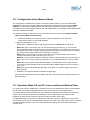
higher this parameter is the more smoothed the
measured value, but with a delayed reaction
time. It is recommended to leave this parameter
to the default setting!
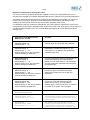
K-Parameter
Standard Setting: 0.01
Setting Range: 0.01 ….. 0.2
This Kalman filter parameter K is used for a predynamic behaviour of the Kalman Filter for
higher changes in the moisture reading, i.e. the
reaction rate of the measurement signal can be
affected hereby. The K-parameter is related to
the Average-Time. It is recommended to leave
this parameter to the default setting!
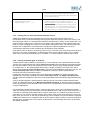
3.3.1. Average Time in the measurement mode CA and CF
SONO-GS1 establishes every 200 milliseconds a new single measurement value which is
incorporated into the continual averaging and issues the respective average value in this timing cycle
at the analogue output. The averaging time therefore accords to the “memory” of the SONO-GS1. The
longer this time is selected, the more inert is the reaction rate, if differently moist material passes the
probe. A longer averaging time results in a more stable measurement value. This should in particular
be taken into consideration, if the SONO-GS1 is deployed in different applications in order to
compensate measurement value variations due to differently moist materials.
At the point of time of delivery, the Average Time is set to 4 seconds. This value has proven itself to be
useful for many types of applications. At applications which require a faster reaction rate, a smaller
value can be set. Should the display be too “unstable”, it is recommended to select a higher value.
3.3.2. Filtering at material gaps in mode CA
A SONO probe is able to identify, if temporarily no or less material is at the probe head and can filter
out such inaccurate measurement values (Filter-Lower-Limit). Particular attention should be directed
at those time periods in which the measurement area of the probe is only partially filled with material
for a longer time, i.e. the material (sand) temporarily no longer completely covers the probe head.
During these periods (Lower-Limit-Keep-Time), the probe would establish a value that is too low. The
Lower-Limit-Keep-Time sets the maximum possible time where the probe could determine
inaccurate (too low) measurement values.
Furthermore, the passing or wiping of the probe head with metal blades or wipers can lead to the
establishment of too high measurement values (Filter-Upper-Limit). The Upper-Limit-Keep-Time
sets the maximum possible time where the probe would determine inaccurate (too high) measurement
values.
Using a complex algorithm, SONO probes are able to filter out such faulty individual measurement
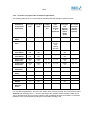
values. The standard settings in the Measurement Mode CA and CF for the filter functions depicted
in the following have proven themselves to be useful for many applications and should only be altered
for special applications.
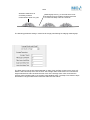
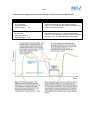
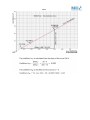
It is appropriate to bridge material gaps in mode CA with Upper- and Lower-Limit Offsets and KeepTime. For example the Lower-Limit Offset could be adjusted with 2% with a Lower-Limit Keep-Time of
5 seconds. If the SONO probe determines a moisture value which is 2% below the average moisture
value with e.g. 8%, than the average moisture value will be frozen at this value during the Lower-Limit
Keep-Time of 5 seconds. In this way the material gap can be bridged. This powerful function inside the
SONO probe works here as a highpass filter where the higher moisture values are used for building an
average value, and the lower or zero values are filtered out. In the following this function is described
with SONO parameters.