1
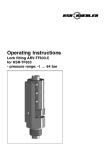
Operating Instructions
KSR-TF 611
with relay output
Contents
Contents
1
About this document
1.1
1.2
1.3
2
.
.
.
.
.
.
.
.
.
.
.
.
.
.
.
.
.
.
.
.
.
.
.
.
.
.
.
.
.
.
.
.
.
.
.
.
.
.
.
.
.
.
..
..
..
..
..
..
..
5
5
5
5
5
6
6
Configuration. . . . . . .
Principle of operation .
Operation . . . . . . . . .
Storage and transport
.
.
.
.
.
.
.
.
.
.
.
.
.
.
.
.
.
.
.
.
.
.
.
.
.
.
.
.
.
.
.
.
.
.
.
.
.
.
.
.
.
.
.
.
.
.
.
.
.
.
.
.
.
.
.
.
.
.
.
.
.
.
.
.
.
.
.
.
..
..
..
..
7
7
8
9
General instructions. . . . . . . . . . . . . . . . . . . . . 10
Mounting instructions . . . . . . . . . . . . . . . . . . . . 13
Preparing the connection . . . . . . . . . . . . . . . . . 15
Connection procedure . . . . . . . . . . . . . . . . . . . 15
Wiring plan, single chamber housing. . . . . . . . . 16
In general . . . . . . . . . . . . . . . . . . . . . . . . . . . . 18
Adjustment elements . . . . . . . . . . . . . . . . . . . . 18
Function chart . . . . . . . . . . . . . . . . . . . . . . . . . 19
Maintenance . . . . . . . . . . . . . . . . . . . . . . . . . . 21
Fault rectification . . . . . . . . . . . . . . . . . . . . . . . 21
Instrument repair . . . . . . . . . . . . . . . . . . . . . . . 22
Dismounting steps . . . . . . . . . . . . . . . . . . . . . . 23
Disposal . . . . . . . . . . . . . . . . . . . . . . . . . . . . . 23
KSR-TF 611 - with relay output
31959-EN-070618
Dismounting
8.1
8.2
2
.
.
.
.
.
.
.
Maintenance and fault rectification
7.1
7.2
7.3
8
.
.
.
.
.
.
.
Set up
6.1
6.2
6.3
7
.
.
.
.
.
.
.
Connecting to power supply
5.1
5.2
5.3
6
.
.
.
.
.
.
.
Mounting
4.1
4.2
5
Authorised personnel . . . . . . . .
Appropriate use. . . . . . . . . . . .
Warning about misuse . . . . . . .
General safety instructions . . . .
CE conformity . . . . . . . . . . . . .
SIL conformity . . . . . . . . . . . . .
Safety instructions for Ex areas
Product description
3.1
3.2
3.3
3.4
4
4
4
4
For your safety
2.1
2.2
2.3
2.4
2.5
2.6
2.7
3
Function . . . . . . . . . . . . . . . . . . . . . . . . . . . . .
Target group . . . . . . . . . . . . . . . . . . . . . . . . . .
Symbolism used . . . . . . . . . . . . . . . . . . . . . . .
Contents
9
Supplement
Technical data. . . . . . . . . . . . . . . . . . . . . . . . . 24
Dimensions . . . . . . . . . . . . . . . . . . . . . . . . . . . 32
31959-EN-070618
9.1
9.2
KSR-TF 611 - with relay output
3
About this document
1 About this document
1.1 Function
This operating instructions manual provides all the information
you need for mounting, connection and setup as well as
important instructions for maintenance and fault rectification.
Please read this information before putting the instrument into
operation and keep this manual accessible in the immediate
vicinity of the device.
1.2 Target group
This operating instructions manual is directed to trained
personnel. The contents of this manual should be made
available to these personnel and put into practice by them.
1.3 Symbolism used
Information, tip, note
This symbol indicates helpful additional information.
Caution: If this warning is ignored, faults or malfunctions can result.
Warning: If this warning is ignored, injury to persons and/or
serious damage to the instrument can result.
Danger: If this warning is ignored, serious injury to persons
and/or destruction of the instrument can result.
Ex applications
This symbol indicates special instructions for Ex applications.
l
à
1
List
The dot set in front indicates a list with no implied sequence.
Action
This arrow indicates a single action.
Sequence
Numbers set in front indicate successive steps in a procedure.
31959-EN-070618
4
KSR-TF 611 - with relay output
For your safety
2 For your safety
2.1 Authorised personnel
All operations described in this operating instructions manual
must be carried out only by trained specialist personnel
authorised by the operator.
During work on and with the device the required personal
protection equipment must always be worn.
2.2 Appropriate use
KSR-TF 611 is a sensor for level detection.
You can find detailed information on the application range in
chapter "Product description".
2.3 Warning about misuse
Inappropriate or incorrect use of the instrument can give rise to
application-specific hazards, e.g. vessel overfill or damage to
system components through incorrect mounting or adjustment.
2.4 General safety instructions
This is a high-tech instrument requiring the strict observance of
standard regulations and guidelines. The user must take note
of the safety instructions in this operating instructions manual,
the country-specific installation standards as well as all
prevailing safety regulations and accident prevention rules.
The instrument must only be operated in a technically flawless
and reliable condition. The operator is responsible for troublefree operation of the instrument.
The user is also obliged to determine, during the entire
duration of use, the compliance of the necessary occupational
safety measures with the current valid regulations and take
note of new regulations.
2.5 CE conformity
31959-EN-070618
KSR-TF 611 is in CE conformity with EMC (89/336/EWG),
fulfils NAMUR recommendation NE 21 and is in CE conformity
with LVD (73/23/EWG).
Conformity has been judged according to the following
standards:
KSR-TF 611 - with relay output
5
For your safety
l
EMC:
- Emission EN 61326/A1: 1998 (class B)
- Susceptibility EN 61326: 1997/A1:1998
l
LVD: EN 61010-1: 1993
2.6 SIL conformity
KSR-TF 611 fulfills the requirements to functional safety
according to IEC 61508 or IEC 61511. You find further
information in the Safety Manual.
2.7 Safety instructions for Ex areas
Please note the Ex-specific safety information for installation
and operation in Ex areas. These safety instructions are part of
the operating instructions manual and come with the Exapproved instruments.
31959-EN-070618
6
KSR-TF 611 - with relay output
Product description
3 Product description
3.1 Configuration
Scope of delivery
The scope of delivery encompasses:
l
l
Components
KSR-TF 611 level sensor
Documentation
- this operating instructions manual
- Additional instructions manual "Safety Manual - Functional safety according to IEC 61508 (SIL)"
- Ex-specific "Safety instructions" (with Ex-versions)
- if necessary, further certificates
KSR-TF 611 consists of the following components:
l
l
l
Housing cover
Housing with electronics
process fitting with tuning fork
1
2
3
Fig.
1
2
3
1: KSR-TF 611
Housing cover
Housing with electronics
Process fitting
3.2 Principle of operation
Area of application
KSR-TF 611 is a level sensor with tuning fork for level
detection.
31959-EN-070618
It is designed for industrial use in all areas of process
technology and can be used in liquids.
Typical applications are overfill and dry run protection. With a
tuning fork of only 40 mm length, KSR-TF 611 can be also
mounted, e.g. in pipelines from DN 25. The small tuning fork
KSR-TF 611 - with relay output
7
Product description
allows use in vessels, tanks and pipes. Thanks to its simple
and robust measuring system, KSR-TF 611 is virtually
unaffected by the chemical and physical properties of the
liquid.
It functions even under difficult conditions such as turbulence,
air bubbles, foam generation, buildup, strong external vibration
or changing products.
Fault monitoring
The electronics module of KSR-TF 611 continuously monitors
via frequency evaluation the following criteria:
l
l
l
Strong corrosion or damage on the tuning fork
loss of vibration
Line break to the piezo drive
If a malfunction is detected or in case of power failure, the
electronics takes on a defined switching condition, i.e. the
relay deenergises (safe condition).
Functional principle
The tuning fork is piezoelectrically energised and vibrates at its
mechanical resonance frequency of approx. 1200 Hz. The
piezos are fixed mechanically and are hence not subject to
temperature shock limitations. The frequency changes when
the tuning fork is covered by the medium. This change is
detected by the integrated oscillator and converted into a
switching command.
Supply
KSR-TF 611 is a compact instrument, i.e. it can be operated
without external evaluation system. The integrated electronics
evaluates the level signal and outputs a switching signal. With
this switching signal, a connected device can be operated
directly (e.g. a warning system, a PLC, a pump etc.).
The data for power supply are stated in chapter "Technical
data" in the "Supplement".
3.3 Operation
With the factory setting, products with a density >0.07 g/cm³
(>0.025 lbs/in³) can be measured. The instrument can be
adapted if products with lower density should be measured.
l
l
8
signal lamp for indication of the switching condition (green/
red)
DIL switch for sensitivity adjustment
KSR-TF 611 - with relay output
31959-EN-070618
On the electronics module you will find the following indicating
and adjustment elements:
Product description
l
Mode switch for selection of the switching condition (A/B)
3.4 Storage and transport
Packaging
Your instrument was protected by packaging during transport.
Its capacity to handle normal loads during transport is assured
by a test according to DIN EN 24180.
The packaging of standard instruments consists of environment-friendly, recyclable cardboard. In addition, the sensor is
provided with a protective cover of ABS. For special versions
PE foam or PE foil is also used. Dispose of the packaging
material via specialised recycling companies.
Storage and transport temperature
l
31959-EN-070618
l
Storage and transport temperature see "Supplement Technical data - Ambient conditions"
Relative humidity 20 … 85 %
KSR-TF 611 - with relay output
9
Mounting
4 Mounting
4.1 General instructions
Switching point
In general, KSR-TF 611 can be mounted in any position. The
instrument must be mounted in such a way that the tuning fork
is at the height of the requested switching point.
The tuning fork has lateral markings (notches) that indicate the
switching point with vertical mounting. The switching point
refers to water with the basic setting of the sensitivity switch
≥0.7 g/cm³ (0.025 lbs/in³). When mounting KSR-TF 611, make
sure that this marking is at the height of the requested
switching point. Keep in mind that the switching point of the
instrument is shifted if the medium has a density other than
water - water 1 g/cm³ (0.036 lbs/in³). For products <0.7 g/cm³
(0.025 lbs/in³) and >0.5 g/cm³ (0.018 lbs/in³) the density switch
must be set to ≥0.5 g/cm³.
Keep in mind that foams with a density >0.45 g/cm³ (0.016 lbs/
in³) are detected by the sensor. This can cause faulty
switchings particulary when used as dry run protection system.
2
1
4
3
10
2: Vertical mounting
Switching point approx. 13 mm (0.51 in)
Switching point with lower density
Switching point with higher density
Switching point approx. 27 mm (1.06 in)
KSR-TF 611 - with relay output
31959-EN-070618
Fig.
1
2
3
4
Mounting
1
Fig. 3: Horizontal mounting
1 Switching point
2
1
Fig. 4: Vertical installation (recommended installation position, especially for
adhesive products)
1 Switching point
2 Marking with screwed version on top, with flange versions directed to the
flange holes
With flange versions, the fork is directed as follows to the
flange holes.
Fig. 5: Fork position with flange versions
31959-EN-070618
Moisture
Use the recommended cables (see chapter "Connecting to
power supply") and tighten the cable gland.
You can give your KSR-TF 611 additional protection against
moisture penetration by leading the connection cable downward in front of the cable entry. Rain and condensation water
KSR-TF 611 - with relay output
11
Mounting
can thus drain off. This applies mainly to mounting outdoors, in
areas where moisture is expected (e.g. by cleaning processes)
or on cooled or heated vessels.
Fig. 6: Measures against moisture penetration
Transport
Do not hold KSR-TF 611 on the tuning fork. Particularly with
flange or tube versions, the tuning fork can be damaged just by
the weight of the instrument. Transport coated instruments
very carefully and avoid touching the tuning fork.
Remove the protective cover just before mounting.
Pressure/Vacuum
The process fitting must be sealed if there is gauge or low
pressure in the vessel. Before use, check if the seal material is
resistant against the measured product and the process
temperature.
The max. permissible pressure is stated in chapter "Technical
data" in the "Supplement" or on the type label of the sensor.
Handling
The vibrating level switch is a measuring instrument and must
be treated accordingly. Bending the vibrating element will
destroy the instrument.
Warning:
The housing must not be used to screw the instrument in!
Applying tightening force on the housing can damage its
rotational mechanical parts.
To screw in, use the hexagon above the thread.
31959-EN-070618
12
KSR-TF 611 - with relay output
Mounting
4.2 Mounting instructions
Welded socket
KSR-TF 611 has a defined thread starting point. This means
that every KSR-TF 611 is in the same fork position after being
screwed in. Remove therefore the supplied seal from the
thread of KSR-TF 611. This seal is not required when using a
welded socket with O-ring in front.
Keep in mind that this welded socket is not suitable for coated
instrument versions.
Screw KSR-TF 611 completely into the welded socket. The
later position can be determined already before welding. Mark
the appropriate position of the welded socket. Before welding,
unscrew KSR-TF 611 and remove the rubber ring from the
welded socket. The welded socket has a marking (notch).
Weld the socket with the notch facing upward, or in case of
pipelines, aligned with the direction of flow.
1
Fig. 7: Marking on the welded socket
1 Marking
Adhesive products
In case of horizontal mounting in adhesive and viscous
products, the surfaces of the tuning fork should be vertical in
order to reduce buildup on the tuning fork. On the screwed
version you will find a marking on the hexagon. With this, you
can check the position of the tuning fork when screwing it in.
When the hexagon touches the seal, the thread can still be
turned by approx. half a turn. This is sufficient to reach the
recommended installation position.
With flange versions, the fork is directed to the flange holes.
31959-EN-070618
When used in adhesive and viscous products, the tuning fork
should protrude into the vessel to avoid buildup. For that
reason, sockets for flanges and mounting bosses should be
avoided when mounting horizontally.
KSR-TF 611 - with relay output
13
Mounting
Inflowing medium
If KSR-TF 611 is mounted in the filling stream, unwanted
mismeasurements may result. Mount KSR-TF 611 at a location
in the vessel where no disturbing influence from e.g. filling
openings, agitators, etc. can occur.
Flows
To minimise flow resistance caused by the tuning fork, KSR-TF
611 should be mounted in such a way that the surfaces of the
blades are parallel to the product movement.
Enamel coating
Instruments with enamel coating should be treated very
carefully and shocks should be avoided. Unpack KSR-TF 611
directly before installation. Insert KSR-TF 611 carefully into the
vessel opening and avoid touching any sharp vessel parts.
31959-EN-070618
14
KSR-TF 611 - with relay output
Connecting to power supply
5 Connecting to power supply
5.1 Preparing the connection
Note safety instructions
Always keep in mind the following safety instructions:
l
Connect only in the complete absence of line voltage
Take note of safety
instructions for Ex
applications
In hazardous areas you should take note of the appropriate
regulations, conformity and type approval certificates of the
sensors and power supply units.
Select power supply
Connect the power supply according to the following diagrams.
Oscillator SWE60R is designed in protection class 1. To
maintain this protection class, it is absolutely necessary that
the ground conductor be connected to the internal ground
terminal. Take note of the general installation regulations. As a
rule, connect KSR-TF 611 to vessel ground (PA), or in case of
plastic vessels, to the next ground potential. On the side of the
housing there is a ground terminal between the cable entries.
This connection serves to drain off electrostatic charges. In Ex
applications, the installation regulations for hazardous areas
must be given priority.
The data for power supply are stated in chapter "Technical
data" in the "Supplement".
Selecting connection cable
KSR-TF 611 is connected with standard cable with round
cross section. An outer cable diameter of 5 … 9 mm
(0.2 … 0.35 in) ensures the seal effect of the cable gland.
If cable with a different diameter or wire cross section is used,
exchange the seal or use an appropriate cable connection.
In hazardous areas, only use approved cable connections for
KSR-TF 611.
Select connection
cable for Ex applications
Take note of the corresponding installation regulations for Ex
applications.
5.2 Connection procedure
31959-EN-070618
With Ex instruments, the housing cover may only be opened if
there is no explosive atmosphere present.
Proceed as follows:
KSR-TF 611 - with relay output
15
Connecting to power supply
1
Unscrew the housing cover
2
Loosen compression nut of the cable entry
3
Remove approx. 10 cm (4 in) of the cable mantle, strip
approx. 1 cm (0.4 in) insulation from the ends of the
individual wires
4
Insert the cable into the sensor through the cable entry
5
Open the terminals with a screwdriver
6
Insert the wire ends into the open terminals according to
the wiring plan
7
Tighten the terminals with a screwdriver
8
Check the hold of the wires in the terminals by lightly
pulling on them
9
Tighten the compression nut of the cable entry. The seal
ring must completely encircle the cable
10 Screw the housing cover back on
The electrical connection is finished.
5.3 Wiring plan, single chamber housing
The following illustrations apply to the non-Ex as well as to the
EEx d version.
Housing overview
3
3
1
Fig.
1
2
3
2
8: Material versions, single chamber housing
Aluminium
Stainless steel
Filter element for pressure compensation
31959-EN-070618
16
KSR-TF 611 - with relay output
Connecting to power supply
Electronics and connection
compartment
SW E60R
345678
A
0,5 g / cm3
B
0,7 g / cm3
20-72V DC
20-253V AC
+
L
N
1
2
3
1 2
3 4 5
6 7 8
4
5
Fig.
1
2
3
4
5
Wiring plan
9: Electronics and connection compartment, single chamber housing
Control lamp
DIL switch for mode adjustment
DIL switch for switching point adaptation
Ground terminal
Screwed terminals
We recommend connecting KSR-TF 611 in such a way that
the switching circuit is open when there is a level signal, line
break or failure (safe condition).
The relays are always shown in non-operative condition.
+ L1 N
1
2
3
4
5
6
7
8
1
2
3
10: Wiring plan, single chamber housing
Relay output
Relay output
Voltage supply
31959-EN-070618
Fig.
1
2
3
KSR-TF 611 - with relay output
17
Set up
6 Set up
6.1 In general
The numbers in brackets refer to the following illustrations.
Function/Configuration
In the basic setting, products with a density >0.7 g/cm³
(0.025 lbs/in³) can be detected. For products with lower
density, you have to set the switch to >0.5 g/cm³ (0.018 lbs/
in³).
On the electronics module you will find the following indicating
and adjustment elements:
l
l
l
Signal lamp (1)
DIL switch for mode adjustment - A/B (2)
DIL switch for sensitivity adjustment (3)
Note:
For test purposes, immerse the tuning fork of KSR-TF 611
always in liquids. Do not test the function of KSR-TF 611 with
the hand. This can damage the sensor.
1
2
3
1
2
3
4
5
6
7
8
6.2 Adjustment elements
18
11: Oscillator SWE60R - Relay output
Signal lamp (LED)
DIL switch for mode adjustment
DIL switch for sensitivity adjustment
31959-EN-070618
Fig.
1
2
3
KSR-TF 611 - with relay output
Set up
Signal lamp (1)
Control lamp (LED) for indication of the switching status.
l
l
l
green = relay energized
red = relay deenergized
red (flashing) = failure
Mode adjustment (2)
With the mode adjustment (A/B) you can change the switching
condition of the relay. You can set the required mode
according to the "Function chart" (A - max. detection or overfill
protection, B - min. detection or dry run protection).
Sensitivity adjustment (3)
With this DIL switch (3) you can set the switching point to
liquids having a density between 0.5 and 0.7 g/cm³ (0.018 and
0.025 lbs/in³). With the basic setting, liquids with a density of
>0.7 g/cm³ (0.025 lbs/in³) can be detected. In liquids with lower
density, you must set the switch to >0.5 g/cm³ (0.018 lbs/in³).
The specifications for the position of the switching point relate
to water - density value 1 g/cm³ (0.036 lbs/in³). In products with
a different density, the switching point will shift in the direction
of the housing or tuning fork end depending on the density and
type of installation.
Keep in mind that foams with a density >0.45 g/cm³ (0.016 lbs/
in³) are detected by the sensor. This can cause faulty
switchings particulary when used as dry run protection system.
6.3 Function chart
The following chart provides an overview of the switching
conditions depending on the adjusted mode and level.
Level
Switching status
Control lamp
Mode A
Overflow protection
3
4
5
(6) (7) (8)
Relay energized
Green
Mode A
Overflow protection
3
4
5
(6) (7) (8)
Relay deenergized
Red
Mode B
Dry run protection
31959-EN-070618
3
4
5
(6) (7) (8)
Relay energized
KSR-TF 611 - with relay output
Green
19
Set up
Level
Switching status
Control lamp
Mode B
Dry run protection
3
4
5
(6) (7) (8)
Relay deenergized
Failure of the supply voltage
(mode A/B)
Red
any
3
4
5
(6) (7) (8)
Relay deenergized
Failure
any
3
4
5
(6) (7) (8)
Relay deenergized
flashes red
31959-EN-070618
20
KSR-TF 611 - with relay output
Maintenance and fault rectification
7 Maintenance and fault rectification
7.1 Maintenance
When used as directed in normal operation, KSR-TF 611 is
completely maintenance free.
7.2 Fault rectification
Causes of malfunction
KSR-TF 611 offers maximum reliability. Nevertheless faults
can occur during operation. These may be caused by the
following, e.g.:
l
l
l
l
Sensor
Process
Supply
Signal processing
Fault clearance
The first measure to be taken is to check the output signal. In
many cases, the causes can be determined this way and the
faults rectified.
Checking the switching signal
? KSR-TF 611 signals "covered" when the vibrating element
is not submerged (overfill protection)
? KSR-TF 611 signals "uncovered" when the vibrating
element is submerged (dry run protection)
l
Supply voltage too low
à Check the power supply
l
Electronics module defective
à Press the mode switch (min./max.). If the instrument
then changes the mode, the instrument may be
mechanically damaged. Should the switching function
in the correct mode still be faulty, return the instrument
for repair.
à Push the mode switch. If the instrument then does not
change the mode, the oscillator may be defective.
Exchange the oscillator.
à Check if there is buildup on the vibrating element, and if
so, remove it.
l
Unfavourable installation location
31959-EN-070618
à Mount the instrument at a location in the vessel where
no dead zones or air bubbles can form.
KSR-TF 611 - with relay output
21
Maintenance and fault rectification
l
Wrong mode selected
à Set the correct mode on the mode switch (max.: overfill
protection, min.: dry run protection). Wiring should be
carried out according to the quiescent current principle.
? Signal lamp flashes red
l
Electronics has detected a failure
à Exchange instrument or return instrument for repair
? The signal lamp flashes alternately red and green
l
instrument defective
à Exchange instrument or return instrument for repair
7.3 Instrument repair
If a repair is necessary, please proceed as follows:
l
l
l
l
Clean the instrument and pack it damage-proof
Attach a description of the fault, the ambient conditions and
measured product to the instrument
If necessary, attach a safety sheet to the instrument
Send the instrument to the address of the agency serving
you, in Germany directly to the headquarters
31959-EN-070618
22
KSR-TF 611 - with relay output
Dismounting
8 Dismounting
8.1 Dismounting steps
Warning:
Before dismounting, be aware of dangerous process conditions such as e.g. pressure in the vessel, high temperatures,
corrosive or toxic products etc.
Take note of chapters "Mounting" and "Connecting to power
supply" and carry out the listed steps in reverse order.
With Ex instruments, the housing cover may only be opened if
there is no explosive atmosphere present.
8.2 Disposal
The instrument consists of materials which can be recycled by
specialised recycling companies. We use recyclable materials
and have designed the electronics to be easily separable.
WEEE directive 2002/96/EG
This instrument is not subject to the WEEE directive 2002/96/
EG and the respective national laws (in Germany, e.g.
ElektroG). Pass the instrument directly on to a specialised
recycling company and do not use the municipal collecting
points. These may be used only for privately used products
according to the WEEE directive.
Correct disposal avoids negative effects to persons and
environment and ensures recycling of useful raw materials.
Materials: see chapter "Technical data"
31959-EN-070618
If you cannot dispose of the instrument properly, please
contact us about disposal methods or return.
KSR-TF 611 - with relay output
23
Supplement
9 Supplement
9.1 Technical data
General data
Material 316L corresponds to 1.4404 or 1.4435
Materials, wetted parts
- Process fitting - thread
-
316L, Hastelloy C4 (2.4602)
Process fitting - flange
316L, 316L with Hastelloy C4 coating, steel
enamelled, 316L with ECTFE coating, 316L
with PFA coating
-
Process seal
Klingersil C-4400 (with threaded versions)
-
Tuning fork
316L, Hastelloy C4 (2.4610)
-
Extension tube ø 21.3 mm (0.84 in)
316L, Hastelloy C4 (2.4610), Hastelloy C4
(2.4610) enamelled, 316L with ECTFE coating,
316L with PFA coating
Sensor length
- length KSR-TF 611
See "Supplement - Dimensions"
Materials, non-wetted parts
- Housing
Aluminium die-casting powder coated, 316L
-
Seal between housing and housing
cover
NBR (stainless steel housing), silicone (Aluminium housing)
-
Ground terminal
316L
-
Temperature adapter (optional)
316L
-
Gas-tight leadthrough (optional)
316L/glass
Weights
- Aluminium housing
-
Stainless steel housing
Layer thickness - coatings
- Enamel
1170 g (41 oz)
1530 g (54 oz)
approx. 0.8 mm (0.03 in)
-
ECTFE
approx. 0.5 mm (0.02 in)
-
PFA
approx. 0.5 mm (0.02 in)
Surface quality
- Standard
Ra approx. 3 µm (approx. 1.18-4 in)
hygienic version (3A)
Ra <0.8 µm (3.15-5 in)
-
hygienic version (3A)
Ra <0.3 µm (1.18-5 in)
24
KSR-TF 611 - with relay output
31959-EN-070618
-
Supplement
Process fittings
- Thread
G¾ A, ¾ NPT, G1 A, 1 NPT
-
Flanges
DIN from DN 25, ANSI from 1"
-
hygienic fittings
Bolting DN 40 PN 40, Tri-Clamp 1", Tri-Clamp
1½" PN 10, conus DN 25 PN 40, Tuchenhagen
Varivent DN 50 PN 10
High voltage test (enamel)
max. 5 KV
Gas-tight leadthrough (optional)
- leakage rate
<10-6 mbar l/s
-
Pressure resistance
PN 64
-
hygienic fittings
Bolting DN 40 PN 40, Tri-Clamp 1", Tri-Clamp
1½" PN 10, conus DN 25 PN 40, Tuchenhagen
Varivent DN 50 PN 10
Output variable
Output
Turn-on voltage
- Min.
-
Max.
Switching current
- Min.
-
Max.
Breaking capacity
- Min.
-
Max.
Contact material (relay contacts)
Modes (adjustable)
- A
31959-EN-070618
-
B
Relay output (DPDT), 2 floating spdts
10 mV
253 V AC, 253 V DC
10 µA
3 A AC, 1 A DC
50 mW
750 VA AC, 54 W DC
If inductive loads or stronger currents are
switched through, the gold plating on the relay
contact surface will be permanently damaged.
The contact is then no longer suitable for
switching low-level signal circuits.
AgNi or AgSnO and Au plated
Max. detection or overflow/overfill protection
Min. detection or dry run protection
Measuring accuracy
Deviation
KSR-TF 611 - with relay output
±1 mm (±0.04 in)
25
Supplement
Influence of the process temperature on the switching point
1
4
10 (
25/64")
8 ( 5/16")
6 ( 15/64")
4 ( 5/32")
3
2 ( 5/64")
0
2
-2 (-5/64")
-4 (-5/32")
-6 (-15/64")
-8 (-5/16")
-10 (-25/64")
0 °C
(32 °F)
Fig.
1
2
3
4
50 °C
(122 °F)
100 °C
(212 °F)
150 °C
(302 °F)
200 °C
(392 °F)
250 °C
(482 °F)
25: Influence of the process temperature on the switching point
Shifting of the switching point in mm (in)
Process temperature in °C (°F)
Switching point at reference conditions (notch)
Tuning fork
Influence of the product density on the switching point
31959-EN-070618
26
KSR-TF 611 - with relay output
Supplement
1
6
10 ( 25/64")
8 ( 5/16")
6 ( 15/64")
4 ( 5/32")
5
2 ( 5/64")
0
2
-2 (-5/64")
4
-4 (-5/32")
3
-6 (-15/64")
-8 (-5/16")
-10 (-25/64")
0,6
(0,022)
Fig.
1
2
3
4
5
6
0,8
(0,029)
1
(0,036)
1,2
(0,043)
1,4
(0,051)
1,6
(0,058)
1,8
(0,065)
2
(0,072)
2,2
(0,079)
2,4
(0,087)
26: Influence of the product density on the switching point
Shifting of the switching point in mm (in)
Product density in g/cm³ (lb/in³)
Switch position 0.5 g/cm³ (corresponds to 0.018 lb/in³)
Switch position 0.7 g/cm³ (corresponds to 0.025 lb/in³)
Switching point at reference conditions (notch)
Tuning fork
31959-EN-070618
Influence of the process pressure to the switching point
KSR-TF 611 - with relay output
27
Supplement
1
4
10 ( 25/64")
8 ( 5/16")
6 ( 15/64")
4 ( 5/32")
3
2 ( 5/64")
0
2
-2 (-5/64")
-4 (-5/32")
-6 (-15/64")
-8 (-5/16")
-10 (-25/64")
12
(174,1)
Fig.
1
2
3
4
25
(362,6)
38
(551,1)
51
(739,7)
64
(928,2)
27: Influence of the process pressure to the switching point
Shifting of the switching point in mm (in)
Process pressure in bar (psi)
Switching point at reference conditions (notch)
Tuning fork
Repeatability
0.1 mm (0.004 in)
Hysteresis
approx. 2 mm (0.08 in) with vertical installation
Switching delay
approx. 500 ms (on/off)
Frequency
approx. 1200 Hz
Ambient conditions
Ambient temperature on the housing
-40 … +70 °C (-40 … +158 °F)
Storage and transport temperature
-40 … +80 °C (-40 … +176 °F)
Process conditions
Parameter
Limit level of liquids
Process pressure
-1 … 64 bar (-14.5 … 938 psi) depending on
the process fitting, e.g. flange (see following
diagrams)
KSR-TF 611 of 316L/Hastelloy C4
(2.4610)
-50 … +150 °C (-58 … +302 °F)
31959-EN-070618
28
KSR-TF 611 - with relay output
Supplement
Process temperature (thread or flange
temperature) with temperature adapter
(option)
- KSR-TF 611 of 316L/Hastelloy C4
-50 … +250 °C (-58 … +482 °F)
-
KSR-TF 611 enamelled
-50 … +200 °C (-58 … +392 °F)
-
KSR-TF 611 with ECTFE coating
-50 … +150 °C (-58 … +302 °F)
-
KSR-TF 611 with PFA coating
-50 … +150 °C (-58 … +302 °F)
2
3
70 °C
(158 °F)
40 °C
(104 °F)
0 °C
(32 °F)
-50 °C
(-58 °F)
1
50 °C
(122 °F)
100 °C
(212 °F)
150 °C
(302 °F)
200 °C
(392 °F)
250 °C
(482 °F)
-40 °C
(-40 °F)
Fig.
1
2
3
28: Ambient temperature - Process temperature
Process temperature in °C (°F)
Ambient temperature in °C (°F)
Temperature range with temperature adapter
1
64
(928)
40
(580)
20
(290)
-1 (-14,5)
-50 °C
(-58 °F)
0 °C
(32 °F)
50 °C
(122 °F)
100 °C
(212 °F)
150 °C
(302 °F)
200 °C
(392 °F)
250 °C
(482 °F)
2
31959-EN-070618
Fig. 29: Process temperature - Process pressure with switch position 0.7 g/cm³ (mode switch)
1 Process pressure in bar (psi)
2 Process temperature in °C (°F)
KSR-TF 611 - with relay output
29
Supplement
1
64
(928)
40
(580)
20
(290)
-1 (-14,5)
-50 °C
(-58 °F)
0 °C
(32 °F)
50 °C
(122 °F)
100 °C
(212 °F)
150 °C
(302 °F)
200 °C
(392 °F)
250 °C
(482 °F)
2
Fig. 30: Process temperature - Process pressure with switch position 0.5 g/cm³ (mode switch)
1 Process pressure in bar (psi)
2 Process temperature in °C (°F)
Viscosity - dynamic
0.1 … 10,000 mPa s (requirement: with density
1)
Density
0.7 … 2.5 g/cm³ (0.025 … 0.09 lbs/in³);
0.5 … 2.5 g/cm³ (0.018 … 0.09 lbs/in³) by
switching over
Electromechanical data
Cable entry/plug (dependent on the version)
- Single chamber housing
l
1x cable entry M20x1.5 (cable-ø 5 … 9 mm),
1x blind stopper M20x1.5; attached 1x
cable entry M20x1.5
or:
l
1x cable entry ½ NPT, 1x blind stopper
½ NPT, 1x cable entry ½ NPT
or:
l
Screw terminals
1x plug M12x1, 1x blind stopper M20x1.5
for wire cross-section up to 1.5 mm²
(0.0023 in²)
Adjustment elements
Mode switch
- A
30
B
Min. detection or dry run protection
KSR-TF 611 - with relay output
31959-EN-070618
-
Max. detection or overflow/overfill protection
Supplement
Density switch
- 0.5
-
0.5 … 2.5 g/cm³ (0.018 … 0.9 oz/in³)
0.7
0.7 … 2.5 g/cm³ (0.025 … 0.9 oz/in³)
Voltage supply
Supply voltage
20 … 253 V AC, 50/60 Hz, 20 … 72 V DC (at
U >60 V DC, the ambient temperature can be
max. 50 °C/122 °F)
Power consumption
1 … 8 VA (AC), approx. 1.3 W (DC)
Electrical protective measures
Protection
IP 66/IP 67
Overvoltage category
III
Protection class
I
Functional safety (SIL)
Functional safety according to IEC 61508/IEC 61511
- Single channel architecture (1oo1
up to SIL2
D)
-
Multiple channel architecture
see supplementary instructions manual "Safety
Manual (SIL)"
Approvals1)
Overfill protection according to WHG
ATEX II 1G 1/2G, 2G EEx ia IIC T6
ATEX II 1/2G, 2G EEx d IIC T62)
FM (NI) CL I, DIV 2, GP ABCD
FM (XP) CL I, DIV 1, GP ABCD (DIP) CL II, III, DIV 1, GP EFG3)
31959-EN-070618
Ship approvals
1)
2)
3)
KSR-TF 611 - with relay output
Deviating data in Ex applications: see separate safety instructions.
Only with Aluminium housing.
Only with Aluminium housing.
31
Supplement
9.2 Dimensions
KSR-TF 611
69mm (2 23/32")
ø77mm (3 1/32")
M20x1,5/
½ NPT
1
116mm (4 9/16")
117mm (4 39/64")
116mm (4 9/16")
ø84mm (3 5/16")
M20x1,5/
½ NPT
M20x1,5
2
Fig. 31: Housing versions
1 Stainless steel housing
2 Aluminium housing
31959-EN-070618
32
KSR-TF 611 - with relay output
Supplement
53 mm
(2 3/32")
53 mm
50 mm
(2 3/32") (1 31/32")
178 mm (7 1/64")
7
5
32: KSR-TF 611
Thread
Tri-Clamp
Cone DN 25
Bolting DN 40
Flange
Gas-tight leadthrough
Temperature adapter
31959-EN-070618
Fig.
1
2
3
4
5
6
7
6
ø 33,7 mm
(1 21/64")
4
3
34 mm
(1 11/32")
2
19 mm
(3/4")
1
55 mm
(2 11/64")
57 mm
(2 1/4")
36 mm
(1 27/64")
32 (G3/4A, 3/4"NPT)
41 (G1A, 1"NPT)
G3/4A, 3/4"NPT
G1A, 1"NPT
53 mm
(2 3/32")
66 mm
(2 23/32")
18,5 mm
(47/64")
KSR-TF 611
KSR-TF 611 - with relay output
33
Supplement
31959-EN-070618
34
KSR-TF 611 - with relay output
31959-EN-070618
Supplement
KSR-TF 611 - with relay output
35
KSR KUEBLER Niveau-Messtechnik AG
Im Kohlstatterfeld 17
69439 Zwingenberg
Germany
Phone +49 6263 87-0
Fax +49 6263 8799
E-mail: [email protected]
www.ksr-kuebler.com
All statements concerning scope of delivery, application,
practical use and operating conditions of the sensors and
processing systems correspond to the information available at the time of printing.
Subject to change without prior notice
31959-EN-070618