1
FCC NOTE (for U. S. A only):
This equipment has been tested and found to comply with
the limits for a Class B digital device, pursuant to Part 15 of
the FCC rules. These limits are designed to provide reasonable protection against harmful interference in a residential
installation. This equipment generates, uses and can radiate radio frequency energy and, if not installed and used
in accordance with the instructions, may cause harmful
interference to radio or television reception, which can be
determined by turning the equipment off and on, the user is
encouraged to try to correct the interference by one or more
of the following measures.
• Reorient or relocate the receiving antenna.
• Increase the separation between the equipment and receiver.
• Connect this equipment into an outlet on a circuit different from that to which the receiver is connected.
• Consult the dealer or an experienced radio/TV technician
for help.
- Do not place anything about 0.1 meter above
the top panel.
- Make a space of about 0.1 meter around the
unit.
- No objects filled with liquids, such as vases,
shall be placed on the apparatus.
- When the switch is in the OFF position, the
equipment is not completely switched off from
MAINS.
- The equipment shall be installed near the
power supply so that the power supply is
easily accessible.
WARRANTY
For warranty information, contact your local Marantz distributor.
NOTE: Changes or modifications may cause
this unit to fail to comply with Part 15 of the
FCC Rules and may void the user’s authority to
operate the equipment.
RETAIN YOUR PURCHASE RECEIPT
This Class B digital apparatus complies with
Canadian ICES-003.
IMPORTANT
Cet appareil numérique de la Classe B est
conforme á la norme NMB-003 du Canada.
This product satisfies FCC regulations when shielded cables
and connectors are used to connect the unit to other equipment. To prevent electromagnetic interference with electric
appliances, such as radios and televisions, use shielded
cables and connectors for connections.
Your purchase receipt is your permanent record of a valuable purchase. It should be kept in a safe place to be referred
to as necessary for insurance purposes of when corresponding with Marantz.
When seeking warranty service, it is the responsibility of the
consumer to establish proof and date of purchase. Your purchase receipt or invoice is adequate for such proof.
FOR U.K. ONLY
This undertaking is in addition to a consumer’s statutory
rights and does not affect those rights in any way.
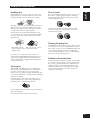
Disc Storage
Be careful not to harm the disc because the data on these
discs is highly vulnerable to the environment.
• Do not keep under direct sunlight.
• Keep in a cool ventilated area.
• Store vertically.
• Keep in a clean protection jacket.
Maintenance of Cabinet
CE marking (for Europe only)
This product is in conformity with the
EMC directive and low-voltage directive.
WARNINGS
- Do not expose the equipment to rain or
moisture.
- Do not remove the cover from the equipment.
- Do not insert anything into the equipment
through the ventilation holes.
- Do not handle the mains lead with wet hands.
- Do not cover the ventilation with any items
such as tablecloths, newspapers, curtains, etc.
- No naked flame sources, such as lighted
candles, should be placed on the equipment.
- When disposing of used batteries, please
comply with govern men tal regulations or
environmental public instruction’s rules that
apply in your country or area.
4
For safety reasons, be sure to disconnect the AC power cord
from the AC outlet.
• Do not use benzene, thinner, or other solvents for cleaning.
• Wipe the cabinet with a soft cloth.
A NOTE ABOUT RECYCLING
T h i s p r o d u c t ’s p a ck a g i n g m a t e r i a l s a r e
re cy cla ble and can be reused. This prod uct
and the accessories packed together are the
applicable product to the WEEE directive except
batteries.
Please dispose of any materials in accordance
with your local recycling regulations.
When discarding the unit, comply with your local
rules or regulations.
Batteries should never be thrown away or
incinerated but disposed of in accordance with
your local regulations con cern ing chemical
wastes.