1
SAFETY DATA SHEET
Halotron-1
(Fire Extinguishing Agent with Expellant)
1.
IDENTIFICATION
Product Name
Other Names
Recommended use of the chemical and
restrictions on use
Identified uses
Restrictions on use
Company Identification
Customer Information Number
Emergency Telephone Number
CHEMTREC Number
Issue Date
Supersedes Date
Halotron-1 (Fire Extinguishing Agent with Expellant)
HCFC Blend B, Halocarbon Agent
Fire Extinguishing Agent
Consult applicable fire protection codes
Kidde Residential & Commercial
1016 Corporate Park Drive
Mebane, NC 27302
USA
(919) 563-5911
(919) 304-8200
(800) 424-9300
(703) 527-3887 (International)
April 10, 2015
February 9, 2015
Safety Data Sheet prepared in accordance with OSHA’s Hazard Communication Standard (29 CFR 1910.1200) and the Globally
Harmonized System of Classification and Labelling of Chemicals (GHS)
2.
HAZARD IDENTIFICATION
Hazard Classification
Gas under pressure – liquefied gas
Simple Asphyxiant
Specific Target Organ Toxicity Single Exposure – Category 2
Specific Target Organ Toxicity Repeat Exposure – Category 2
Label Elements
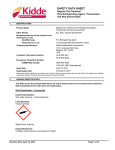
Hazard Symbols
Signal Word: Warning
Hazard Statements
Contents under pressure; may explode if heated.
May displace oxygen and cause rapid suffocation.
May cause damage to organs (liver, central nervous system) through inhalation.
May cause damage to organs (liver) through prolonged or repeated exposure (inhalation).
Revision Date: April 10, 2015
Page 1 of 9
SAFETY DATA SHEET
Halotron-1
(Fire Extinguishing Agent with Expellant)
2.
HAZARD IDENTIFICATION
Precautionary Statements
Prevention
Do not enter confined space unless adequately ventilated.
In case of inadequate ventilation wear respiratory protection.
Do not breathe fume/gas/mist/vapors/spray.
Wash hands thoroughly after handling.
Do not eat, drink or smoke when using this product.
Response
Get medical advice/attention if you feel unwell.
If exposed or concerned: Call a poison center or doctor.
Storage
Keep container tightly closed.
Protect from sunlight and store in well-ventilated place.
Store locked up.
Disposal
Dispose of contents/container is accordance with local and national regulations.
Other Hazards
Direct contact with the cold gas or liquid can cause freezing of exposed tissues. Avoid direct inhalation of
undiluted gas. Can cause suffocation by reducing oxygen available for breathing. Breathing very high
concentrations can cause dizziness, shortness of breath, unconsciousness or asphyxiation.
Specific Concentration Limits
The values listed below represent the percentages of ingredients of unknown toxicity.
Acute oral toxicity
1 – 10%
Acute dermal toxicity
1 – 10%
Acute inhalation toxicity
1 – 10%
Acute aquatic toxicity
1 – 10%
3.
COMPOSITION/INFORMATION ON INGREDIENTS
Synonyms: HCFC Blend B, Halocarbon Agent
This product is a mixture.
Component
2,2-dichloro-1,1,1-trifluoroethane
Proprietary gas mixture
CAS Number
306-83-2
NA
Concentration
85 – 95%
1 – 10%
Note: The expellant is argon.
4.
FIRST- AID MEASURES
Description of necessary first-aid measures
Eyes
Immediately flood the eye with plenty of warm water for at least 15 minutes, holding the eye open.
Obtain medical attention if soreness or redness persists.
Skin
Flush with water. Obtain medical attention if frostbite or blistering occurs or redness persists.
Revision Date: April 10, 2015
Page 2 of 9
SAFETY DATA SHEET
Halotron-1
(Fire Extinguishing Agent with Expellant)
4.
FIRST- AID MEASURES
Ingestion
Ingestion is not considered a potential route of exposure.
Inhalation
Remove from exposure. If there is difficulty in breathing, give oxygen. Obtain medical attention
immediately.
Most important symptoms/effects, acute and delayed
Aside from the information found under Description of necessary first aid measures (above) and
Indication of immediate medical attention and special treatment needed, no additional symptoms and
effects are anticipated.
Indication of immediate medical attention and special treatment needed
Notes to Physicians
In case of frostbite, place the frostbitten part in warm water. If warm water is not available or impractical
to use, wrap the affected parts gently in blankets. DO NOT USE HOT WATER.
The use of catecholamines such as adrenaline, or similar compounds can increase susceptibility to heart
irregularities caused by excessive exposure to these types of compounds.
5.
FIRE - FIGHTING MEASURES
Suitable Extinguishing Media
Halotron-1 is used as an extinguishing agent and therefore is not a problem when trying to control a fire.
Use extinguishing agent appropriate to other materials involved. Keep containers and surroundings cool
with water spray as containers may rupture or burst in the heat of a fire. The concentrated agent when
applied to fire can produce toxic by-products specifically hydrogen halides which can cause damage.
Avoid inhalation of these materials by evacuating and ventilating the area.
Specific hazards arising from the chemical
Containers may explode in heat of fire.
Special Protective Actions for Fire-Fighters
Wear full protective clothing and self-contained breathing apparatus as appropriate for specific fire
conditions.
6.
ACCIDENTAL RELEASE MEASURES
Personal precautions, protective equipment and emergency procedures
Remove leaking cylinder to a safe place. Ventilate the area. Vapors can accumulate in low areas.
Leaks inside confined spaces may cause suffocation as oxygen is displaced and should not be entered
without a self-contained breathing apparatus.
Manufacturer’s Recommended 1 Hr. Emergency Exposure Limit: 1000ppm (v/v)
Manufacturer’s Recommended 1 Min. Emergency Exposure Limit: 2500ppm (v/v)
Environmental Precautions
None
Methods and materials for containment and cleaning up
None
Revision Date: April 10, 2015
Page 3 of 9
SAFETY DATA SHEET
Halotron-1
(Fire Extinguishing Agent with Expellant)
7.
HANDLING AND STORAGE
Precautions for safe handling
Wear appropriate protective clothing. Prevent skin and eye contact.
Conditions for safe storage
Pressurized containers should be properly stored and secured to prevent falling or being knocked over.
Do not drag, slide or roll pressurized containers. Do not drop pressurized containers or permit them to
strike against each other. Never apply flame or localized heat directly to any part of the pressurized or
plastic container. Store pressurized containers away from high heat sources. Storage area should be: cool - dry - well ventilated - under cover - out of direct sunlight
8.
EXPOSURE CONTROLS/PERSONAL PROTECTION
Control parameters
Exposure limits are listed below, if they exist.
Workplace Environmental Exposure Level (chronic handling)
WEEL(AIHA)(8 hrs): 50 ppm (v/v), based on the primary component
Manufacturer’s Recommended 1 Hr. Emergency Exposure Limit: 1000ppm (v/v)
Manufacturer’s Recommended 1 Min. Emergency Exposure Limit: 2500ppm (v/v)
Exposure Level When Using Halotron I in a Fire Extinguisher
Exposure when using this material as a fire extinguishing agent - the exposure should not exceed 20,000
ppm (v/v). Guidelines for the safe minimum volume when this agent is used in a confined space are
provided on the label of the extinguisher.
Appropriate engineering controls
Use with adequate ventilation. There should be local procedures for the selection, training, inspection
and maintenance of this equipment. When used in large volumes or odor becomes apparent, use local
exhaust ventilation.
Individual protection measures
Respiratory Protection
Not normally required under conditions of use as a portable fire extinguisher. In oxygen deficient
atmospheres, use a self contained breathing apparatus, as an air purifying respirator will not provide
protection.
Skin Protection
Neoprene, PVC or PVA gloves
Eye/Face Protection
Chemical goggles or safety glasses with side shields.
Body Protection
Normal work wear.
9.
PHYSICAL AND CHEMICAL PROPERTIES
Agent – Halotron-1
Appearance
Physical State
Color
Odor
Odor Threshold
Revision Date: April 10, 2015
Liquefied gas under pressure
Colorless
Slight ether-like
No data available
Page 4 of 9
SAFETY DATA SHEET
Halotron-1
(Fire Extinguishing Agent with Expellant)
9.
PHYSICAL AND CHEMICAL PROPERTIES
pH
Relative Density (Air = 1)
Liquid Density
Gas Density
Boiling Range/Point (°C/F)
Melting Point (°C/F)
Flash Point (PMCC) (°C/F)
Vapor Pressure of liquid
Evaporation Rate (BuAc=1)
Solubility in Water
Vapor Density (Air = 1)
VOC (%)
Partition coefficient (noctanol/water)
Viscosity
Auto-ignition Temperature
Decomposition Temperature
Upper explosive limit
Lower explosive limit
Flammability (solid, gas)
Expellant - Argon
Appearance
Physical State
Color
Odor
Odor Threshold
pH
Specific Gravity
Boiling Range/Point (°C/F)
Melting Point (°C/F)
Flash Point (PMCC) (°C/F)
Vapor Pressure
Evaporation Rate (BuAc=1)
Solubility in Water
Vapor Density (Air = 1)
VOC (g/l)
VOC (%)
Partition coefficient (noctanol/water)
Viscosity
Auto-ignition Temperature
Decomposition Temperature
Upper explosive limit
Lower explosive limit
Flammability (solid, gas)
Revision Date: April 10, 2015
Not applicable
5.14
92.3 lb/ft3 @ 77 oF
1.48 kg/l @ 25oC
~ 0.385 lb/ft3
~6.17 kg/m3
27oC/80.6oF
No data available
Not flammable
~ 11.2 psig @ 68oF
77 kPa @ 20oC
Faster than water, slower than ether
0.39% wt @25oC/ 77oF, 1 atm.
No data available
No data available
No data available
Not applicable
No data available
No data available
No data available
No data available
Not flammable
Compressed gas
Colorless
None
No data available
Not applicable
No data available
No data available
No data available
Not flammable
No data available
No data available
No data available
Not applicable
None
None
No data available
Not applicable
No data available
No data available
Not explosive
Not explosive
Not flammable
Page 5 of 9
SAFETY DATA SHEET
Halotron-1
(Fire Extinguishing Agent with Expellant)
10.
STABILITY AND REACTIVITY
Reactivity
Containers may rupture or explode if exposed to heat.
Chemical Stability
Stable under normal conditions.
Possibility of hazardous reactions
Hazardous polymerization will not occur.
Conditions to Avoid
Extremely high temperatures - flames
Incompatible Materials
Incompatible with alkali or alkaline earth metals, and powdered metals Al, Zn, Be, etc.
Hazardous Decomposition Products
Hydrochloric and hydrofluoric acids - possibly carbonyl halides
11.
TOXICOLOGICAL INFORMATION
Acute Toxicity
2,2-dichloro-1,1,1-trifluoroethane
Simple asphyxiant
Inhalation 4 hour, LC50(rat) 32,000 ppm
Oral Approximate Lethal Dose, rat: 9000 mg/kg
Dermal Approximate Lethal Dose, rat: >2000 mg/kg
Cardiac LOAEL: 2% vol.
Cardiac NOAEL: 1% vol.
Argon
Simple asphyxiant
Specific Target Organ Toxicity (STOT) – single exposure
2,2-dichloro-1,1,1-trifluoroethane: Adverse effects to the liver and central nervous system were observed
in animal studies (inhalation.)
Argon: Exposure to argon gas at high concentrations can cause suffocation by reducing oxygen
available for breathing. Breathing very high concentrations can cause dizziness, shortness of breath,
unconsciousness or asphyxiation.
Specific Target Organ Toxicity (STOT) – repeat exposure
2,2-dichloro-1,1,1-trifluoroethane: Adverse effects to the liver were observed in animal studies
(inhalation.)
Serious Eye damage/Irritation
2,2-dichloro-1,1,1-trifluoroethane: In rabbit study, mild to moderate conjunctival irritation with no corneal
or iritic involvement was observed in an unwashed rabbit eye. An eye dosed with the test substance and
promptly washed had mild to slight transient corneal opacity and mild to moderate conjunctival irritation
with no iritic involvement. Both eyes were normal within 3-7 days.
Skin Corrosion/Irritation
2,2-dichloro-1,1,1-trifluoroethane: Dermal exposure in rabbits did not result in any irritation.
Revision Date: April 10, 2015
Page 6 of 9
SAFETY DATA SHEET
Halotron-1
(Fire Extinguishing Agent with Expellant)
11.
TOXICOLOGICAL INFORMATION
Respiratory or Skin Sensitization
No relevant studies identified.
Carcinogenicity
Not considered carcinogenic by NTP, IARC, and OSHA.
Germ Cell Mutagenicity
2,2-dichloro-1,1,1-trifluoroethane: Not considered genotoxic based on animal and test-tube studies.
Reproductive Toxicity
2,2-dichloro-1,1,1-trifluoroethane: No affects to reproductive performance were seen in rats or harm to
the unborn animals in rats or rabbits at 5000 and 10,000ppm
Aspiration Hazard
Not an aspiration hazard.
12.
ECOLOGICAL INFORMATION
Ecotoxicity
2,2-dichloro-1,1,1-trifluoroethane
LC50 Fathead minnow 77mg/l 96hr
Mobility in soil
No relevant studies identified.
Persistence/Degradability
No relevant studies identified.
Bioaccumulative Potential
No relevant studies identified.
Other adverse effects
No relevant studies identified.
13.
DISPOSAL CONSIDERATIONS
Disposal Methods
Dispose of container in accordance with all applicable local and national regulations. Do not cut puncture
or weld on or near to the container. If spilled, contents will vaporize to the atmosphere.
14.
TRANSPORT INFORMATION
Safety Data Sheet information is intended to address a specific material and not various forms or states
of containment. Specific volumes, pressures or hardware configurations containing such materials can
dictate various different hazard classifications for transportation and labelling requirements. Under
Federal Regulations only trained and qualified individuals are permitted to label and ship products
following the applicable Department of Transportation (DOT), Federal Aviation Administration
(FAA), Transport Canada (TC), International Maritime Dangerous Goods (IMDG) or International Air
Transport Association (IATA) requirements.
Revision Date: April 10, 2015
Page 7 of 9
SAFETY DATA SHEET
Halotron-1
(Fire Extinguishing Agent with Expellant)
15.
REGULATORY INFORMATION
United States TSCA Inventory
All components of this product are in compliance with the inventory listing requirements of the US Toxic
Substance Control Act (TSCA) Chemical Substance Inventory.
Canada DSL Inventory
All ingredients in this product have been verified for inclusion on the Domestic Substance List (DSL).
SARA Title III Sect. 311/312 Categorization
Immediate (Acute) Health Hazard, Delayed(Chronic) Health Hazard, Pressure hazard
SARA Title III Sect. 313
This product contains a chemical which is listed in Section 313 at or above de minimis concentrations:
2,2-dichloro-1,1,1-trifluoroethane (306-83-2)
16.
OTHER INFORMATION
NFPA Ratings
NFPA Code for Health - 1
NFPA Code for Flammability - 0
NFPA Code for Reactivity - 1
NFPA Code for Special Hazards – None
HMIS Ratings
HMIS Code for Health - 1*
HMIS Code for Flammability - 0
HMIS Code for Physical Hazard - 1
HMIS Code for Personal Protection - See Section 8
*Chronic
Legend
ACGIH: American Conference of Governmental Industrial Hygienists
CAS: Chemical Abstracts Service
IARC: International Agency for Research on Cancer
LCLo: Lethal concentration low
N/A: Denotes no applicable information found or available
NTP: National Toxicology Program
OSHA: Occupational Safety and Health Administration
PEL: Permissible Exposure Limit
SDS: Safety Data Sheet
STEL: Short Term Exposure Limit
TLV: Threshold Limit Value
Revision Date: April 10, 2015
Replaces: February 9, 2015
Changes made: Updated to GHS Classification.
Information Source and References
This SDS is prepared by Hazard Communication Specialists based on information provided by internal
company references.
Revision Date: April 10, 2015
Page 8 of 9
SAFETY DATA SHEET
Halotron-1
(Fire Extinguishing Agent with Expellant)
16.
OTHER INFORMATION
Prepared By:
EnviroNet LLC.
The information and recommendations presented in this SDS are based on sources believed to be
accurate. Kidde Residential & Commercial assumes no liability for the accuracy or completeness of this
information. It is the user's responsibility to determine the suitability of the material for their particular
purposes. In particular, we make NO WARRANTY OF MERCHANTABILITY OR ANY OTHER
WARRANTY, EXPRESS OR IMPLIED, with respect to such information, and we assume no liability
resulting from its use. Users should ensure that any use or disposal of the material is in accordance with
applicable Federal, State, and local laws and regulations.
Revision Date: April 10, 2015
Page 9 of 9