1
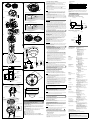
Connecting to the side conduit hole 1 The cables are set up at the factory to pass through the bottom conduit hole. If you want to use the side conduit hole, perform the following steps: Remove the conduit hole cover. Disconnect the cables from the connectors, and pull them out from the bottom conduit hole. Insert the cables through the side conduit hole, and connect the cables to their respective connectors. Pass the cables through the guides to secure the cables. (-5) Attach the conduit hole cover that was removed from the side conduit hole to the bottom conduit hole. 5 4 1,3 2 2 Notes Rating label If the bottom conduit hole is dirty, the conduit hole cover cannot be fixed firmly. In this case, moisture may leak into the casing and this may cause a malfunction. Wipe off the dust with a soft cloth, and fix the conduit hole cover firmly. Cover the joint part of the pipe/cover with silicon sealant, etc. to prevent moisture from getting inside the casing. When you install the camera on a wall lengthwise, position the side conduit hole directly below to prevent moisture from getting inside the casing. (-1) Use a pipe/plug with a thread length of 12 mm (1/2 inch) or less so that it does not damage the camera. (-2) When ZOOM/FOCUS switch slides to W/T Wiring slit The number indicates the zoom position. 3, 4 * mark indicates the approximate zoom position. AUDIO IN recommended cable DC 12 V: CABLE(AWG) #24 #22 #20 4 6 9 CABLE(AWG) #24 #22 #20 Max. length(m) 13 23 30 Max. length(m) AC 24 V: Connecting to the power supply equipment pursuant to IEEE802.3af The power supply equipment pursuant to IEEE802.3af supplies the power through the LAN cable. For details, refer to the Instruction Manual of the equipment. Connecting the I/O Cable Connect the wires of the I/O cable as follows: Wiring diagram for sensor input Mechanical switch/open collector output device Camera inside 3.3 V Installation WARNING 10 KΩ If you attach the camera in the height such as the wall or the ceiling, etc., entrust the installation to an experienced contractor or installer. If you install the camera at a height, ensure that the installation location and its material are strong enough to withstand a weight of 15 kg (33 lb 11 oz) or more, and then install the camera securely. If they are not strong enough, the camera may fall and cause serious injury. If the ceiling is not strong enough, the camera may fall and cause serious injury. To prevent the camera from falling, make sure to attach the supplied wire rope. If you attach the camera to the ceiling, check periodically, at least once a year, to ensure that the connection has not loosened. If conditions warrant, make this periodic check more frequently. When ZOOM/FOCUS switch slides to N/F The number indicates the focus position. * mark indicates the approximate focus position. Deciding the Installation Location of the Camera 2.2 KΩ 10 KΩ 10 KΩ GND GND Sensor input + Open collector output device GND Camera inside R Alarm Output + Magnet relay – 24 V AC 24 V DC, 1 A or less WARNING Installing the Camera 1 Install the supplied bracket on the ceiling or wall. Refer to “Mounting screws” for screws to be used. 2 Fix the supplied wire rope to the camera unit and the ceiling or wall. Fix the wire rope with the supplied Screw M4 × 8 to the hole for the wire rope on the bottom of the camera unit. Fix the wire rope to the ceiling or wall. When you install the camera on a wall, feed the cables through it. (-1) 3 Attach the camera unit to the bracket with the supplied four screws. The screws have a fall-prevention mechanism. The screws inserted into the screw holes of the camera unit do not fall even if you turn the camera unit upside down. Insert the two holders to any two of the grooves on the bracket. Turn the camera clockwise until the locating pins snap to the holes on the holders. Then the four camera installation holes will align the projections on the bracket accordingly. There are four projections with an angle of 90 degrees, so you can select one of four directions. Then tighten the four camera unit mounting screws to attach the camera unit to the bracket through the camera installation holes. Network cable (straight, not supplied) 1 10BASE-T/ 100BASE-TX Note Position of conduit hole Router or hub Power input cable If you cannot use screws on a ceiling or wall, or if you want to make the camera less conspicuous, use the YT-ICB45 in-ceiling bracket (optional) with which you can mount the camera on the ceiling. For this model, install the camera to the position on the side brackets of YT-ICB45. Refer to the Installation Instructions of YT-ICB45 for detail information. 2 85.7 (3 3/8) 46 (1 13/16) Hole for connecting cables ø73 (2 7/8) 83.5 (2 9/32) Adjusting the Camera Direction and Coverage 1 Loosen the camera head fixing screw. 2 Adjust the camera to turn the lens in the desired direction. 3 Tighten the camera head fixing screw to fix the camera. 4 Slide the ZOOM/FOCUS switch to W/T to adjust the zoom. 12 mm (1/2 inch) or less 14 0 (4 5 6 3 4 /) When you adjust the camera head angle without loosening camera head fixing screw, an internal part may be damaged. When the lens is not put in the slit of the camera head holder, the moving range of the camera head is limited. If the camera head is too heavy to be adjusted, loosen the camera head fixing screw until it moves freely. When adjusting the angle, be sure that the TOP mark on the camera head section faces the ceiling. If the camera is installed with the TOP mark facing the floor, the image appears upside down. If you cannot achieve satisfactory focus with the Easy Focus button due to the shooting environment, slide the ZOOM/FOCUS switch level to N/F to focus manually. The focus indicator is displayed on the monitor. Poor focus may also be caused by the dome case assembly. Readjust the focus using the system menu. For details, refer to the User Guide of the equipment. 4- ø5 (7/32) hole Hole for installing the bracket The zoom indicator is displayed on the monitor. Press the Easy Focus button to automatically adjust the focus. Repeat steps 1 to 5 until the coverage and the focus are determined. Notes Horizontal marker Vertical marker Unit: mm (inches) 1 Note Do not turn the lens more than 360 degrees, as this may damage the wiring inside, which may cause failure on video output. ø166 (6 5/8) Ceiling Fix the dome casing and the camera unit. Align four screw holes on the dome casing with that on the camera unit, and tighten four screws with the supplied wrench to secure the dome casing. 119 (4 3/4) Note Make sure that the cord does not get caught between the dome casing and the unit casing. Rotate the cord and adjust the position of the cord. Connection 2, 3 Unit: mm (inches) Locating pin Connecting to the Network Connect the LAN cable of the camera to a router or hub in the network using the network cable (straight, not supplied). To connect to a computer Ceiling Groove Connecting the Cables to the Camera Wire rope (supplied) Connect the LAN cable of the camera to the network connector of a computer using the network cable (cross, not supplied). Preparations Before installation, connect the supplied cables to the camera as required for your usage and wire them. 1 Screw M4 × 8 (supplied) Holder Remove the dome casing. Loosen the four fixed screws of the dome casing using the supplied wrench and lift the dome casing. 2 Pass the cables through the conduit hole on the bottom of the camera unit. When you route the cables from the side of the camera unit, see “Connecting to the side conduit hole”. 3 Connect the cables to the connectors on the camera unit. I/O cable: to EXT CTRL connector BNC cable: to VIDEO OUT connector Audio cable: to AUDIO IN connector 4 Pass the cables through the guides to secure the cables. (-4) 5 Camera unit mounting screw (supplied) (4) Pull the cables gently from the bottom of the camera unit to take in the slack. Connecting the Power Source There are three ways to supply the power source to this camera, as follows. 12 V DC 24 V AC Power supply equipment pursuant to IEEE802.3af (PoE* system) *PoE means Power over Ethernet. Note If the power is supplied from the power input cable and LAN cable at the same time, the power from the LAN cable has priority over the other. Connecting to 12 V DC or 24 V AC source GND Specifications Compression Video compression format Audio compression format Maximum frame rate Camera JPEG/MPEG4/H.264 G.711/G.726 (40, 32, 24, 16 kbps) SNC-DH180: JPEG/MPEG4/H.264: 30 fps (1280 × 720) JPEG: 30 fps (1280 × 1024) MPEG4: 25 fps (1280 × 1024) H.264: 20 fps (1280 × 1024) SNC-DH280: JPEG: 16 fps (1920 × 1080) / 12 fps (1920 ×1440) MPEG4: 20 fps (1920 × 1080) / 15 fps (1920 ×1440) H.264: 30 fps (1920 × 1080) / 20 fps (1920 ×1440) IR LED IR working distance Signal system Image device 21 pcs SNC-DH180: 30 m (50 IRE) SNC-DH280: 30 m (50 IRE) NTSC color system/PAL color system (switchable) SNC-DH180: 1/3 type CMOS (Exmor) Effective picture elements: Approx. 1,390,000 SNC-DH280: 1/2.8 type CMOS (Exmor) Effective picture elements: Approx. 3,270,000 Synchronization Internal synchronization Horizontal resolution 600 TV lines (analog video) Video S/N More than 50 dB (AGC 0 dB) Minimum illumination SNC-DH180: F1.2/View-DR Off/VE Off/AGC High/XDNR Middle/ 50 IRE (IP) Color 0.20 lx Black & White 0 lx (IR On) SNC-DH280: F1.2/View-DR Off/VE Off/AGC High/XDNR Middle/ 50 IRE (IP) Color 0.40 lx Black & White 0 lx (IR On) Lens Focal length Maximum relative aperture View angle Minimum object distance 3.1 mm to 8.9 mm F1.2 ~ F2.1 SNC-DH180: Vertical: 67.4° to 25.0° (1280 × 1024) Horizontal: 85.4° to 31.2° SNC-DH280: Vertical: 65.2° to 24.2° (1920 × 1440) Horizontal: 88.5° to 32.3° 300 mm Interface LAN port 10BASE-T/100BASE-TX, auto negotiation (RJ-45) I/O port Sensor input : × 1, make contact, break contact Alarm output : × 2, 24 V AC/DC, 1 A (mechanical relay outputs electrically isolated from the camera) Video output VIDEO OUT: BNC, 1.0 Vp-p, 75 ohms, unbalanced, sync negative Microphone input* Minijack (monaural) Plug-in-power supported (rated voltage: 2.5 V DC) Recommended load impedance: 2.2 kΩ Line input* Minijack (monaural) * The microphone input and the line input are switchable with operating menu. Attaching the Dome Casing Bracket (supplied) Circuit example Alarm Output – The required mounting screws differ depending on the installation location and its material. If you do not secure the camera with the appropriate mounting screws, the camera may fall off. LAN cable Outside 5V The supplied bracket is provided with eight ø4.5 mm (3/16 inch) mounting holes. Install the bracket on a ceiling or wall with screws through four mounting holes: two 83.5 mm (3 9/32 inch)-pitched holes or four 85.7 mm (3 3/8 inch)-pitched holes. The required mounting screws differ depending on the installation location and its material. (Mounting screws are not supplied.) Steel wall or ceiling: Use M4 bolts and nuts. Wooden wall or ceiling: Use M4 tapping screws. The panel thickness must be 15 mm (5/8 inch) or more. Concrete wall: Use anchors, bolts and plugs suitable for concrete walls. Junction box: Use screws to match the holes on the junction box. Ceiling or Sensor input − (GND) Mounting screws 5 Mechanical switch Wiring diagram for alarm output After deciding the direction in which the camera will shoot, make the required hole (ø73 mm (2 7/8 inches)) for the connecting cables using the supplied template. Then decide the four mounting hole positions to install the bracket. 85.7 (3 3/8) Outside Connect the power input cable of the camera to a 12 V DC or 24 V AC source. Use a 12 V DC or 24 V AC source isolated from 100 to 240 V AC. Each usable voltage ranges are as follows. 12 V DC: 10.8 V to 13.2 V 24 V AC: 21.6 V to 26.4 V In the USA, The product shall be powered by a UL Listed Class 2 Power Supply Only. In Canada, The product shall be powered by a CSA certified Class 2 Power Supply Only Use UL cable (VW-1 style 10368) for these connections. Line output Others Minijack (monaural), Maximum output level: 1 Vrms Power supply 12 V DC ± 10% 24 V AC ± 10%, 50/60 Hz IEEE802.3af compliant (PoE system) Power consumption SNC-DH180: 28 W max. SNC-DH280: 29 W max. Operating temperature (AC 24 V and DC 12 V) Start temperature: −20°C to +50°C (−4°F to +122°F) Working temperature: −30°C to +50°C (−22°F to +122°F) Operating temperature (IEEE802.3af (PoE SYSTEM)) Start temperature: 0°C to 50°C (32°F to 122°F) Working temperature: −10°C to +50°C (14°F to 122°F) Heater operation Supported by 24 V AC and 12 V DC only. IEEE802.3af (PoE SYSTEM) (camera power only) Storage temperature –20°C to +60°C (–4°F to +140°F) Operating humidity 20% to 80% (Non-condensing) Storage humidity 20% to 95% Dimensions (diameter/height) 166 mm × 119 mm (6 5/8 inches × 4 3/4 inches), not including the projecting parts Mass Approx. 1.38 kg (3 lb 0.68 oz), not including the cables and bracket Supplied accessories CD-ROM (User’s Guides, and supplied programs) (1), Bracket (1), Template (1), Wire rope (1), Camera unit mounting screws (4), Screw M4 × 8 (1), Audio cable (1), I/O cable (1), LAN cable (1), BNC cable (1), Power input cable (1), Wrench (1), Installation Manual (this document) (1 set) Optional accessory In-ceiling bracket YT-ICB45* * Using the fixture position on the bracket. Design and specifications are subject to change without notice. Recommendation of Periodic Inspections In case using this device over an extended period of time, please have it inspected periodically for safe use. It may appear flawless, but the components may have deteriorated over time, which may cause a malfunction or accident. For details, please consult the store of purchase or an authorized Sony dealer.