1
Operating & Installation Manual
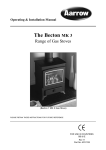
Beacon
Multifuel Stoves
AARROW BEACON
75
SHOWN
PLEASE RETAIN THESE INSTRUCTIONS FOR FUTURE REFERENCE
Rev 1
October 2005
AFS 1269
Congratulations on your choice of an Aarrow Stove.
More than 20 years experience has been put into the development
of our Beacon stove to ensure ultimate performance and years of
trouble free enjoyment.
Every detail on the fire has been carefully engineered and
designed which is why we are so confident in the reliability of
our product.
Should you have any questions about our Beacon Stoves that are
not covered in this manual, please contact the Aarrow dealer in
your area, or call our Technical support department on
01308 427234
`
© COPYRIGHT 2005
Arada Ltd
This booklet has copyright & may not be
copied in whole or part or be used for any
purpose other than that for which it is
supplied without express written consent
from Arada fires Ltd.
CONTENTS
INTRODUCTION
Page
INSTALLATION
Page
Safety Notices
5
General Precautions
16
The Principle of the Fire
5
Handling
16
Check List
6
Hearth
16
Technical Data
7
Combustible Materials
16
Air For Combustion
16
OPERATING INSTRUCTIONS
Firebox Linings and Throat Plate
8
Firebox Liner Panels
17
Multifuel Grate
8
Romoval Of The Throat Plate
17
Air inlet Controls
8
Fitting The Flue Outlet & Hot Plate
18
Airwash System
8
Flues & Chimneys
18-21
Interlock
9
Installation Check List
22
Multi-Purpose Operating Tool
9
Parts List
23-25
Door Trim
9
GUARANTEE
Fire Door Glass
9-10
Guarantee
26
Door Adjustment
10
Customer Registration
26
Fuel Types
11
SERVICE RECORD
Lighting The Fire
11-12
Overnight Burning
12
Over-Firing
13
Cleaning
13
Annual Maintenance
14
Accessories
15
Service Record
27
Final Factory Check List
28
3
WARNING
TO ALL MULTIFUEL USERS
PETROLEUM COKE
SOME OF WHOSE BRAND NAMES ARE
"CALCO", "PETROCOKE" OR "WONDERCO"
MUST NOT BE BURNED IN THIS APPLIANCE
TO USE THESE FUELS WILL INVALIDATE THE
APPLIANCE GUARANTEE
IF IN DOUBT CONTACT THE SOLID FUEL ASSOCIATION
TELEPHONE NUMBER 0800 600 000
www.solidfuel.co.uk
THE USE OF SPARE PARTS OTHER THAN THOSE SUPPLIED
BY ARADA LTD WILL INVALIDATE THE
APPLIANCE GUARANTEE.
4
Beacon Multifuel Stoves
INTRODUCTION
SAFETY
A fireguard conforming to BS 8423: 2002 should
be used in the presence of children and old/or
infirm people. If the appliance is used with the fire
door open, a spark guard conforming to BS 3248
should be fitted.
Do not use aerosol sprays or any other flammable material near the appliance under fire.
Do not fit an extractor fan in the same room as
the appliance.
Fire cement is caustic, hand and eye protection
should always be worn, prolonged contact with
the skin should be avoided.
Arada Ltd will not be responsible for any consequential or incidental loss or injury however
caused.
Before continuing any further with the installation
of this appliance please read the following guide to
manual handling.
• Always obtain assistance when lifting the
appliance.
• When lifting always keep your back
straight. Bend your legs not your back.
• Avoid twisting at the waist. It is better to
reposition your feet.
• Avoid upper body/top heavy bending. Do not
lean forwards or sideways when
handling the fire.
• Always grip with the palms of your hands.
Do not use fingertips for support.
• Always keep the stove as close to the body as
possible. This will minimise the cantilever
action.
• Use gloves to provide additional grip.
THE PRINCIPLE OF THE FIRE
Your Aarrow Fire is built to the highest standard of
craftsmanship using the best materials and the most
modern equipment available. It is a highly efficient
and sophisticated piece of machinery and when
properly installed and operated it should provide a
lifetime of heating satisfaction.
Beacon Multifuel Stoves
Safety is the most important consideration when
installing your fire. If not properly installed and
operated a house fire may result. installation must
comply with the Building Regulations and conform
to all relevant fire safety standards.
Arada Ltd produce a variety of appliances ranging
from units, which are traditional in style to stoves
which are modern in appearance, all
bristling
with "High Tech" features.
Model types include simple room heaters,
convectors, integral boiler models and inset units.
Your Aarrow Fire is constructed from either single
or twin wall steel strengthened where necessary.
Cast iron is used where appropriate for decorative
features.
All fire doors are fitted with special high
temperature ceramic glass panels through which
the fire can be viewed.
Multifuel stoves are fitted with a cast iron grate to
give full multifuel facility and positive de-ashing.
All models except integral boiler models are lined
with firebricks or heat reflective panels which
ensure complete combustion and provide a good
heat store to even out fluctuations in burning.
An internal throat plate produces turbulence to
encourage secondary combustion and directs the
flue gas around the whole upper firebox before
allowing it to escape up the chimney.
On multifuel appliances the primary air for burning
enters the ash pit chamber beneath the grate,
controlled by the air inlet mechanism.
Aarrow Fires are also fitted with an "air wash" so
called because it provides a curtain of high speed
preheated air behind the glass to help keep it clean
and to provide secondary air/over draught.
The provision of two inlets on all multifuel stoves
gives a wide range of primary air/secondary air,
under draught/over draught combinations. The
optimum settings will only be established by
experience in firing the appliance, and will depend
on type of fuel, the position of the appliance in the
house, condition of chimney etc.
5
CHECK LIST
Inside the appliance you should find the following:
Part Description
&Visual Aid
(not to scale)
Beacon 75
Beacon 77
1
1
1
1
1(5”)
1(5”)
1(5”)
1(5”)
1
1
6.Operating
tool
1
1
7. Rear
liner
1
1
2
2
1
1
1. Cast Grate
2. Throat
plate
3. Flue
spigot
4. Hot plate
5. Ash pan
8. Side liners
9. Instructions
6
Beacon Multifuel Stoves
TECHNICAL DATA
TECHNICAL DATA
Beacon 75
Beacon 77
Room Min/Max
Room Heater Only Output (kW)
1.5-7
1.5-7
Room Heater with Domestic Hot
Water with add in boiler type
N /A
N /A
N /A
N /A
Height (mm)
548
543
Width (mm)
476
482
Depth (mm)
345
345
Height to Centre of Rear Flue
440
440
Depth from Back to Centre of
Flue
102
120
127 (5”)
127 (5”)
57
55
Max Output to Room (kW)
Max Output to Water (kW)
Flue Diameter
Weight packed (Kg)
Beacon Multifuel Stoves
7
OPERATING INSTRUCTIONS
FIREBOX LININGS & THROAT
PLATE
The Beacon Multifuel stoves firebox has reflective
liners to the sides and rear. A specially shaped
throat plate which sits on the liners. If these are not
in place please refer to page 17 to install these.
Fig. 1 Fully Closed
MULTIFUEL GRATE
The static cast grate fitted to your Beacon multifuel stove, is designed to burn solid fuel briquettes,
well seasoned wood and peat. A combination of
these fuels can also be burnt, please note, the grate
requires no setting between the differing fuel types.
AIR INLET CONTROLS
Beacon multifuel stoves have two air inlets:
•The air wash system (so called because its
pre-heated high speed air washes across the inner
face of the door glass, keeping it clear), which
provides over draught, and
•The primary air inlet providing under draught to
the base of the fire chamber through the gap
between the body and the ash pit door.
PRIMARY AIR FOR MULTIFUEL
On Multifuel units primary air enters the appliance
through the gap between the body and the ash pit
door. The width of the gap is controlled by rotating
the door knob (if hot, with a suitable glove) anticlockwise to increase the the air inlet, clockwise to
reduce the air inlet, or seal the ash door
completely.
Note: Opening or part opening of the ash door is
controlled by the "interlock" device located in the
front of the unit (refer to INTERLOCK section on
page 9).
Fig. 2 Fully Open
Sliding it to the left will shut off the air inlet slots
as shown in Fig. 1. Even when all the slots are completely shut a "bleed" of secondary air will be maintained ensuring that inflammable gases are burnt
off.
DISASSEMBLE AIRWASH
The Beacon air wash may be disassembled for
cleaning or adjustment. To achieve this, the
following procedure should be followed:
This should only be carried out when the fire is cold
and unlit.
•Support Air Wash cover with one hand
•Move cover up by smartly tapping the bottom with
a hammer. (Fig. 3)
•Remove assembly from appliance.
•Clean and/or adjust.
•Refit using reverse procedure.
AARROW AIRWASH SYSTEM
The air wash has an internal sliding plate with slots,
housed in a cover plate, and is located above the fire
door. Sliding the control knob to the right as far as it
will go achieves the fully open position.
8
Fig. 3
Beacon Multifuel Stoves
OPERATING INSTRUCTIONS
INTERLOCK SYSTEM
Beacon fires are fitted with an "interlock" system.
A situation where the fire door is closed and the ash
door is open may lead to serious over firing which
could damage the appliance. Correct use of the
doors and interlock system will ensure that this
does not happen.
locks the glass retaining clips in position.
(Fig 5)
The fire door should be removed so that the above
operations can be carried out on a workbench or
similar. Remove the door by GENTLY tapping the
door upwards; this will lift off of its hinges.
Operation is as follows:
A pivoted lug prevents closure of the fire door,
unless the ash door has been shut first. When the
fire door is shut the ash door knob can be turned
anti-clockwise by up to 95 degrees creating a
variable gap between the top of the ash door and the
body, through which primary combustion air can
enter the appliance.
Note: In order to turn the ash door knob
sufficiently for the catch to release and permit the
ash door to be opened fully THE FIRE DOOR
MUST BE OPENED FIRST.
Fig. 5
FIRE DOOR GLASS
MULTI - PURPOSE OPERATING
TOOL
Your Aarrow fire comes with a multi-purpose tool,
which is used to empty the ash pan. (fig. 4) Please
ensure the forked end of the tool is located fully
into the ashpan before removal.
If necessary the glass can be removed as follows
see Fig. 6.
Step 1 Remove the brushed steel finish trim by
pressing on the curved edge at the top until the trim
can be disengaged from the lugs.
Step 2 Slide the two glass retainer clips on one side
only, inwards, towards the centre of the door as far
as they will go.
Step 3 Pull this side of the glass away from the door
casting, easing the tags on the glass retaining clips
past the edge of the aperture in the door casting.
Fig. 4
DOOR TRIM
Beacon fire doors are fitted with a brushed steel
finish trim as standard. This, clips on to the small
lugs at the top and bottom of the aperture in the cast
iron fire door, as a "spring fit". When fitted, the trim
Beacon Multifuel Stoves
Step 4 Remove the glass completely. Store glassretaining clips and white gasket (if sound) safely
for re-use.
Step 5 Follow this procedure in reverse to fit
replacement door glass or gasket.
9
OPERATING INSTRUCTIONS
Fig. 6
Fig. 7
DOOR ADJUSTMENT
•Lift the fire door up off the hinges.
The catch can be adjusted by sharply tapping the
catch on the inside of the door.
•Drop one washer on the top and bottom hinge pin.
Once the appliance has been under fire for a period
of time the fire door may appear to have moved out
of alignment with relation to the door aperture or
catch on the door interlock mechanism. This is
quite normal and due to the settling of the casing.
•Refit the door and check to ensure door is free of
the interlock. If not remove and repeat fitting
second washer.
The fire door can be re-aligned by the user as
follows:
•When the appliance is cold, open the fire door so
that it is at a right angle to the front face of the fire.
•Lift the fire door up off the hinges.
•Gently tap the two hinge pins in a direction to
compensate for the misalignment.(fig 7)
•Refit the door and check to ensure it now sits
square to the body; if not repeat above steps.
Raising the door as follows:
•When the appliance is cold, open the fire door so
that it is at a right angle to the front.
10
Beacon Multifuel Stoves
OPERATING INSTRUCTIONS
FUEL TYPES
Wood- Any type of wood is suitable provided it is
well seasoned and has a moisture content below
20%. This usually implies that the timber has been
suitably stored to allow moisture to evaporate for at
least nine months in the case of soft woods, and at
least eighteen months in the case of hard wood. We
recommend that for general burning, wood should
be split into logs of no more than 130mm (5")
diameter.
Larger logs can be used for overnight burning.
WARNING wet wood must not be used as this will
greatly contribute to the creation of tar and creosote
which may, in extreme cases, run down the
chimney in liquid form. This will seriously damage
both the chimney and the appliance, and increase
the risk of chimney fire.
Note: If you have sticky tar inside the appliance or
chimney your wood is 'Green' or too wet.
Recommended Reading:
"Wood as Fuel" available from the Forestry
Commission.
Peat- Can be used in turf or briquette form, but
again the moisture content must be low.
Paper- paper will burn successfully. Burn dry
paper only or chimney damage will occur.
NEVER BURN PLASTICS OR WASTE IN
YOUR STOVE.
Coal - Household coal produces a large amount of
ash and smoke. If used the appliance and chimney
will require frequent cleaning. Therefore soft house
coal is not recommended.
Recommended fuels are as follows:
The Hetas Ltd, "Three Tick" appliance approval
only covers the use of the following fuels in this
appliance; Phurnacite, Phurnacite Plus,
Centurion, Maxibrite, Extracite, Pureheat,
Blazebrite, Taybrite, Sunbrite (Doubles/Singles),
Anthracite (Large Nuts), and Welsh Dry Steam
Coal (Large/Small Nuts).
Beacon Multifuel Stoves
Approval does not cover the use of other fuels
either alone or mixed with the suitable fuels listed
above, nor does it cover instructions for the use of
other fuels.For latest details please refer to Hetas
website www.hetas.co.uk.
Do not use Homefire (six sided) and smaller sizes
than Stovesse, e.g. Beans, Peas,Grains.
Do not use petroleum based solid products such
as Calco or Petrocoke.
To do so will invalidate the appliance guarantee
LIGHTING THE FIRE
Prior to lighting the fire for the first time check
with the installer that:
•Installation and all building work is complete.
•The chimney is sound and has been swept and is
free from obstruction.
•Adequate provision for combustion air has
been made, i.e. a permanent vent of at least
550mm² per kW of rated output above 5 kW,
is fitted in the room in which the appliance
is installed.
•That Building Regulations and any local
by-laws have been followed during installation
(see installation instructions).
•All firebox liner panels are in place.
•Throat plate is in place.
•Where add in boilers are fitted ensure that the
system is full of water and vented, and
precautions have been taken to prevent corrosion
(see installation Instructions).
•That the chimney draw has been checked and is
within specification. With the chimney warm the
draught should be between 1 - 2mm water gauge
(0.1 - 0.2mbar).
WARNING: An over drawing chimney can cause
over-firing resulting in damage to the appliance.
11
OPERATING INSTRUCTIONS
ENSURE THAT YOU HAVE READ &
UNDERSTOOD THESE INSTRUCTIONS
BEFORE LIGHTING THE FIRE.
ALWAYS WEAR SUITABLE PROTECTIVE
FIRE GLOVES WHEN REFUELLING YOUR
STOVE.
SOLID FUEL BURNING
•Ensure that the ash pan is in position and the fire
doors are closed.
•Set the air wash to one quarter open position.
•Set the primary inlet to the fully open position
•Light in the normal manner with paper and
kindling, or use a fire lighter.
•If using a gas poker be sure to remove it
immediately the fire is alight.
•When the fire is well alight regulate the burning
rate by adjusting the setting on the primary air
inlet control.
•The air wash can be opened sufficiently to keep
the door glass clean
BURNING WOOD
•Set air wash to fully open position.
•Proceed as for solid fuel but note the fire will burn
up and become established more quickly.
MIXED FUELS
•As per coal but allow additional secondary air.
•The primary air inlet can be closed and burning
regulated by means of the air wash above the door.
ANTRACITE
Anthracite is more difficult to keep in for long
periods, consequently more care in setting the
controls and some familiarisation is necessary
when burning anthracite.
Use the smallest size fuel (Stovesse or Small Nuts).
Proceed as for manufactured smokeless fuel. Leave
the air inlet control open about a quarter or less.
Note: The high temperature paint acquires
durability by being "cured" during the initial
firings of the appliance will give off fumes which
are non-toxic, but which certain persons may find
have an unpleasant or irritant effect. Ensure that
the area is well ventilated during this time.
12
OVERNIGHT BURNING
The appliance will burn overnight provided:
•Sufficient fuel is placed in the firebox.
•The controls are set correctly.
•Excess draught is not present in the chimney.
•Close the door.
•If the fire goes out with unburnt fuel left in the
firebox increase the air opening slightly, and vice
versa.
In the morning
Open the air control fully until embers begin to
glow brightly and place pieces of fuel on the fire
until it is well established.
WARNING: When wood is burnt slowly in a
closed appliance it produces moisture and tar,
which will create condensation and deposits in the
chimney. This effect can be minimised by burning
hard for a short period, about 20 minutes, twice a day.
It is usually convenient to do this morning and night.
Note: To avoid chimney problems your fire should
not be burnt slowly for longer than 12 hours
without a period of fast burning.
WARNING: Properly installed, with a suitable
flue and chimney and operated and maintained
this appliance will not emit fumes into the
dwelling. Occasional fumes from the de-ashing
and re-fuelling may occur. However, persistent
fume emission is potentially dangerous and must
be investigated dy a Hetas registered installer.
Stop using the appliance if you smell fumes or
see smoke escaping.
If fume emission does persist, the following
immediate actions should be taken.
•Open doors and windows to ventilate room.
•Let the fire die or extinguish and safely
dispose of fuel from the appliance.
•Check for flue or chimney blockage, and
clean if required.
Seek expert advice from your HETAS registered
installer. Do not attempt to re-light the fire until the
cause of the fume emission has been identified and
corrected.
Beacon Multifuel Stoves
OPERATING INSTRUCTIONS
ASH REMOVAL
The ash pan should be emptied at least twice a day
or when the level of ash reaches the top of the ash
pan. On no account should the ash be allowed to
build up to touch the grate as this will greatly
shorten its life.
DE - ASHING
It is necessary to maintain an ash layer on the upper
surface of the grate, in order to protect it, so de-ashing should cease as soon as the first red embers
drop into the ash pan. Further de-ashing will cause
heat build-up under the grate, which will considerably shorten its life.
CLEANING
IMPORTANT
Under some circumstances soot can quickly build
up on the throat plate and adjacent areas. The throat
plate should be removed and checked monthly, and
any debris stripped off. Similarly, clean the upper
surface of the firebox.
Refer to page 17 for instructions on throat plate
removal/inspection.
TO EMPTY THE ASH PAN
Open the fire door; open the ash door. Fit the fork
end of the operating tool into the ash pan and
remove from the ash pit chamber.
WARNING: The ash can be very hot. Empty only
into a metal container. Even if the ash appears cold,
red-hot pieces of ash may be concealed and could
easily start a fire or cause an injury.
CLINKER
The formation of clinker suggests that the unit is
being over-fired. Any clinker forming on the grate
should be removed when cold.
OVER-FIRING
Do not over fire your appliance. Using flammable
liquids or too much wood or firing the fire at
maximum for prolonged periods may result in
over-firing. If the chimney connector or casing
glows red it is being over-fired. If this occurs
immediately close all air inlets to the appliance to
reduce the air supply to the fire. Should a chimney
fire occur immediately close the appliance down.
Get everyone out of the house and call the fire
brigade. A chimney fire may cause structural
damage of the chimney. Do not use the appliance
until the chimney and connector have been
inspected and any damaged parts repaired or
replaced. This should be done by a competent
person such as a HETAS registered engineer.
Beacon Multifuel Stoves
13
SERVICING
ANNUAL MAINTENANCE
It is important that your fire is regularly serviced in
accordance with these instructions. This should be
carried out at least annually by a qualified person
and should consist of the following.
Remove the firebricks lining and throat plate,
inspect all gasketing on doors, glass etc., and
re-order any items that may need replacing, from
your Aarrow dealer. With a wire brush clean inside
the appliance paying particular attention to the
small inlet holes of the air wash on the inside,
above the fire door and to the door.
Sweep the chimney and confirm that it is sound.
Examine all joints in the flue pipe etc., and re-seal
if necessary. Reassemble and leave with the air
inlet and air wash control about half way open. This
will allow a free flow of air through the appliance
thus preventing moisture and condensation from
building up inside the fire and chimney.
CHIMNEY SWEEPING
Sweeping should be carried out with an appropriate
sized bristle brush and rods to suit chimney size and
type. As with all appliances regular sweeping of the flue
is essential to avoid the danger of blockage and the
escape of poisonous fumes. Access for cleaning should
also be incorporated in the chimney (e.g. soot door or
access through register plate).
Any existing chimney should be swept prior to
installation of the appliance, and swept again a
second time within one month of regular use after
installation to establish frequency of sweeping
required. This should be done by a competent
person such as a NACS chimney engineer who will
provide a Certificate of Chimney Sweeping.
Sweep the whole flue way, including the outlet, at
least twice per burning season. It is important that
the flue ways, flue pipe and chimney be cleaned
prior to lighting the fire after a prolonged
shut-down period.
DOOR GLASS
The door glass should remain clear during normal
daytime burning. However under certain conditions-such
as burning at a low rate with damp wood, or overnight
14
burning, the glass may become somewhat blackened. To
remedy this, operate the appliance at a fast rate.
Alternatively when the stove is cold open the door and
clean the inside face of the glass with a damp cloth or
with glass cleaner (available from fire stockists). A piece
of cloth moistened with vinegar and dipped in wood ash
- not coal ash - will provide a good soft scourer to
remove the soot without scratching the glass.
OUTER FINISH
The outside finish of the appliance is a durable high
temperature paint. It is best cleaned by brushing
down with a clean shoe brush. Do not allow
moisture to remain on the appliance whilst cold or
surface rust may form.
The high temperature paint should not require
attention for some time, depending on use. The
hotter the fire burns the sooner repainting will be
necessary. Aerosol tins of paint are available for
complete refurbishing. Before repainting make sure
that the fire is out and is cold.
•Remove the door glass.
•Lightly wire brush, or rub with wire wool, the
body of the appliance to remove any loose paint
powder.
•Mask or remove items such as brass work.
•Any adjacent brickwork, mantelpiece, hearth,
etc., should be carefully masked for quite a
distance around the appliance. (this precaution is
to prevent discolouration of the surrounding brick
work, wallpaper etc).
Re-spray in a well-ventilated area - avoid breathing
the vapour. Refer to safety instructions on paint
cans.
•When the paint is dry refit door glass and any
other parts previously removed.
•Leave the appliance for eight hours before
re-lighting.
•Burn slowly for the first four hours, then build up
heat gradually to cure the paint.
Note: Use only genuine Aarrow touch-up spray as
some paints interact. This could ruin the finish
and invalidate the guarantee.
Beacon Multifuel Stoves
ACCESSORIES
ACCESSORIES
STANDS
Elegant stands are available for the Beacon multifuel stoves. These increase the height of the appliance and
rear flue outlet by approximately 100mm (4'').
TRACERIES
For added decorative effect, beautiful Door Traceries are available to complete your Beacon multifuel stove.
PAINT
Matching aerosol paint to tone in any connecting flues, pipes or surrounding metalwork.
INTERCHANGEABLE CANOPIES
•To fit the interchangeable canopy (Fig 8): Remove the front clamps.
•Tilt the canopy as shown in stage 1.
•Engage the rear clips and pull fully forward.
•Fit the front clamps and tighten.
•Fit the required blanking plates as shown in stage 2.
Traditional canopies (High or Low) are available for your Beacon multifuel stove. They are easy to fit and
can always be added afterwards.
Fig 8
Beacon Multifuel Stoves
15
INSTALLATION
GENERAL PRECAUTIONS
Note - All installations must conform to the
appropriate building regulations.
The Building Regulations for England and Wales
2000 ref Approved Document J 2002 edition
(issued by the DTLR).
The Building Standards (Scotland) (Consolidation)
Regulations.
Detailed recommendations for installation of
appliances, chimneys and flues are outlined in the
current issue of the following British Standards:BS6461, BS8303 and BS4543.
Any Manufacturer's Instructions must not be
taken as overriding statutory requirements.
During installation ensure that adequate
precautions are taken to avoid unnecessary risk to
yourself or any householder. In particular the
danger from the caustic nature of the fire cement
should be avoided by using these accepted
methods:
• Wear gloves when handling fire cement.
• Wear goggles when chiselling or looking up
chimneys.
Make sure that Building Regulations are adhered to
during installation along with any local by-laws. In
the case of heating systems make sure that the pipe
work is correctly bonded to ensure electrical
earthing.
HANDLING
By the time you read this you will appreciate the
weight of the appliance. The Safety and handling
guidelines as set out on page 5 of this manual
should be followed.
To make movement easier internal fittings, fuel
retainers, grates, firebox liners, flue outlets, hot
plate, throat plate, etc., can be removed.
HEARTH
The fire should be installed to stand on a
constructional hearth of non-combustible materials
not less than 125mm (5'') thick conforming to
Building Regulations. Dimensions of the hearth
should project at least 300mm (12'') forward of the
front of the appliance and 150mm (6'') at the sides.
The surface of the hearth should be free of
combustible materials. In most buildings with solid
concrete floors the requirement will be met by the
floor itself, but mark the perimeter of the hearth to
ensure floor coverings are kept well away or use
different levels to mark the hearth perimeter.
COMBUSTIBLE MATERIALS
A gap of at least 450mm (18'') should be allowed
between the appliance and any combustible
materials including furnishings. Adjacent walls
should be of suitable non-combustible
construction, preferably brickwork. In large
fireplaces take care that any supporting beam is
protected by a 13mm (0.5'') sheet of
Masterboard/Supalux spaced 13mm (0.5'') off the
surface with strips of non-combustible material
- not wood.
Make sure that there is a gap between an
uninsulated flue system and any combustible
material. This gap must be at least 3 x the outside
diameter of the flue pipe, or 1.5 x the flue diameter
to non combustible surfaces. see illustration p21.
AIR FOR COMBUSTION
There must always be a permanent means of
providing air for combustion into the room in
which the fire is installed. A permanent vent with a
total free area of at least 550mm for every kW
rated output above 5kw should be connected
directly to the outside air or to an adjacent room
which itself has a permanent vent of the same size
direct to the outside air. The fitting of an extractor
fan to either of these rooms is not recommended.
2
Care should be taken to make sure that the hinges
are not damaged during installation.
16
Beacon Multifuel Stoves
INSTALLATION
FIREBOX LINER PANELS
The Beacon Multifuel stove uses firebox liner
panels to the sides and back. The throat plate sits on
top of the side and rear panels (fig 9). These should
come fitted to your fire, if however they are not
proceed as follows to fit them.
•Open the main fire door and ensure the cast static
grate is correctly fitted into both side lugs.(Fig 10)
•Set the 1x rear liner into the stove, this liner sits on
a ledge behind the static grate.
Fig. 10
•Insert the 2x side liner panels, again these sit on
the side landings behind the top edge of the grate.
(Fig 11)
•Fit the throat plate with the single bend and two
cut outs to the front facing up. The projecting lugs
sit on top of the side liners. The long centre tab on
the back edge rests on the rear liners. The shorter
turn-down tabs against the vertical face.(Fig 12)
Note: Neither the rear firebox liners nor the side
firebox liners are "handed", both faces are
suitable for direct contact with the fire.
Fig. 11
Note: Cracking of lining panels does not effect
efficiency.
Fig. 12
REMOVAL OF THE THROAT PLATE
Blocked chimneys cause dangerous fumes to
escape. Remove throat plate at least monthly to
clean. Keep chimney and flue ways clear.
Fig. 9 Beacon multifuel liners and throat
plate.
Beacon Multifuel Stoves
17
INSTALLATION
FITTING THE FLUE OUTLET
AND HOT PLATE
The flue outlet spigot is found packed inside the
appliance. The hot plate (blanking plate) is supplied fitted to the top opening and is removed by
turning clockwise (as is the flue outlet).
Smear a very thin layer of fire cement on the faces
of the flue outlet and the blanking plate. Fit the
outlet to the appliance in the desired position .
Lock into place by rotating anti-clockwise and
tighten by tapping with a block of wood and mallet from the inside of the appliance. Similarly, fit
the blanking plate to the unused opening. Clean
off any surplus fire cement.
Place appliance on the hearth and make sure that it
is level and does not rock.
Connect the chimney ensuring all joints are sealed
with fire cement.
FLUES AND CHIMNEYS
Please remember that chimney draught is
dependent on four main factors:
• Flue gas temperature.
• Flue height.
• Flue size.
• Flue terminal.
The stove must be connected to a suitable and
efficient flue that provides a good updraught to
safely take the products of combustion (fumes)
from the stove outlet to the outside air. To ensure
a good updraught it is important that the flue gases
are kept warm and that the flue size suits the stove.
The termination of the outlet at the top of the flue
also needs to comply with the Building
Regulations. The minimum effective height of the
flue must be at least 4.5 metres from the top of the
stove to the top of the flue outlet. When warm the
flue draught should be between 0.1 and 0.2 mb.
A chimney may comply with the regulations but
still be subject to down draught and similar
problems. A chimney terminating above the ridge
level is generally less likely to suffer such
problems.
If a new chimney is being provided it should fully
comply with the relevant Building Regulations
that specify the requirements for solid fuel burning
installations. Suitable types of chimney include
the following.
*NOTE
THE FLUE PIPE MUST BE FITTED INSIDE THE OUTLET SPIGOT
FAILURE TO DO SO COULD RESULT IN THE SPILLAGE OF
CONDENSATION ECT. RUNNING DOWN THE FLUE.
Fig. 13 Flue and Spigot Fitting
Masonry chimney built with clay or concrete
liners, or a chimney block system meeting
Building Regulations. These types of chimney
should be installed in accordance with the
Building Regulations and BS 6461: Part 1.
Factory made insulated chimney complying
with BS 4543: Part 2 (often called "Class 1
prefabricated metal chimney"). These types of
chimney should be installed in accordance with
the Building Regulations and BS 7566: Parts 1 to
4.
18
Beacon Multifuel Stoves
INSTALLATION
Due to the gradual introduction of European
Chimney Standards chimneys will be specified
according to their performance designation as
defined in BS EN 1443 that covers the General
Requirements for chimneys. The minimum
performance designation required for use with
solid fuel burning stoves is T450 N2 S D3.
Precautions" section page 16 of these instructions.
A chimney may comply with the regulations but
still be subject to down draught and similar
problems. A chimney terminating above the ridge
level is generally less likely to suffer such
problems.
The flue and chimney installation must be carefully checked by a competent person before fitting the
stove to ensure it is suitable and will work safely.
Chimneys should be as straight as possible.
Horizontal runs should be avoided except where
the rear outlet of the appliance is used, in which
case the horizontal section should not exceed
150mm (6'') in length.
If the chimney is old (ie built of brick or stone
without a liner) or being opened up for reuse
additional checks and smoke testing as described
in Appendix E of the Approved Document J 2002
Edition should also be carried out to ensure the
flue and chimney are in good operating condition.
Unless the existing flue is in good condition with
suitable access for collection and removal of
debris. If the flue size is more than 225mm (9 inches) diameter or 200 x 200mm square, a suitable
lining of 150mm (6 inches) diameter should be fitted, or if the flue length is over 5.5 metres one size
larger than the appliance outlet should be fitted.
This should be a double skin stainless steel flexible
flue liner that is independently certified for use
with solid fuel. Details of suitable linings for use
with solid fuel are given in the Official HETAS
guide that can be viewed on their website at
www.hetas.co.uk
It is also important that suitable flue pipe
complying with the Building Regulations is used
to connect the stove to the flue in the chimney and
that suitable access is provided into the flue for
regular inspection and sweeping of the flueways.
The installer should comply with the Building
Regulation requirements in respect of providing a
Notice Plate giving details on the chimney, flue
lining, hearth and fireplace installation. Approved
Document J of the Building Regulations for
England and Wales is available from The
Stationery Bookshops and can also be
viewed
at
the
ODPM
website
at
www.safety.odpm.gov.uk/bregs/brads.htm
Details on the relevant Building Regulations and
BS British Standards are given in the "General
Beacon Multifuel Stoves
If the fire appears to be working hard but produces very little output to the room it is likely that
excessive draw is present in the chimney, and that
heat is being sucked out of the appliance and up
the chimney. If this is the case we recommend the
fitting of a draught stabiliser in preference to a
flue damper, in the interest of safety and efficiency.
We do not recommend the use of a damper when
burning solid fuel.
FOR ALL APPLIANCES
Access for cleaning the flue should be incorporated in the system other than through the appliance
(e.g. a soot door or access through register plate).
Purpose-made soot doors and inspection lengths
are available from manufacturers of all systems.
Ensure that the whole length of the flue can be
reached from the soot door.
Note: if the appliance is fitted with a draught
stabiliser or if one is fitted to the flue pipe or
chimney in the same room as the appliance,
then the permanent air entry opening (or openings) should be increased by 300mm2 for each
kW of rated output.
For advice on flues and chimneys contact;
NACE (National Association of Chimney
Engineer): telephone 0800 0924019
www.nace.org.uk
or
NACS (National Association of Chimney
Sweeps): telephone 01785 811732
www.chimneyworks.co.uk
19
INSTALLATION
20
Beacon Multifuel Stoves
INSTALLATION
TYPICAL METAL INSULATED CHIMNEY SYSTEM
TO BE INSTALLED TO THE CHIMNEY MANUFACTURERS INSTRUCTIONS IN COMPLIANCE
WITH BUILDING REGULATIONS AND BS7566 PTS 1-4
PLAN VIEW OF REGISTER PLATE AND
CLEARANCES FOR NON INSULATED
FLUES
A is minimum clearance for non-insulated flue =
1.5 x D to a non-combustible surface/material
or
3 x D to combustible surface/material
Beacon Multifuel Stoves
21
INSTALLATION
CHECKLIST
Hearths, Fireplaces, Flues and chimneys
This checklist is to ensure hearths, fireplaces, flues and chimneys are satisfactory, and to show what you have done to comply with the
requirements of The Building Regulations 2000 Approved Document J 2002.
1. Building address, where work has been carried out.......................................................................................................................................
.........................................................................................................................................................................................................................
2. Identification of hearth, fireplace chimney or flue
3. Firing capability: solid fuel/gas/.
4. Intended type of appliance.
State model and output.
5. Ventilation provisions for the appliance:
State type and area of permanently open vents.
6. Chimney or flue construction
a) State the type or make and whether new or existing.
b) internal flue size (and equivalent height, where
calculated - natural draught gas appliances only).
c) If clay or concrete flue liners used confirm that they are
correctly jointed with socket end uppermost and
state jointing materials used.
d) If an existing chimney has been refurbished with a
new liner, type or make of liner fitted.
e) Details of flue outlet terminal and diagram reference.
Outlet Details:
Complies with:
f) Number and angle of bends.
g) Provision for cleaning and recommended frequency.
7. Hearth. Form of construction. New or existing?
8. Inspection and testing after completion
Tests carried out by:
Tests and results
Flue
inspection
visual
sweeping
coring ball
smoke
Appliance (where included) spillage
I/we the undersigned confirm that the above details are correct. In my opinion, these works comply with the relevant requirements in
Part J of Schedule 1 to the Building regulations.
Print name and title....................................................................................................Profession..........................................................................
Capacity......................................................................................................................Telephone..........................................................................
Address............................................................................................................................................................Post code.......................................
Signed........................................................................................................Date.................................
Registered membership of..(e.g. CORGI, OFTEC, HETAS, NACE, NACS)............................................
22
Beacon Multifuel Stoves
PART LIST
Part Description
Visual Aid
(not to scale)
Beacon 75
Part No.
Beacon 77
Part No.
AFS1269
AFS1269
AFS1019
AFS1019
AFS1083
AFS1083
AFS010
AFS010
AFS008
AFS008
AFS058
AFS058
AFS009
AFS009
1. Replacement
Instruction Manual
2. Throat Plate
3. Grate
4. Hot Plate
5. Operating Tool
6. Ashpan
7. Flue Spigot
Beacon Multifuel Stoves
23
PART LIST
Part Description
Visual Aid
(not to scale)
Beacon 75
Part No.
Beacon 77
Part No.
AFS1271
AFS1271
AFS1058
AFS1058
AFS1072
AFS1072
AFS069
AFS088
AFS070
AFS089
AFS047
AFS047
AFS1077
AFS1077
8. Liner Set
9. Side Liner
10. Back Liner Set
11. Glass
Replacement Kit
Complete with
Gasket
12. Glass Clips and
Gasket
13. Hinge kit
Comprises 2 Hinges
& 4 Fixings Per Set.
14. New 2002
Airwash
24
Beacon Multifuel Stoves
PART LIST
Part Description
15. Fire Door Rope
Kit Complete with
Door Rope Glue.
16. Main Door
Assembly Complete
with Handle,Glass,
Gaskets,Clips and
Seal.
Visual Aid
(not to scale)
Beacon 75
Part No.
Beacon 77
Part No.
AFS048
AFS048
AFS1270
AFS1272
AFS094A
AFS095
AFS1146
AFS1146
AFS997
AFS997
17. Decorative Door
Surround
18. Fire Door
Locking Assembly
19. Aarrow Fires
Gauntlet Gloves
Beacon Multifuel Stoves
25
GUARANTEE
Guarantee
Once again we would like to thank you for buying
a Beacon multifuel stove.
USE OF SPARE PARTS OTHER THAN
THOSE SUPPLIED BY ARADA LTD
WILL INVALIDATE THE APPLIANCE
WARRANTY.
When you buy an Aarrow Fire, you are not only
buying a first class appliance - you are buying a
commitment from us to look after you and your
appliance for as long as you want.
All Guarantee periods commence on the date of
purchase and are non-transferable.
The Beacon Stoves come with a
One Year
Guarantee
against splitting or cracking of the
main body. The main body being defined as the
steel outer casing and items fixed immovably to the
casing. All other parts are covered by a one-year
no-quibble parts Guarantee.
This Guarantee shall not apply to any part that has
been altered in any way, or which in our judgment
has been subjected to misuse, neglect, accident,
abuse and fair wear and tear.
Items which would be subject to fair wear or tear,
firebox liner panels, fuel retainers, throat plate,
door rope, door glass and gaskets are not covered
by the guarantee. However, should you have any
problems with your appliance please contact your
Aarrow stockist who will have the knowledge and
facilities to help you.
Claims are not valid where the installation does
not conform to local Building Regulations and
fire codes.
The Guarantee is conditional upon the appliance
being serviced and checked annually by a qualified heating engineer.
The Manufacturers decision shall be final.
Our Lifetime Guarantee is offered as an addition to
your statutory rights.
If you think your fire is not working correctly or in
the event of a breakdown, please call your local
dealer.
When you contact them, they will want to know:
1.Your Name, Address/Post Code and Telephone
Number
2.Serial Number
3.Clear and concise details of the fault
CUSTOMER REGISTRATION
See card enclosed
To guarantee the very best in after-sales service,
do not forget to complete and return your
Customer Registration Card within 14 days (a
stamp is required).
Just complete the form and return it to us to:
1. Benefit from our Lifetime Guarantee.
2. Register your appliance for a full year's Parts
Guarantee.
Please contact us direct 01308 427234 if no
Customer Registration Card is included.
If your appliance proves to be defective as a
result of faulty materials or workmanship
during guarantee, we will repair or replace it
FREE OF CHARGE as long as the fire has been
installed according to the manuals instructions
and the Final Installation Check List on p22 has
been completed and signed by a suitably
qualified engineer.
26
Beacon Multifuel Stoves
SERVICE RECORD
Date of Visit
Company
Work Carried Out
Signature
Should you have any questions about your Beacon Multifuel Stove that is not covered in this manual please
contact your Aarrow retailer.
Please keep all repair receipts safely.
Please ensure you have this manual available when an engineer visits as they will complete the service record
chart.
Beacon Multifuel Stoves
27
FINAL FACTORY CHECK LIST
Model..................................
Serial No.............................
QUALITY
FINISH
PARTS
FLUE OUTLET
I’ve checked it
and it’s O.K.
HOT PLATE
OPERATING INSTRUCTIONS
GRATE
FIREBOX LININGS
Assembled by.............................
THROAT PLATE
Checked by ................................
AIR WASH
DOOR CATCHES
INTERLOCK
ASH PAN
OPERATING TOOL
Please ensure the enclosed registration card is completed and returned to Arada Ltd and the following
information completed for your own information.
Date of Purchase....................................
Name and address of supplier.......................................................................
.......................................................................................................................
.......................................................................................................................
* Please ensure installer completes INSTALLATION CHECK LIST details
on page 22 of this manual.
BK001