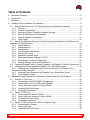
1
1 Executive Summary
This document provides recommendations for deploying standalone Oracle Database 11g
Release 2 (version 11.2, or 11gR2) on Red Hat Enterprise Linux 6 that go beyond Oracle’s
installation instructions, and describes the benefits for doing so in certain cases. In particular,
it describes the benefits of advanced features found in Red Hat Enterprise Linux 6 to increase
performance and provide security; for example, I/O scheduling, transparent and regular huge
pages, automatic tuning of TCP/IP parameters, SELinux, and tuned profiles for automatically
configuring the system for enterprise storage.
This document provides database deployment instructions in Red Hat Enterprise Linux 6.2 for
four reference storage solutions using both traditional spinning devices (hard disk drives, or
HDDs) and low-latency spinless devices (solid-state drives, or SSDs). The first two
configurations store the entire set of database files and logs on one device. (See Figures 5-1
and 5-2.)
The other two reference storage solutions use storage area network (SAN) HDDs and SSDs
simultaneously. Depending on your database application and budget, a hybrid configuration
might yield better performance for a reasonable price (currently, SSDs are generally more
expensive per gigabyte than HDDs). In the third reference configuration, we assign frequently
used database files, logs and some indices, on the smaller, low-latency SSD, and the bulk of
the data on the HDDs. (See Figure 5-3.)
The fourth configuration uses software provided by the SSD vendor Fusion-io to accelerate
access to HDDs. The SSDs are used as a memory device rather than for long-term storage.
They become an automatic front-side file cache for the HDDs, which provide the long-term
storage. (See Figure 5-4.) This Linux package, ioMemory, caches frequently used data read
from the HDD in the SSD so that it can be quickly sent to the CPU. Unlike the previous
configuration, users need not think in terms of files as the cache works with smaller chunks of
data, or determine which files to assign to which device. For further details on Oracle
Database performance with Flash-based SSDs, see the Red Hat Performance Brief,
Optimizing Fusion ioMemory on Red Hat Enterprise Linux 6 for Database Performance
Acceleration.1
[email protected]
5
www.redhat.com