1
R
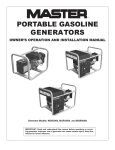
PORTABLE GASOLINE
GENERATORS
OWNER’S OPERATION AND INSTALLATION MANUAL
EL
FU
E
F
0V K
12 OC
ISTL
TW
0V
12
0V
12 CI
GF
T
SE
RE
ST
TE
UR
HO
R
TE
ME
V
40 K
0/2
12 TLOC
IS
TW
V
40 K
0/2
12 TLOC
IS
TW
M
EN 05
00
00 1/10
00
HO
UR
S
LE
-ID
TO
AU
T
SE
RE
ON
T
SE
RE
F
OF
T
SE
RE
T
SE
RE
FU
EL
E
F
Generator Models: MGH8500AIE and MGH10000C
IMPORTANT: Read and understand this manual before operating or servicing generator. Improper use of generator can cause serious injury. Keep this
manual for future reference.
R
PORTABLE GASOLINE GENERATORS
SAFETY
INFORMATION
1.
WARNINGS
IMPORTANT: Read this owner’s
manual and the engine owner’s
manual carefully. Become familiar
with this generator before trying
to operate or service it. Know
its uses, limitations, and any
hazards involved. Improper use
of generator can cause severe
injury or death from explosion,
fire, burns, electrical shock, or
carbon monoxide poisoning.
DANGER: Carbon monoxide
poisoning may lead to death!
Engine exhaust contains poisonous carbon
monoxide gas. Overexposure will cause loss
of consciousness and will lead to death. Use
only in well-vented areas. Make sure area
has plenty of free-moving, fresh, outside
air. Never run generator in an enclosed or
confined area. Never run generator inside
occupied building.
Carbon Monoxide Poisoning: Early
signs of carbon monoxide poisoning resemble the flu, with headaches, dizziness,
and nausea. If you have these signs, get
fresh air at once! Some people are more
affected by carbon monoxide than others.
These include pregnant women, persons
with heart or lung disease or anemia, those
under the influence of alcohol, and those at
high altitudes. Make certain you read and
understand all warnings. Keep this manual
for reference. It is your guide to safe and
proper operation of this generator.
Safety information appears throughout these
instructions. Pay close attention to them.
Below are definitions for the safety information listed throughout this manual.
DANGER: indicates a hazard which will cause
severe personal injury, death, or substantial
property damage if you ignore warning.
WARNING: indicates a hazard which can
cause severe personal injury, death, or substantial property damage if you ignore warning.
2.
3.
Gasoline presents a hazard of fire or
explosion. Gasoline is flammable. Its
vapor is explosive.
• Keep fuel out of children’s reach.
• Refuel generator in a well-vented
area. Do not fill fuel tank in the dark.
Do not refuel while engine is running. Unhook all electrical loads and
shut off engine before refueling.
• Do not overfill fuel tank. Always allow room for fuel to expand. If you
overfill tank, fuel can overflow onto
hot generator. This can cause fire or
explosion. After refueling, tightly
close fuel tank cap.
• Do not spill fuel. Fuel or fuel vapor
may ignite. If fuel spills, make sure
area is dry before starting engine.
• Never smoke in refueling area. Never
allow open flames or sparks in area.
• Store fuel in approved container.
Store fuel in a well-vented area free
of open flames or sparks.
Guard against fire hazard. Keep operation area well-vented. Keep generator at
least three feet away from any object.
Do not place flammable objects near
generator.
• Do not use generator where flammable vapors are present. Some
vapors are heavier than air. These
vapors settle in low-lying places.
• Do not use generator in enclosed
spaces. This includes motor home
or RV generator compartments.
Guard against electric shock. Generator
produces high voltage. This high voltage
can cause severe electric shock. Only responsible adults should use generator.
• Properly ground generator before
starting.
• Never let anyone operate or service
generator without proper instructions.
• Avoid contact with live terminals or
bare wires.
• Do not use generator outdoors in rain
or snow.
• Do not use generator near standing
water or snow.
• Do not use if generator is wet or
damp.
4.
5.
6.
7.
8.
• Do not use generator in highly conductive areas. These areas include
metal decking and steelwork.
• Only use grounded extension cords.
• Do not use any worn or damaged
electric cords. Electric shock or damage to generator may result.
• Do not wear damp clothing or wet
shoes when using generator.
Guard against burns. Hot engine parts
can cause severe injury. Use caution and
remain alert when using generator.
• Keep children and animals away from
generator while it is running or hot.
• Keep all covers and shields in place.
Keep them tightly secured.
• The muffler becomes very hot during operation. The muffler remains
hot for a while after shutdown. Do
not touch muffler while it is hot.
Do not let muffler touch anything
flammable. Let engine cool before
transporting or storing.
Have standby installation to home
or building performed by a licensed
electrician. Do not let anyone else wire
into a utility circuit. Personal injury,
equipment damage, or damage to home
could occur.
Never connect generator to any existing electrical circuits. The generator
output will back-feed into the utility
power line. This may electrocute a
power company line repair person.
Also, if generator is powering electrical
circuits, the chance of an electrical fire
exists.
Battery gives off explosive gases. Keep
sparks, flames, and cigarettes away. Do
not remove or install battery cables
when engine is cranking or running.
Only service or use battery in a wellvented area.
Battery contains sulfuric acid. Battery
acid is poisonous if swallowed. Contact
with skin or eyes may cause severe
burns. Do not tilt generator with battery
installed. Tilting could cause battery
acid to spill. Wear protective clothing
and face shield when servicing. Keep
out of children’s reach.
CAUTION: indicates a hazard which will
or can cause minor personal injury or
property damage if you ignore warning.
2
117846
OWNER’S MANUAL
SAFETY
INFORMATION
Continued
9.
Gas Cap/Fuel Gauge
Gas Tank
Wheels (2)
Roll Cage
Auto-Idle Switch
120/240 Volt Receptacle
120/240 Volt, 50 Amp
Receptacle
Oil Dipstick
Oil Filler Cap
Circuit Breaker
Choke Lever
45
45
30
30
20
Run Lamp
ET
RES T
TES
20
Hour Meter
Engine
E
F
117846
Alternator
EL
FU
14.
Oil
Filter
Handles (2)
F
13.
Ground Lug
E
12.
Control Panel
L
11.
Air Filter Housing
E
FU
10.
Only a qualified electrical service person
should service and repair generator.
• Generator produces high voltage.
Use extreme caution when working
on electrical parts.
• Always remove spark plug wire from
spark plug before servicing. This will
prevent accidental starting.
• When working on generator, avoid hot
muffler, exhaust manifold, and engine
parts. Severe burns may occur.
• Do not work on generator when
tired.
• Use only factory approved replacement parts.
Store generator in a well-vented area.
Make sure fuel tank is empty. Never
store with fuel in tank. Vapors may
reach an open flame or spark. Fire or
explosion may result.
Never operate generator
• if engine speed changes greatly
• if engine misfires often
• if powered items overheat
• if electrical output drops
• if it is sparking
• if it produces smoke or flames
• if it vibrates at high levels
• if it has a damaged receptacle
Keep generator and nearby areas
clean.
• Keep generator free of oil, mud, and
other foreign matter.
• Remove anything that creates slippery areas around generator.
• Remove oily rags and other items
that create fire hazards.
• Keep a fire extinguisher nearby.
Make sure it is rated ABC by the
NFPA. They are good for all uses.
Consult your local fire department.
• Keep fire extinguisher well maintained. Be familiar with its use.
Know how to stop engine quickly.
Know how to use all controls.
Prolonged exposure to loud noise can
cause hearing loss.
• When working around generator,
wear approved hearing protection.
• Remember neighbors when using
generator.
PRODUCT
IDENTIFICATION
120 Volt Receptacle
(Duplex)
120 Volt Receptacle (GFCI)
120 Volt Receptacle
Engine ON/
OFF Switch
Figure 1 - Portable Generator - Model MGH10000C
3
R
PORTABLE GASOLINE GENERATORS
PRODUCT
IDENTIFICATION
VENTILATION
(Continued)
Choke
Lever
Gas Tank
Gas Cap/Fuel Gauge
DANGER: Use only in wellvented areas. Make sure area
has plenty of free-moving, fresh,
outside air. Never run generator
in an enclosed or confined area.
Never run generator inside occupied building. Engine exhaust
contains poisonous carbon
monoxide gas. Overexposure will
cause loss of consciousness and
will lead to death.
L
E
FU
E
F
Ground
Bolt
Oil Filter
120 Volt
Receptacle
0V
12 LOCK
IST
TW
Alternator
0V
12
0V
12 CI
GF
T
SE
RE
ST
TE
UR
HO
120 Volt
Receptacle (GFCI)
V
40
0/2 CK
12 LO
IST
TW
120 Volt Receptacle
(Duplex)
M
EN 05
000
000
HO
V
40
0/2 CK
12 LO
IST
TW
R
TE
ME
1/10
URS
LE
-ID
TO
AU
T
SE
RE
ON
T
SE
RE
F
OF
T
SE
RE
120/240 Volt Receptacle
T
SE
RE
Hour Meter
Circuit Breaker
Auto-Idle Switch
Roll Cage
Control Panel
Figure 2 - Portable Generator - Model MGH8500AIE
GENERAL
INFORMATION
Master portable generators are rugged and
compact. These generators use brushless
alternators for dependable, trouble-free service. Honda gasoline engines provide long
life under heavy use. Honda engines have
overhead valves (OHV). This provides high
performance with lower fuel consumption.
These engines are governed to maintain
engine speed of 3600 RPM under load. 3600
RPM engine speed provides 120/240V, 60
Hz power.
UNPACKING
1.
2.
3.
4.
Remove generator from carton.
Remove any protective packaging applied to generator for shipment.
Check for loose or missing parts. Check
for shipping damage. If any parts are
missing or damaged, promptly inform
dealer where you bought generator.
Battery cables are supplied and installed. See Battery, page 8 for battery
installation instructions.
DUST, DIRT, RAIN,
AND SNOW
WARNING: Do not use generator outdoors in rain or snow. Do not
use generator near standing water
or snow. Do not use if generator is
wet or damp. Operating generator
in these conditions increases the
risk of electrocution. Severe injury
or death can occur.
Do not use generator in extremely dusty or
dirty conditions. This will severely affect its
life. Keep generator clean. Do not allow dust,
dirt, rain, or snow to collect on it. Protect
generator from outdoor elements.
HIGH AND LOW
TEMPERATURE
OPERATION
Air temperature affects generator output.
Output drops 1% for each 10° temperature rise
above 60° F. Very low temperatures may make
the engine hard to start. See engine owner’s
manual for more information.
Additional Features
•
•
•
•
•
This generator needs cooling air to run properly. Never block free-flowing, cooling air
to generator. Overheating will occur without
cooling air. This will damage the generator.
Keep generator at least three feet away from
any object.
Circuit breaker protection
Large fuel tank
Oil alert system
Electric starter
15-Amp ground fault circuit interrupter
(GFCI) receptacle
4
117846
OWNER’S MANUAL
SPECIFICATIONS
MODEL
MGH10000C
GENERATOR
FEATURES
MGH8500AIE
Electrical
Rated Wattage .........................10,000 ............................ 8500
Rated Amperage
120 V ....................................83.3 ...............................70.8
240 V ....................................41.7 ...............................35.4
OIL ALERT SYSTEM
The oil alert system protects the engine from
low oil damage. This system automatically
shuts down the engine and prevents engine
restarting if the oil level falls too low.
Receptacle
120-V, 20-A Duplex .................... Yes ................................ Yes
120-V, 15-A GFCI ...................... Yes ................................ Yes
120-V Twist-Lock ................... 30 Amp............................. Yes
120/240-V Twist-Lock ............. 30 Amp............................. Yes
120/240-V, 50-A ......................... Yes .................................No
Note: When this happens, the engine switch
remains in the ON position. The oil alert
system is wired into the ON/OFF Switch.
If this system shuts down the engine, the
engine will not start until you add oil. Add
oil to engine (see Engine Oil, page 7).
General
Honda Engine H.P....................... 20 .................................. 20
Honda Model .................... GX620K1VXE2 .............GX620K1VXE2
Fuel Type ............................... Gasoline ........................ Gasoline
Fuel Tank Capacity .................. 13 gal. ............................8 gal.
Oil Alert System......................... Yes ................................ Yes
Auto-Idle .................................... Yes ................................ Yes
Hour Meter................................. Yes ................................ Yes
Start Method .......................... Electric .......................... Electric
Weight (pounds) ........................ 350 ................................ 325
Note: Operate generator on a level surface.
If not level, the oil may flow away from the
oil level sensing device. This will cause the
oil alert system to shut down engine.
See engine owner’s manual for more
information.
HONDA
* Single-phase, 1.0 power factor
ON
OFF
Note: Ratings apply to SAE standard
conditions. Reduce ratings 3 1/2% for
each 1000 feet above sea level and 1% for
each 10° Fahrenheit rise above 60°F.
START
ENGINE SW
Figure 3 - Engine Switch Location
117846
5
R
PORTABLE GASOLINE GENERATORS
GENERATOR
FEATURES
Continued
AUTO-IDLE SYSTEM
The Auto-Idle System allows the engine to idle
down or run at a slower speed when the generator is not being used to supply power. The
Auto-idle system can be turned ON or OFF by
a rocker switch on the control panel. When the
switch is in the OFF position, the engine runs
at full speed all of the time. When the switch
is in the ON position, the engine slows down
to idle speed until an electrical load is applied.
When a load is applied to the generator (an
electrical item is plugged in and turned on) the
engine speeds up to the preset speed required
to produce the correct voltage.
IMPORTANT: A minimum current load
of 1 Amp is required to disengage the auto
idle solenoid and cause the engine to come
up to speed for correct voltage. Powering
items at reduced engine speed will damage
generator and powered items.
ELECTRIC START
GROUND FAULT CIRCUIT
INTERRUPTER RECEPTACLE
The GFCI receptacle is on the control panel.
The GFCI protects you against hazardous
electrical shock caused when your body
becomes a path through which electricity
travels to reach ground. This could happen
when you touch an appliance or cord that
is ‘live’ through faulty mechanism, damp or
worn insulation, etc.
ENGINE CIRCUIT BREAKER
This fuse protects the battery charging circuit. A short circuit will trip the break the
fuse. The fuse will also break if you install
battery wrong. Replace fuse if engine will
not start. The fuse is located inside of the
keyswitch box.
RECEPTACLE CIRCUIT
BREAKER
Test Procedure
The circuit breakers protect the receptacles
and alternator. Overloading generator will
trip circuit breaker. A short circuit in item
being powered will also trip breaker. If this
occurs, unplug electrical load from receptacle.
Let circuit breaker cool down. Push circuit
breaker button to reset.
Check the GFCI receptacle every month.
This insures it is working right.
1. Push black TEST button. Red RESET
button should pop out. This should trip
GFCI, resulting in no electrical power
at receptacle. Verify this by plugging
test lamp with good bulb into receptacle. If lamp does not work, GFCI
receptacle is good.
Electric motors need higher starting current.
They require up to three-times their rated
wattage to start. The starting current needed
may be too high. This can cause nuisance
circuit breaker tripping. To help prevent this,
start electric motors first. Connect additional
items to generator after starting motors. If
this continues to happen, reduce the total
generator load.
When protected by the GFCI, you may still
feel a shock, but the GFCI should cut it off
quickly. A person in normal health should
not receive serious injury. Note: Infants and
very small children may still be affected.
A battery is not supplied with generator.
You must provide a 12-volt, 32-amp-hour
battery. For more battery information, see
Battery, page 8.
WARNING: If RESET button
does not pop out, do not use the
GFCI receptacle. Contact a qualified electrician for repairs.
2.
If the GFCI receptacle tests okay,
restore power by pushing the RESET
button back in. The test lamp should
work at this time. IMPORTANT: You
must press the RESET button firmly
and fully. It should lock into place. If
the GFCI does not lock into place, do
not use receptacle. Contact a qualified
electrician for repairs.
Normal
20
Normal
Tripped
20
Tripped
Figure 5 - Receptacle Circuit Breaker
Button
Note: High ambient temperature will cause
nuisance tripping.
RE
SE
TE T
ST
Figure 4 - GFCI Receptacle
6
117846
OWNER’S MANUAL
CHECKING OIL LEVEL AND
ADDING OIL
Follow steps below to check oil level. Make
sure engine is level and stopped.
1. Remove dipstick (see Figure 6). Wipe
dipstick clean.
2. Insert dipstick into oil filler neck. Oil
level should be between the two dots
on dipstick.
3. If level is low, fill to top dot on dipstick.
Only use oil recommended in engine
owner’s manual.
Note: If oil level is too low, oil alert system
will shutdown engine and prevent engine
from restarting.
Oil Fill Cap
Upper
Limit
Lower
Limit
Dip Stick
Figure 6 - Checking Oil Level (MGH8500AIE
Shown)
WARNING: Gasoline presents
a hazard of fire or explosion.
Gasoline is flammable. Its vapor
is explosive.
• Keep fuel out of children’s
reach.
• Refuel generator in a wellvented area. Do not fill fuel tank
in the dark. Do not refuel while
engine is running. Unhook all
electrical loads and shut off
engine before refueling.
• Do not overfill fuel tank. Always
allow room for fuel to expand.
If you overfill tank, fuel can
overflow onto hot engine. This
can cause fire or explosion.
After refueling, tightly close
fuel tank cap.
• Do not spill fuel. Fuel or fuel
vapor may ignite. If fuel spills,
make sure area is dry before
starting engine.
• Never smoke in refueling area.
Never allow open flames or
sparks in area.
• Store fuel in approved container. Store fuel in a well-vented
area free of open flames or
sparks.
Use clean, fresh, unleaded gasoline. Use
gasoline with octane rating of 86 or higher.
Service station gasoline pumps should display the octane rating. Using gasoline with
lower octane level could damage engine.
Avoid getting dirt, dust, or water in fuel
tank. Do not mix oil with gasoline.
Follow the steps below to attach the handles
and top cover to Model MGH10000C:
1. Remove the two bolts, lock nuts, and
washers holding side panels to control
panel end of roll cage. Insert bolts
with washers through two holes in the
handle and then back through roll cage
and side screen panels (See Figure 7).
Tighten the lock nuts against the side
screen panels.
2. Place top cover on top of generator roll
cage with notch on control panel side.
Use four #8 sems screws provided to attach cover to roll cage (See Figure 8).
Roll Cage
EL
We ship the generator without oil in the
engine crankcase. You must add oil before
starting engine. See engine owner’s manual
for specific oil type.
HANDLES AND TOP
COVER
FU
FUEL
F
ENGINE OIL
Bolts Washers
Handle
Lock Nuts
Figure 7 – Attaching Handles to Roll Cage
SEMS Screws
Top Cover
FU
F
EL
See engine owner’s manual for more
information.
SEMS
Screws
Figure 8 – Attaching Top Cover to Roll
Cage
117846
7
R
To Engine
Block (–)
MOUNTING BATTERY TO
GENERATOR
4.
UR
HO
M
EN 05
00
00 1/10
00
HO
S
ON
T
SE
RE
OFF
T
SE
RE
Figure 11 - MGH8500AIE - Connecting
Positive and Negative Cables to Battery
(Alternator Removed for Clarity)
T
SE
RE
To Starter
Solenoid
L
To Engine
Block
EL
E
F
Figure 12 - MGH10000C - Connecting
Positive and Negative Cables to Battery
Nut
Battery Mounting
Bracket
0V K
12 OC
ISTL
TW
0V
12 CI
GF
T
SE
RE
ST
TE
UR
HO
R
TE
ME
V
40 K
0/2
12 TLOC
IS
TW
V
40 K
0/2
12 TLOC
IS
TW
M
EN 05
00
00 1/10
00
HO
UR
S
LE
-ID
TO
AU
T
SE
RE
ON
Hook Bolt
T
SE
RE
T
SE
RE
Nut
Battery Mounting
Bracket
F
F
U
E
L
Battery
Hook
Bolt
Figure 10 - MGH10000C - Battery HoldDown System
8
EXTENSION
CORDS
Only use grounded extension cords. Be sure
to use extension cord with proper wire gauge
size. See chart below.
T
SE
RE
F
OF
Figure 9 - MGH8500AIE - Battery HoldDown System (Alternator Removed for
Clarity)
A battery is not supplied with generator. A
12-volt, 32 Amp-Hour minimum, group U1,
lug terminal battery is recommended. The
positive and negative battery cables are supplied with generator. You must install these
cables before mounting battery.
Always wear safety glasses when working
with battery. Make sure battery terminals
are clean. Make sure cable connections
are tight.
UR
To Starter Solenoid (+)
See engine owner’s manual for more
information.
Battery
IMPORTANT: Make sure battery connections are the correct polarity. Electric start
generators use negative ground, 12-volt DC
starting system.
0V
0/24 CK
12 TLO
IS
TW
0V
0/24 CK
12 TLO
IS
TW
ER
MET
LE
-ID
TO
AU
E
3.
Secure battery to generator using battery hold-down system. This system
consists of the battery mounting bracket, hook bolts, and nuts (see Figures 9
and 10).
Locate the red, positive (+) battery
cable from starter solenoid. Connect it
to the positive (+) battery terminal (see
Figures 11 and 12).
Locate the black, negative (–) battery
cable attached to engine block. Connect
it to the negative (–) battery terminal
(see Figures 11 and 12).
Check battery before starting engine.
Make sure fluid levels are full. Make
sure battery is charged.
FU
2.
T
SE
RE
ST
TE
F
1.
0V
12 I
GFC
0V
12
CAUTION: If you remove battery, insulate the red, positive (+)
battery cable terminal. Insulate
with electrical tape. Exposed
terminal may spark when generator runs.
0V
12 OCK
ISTL
TW
0V
12
FU
WARNING: Battery contains
sulfuric acid. Contact with skin
or eyes may cause severe burns.
Do not tilt generator with battery
installed. Tilting could cause battery acid to spill. Wear protective
clothing and face shield when
servicing. Keep out of children’s
reach.
• If battery acid gets on your skin,
wash with water.
• If battery acid gets in your eyes,
flush with water at least 15
minutes. Call a doctor at once.
Battery acid is poisonous.
• If swallowed, drink large
amounts of water or milk. Follow with milk of magnesia or
vegetable oil. Call a doctor at
once.
F
WARNING: Battery gives off
explosive gases. Keep sparks,
flames, and cigarettes away. Do
not remove or install battery
cables when engine is cranking
or running. Only service or use
battery in a well-vented area.
Always shut down engine before removing
or attaching battery cables. Always remove
the negative (–) cable first. Always attach
negative (–) cable last.
E
BATTERY
EL
FU
PORTABLE GASOLINE GENERATORS
Recommended Minimum Wire
Gauges (AWG) for Extension
Cords
Ampere
Load
2
3
4
5
6
8
10
12
14
16
20
AWG for Length of
Cord in Feet
50'
100'
150'
18
18
16
16
16
16
16
14
14
12
10
18
18
16
16
16
14
14
14
12
12
10
18
18
16
16
14
12
12
12
10
10
8
117846
T
SE
RE
OWNER’S MANUAL
GENERATOR
GROUNDING
WARNING: You must properly earth-ground generator before starting. This will help guard
against deadly electric shock. Only
use grounded plugs with generator. Only use grounded extension
cords. Only use three-wire or
double-insulated power tools.
SEMS Nut
WARNING: Have standby installation performed by a skilled,
licensed electrician. Do not let
anyone else wire into a utility
circuit. Personal injury, equipment damage, or damage to home
0V
24 CK
occur.
0/could
2
1 TLO
Ground Bolt
IS
TW
Spade
0
ER Connector
GE
12
ET
TA
M
UR
HO
Detail A
HO
UR
+
0
24
L
VO
M
EN 05
00
00 1/10
00
S
OR
CT
LE
SE
F
LE
-ID
TO
AU
0
12 Y
L
ON
E
117846
0V
12
EL
You must supply the ground wire and grounding point. These do not come with generator.
Follow the National Electrical Code and all
state and local codes. Consult your power
company or a licensed electrician.
Flat Washer
0V K
12 LOC
IST
TW
FU
Grounding generator helps prevent electric
shock from a ground fault condition. Follow
these steps to ground your generator:
1. Locate ground lug on generator housing
(see Figure 13).
2. Loosen SEMS nut on ground lug. Note:
Do not remove SEMS nut or set screw
from ground lug.
3. Attach a spade connector to #10-8
stranded-copper ground wire. Place
spade connector on ground bolt between
flat washer and SEMS nut. Tighten
SEMS nut (see Detail A, Figure 13).
4. Drive grounding point into ground.
Note: Grounding point can be a stake,
grounding rod, or pipe. Grounding
point should be copper or brass.
5. Attach ground wire to grounding
point.
STANDBY
INSTALLATION
TO HOME OR
BUILDING
WARNING: For a grounding
point, do not use metal pipe being used to carry combustible
materials or gases.
ON
T
SE
RE
F
OF
T
SE
RE
T
SE
RE
0V
12 LOCK
IST
TW
0V
12
Ground
Wire
0V
12 CI
GF
T
SE
RE
ST
TE
UR
HO
R
TE
ME
V
40
0/2 CK
12 LO
IST
TW
V
40
0/2 CK
12 LO
IST
TW
IMPORTANT: This generator will not
power your entire home. Most home utility
electric service is more than 60 amps. This
will exceed generator output. Only power
needed items during a power outage. Make
sure total wattage of electrical load does not
T
SE
exceed
rated wattage of generator.
RE
You may need to use this generator as a
standby power source. During a power outage, the generator will power selected items
in a building. Have generator and additional
wiring installed by a skilled, licensed electrician. This is not a do-it-yourself job. Follow
all local codes.
M
EN 05
000
1/10
000
HO
URS
LE
-ID
TO
AU
T
SE
RE
ON
T
SE
RE
F
OF
T
SE
RE
T
SE
RE
Copper or Brass
Grounding Point
Alternator
Figure 13 - Grounding Generator
(MGH8500AIE Shown)
9
WARNING: The electrician
must install a double-throw
transfer switch. This isolates existing electrical circuits from the
utility power line. If not isolated,
generator output will back-feed
into utility power line. This may
electrocute a power company line
repair person.
R
PORTABLE GASOLINE GENERATORS
DETERMINING
ELECTRICAL LOAD
FOR GENERATOR
You must decide what electrical load your
generator can power. Do this before using generator. Use the following four-step
method. It will help you select a load that
is not too large. Make sure total wattage of
all electrical loads does not exceed rated
wattage of generator. For rated wattage of
your generator, see Specifications, page 5.
Electric motors present a special problem
when figuring load. Read Step 3 carefully.
1. Make two lists of items you want powered by generator. List all motors and
motor powered appliances in one. List all
lights, small appliances, etc. in the other.
For standby service to home or building,
only include items you must power.
2. Enter running watts of each item except
motors. The light bulb or appliance
nameplate lists its wattage. Remember, 1KW = 1000 watts. Note: The
nameplate may not list wattage. It may
only list volts and amps. The formula
for finding wattage is: Volts x Amps
= Watts. For example: An appliance
nameplate states 3 amps at 120 volts.
3 amps x 120 volts = 360 watts.
3. Electric motors present a special problem. They require up to three-times
their rated wattage to start. Chart 2,
below, shows starting watts for different
size motors. For example: an electric
motor nameplate states 5 amps at 120
volts. 5 amps x 120 volts = 600 watts
running. Multiply this figure by 3. This
will show the starting watts needed. 600
watts x 3 = 1800 watts to start. When
figuring the generator load for motors,
you must use the starting watts figure.
Do not use the running watts figure.
Note: Some motors require nearly the
same wattage to run as to start. These
items include saws, drills, hair dryers,
and food mixers. See Chart 1 for typical
appliance wattage examples.
4. Add watts and starting watts of all items.
This total must not be larger than the rated
wattage of your generator. It is a good
idea to have up to 25% extra capacity for
future needs or extra equipment.
Chart 1 - Typical Electric Appliance Wattages
Equipment
Light bulb (100W)
Radio
Fan
Television
Furnace fan (1/3 hp)
with blower
Vacuum cleaner
Sump pump (1/3 hp)
Refrigerator/freezer
6" Circular saw
Floodlight
Running
Watts
Starting
Watts
100
150
200
400
100
150
600
400
600
600
700
800
800
1000
1800
750
2100
2400
1000
1000
Equipment
1/2" Drill
Toaster
Coffee maker
Skillet
14" Chain saw
Water well pump
(1/2 hp)
Hot plate/range
(per burner)
10" Table saw
Water heater
(storage-type)
Running
Watts
Starting
Watts
1000
1200
1200
1200
1200
1250
1200
1200
1200
1500
1000
3000
1500
2000
1500
6000
5000
5000
Chart 2
Approximate Starting Watts*
Motor
HP
Rating
Approximate
Running
Watts
Universal
Motors
(small appliance)
Repulsion
Induction
Motors
Capacitor
Motors
Split
Phase
Motors
1/8
1/4
1/3
1/2
3/4
1
1 1/2
2
3
500
700
800
1100
1400
1700
2100
2450
3600
625
875
1000
1375
1750
2125
2625
3075
x
1100
1550
1750
2400
3100
3750
4620
5400
7900
1500
2100
2400
3300
4200
5100
6300
7350
10800
2250
3150
3600
4950
x
x
x
x
x
* – Always use starting watts, not running watts, when figuring correct electrical load.
x – Motors of higher horsepower are not generally used.
10
117846
OWNER’S MANUAL
OPERATION
GENERAL INFORMATION
DANGER: Never connect generator to any existing electrical
circuits.The generator output will
back-feed into the utility power
line.This may electrocute a power
company line repair person. Also,
if generator is powering electrical
circuits, the chance of an electrical fire exists.
Note: We supply the engine owner’s manual
with generator. Refer to that manual for questions concerning engine operation.
120V, 15-Amp
GFCI Duplex
120V, 20-Amp Duplex
This generator is not large enough to power
your entire home. Do not connect generator
to any existing electrical circuits. Plug items
directly into generator receptacles. Do not
exceed amperage rating of receptacles. Only
use grounded cords.
DANGER: Use only in wellvented areas. Make sure area
has plenty of free-moving, fresh,
outside air. Never run generator
in an enclosed or confined area.
Never run generator inside occupied building. Engine exhaust
contains poisonous carbon
monoxide gas. Overexposure will
cause loss of consciousness and
will lead to death.
120V, 30-Amp
Twist-Lock
120V, 15-Amp GFCI Duplex
120V, 30-Amp Twist-Lock
120V, 20-Amp
Duplex
Re
12
0
se
t
12
0
GF V
CI
Vo
lt
Re
se
t
RE
SE
TE T
ST
12
0V
RE
SE
TE T
ST
TW 120
IST V
LO
CK
Se
le
HO
UR
ME
TE
R
S
Idle
On
cto
E
00 NM
00
00
0
HO
UR
EN
M
00
00
05
00
HO
U
Au
to
Off
r
5
1/1
0
RS
1/1
0
AU
TO
-ID
LE
1
TW20/2
IST 40V
LO
CK
ReO
seFF
t
12
0
ON
Re
s
et
RE
SE
T
RE
SE
T
1
TW20/2
IST 40V
LO
CK
Vo
lt
120/240V, 30-Amp Twist-Lock
RE
SE
TE T
ST
RE
SE
T
Au
to
Off
RE
SE
T
Se
le
120/240V, 50-Amp
Idle
On
cto
r
E
00 NM
00
00
05
U
HO
RS
20
1/1
0
120/240V, 30 Amp
Twist-Lock
0V
p;t
Re
s
et
Re
se
t
Re
se
t
120/240V, 20 Amp Twist-Lock
Re
Figure 14 - Receptacle Locations
(MGH8500AIE)
se
t
USING RECEPTACLE
Note: Do not exceed amperage rating of
receptacles. Exceeding rating will trip receptacle circuit breaker.
Figure 15 - Receptacle Locations
(MGH10000C)
Use receptacles properly. Improper use could
damage generator. Use only grounded extension cords. Power only grounded or doubleinsulated items. Do not overload receptacles.
The generators have the following receptacles
(see Figure 16):
• 120V, 15-amp GFCI duplex receptacle
• 120V, 20-amp duplex receptacle
• 120V, 30-amp twist-lock receptacle
• 120/240V, 20-amp twist-lock receptacle
(MGH8500AIE only)
• 120/240V, 30-amp twist-lock receptacle
• 1 2 0 / 2 4 0 V, 5 0 - a m p r e c e p t a c l e
(MGH10000C only)
Continued
117846
11
R
PORTABLE GASOLINE GENERATORS
OPERATION
Continued
POWER CORD AND PLUG
REQUIREMENTS
120V, 30-amp twist-lock receptacle
• NEMA L5-30P plug
• Three-wire, 30-amp cord
120/240V, 20 or 30-amp twist-lock
receptacle
• NEMA L14-20P (20-amp) or L14-30P
(30-amp) plug
• Four-wire, 20-amp or 30-amp cord
120/240V, 50-amp receptacle
• NEMA L14-50P
• Four-wire, 50-amp cord
PRESTART
3.
Operate generator on a firm, dry, and clean
surface. The surface must be level. Protect
generator from heavy dust, sand, dirt, rain,
or snow. Do not locate generator near
standing water and snow. Make sure area
is well-vented.
WARNING: Only responsible
adults should use generator.
Never let anyone operate generator without proper instructions.
Note: If oil level is too low, oil alert system
will keep engine from starting (see Oil Alert
System, page 5). Make sure oil level is full
before starting. See Engine Oil, page 7.
4.
Start the engine.
Turn the engine switch to the START
position (see Figure 18). Hold it there
until engine starts. When engine starts, let
switch return to the ON position.
IMPORTANT: Do not use electric
starter more than five seconds. Starter
motor damage may occur. If engine
fails to start, release the switch and
wait ten seconds. After ten seconds, try
starting again.
Note: If engine does not start, check
the oil in the crankcase. Add oil as
necessary. Be sure engine is on a level
surface. See Oil Alert System, page 5.
As engine warms up, the choke will
automatically open.
Before starting the engine, disconnect all
electric loads from generator.
30
30
STARTING
20
ET
RES T
TES
20
HONDA
Engine
Switch
ON
OFF
START
ENGINE SW
Figure 18 - Engine Switch
MGH10000C Only
Figure 16 - Cord and Plug Configurations
12
117846
F
Figure 17 - Choke Button Closed
E
MGH8500AIE Only
IMPORTANT: Never start generator with
electrical loads connected. Start engine
before adding electrical loads.
1. Make sure gasoline tank is full. See
Fuel, page 7 for fuel information.
2. Pull choke button out (see Figure 17).
This closes the choke.
Note: You may not need to close choke
if engine is warm or air temperature is
high.
Choke Button
Pulled Out
(Closed
Position)
EL
FU
IMPORTANT: The engine speed is preset.
The throttle is locked in preset position. Do
not adjust throttle. Preset position lets engine
run at 3600 RPM under load. The engine
must maintain 3600 RPM for generator to
create correct voltage. Running engine at
lower speeds will damage generator and
powered items.
OWNER’S MANUAL
OPERATION
Continued
AUTO-IDLE OPERATION
IMPORTANT: Never start engine with electrical loads connected. Start engine before
adding electrical loads.
1. If engine is cold, turn the Auto-Idle
switch OFF (see Figure 19).
2. Start engine. Allow engine to warm up
with no load for five minutes.
3. Turn Auto-Idle switch ON. Engine will
slow to idle speed. Engine idle speed
is preset. Idle speed adjustment should
not be necessary.
4. Operate generator according to specifications outlined in owner's manual.
5. Engine will automatically increase to
normal operating speed when you plug
load into any generator outlet.
6.
Adjusting the Idle Speed
WARNING: Always set the idle
speed before turning on the AutoIdle. If idle speed is not set, the
larger resistor on the control board
may become hot. Heat from the
resistor may damage the protective
coating on the control board.
12
0
GF V
CI
12
0V
SE
TE T
ST
2.
TW 120
IST V
LO
CK
HO
UR
ME
TE
R
EN
00 M
00
00
05
UR
HO
S
1/10
1
TW20/2
IST 40V
LO
CK
AU
TO
-ID
LE
3.
4.
1
TW20/2
IST 40V
LO
CK
OF
F
ON
RE
SE
T
RE
SE
T
Res
12
0
et
5.
RE
SE
T
Auto-Idle Switch
RE
SE
T
Vo
lt
6.
Res
et
RE
SE
TE T
ST
Au
Off
Se
to
Idle
lect
or
On
EN
M
00
00
HO
05
UR
Locate Auto-Idle solenoid. The AutoIdle solenoid is located between the
alternator and the engine when viewed
from the top of the generator (see Figure 20).
Loosen two M7 nuts.
Rotate solenoid (located under the
solenoid bracket) left or right to adjust
Auto-Idle speed (see Figure 20).
With a volt meter, check the no-load
output voltage at the 120-volt duplex
receptacle. At proper idle speed (3000
minimum RPM) the meter should read
50-60 volts. Lower settings will cause
the Auto-Idle to not operate properly.
After reaching proper idle speed,
tighten M7 nuts to secure solenoid to
mounting bracket (see Figure 20).
00
S
1/1
20
0
Res
Res
0 Vp
;t
et
et
Res
et
Res
et
MGH10000C
Figure 19 - Control Panel
117846
Solenoid Bracket
M7 Nuts
Auto-Idle
Solenoid
IMPORTANT: Adjust the idle speed only:
• If the idle speed becomes too high.
• If the engine idle speed will not regulate (engine idles and speeds up again and again).
1. Turn Auto-Idle switch OFF. Start engine. Allow engine to warm up with no
load for five minutes.
MGH8500AIE
RE
Note: MGH10000C Only - The 250
Volt/50 Amp receptacle is not connected through the Auto-Idle circuit.
The Auto-Idle switch must be turned
off to get full power out of this receptacle (see Figure 19).
The Auto-Idle system should be turned
OFF when generator is shut down.
13
Figure 20 - Solenoid Bracket Location
(MGH10000C Shown)
R
PORTABLE GASOLINE GENERATORS
OPERATION
Continued
HIGH ALTITUDE OPERATION
This generator will not perform well at high
altitudes without proper adjustment. See
engine owner’s manual for details.
ADDING ELECTRICAL
LOADS
IMPORTANT: Do not overload generator.
Make sure total wattage of all electrical loads
does not exceed rated wattage of generator.
Overloading may shorten generator life. It
could also cause internal damage to generator. Overloading will trip circuit breaker.
1. Check items to be powered. Their
nameplate lists their wattage ratings.
Note: The wattage ratings for some
electrical motors are misleading. They
may require up to three-times their
rated wattage to start. You must figure
total electrical load wattage. Make sure
total wattage of all electrical loads does
not exceed rated wattage of generator.
See Determining Electrical Load For
Generator, page 10.
2. Start engine. Let engine reach full
speed.
3. Connect electrical loads one at a time.
If the load consists of electric motors,
start them first. Always start the largest
first. Start each motor individually.
STOPPING ENGINE
IMPORTANT: The engine speed is preset.
The throttle is locked in preset position. Do
not adjust throttle.
Follow the steps below to stop engine.
1. Remove all electrical loads from generator (see Disconnecting Electrical
Loads). Remove electrical loads one
at a time.
2. Let engine run for two or three minutes
after removing electrical loads. This
lets engine cool slightly.
3. Turn engine switch to the OFF position
(see Figure 21).
HONDA
ON
OFF
START
ENGINE SW
Figure 21 - Engine Switch In OFF Position
MAINTENANCE
AND REPAIRS
WARNING: Only a qualified
electrical service person should
service and repair the alternator
on this generator. Use only factory
approved replacement parts.
CAUTION: The engine speed
is preset. The throttle is locked
in preset position. Do not adjust
throttle. Preset position lets
engine run at 3600 RPM under
load. The engine must maintain
3600 RPM for generator to create
correct voltage. Running engine
at lower speeds will damage generator and powered items.
CAUTION: Shut off generator
before performing maintenance.
IMPORTANT: Keep generator level when
servicing. Never turn generator upside down
or stand it on end to service.
Note: We supply the engine owner’s manual
with generator. Refer to that manual for
questions concerning engine maintenance
and repairs.
Non-engine parts require little maintenance.
Keep generator clean. Use a damp cloth to
clean outside surfaces. Never use water to
clean generator. Water can cause damage to
internal parts. Use vacuum to clean air inlet
and outlet louvers of alternator.
DISCONNECTING ELECTRIC
LOADS
Remove electrical loads one at a time. Remove voltage sensitive items first. Voltage
sensitive items include TVs, VCRs, and other
home electronic items.
14
117846
OWNER’S MANUAL
STORAGE
WARNING: Remove all fuel from
fuel tank before storing generator.
Store fuel in approved container.
Store fuel in a well-vented area free
of open flames or sparks.
WARNING: The muffler becomes very hot during operation.
The muffler remains hot for a
while after shutdown. Let engine
cool before storing.
IMPORTANT: Keep generator level while in
storage. Never store generator upside down
or standing on end.
Note: We supply the engine owner’s manual
with generator. Refer to that manual for
questions concerning engine storage.
Use a fuel additive, such as STA-BIL® or an
equivalent, when storing generator with fuel
in fuel tank. This will minimize fuel gum
deposits from forming in engine.
Cover and store generator in a clean, dry
place. Do not expose generator to extreme
high or low temperatures during storage.
SERVICING THE
ENGINE
Honda parts and services should be handled
by your nearest authorized engine service
firm. Check the yellow pages of your telephone directory under the listing:
Engines Gasoline, Honda
or visit:
www.honda-engines.com
or call Honda direct:
1-800-426-7701
TROUBLESHOOTING
Note: For additional help, visit DESA
International’s technical service web site
at www.desatech.com.
TECHNICAL
SERVICE
You may have further questions about assembling, operating, or maintaining this
product. If so, you can visit our Technical
Service web site at www.desatech.com or
contact our Technical Service Department
at 1-800-858-8501 (English Only). You may
also write to:
DESA Specialty Products™
ATTN: Technical Service Specialty Products
P.O. Box 90004
Bowling Green, KY 42102-9004
When contacting DESA Specialty Products™, have ready
• Your Name
• Your Address
• Your Phone Number
• Model Number of Product
• Serial Number
• Date of Purchase (Include copy of receipt
for written requests).
WARNING: Only a qualified electrical service person should service
and repair generator. Use only factory approved replacement parts.
Note: See engine owner’s manual for engine troubleshooting.
OBSERVED PROBLEM
POSSIBLE CAUSE
REMEDY
No voltage when starting generator with no
electrical load
1. Defective capacitor
2. Winding short circuit or loose
connections
3. Defective rotor diode
4. Loss of residual magnetism
1. Replace capacitor
2. Check resistance of coils (see Electrical
Component Specifications, page 16)
3. Replace both diodes on rotor
4. Apply 12-volt battery to capacitor terminals for 2-3 seconds
Voltage is less than normal voltage with no
electrical load
1. Engine speed too low
1. Set engine speed to 3720 RPM (62 Hz)
with no load
2. Replace both diodes on rotor
3. Check resistance of coils (see Electrical
Component Specifications, page 16)
4. Replace capacitor
2. Defective rotor diode
3. Partial short circuit in winding
4. Defective capacitor
Voltmeter reading more than 10% high with
no electrical load
1. Engine speed too high
1. Set engine speed to 3720 RPM (62 Hz)
with no load
Voltmeter reading correct with no electrical
load, but more than 10% low when electrical
load is added
1. Defective rotor diode
2. Electrical load too high
3. Engine not running properly
1. Replace both diodes on rotor
2. Do not overload generator
3. Contact an authorized engine service
center
www.desatech.com
117846
15
R
PORTABLE GASOLINE GENERATORS
ELECTRICAL
COMPONENT
SPECIFICATIONS
Resistance in Ohms
Stator
Stator
Rotor
Main
Auxiliary
Primary
Winding * Winding Δ Winding †
Model
MGH8500AIE
MGH10000C
0.41
0.33
.098
0.71
Capacitor,
MFD
450 Volt
Diodes (2)
800 Volt
45
60
8 Amp
8 Amp
7.81
8.53
* Connect T2 (green) and T3 (black). Measure resistance between T1 (red) and T4 (yellow).
Δ Resistance between brown and white leads.
† Remove diodes to check resistance.
WIRING DIAGRAMS
Blue
Gray
Blue
To
Auto-Idle
Solenoid
To
Power Supply
On Engine
P5-4
P5-3
Green
250V 30A
Receptacle
P5
250V 50A
Receptacle
Red
Auto-Idle
Control Board
Circuit
Breaker
30A
Red
Circuit
Breaker
45A
Circuit
Breaker
30A
Yellow
P2
P1
P4
P3
Circuit
Breaker
45A
h
W
Run Black
Light
Hour Meter
T4
T3
T2
Black
Red
Black
White
Green
White
White
White
Circuit
Breaker
20A
Black
Yellow
Black
Red
Circuit
Breaker
20A
White
Gr
ee
n
White
Black
T1
White
Black
Black
Red
Capacitor
125V, 15A
Receptacle
White
Red
Black
Yellow
Green
Black
125V, 30A
GFCI 125V, 15A
Receptacle
Receptacle
Green
P5-1
Gray
P5-2
Gray
Gray
Gray
Green
Black
Black
Main
Windings
T2
T1
T3
T4
Rotor
Diode
Diode
Stator
Stator
T1
L1
T2
T3
T4
220/240V
110/120V
L2
110/120V
Figure 22 - Wiring Diagram, Model MGH10000C
16
117846
OWNER’S MANUAL
WIRING DIAGRAMS
(Continued)
Stator
T3
T4
220/240V
L1
110/120V
Black
Red
L2
White
110/120V
120V, 30A
Receptacle
Stator
Brown
White
120V, 15A
Receptacle
Duplex
GFCI
Red
Capacitor
White
120V, 20A
Receptacle
White
Wht
Auxiliary
Phase
Diode
Grn/
Ylw
Wht
Rotor
HOT
T2
LINE
Grn/
Ylw
Grn/
Ylw
Diode
Green/Yellow
Red
White
Wht
T4
Blue
Red
Black
T3
T1
Red
Green
T1
T4
White
WHITE
T1
T3
Main
Windings
Green/
Yellow
120/240V
20A/30A
Receptacle
T2
Blk
120/240V
20A/30A
Receptacle
Red
Green
Blk
Green/
Yellow
White
Hour
Meter
Auto-Idle
Gray
Gray
T2
Red
Green
Red
Blk
Green/
Yellow
Blue
Circuit
Breaker
45A
Circuit
Breaker
45A
Red
Red
Black
Red
Yellow
Green/
Yellow
P2 P1 P4 P3
Blue
P5
P5-3
P5-4
P5-1
P5-2
Green/Yellow
Gray
To
Power Supply
On Engine
To Alternator
Ground
Figure 23 - Wiring Diagram, Model MGH8500AIE
117846
Gray
Gray
Auto-Idle
Control Board
To
Auto-Idle
Solenoid
Blue
Circuit
Breaker
20A
Circuit
Breaker
20A
17
To Roll Cage
R
PORTABLE GASOLINE GENERATORS
ILLUSTRATED
PARTS LIST
For Model MGH8500AIE Fuel
Tank and Roll Cage
1
EL
FU
E
F
3
4
SA
FE
TY
INF
OR
MA
TIO
N
2
Unl
eade
d
Gas
olin
eO
nly
7
6
9
5
9
0V K
12 LOC
IST
TW
0V
12
0V
12 CI
GF
T
SE
RE
ST
TE
17
R
TE
ME
UR
HO
0V
0/24 CK
12 TLO
IS
TW
0V
0/24 CK
12 TLO
IS
TW
M
EN 05
00
00 1/10
00
HO
UR
14
S
LE
-ID
TO
AU
T
SE
RE
ON
T
SE
RE
F
OF
15
T
SE
RE
T
SE
RE
16
14
15
8
16
14
13
11
11
12
12
10
15
14
18
117846
OWNER’S MANUAL
ILLUSTRATED
PARTS LIST
For Model MGH8500AIE Fuel
Tank and Roll Cage
This list contains replaceable parts used in
your generator. When ordering parts, follow
the instructions listed under Replacement
Parts on page 25 of this manual.
KEY
NO.
PART
NUMBER
DESCRIPTION
1
2
3
4
5
6
7
8
9
10
11
12
13
14
15
16
17
25954002
114720-01
114787-01
WP-4C
19508001
25985008
114714-03
115398-01
M10908-27
116169-01
*
WLE-5
103289-01
NEC-5C
WP-5C
103289-02
114721-04
Gas Cap/Fuel Gage
Gas Tank (with 90° fitting)
Screw, 1/4"-28 x 3/4"
Washer, 1/4"
Gas Line Clamp
Fuel Line
Heat Shield
Roll Cage
Screw #10-32 x 1/2"
Spacer
Bolt, 5/16"-18 x 1/2"
Lock Washer, 5/16"
Shock Mount
Lock Nut, 5/16"-18
Flat Washer, 5/16"
Shock Mounts
Control Panel Assembly
QTY.
1
1
4
4
2
1
1
1
8
1
2
2
1
4
3
2
1
PARTS AVAILABLE - NOT SHOWN
100003-07
099873-07
099873-02
*
*
*
Operation Decal
Battery Cable (Positive, Red)
Battery Cable (Negative, Black)
5/16"-18 x 1/2" Grounding
Bolt
5/16" Flat Washer
5/16" SEMS Nut
* Available at any hardware store.
117846
19
1
1
1
1
1
1
R
PORTABLE GASOLINE GENERATORS
ILLUSTRATED
PARTS LIST
36
For Model MGH10000C
Fuel Tank and Roll Cage
35
33
9
9
10
23
20
20
10
25
10
36
10
24
22
32
9
28
29
31 30
2
26
27
18
19
12
10
9
18
20
10
25
20
34
10
9
10
21
19
16
17
15
14
E
L
10
F
U
1
F
21
13
10
4
9
6
3
5
6
12
8
7
11
20
117846
OWNER’S MANUAL
ILLUSTRATED
PARTS LIST
For Model MGH10000C
Fuel Tank and Roll Cage
This list contains replaceable parts used in
your generator. When ordering parts, follow
the instructions listed under Replacement
Parts on page 25 of this manual.
KEY
NO.
PART
NUMBER
DESCRIPTION
1
2
3
4
5
6
7
8
9
10
11
12
13
14
15
16
17
18
19
20
21
22
23
24
25
26
27
28
29
30
31
32
33
34
35
36
079503-25AA
105905-02
105906-01
102933-03
102932-02
WP-16C
C4-12C
100135-01
NEC-5C
WP-5C
103880-01
WP-4C
097190-06
M51151-02
M10990-3
106988-01
25985008
105035-01
115045-01
HC5-14C
H8C5-20C
099750-01
099749-01
105908-01
17529000
102962-02
H5C4-24C
26302006
WLI-8
14138000
M10908-74
WLE-5
106775-02
106775-01
106776-01
100410-01
Gas Tank Assembly
Roll Cage
Axle Mount
Axle
Wheels, Pneumatic
Flat Washer, 1"
Cotter Pin
U-Bolt
Lock Nut, 5/16-18
Flat Washer, 5/16"
Lock Nut,1/4-20
Flat Washer, 1/4"
Gas Cap w/Fuel Gage
Fuel Line
Bushing
Barbed Connector, 1/4"
Fuel Line
Handle
Grip
Bolt, 5/16-18 x 1.75"
Bolt, 5/16-18 x 2.5"
Bolt, J-Hook 5/16-18
Battery Bracket
Battery Mount
Shock Mount
Spreader
Bolt, 1/4-20 x 3"
Bolt, 1/2-10 x 1"
Internal Tooth Lockwasher
Ground Strap
Tapping Screw, 1/4-20 x .5"
External Tooth Lockwasher
Side Panel
Side Panel
Top Cover
Sems Screw, 8-18
QTY.
1
1
1
1
2
4
2
2
22
30
4
8
1
1
1
1
1
2
2
12
4
2
1
1
3
1
4
2
2
1
1
1
1
1
1
8
PARTS AVAILABLE - NOT SHOWN
099866-05
100003-04
099873-01
099873-05
HC4-6C
115399-01
106108-01
117846
21
Safety Information Decal
Operation Decal
Battery Cable (Positive, Red)
Battery Cable (Negative, Black)
Screw, 1/4-20 x .75"
Muffler
Muffler Hanger
1
1
1
1
2
1
1
R
PORTABLE GASOLINE GENERATORS
ILLUSTRATED
PARTS LIST
5
4
For Model MGH8500AIE
Control Panel
3
RE
SE
TE T
ST
10
This list contains replaceable parts used in
your generator. When ordering parts, follow
the instructions listed under Replacement
Parts on page 25 of this manual.
16
14
P2
6
1
P1
P4
P3
P5
11
12
0
GF V
CI
12
0V
TW 120
IST V
LO
CK
9
2
7
2
HO
UR
ME
TE
R
15
E
00 NM
00
00
HO
05
UR
S
1/10
AU
TO
-ID
LE
1
TW20/2
IST 40V
LO
CK
8
1
TW20/2
IST 40V
LO
CK
OF
F
ON
7
13
RE
SE
T
RE
SE
T
RE
SE
T
RE
SE
T
12
KEY
NO.
PART
NUMBER
DESCRIPTION
1
2
3
4
5
6
7
8
9
10
11
12
13
14
15
16
†
‡
114738-03
22616009
099833-01
104202-01
100445-01
099835-01
103184-01
099834-01
101350-01
099760-02
114722-01
116475-01
100366-01
116549-01
116678-01
114785-01
114721-04
114963-03
Control Panel
Circuit Breaker, 20 Amp *
120V, 30A Twist-Lock Receptacle *
120V, 20A Duplex Receptacle *
120V, 15A Duplex (GFCI) Receptacle *
120/240V, 30A Twist-Lock Receptacle *
Circuit Breaker, 45 Amp *
120/240V, 20A Twist-Lock Receptacle *
Hour Meter
Bushing
Enclosure
Plastite Pan Head Screw
Rocker Switch
Auto-Idle Control Board
Auto-Idle Wiring Harness
Locking Circuit Board Supports
Control Panel Assembly
Panel Schematic Decal
QTY.
1
2
1
1
1
1
2
1
1
1
1
6
1
1
1
4
1
1
* Includes fastening hardware
‡ Not shown
† Includes reference numbers 1 through 14
22
117846
OWNER’S MANUAL
ILLUSTRATED
PARTS LIST
14
For Model MGH10000C
Control Panel
2
This list contains replaceable parts used in
your generator. When ordering parts, follow
the instructions listed under Replacement
Parts on page 25 of this manual.
19
2
3
6
18
16
1
RE
SE
TE T
ST
Res
12
0
et
11
Vol
t
12
5
et
Off
Aut
o Id
le
7
12
15
20
9
0V
p;t
8
Res
et
Res
et
Res
et
Res
et
E
00 NM
00
00
05
UR
HO
S
1/10
10
13
4
KEY
NO.
PART
NUMBER
DESCRIPTION
1
2
3
4
5
6
7
8
9
10
11
12
13
14
15
16
17
18
19
†
‡
103182-01
22616009
099833-01
100410-01
22261000
100445-01
103183-01
103184-01
26299000
101350-01
099835-01
22616010
099760-01
103185-01
100366-01
104202-01
116549-01
114785-01
116678-01
102927-02
100177-08
Control Panel
Circuit Breaker, 20 Amp
120V, 30A Twist-Lock Receptacle
Sems Screw, #8-18 x 1/2"
U-Nut
20V, 15A Duplex (GFCI) Receptacle
125/250V, 50A Receptacle
Circuit Breaker, 45 Amp
Run Light
Hour Meter
120/240V, 30A Twist-Lock Receptacle
Circuit Breaker, 30 Amp
Bushing
Control Box
Rocker Switch
120V, 20A Duplex Receptacle
Auto-Idle Control Board
Locking Circuit Board Supports
Auto-Idle Wiring Harness
Control Panel Assembly
Panel Schematic Diagram
† Includes reference numbers 1 through 16
‡ Not shown
23
QTY.
1
2
1
16
20
1
1
2
1
1
1
2
1
1
1
1
1
4
1
1
1
5
P2
On
tor
P1
Sel
ec
P4
P3
4
117846
5
P5
Res
17
R
PORTABLE GASOLINE GENERATORS
ILLUSTRATED
PARTS LIST
1
2
For Models MGH8500AIE
and MGH10000C Alternator
Assembly
This list contains replaceable parts used in
your generator. When ordering parts, follow
the instructions listed under Replacement
Parts on page 25 of this manual.
3
5
6
7
12
11
13
16
10
8
9
15
17
14
PART NUMBER
KEY
NO.
MGH8500AIE
MGH10000C
DESCRIPTION
1
2
3
4
5
6
7
8
9
10
11
12
13
14
15
16
17
114285-03
115243-01
M10908-27
115244-01
115247-01
115246-01
115245-02
*
115255-02
115308-01
WLE-5
115315-01
115316-01
*
115317-01
**
**
115242-01
114285-03
115243-01
M10908-27
115244-01
115247-01
115246-01
115245-02
*
115255-03
115308-01
WLE-5
115315-01
115316-01
*
115317-01
**
**
115242-01
Alternator Assembly
Top Cover, Alternator
Screw, 10-32 x 1/2"
End Cover, Alternator
End Cap, Shaft
Flange Nut, 8mm
Draw Bolt, Alternator
Stator, Alternator
Capacitor
Hex Head Taptite, 8mm Screw
Lock Washer, 5/16"
Bearing
Diode
Rotor, Alternator
Fan
Bolt, 3/8"-16 x 5/8"
Lock Washer, 3/8"
Flange, Alternator
QTY.
1
1
4
1
1
1
1
1
1
4
4
1
2
1
1
4
4
1
* Part not available by itself. Must purchase Alternator Assembly.
** Available at any hardware store.
24
117846
4
OWNER’S MANUAL
REPLACEMENT
PARTS AND
ACCESSORIES
For original replacement parts and accessories, contact your nearest Authorized
Dealer or Authorized Service Center for this
product. If they can not supply the part or
accessory, contact your nearest Parts Central
listed below. Each Authorized Dealer, Authorized Service Center, and Parts Central is
independently owned and operated.
See pages 18 through 24 for an Illustrated
Parts List.
If you need additional referral information,
contact our Technical Service Department
(see Technical Service, page 15).
In Canada call 1-800-561-3372 for parts
information.
Heavy-Duty Wheel Kit – PA2022
(MGH8500AIE Only)
Wheelbarrow-style wheel kit. Makes generator easy for one person to move.
This kit includes:
• Large 12-inch wheels for easy rolling
• Powder coated tubing and plated hardware for long life
• Long handles with thick grips for greater
comfort and control
Complete installation instructions included.
117846
REPAIR SERVICE
Note: Only use original replacement parts.
This will protect your warranty coverage for
parts replaced under warranty.
Each Authorized Service Center is independently owned and operated.
For additional Service Center or warranty
information, call 1-800-858-8501 or visit
our Technical Service web site at www.
desatech.com.
WARRANTY SERVICE
If product requires warranty service, return it to
nearest Authorized Service Center. You must
show proof of purchase. If faulty materials or
workmanship caused damage, we will repair or
replace product without charge. Note: Normal
wear, misuse, abuse, neglect, or accidental
damage is not covered under warranty.
NON-WARRANTY SERVICE
If product requires service, return it to nearest
Authorized Service Center. Repairs will be
billed to you at regular repair list prices.
PARTS CENTRALS
These Parts Centrals are privately owned
businesses. They have agreed to support
our customer’s needs by providing original
replacement parts and accessories.
Tool & Equipment
5 Manila Drive
Hamden, CT 06514-0322
203-248-7553
1-800-397-7553
Grainger Parts Operations
1657 Shermer Road
Northbrook, IL 60062-5362
708-498-5900
1-800-323-0620
www.grainger.com
Portable Heater Parts
342 North County Road 400 East
Valparaiso, IN 46383-9704
219-462-7441
1-800-362-6951
www.portableheaterparts.com
[email protected]
[email protected]
25
FBD
1349 Adams Street
Bowling Green, KY 42103-3414
270-846-1199
1-800-654-8534
[email protected]
Master Part Distributors
1251 Mound Avenue NW
Grand Rapids, MI 49504-2672
616-791-0505
1-800-446-1446
www.masterparts.net
Bowden Electric Motor Service
1681 S. Wesleyan Blvd.
Rocky Mount, NC 27803
252-446-4203
East Coast Energy
10 East Route 36
West Long Branch, NJ 07764-1501
1-800-755-8809
Laportes
2444 N 5th Street
Hartsville, SC 29550-7704
843-332-0191
MTA Distributors
555 Hickory Hills Blvd.
Nashville, TN 37189-9244
615-299-8777
1-800-264-0225
Industrial Hardware
4109 Bainbridge Blvd.
Chesapeake, VA 23324-1403
804-543-2232
1-800-788-0008
[email protected]
Mills Lawn and Garden
928 Commonwealth Place
Virginia Beach, VA 23464
757-361-9293
www.mills-parts.com
Tuco Industrial Products
5223 180th Street SW
Suite 4A-1
Lynnwood, WA 98037-4506
425-743-9533
1-800-735-1268
www.tucoheat.com
R
PORTABLE GASOLINE GENERATORS
NOTES
________________________________________________________________________________________________
________________________________________________________________________________________________
________________________________________________________________________________________________
________________________________________________________________________________________________
________________________________________________________________________________________________
________________________________________________________________________________________________
________________________________________________________________________________________________
________________________________________________________________________________________________
________________________________________________________________________________________________
________________________________________________________________________________________________
________________________________________________________________________________________________
________________________________________________________________________________________________
________________________________________________________________________________________________
________________________________________________________________________________________________
________________________________________________________________________________________________
________________________________________________________________________________________________
________________________________________________________________________________________________
________________________________________________________________________________________________
________________________________________________________________________________________________
________________________________________________________________________________________________
________________________________________________________________________________________________
________________________________________________________________________________________________
________________________________________________________________________________________________
________________________________________________________________________________________________
________________________________________________________________________________________________
________________________________________________________________________________________________
________________________________________________________________________________________________
________________________________________________________________________________________________
________________________________________________________________________________________________
________________________________________________________________________________________________
________________________________________________________________________________________________
________________________________________________________________________________________________
________________________________________________________________________________________________
________________________________________________________________________________________________
26
117846
OWNER’S MANUAL
NOTES
________________________________________________________________________________________________
________________________________________________________________________________________________
________________________________________________________________________________________________
________________________________________________________________________________________________
________________________________________________________________________________________________
________________________________________________________________________________________________
________________________________________________________________________________________________
________________________________________________________________________________________________
________________________________________________________________________________________________
________________________________________________________________________________________________
________________________________________________________________________________________________
________________________________________________________________________________________________
________________________________________________________________________________________________
________________________________________________________________________________________________
________________________________________________________________________________________________
________________________________________________________________________________________________
________________________________________________________________________________________________
________________________________________________________________________________________________
________________________________________________________________________________________________
________________________________________________________________________________________________
________________________________________________________________________________________________
________________________________________________________________________________________________
________________________________________________________________________________________________
________________________________________________________________________________________________
________________________________________________________________________________________________
________________________________________________________________________________________________
________________________________________________________________________________________________
________________________________________________________________________________________________
________________________________________________________________________________________________
________________________________________________________________________________________________
________________________________________________________________________________________________
________________________________________________________________________________________________
________________________________________________________________________________________________
________________________________________________________________________________________________
117846
27
WARRANTY INFORMATION
KEEP THIS WARRANTY
Model
Serial No.
Date Purchased
Always specify model and serial numbers when communicating with the factory.
We reserve the right to amend these specifications at any time without notice. The only warranty applicable is our standard
written warranty. We make no other warranty, expressed or implied.
FIVE-YEAR LIMITED WARRANTY
GASOLINE PORTABLE GENERATORS
DESA Specialty Products™ makes no warranty with respect to the engine and engine components not of its manufacture. They are subject to warranties of their manufacturers. Honda warrants the engine. See engine owner’s manual for
engine warranty information.
DESA Specialty Products™ warrants each generator, excluding engine, of its manufacture, to be free from defects in
material and workmanship for five years from the date of first purchase from an authorized dealer, provided that the
product has been properly installed, maintained, and operated in accordance with all applicable instructions. The bill
of sale or proof of purchase must be presented at the time a claim is made under this warranty.
This warranty is extended only to the original retail purchaser. This warranty covers only the parts and labor required
to restore this unit to its proper operating condition. Warranty parts must be obtained through factory authorized dealers and service centers for this product. These dealers and service centers will provide original factory replacement
parts. Failure to use original factory replacement parts voids this warranty.
This warranty does not apply to parts that are not in original condition because of normal wear and tear, or parts that
fail or become damaged as a result of misuse, abuse, negligence, accident, lack of proper maintenance, alteration,
modification, tampering, contaminated fuels, repair using improper parts, or repair by anyone other than an authorized
dealer or service center. Routine maintenance is the responsibility of the owner. Travel, handling, transportation, and
incidental costs associated with warranty repairs are not reimbursable under this warranty and are the responsibility of
the owner.
To the full extent allowed by the law of the jurisdiction that governs the sale of the product, this express warranty
excludes any and all other expressed warranties and limits the duration of any and all implied warranties, including warranties of merchantability and fitness for a particular purpose to five years from the date of first purchase, and DESA
Specialty Products’™ liability is hereby limited to the purchase price of the product and DESA Specialty Products™
shall not be liable for any other damages whatsoever including indirect, incidental, or consequential damages.
Some states do not allow limitation of how long an implied warranty lasts or an exclusion or limitation of incidental or
consequential damages, so the above limitation of damages may not apply to you.
This warranty provides the original purchaser with specific rights. For information regarding those rights, please consult the applicable state laws.
Bowling Green, KY 42102-9004
www.desatech.com
117846-01
REV. B
11/05