1
US 8,245,252 B2
8
7
I. Method of the Present Invention
less-objectionable content, such as information suf?cient to
The system, method, and computer program product of the
present invention provides for the selective replacement of
ally).
objectionable content in a program With less-objectionable
material, such as, e. g. advertisements. Programming, and the
The less-obj ectionable content may be simply substituted
for the objectionable content. The less-objectionable content
may be received by the audio-video device in the form of an
locate the content (either temporally, spatially, or position
audio and/or video signals representing such programming,
that the system, method, and computer program product of
the present invention may be employed to replace includes
NTSC, PAL, and SECAM video, streaming audio/video, and
any other analog or digitally represented programming.
audio and/or video signal representing the less-objectionable
content. The less-obj ectionable content may, hoWever, be
provided to the replacement device through any suitable
means such as being supplied on a recorded medium, such as
a video cassette, DVD, or CD for playback by a suitable
player. A sWitch, e. g. may be used to sWitch the input from the
stream of objectionable content to that of less-objectionable
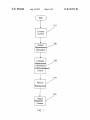
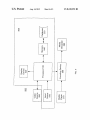
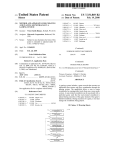
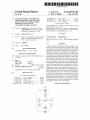
With reference to FIG. 1, a How diagram representing the
method steps for selectively replacing objectionable content
in a program With less-objectionable material, such as, eg
advertisements in accordance With the system, method, and
computer program product of the present invention is shoWn.
The method of the present invention may comprise the step
110 of encoding the program to mark potentially objection
able content present in the program. The encoding step 110
may include embedding or inserting replacement information
into the program su?icient to identify the potentially objec
tionable content (video and/or audio) or may include storing
or transmitting replacement information, separately from the
program, suf?cient to identify the potentially objectionable
content in the program. As discussed in greater detail beloW,
step 110 may preferably be performed off-line, Which
involves performing the encoding after production of the
program, but prior to its broadcast, playback, etc. Alterna
tively, the encoding step 1 10 may be performed in real-time or
on-line as the program is being broadcast, played back, etc.
The encoding step 110 may be performed by a broadcaster,
content.
20
codes, Which indicate the type of potentially objectionable
material that may be present, as Well as information suf?cient
to selectively and accurately perform replacement of the
material.
25
1. A-Codes (Audio)
Replacement code “A” (A-code or audio code) represents
“Audio” and marks (e.g., identi?es the placement in the pro
gram) a potentially objectionable Word or phrase present in
30
beloW, each A-code consists of a preamble containing the
Word being identi?ed as potentially objectionable, Which per
mits users to program their replacement device to replace (or
the audio portion of the program. As described in more detail
captioner, production house, post production house, or other
entity.
At step 120, the encoded program, Which may be received
by the audio-video device, may be decoded. The encoded
program may be received by the audio-video device in the
form of an audio and/or video signal representing the encoded
program. The decoding process extracts the encoded replace
ment information from the audio and/ or video signal. As
described above, the replacement information may be in the
Finally, the replaced program may then be produced as an
output for the immediate presentation to the vieWer or for
recording or transmission at step 150.
A. Replacement Information of the Present Invention
In one embodiment of the present invention, the replace
ment information includes any one of three replacement
not replace) on a Word-by-Word basis. The A-code also
includes a duration, and a start symbol.
35
2. V-Codes (Violent Content)
Replacement code “V” (V-code or violence code) repre
sents “Violence” and marks potentially objectionable violent
material present in the video portion of the program. Each
V-code contains information relating to the level of intensity
40
of the violence referred to in this example embodiment as an
VBI or, alternatively, may be stored in a database or ?le
intensity level. The intensity levels in this example embodi
transmitted separately to the audio-video device, or embed
ded in another part of the incoming audio and/ or video signal
ment are:
for digital signals.
24Graphic violence
The encoded program is, preferably, received by the
replacement device, Which decodes the encoded program.
The encoded program, hoWever, may be provided to the
replacement device through any suitable means such as being
liMild or fantasy violence
45
In addition, each V-code includes information relating to a
set of display coordinates to be replaced, a start code, and
duration information.
3. S-Codes (Sexual Content)
supplied on a recorded medium, such as a video cassette,
DVD, or CD for playback by a suitable player for decoding.
The extracted replacement information, Which includes
50
information identifying potentially objectionable material in
the program, may be then compared With the replacement
criterion at step 130. The replacement criterion may include
information that may be provided by the user, supplied by the
manufacturer of the replacement device, and/ or periodically
3iExtreme violence or rape
Replacement code “S” (S-code or sex code) marks poten
tially objectionable sexual content in the video portion of the
program. S-codes andV-codes function nearly identically and
are differentiated primarily to alloW end users to replace
55
S-codes independently of V-codes, and vice versa. S-codes
have intensity levels as folloWs:
liMild nudity (topless, see-through)
supplied by a remote source (e.g., a cable company) and
2iFull nudity or highly suggestive sexual behavior
indicates the type and level of potentially objectionable mate
34Graphic sex or strong sexual content
rial that is to be replaced in the video as Well as the particular
Words and phrases that are to be replaced in the audio.
60
If the replacement information does not match the replace
ment criterion then no replacement is performed. If the
The content that may be considered “potentially objection
able” may be de?ned by the designer and Will vary according
to the implementation of the present invention. Alternate
embodiments may use additional and or different codes to
replacement information matches the replacement criterion,
information also includes information su?icient to permit the
permit other types of replacement. For example, a N-code
could be used to identify and replace nudity, but Would not
identify or replace other sexually explicit content (e.g., kiss
ing). LikeWise, an R-code might be used to identify and
replacement device to replace the objectionable content With
replace potentially objectionable religious content. Other
then the program material may be replaced according to the
replacement information at step 140. Thus, the replacement
65