1
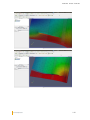
SIF tab
SIF tab
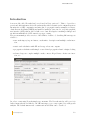
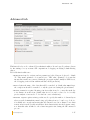
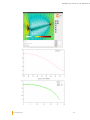
Using this tab the FE solution of the current cracked structure solution will be computed
and post-processed to calculate energetic crack parameters. It constitutes the crack analysis
toolbox. Here SIF computation and energy release rates computation can be carried out using
a G − θ approach, the process is multi-threaded using the number of processes specified in
the main window. Two branching criteria can be used to predict the suitable propagation
direction that will be chosen by the advancing crack:
• the first one is based on the SIF extraction (obtained from an integration integral using
the Westergaard analytical solutions), a maximal opening stress criterion is then used:
if the extracted stress intensity factor value in mode II KII is sufficiently high compared
to mode I value KI , the branching angle α is computed as:
!
p
−KII /KI + (KII /KI )2 + 8
α = 2 arctan
(1)
4
This criterion, is very fast to get the branching direction but can only be used for
homogeneous isotropic materials
• the second one, is based on two computations of the energy release rate value in two
orthogonal directions. The first one, is along the tangential crack direction is gives a
value called GI , the second one in the orthogonal direction produces a second value
called GII . The chosen branching angle for the new propagation direction is set to
Z-set — Non-linear material
& structure analysis suite
1.11