1
codes, nested classes are lifted out and result in separate .class
files. We equivalently lift a nested class, and provide a separate
module for external access. We treat a nested class and its container
as members of a cycle, placing both in the same module.
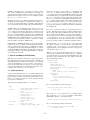
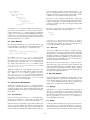
(let/cc break-k
(let loop ()
(let/cc continue-k
(when #t
(if (= x 0)
(break-k )
(if (= x 5)
(continue-k )
(set! x (+ x 1))))
(loop)))))
Inner classes are also compiled to separate classes. Unlike static
nested classes, they may not be accessed except through an instance
of their containing class. A separate module is therefore not provided, and construction may only occur through a method within
the containing class.
The name of a nested class is the concatenation of the containing
class’s name with the class’s own name. Class B in
As it happens, let/cc is expensive in PLT Scheme. We plan to apply a source-to-source optimizer to our Java-to-Scheme compiler’s
output to eliminate these let/cc patterns, putting each statement in
a separate letrec-bound function and chaining them. Although we
could avoid let/cc in the output of our Java-to-Scheme compiler,
it is easier to translate most Java statements directly to Scheme, and
then work with Scheme code to optimize.
5.4
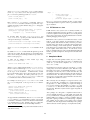
class A {
class B {
}
}
is accessed as A.B. For anonymous inner classes, we intend to
follow the bytecode strategy: the class will be given a name at
compile-time, the containing class name appended with a call to
gensym, and then lifted as other nested classes.
Native Methods
Most Java implementations use C to provide native support. Our
system, naturally, uses Scheme as the native language. When our
compiler encounters a class using native methods, such as
5.5.2
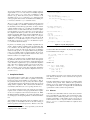
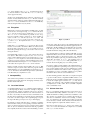
class Time {
static native long getSeconds(long since);
native long getLifetime();
}
Java supports multiple forms of reflection: examining and interacting with classes and objects specified at runtime; dynamically
extending classes; and modifying the means of class loading and
compilation. The first one can be supported either with macros or
generating methods during compilation to provide the data. We do
not yet know how the second will be supported, or what support for
the third would mean within our system.
the resulting module for Time requires a Scheme module
Time-native-methods which must provide a function for
each native method. The name of the native method must be
the Scheme version of the name, with -native appended at the
end. Thus a native function for getSeconds should be named
Time-getSeconds-long-native and getLifetime should
be getLifetime-native.
The first form of reflection allows users to create new class instances with strings, inspect and modify fields, call methods, and
inspect what fields and methods are available. The last of these is
easily supported by generating the information during compilation
and storing it in an appropriate method. The other functionality can
be supported through Scheme functions.
Within the compiled code, a stub method is generated for each
native method in the class, which calls the Scheme native function. When getSeconds is called, its argument is passed to
Time-getSeconds-long-native by the stub, along with the
class value, relevant accessors and mutators, and generics for private methods. An instance method, such as getLifetime, additionally receives this as its first argument.
5.5
6
Run-Time Support
Java provides two kinds of built-in data: primitive values, such as
numbers and characters, and instances of predefined classes. The
former translate directly into Scheme, and most of the latter (in
java.lang) can be implemented in Java. For the remainder of the
built-in classes, we define classes directly in Scheme.
Constructs in Development
We have not completed support of switch, labeled statements,
nested classes, and reflection. The first two are straightforward, and
we discuss our design of the other two further in this section. Our
partial implementation of nested classes suggests that this design is
close to final.
5.5.1
Reflection
6.1
Strings
Although the String class can be implemented in Java using an
array of chars, we implement String in Scheme. This implementation allows a Scheme string to hold the characters of a Java string,
thus facilitating interoperability. From the Scheme perspective, a
Java String provides a get-mzscheme-string method to return an immutable Scheme string.
Nested Classes
In Java, a nested class may either be static or an instance class,
also known as an inner class. An inner class can appear within
statement blocks or after new (i.e. an anonymous inner class).
6.2
Static nested classes are equivalent to top-level classes that have the
same scope as their containing class, with the restriction that they
may not contain inner classes. These can be accessed without directly accessing the containing class. When compiled to Java byte-
Arrays
A Java array cannot be a Scheme vector, because a Java array can be
cast to and from Object and because assignments to the array indices must be checked (to ensure that only objects of a suitable type
are placed into the array). For example, an array created to contain
58