1
>@9
Multitone Audio Test System
User Manual
1 OVERVIEW
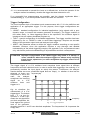
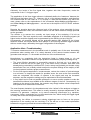
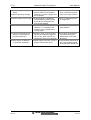
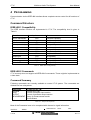
The trend in modern audio testing is to reduce more and more the time required for a
complete performance test of the device being tested. This tendency results partly from the
demand of broadcasters being forced to provide 24hour programming, leaving little time for
testing. In a modern studio with dozens of input channels, several routing paths and more
than 24 recording channels, a complete test including all parts of the studio becomes very
time-consuming and boring since the tests are highly repetitive.
Industrial applications also require reduced test time, especially at production lines where
any time wasting process becomes a bottleneck. Reducing test time by a factor of 20 to 50
ensures for years that testing will not be the limiting factor and increases production density.
>@9 is a modern and advanced audio test system with the capability to evaluate the
important performance Parameter of a device within a fraction of a second. >@9 is a
complete, optimized system, containing a remote controllable generator as well as an
intelligent analyzer, and can be easily integrated into an automated environment. The
system provides the highest performance and specifications to meet also the requirement of
professional equipment.
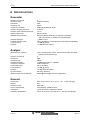
• Frequency range
20Hz to 20kHz
• Output level
-60dBVp to +20dBVp
• Input range
-60dBVp to +20dBVp
• Measurements
level, noise, distortion, crosstalk and phase in one step
• Burst transmission time typ. 250-960ms
• Residual distortion
< -86dB
>@9 is very simple in terms of connecting, handling and use within any automated
environment, but highly complex in terms of the implemented structures and algorithms to
perform the analysis in a extremely short period of time.
>@9 is very compact, using the most advanced technology available on the market. Within
its case of 19“ width and height of one unit (1.75“) only, it provides two generator channels
and two independent analyzer channels. The analyzer and generator can be operated
completely independently even though they are located in the same housing.
There is no external synchronization required to perform the analysis. Each transmitted
multitone signal contains an information header allowing any listening analyzer to
synchronize onto the signal.
Communication
Since >@9 does not provide any control elements, it must be completely controlled by a host
PC. Due to performance reasons, an IEEE-488 parallel interface has been integrated into
the instrument. This allows to transmit any command independently of the actual generator
and/or analyzer activities. The instruction to transmit a previously defined multitone signal
can be issued from the PC at any time.
Consequently, the basic requirements for the host PC is a standard IEEE-488 interface
board with installed software drivers. Detailed descriptions of the IEEE-488 connection and
all commands are filed in chapters Mains Cable and Programming respectively.
V 3.32
9 / 71