1
STATION REPORT
PTS Taipei, Taiwan
Satellite Channels for Taiwan PTS’s Control Center
“85% of the country is cabled”, explains
Ching Swen, the Executive Vice President of
the “Public Television Service Foundation”,
founded in 1998. That really doesn’t leave
much room at all for direct satellite reception. Nevertheless, there is a single programming package for the Aborigines in Taiwan. As
democratization came about, these Aborigines
earned more rights as well as their own TV
channels. Since most of these Aborigines live
in the mountainous regions in the center of the
country, satellite transmissions were mostly
meant for them. Of the seven channels available in the package, three of them are produced by PTS.
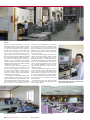
Ching Swen invited us to visit the control
room located in an adjacent building. Su Miao,
Engineering Manager of the control room,
described to us the setup: “Here we are able
to watch over six channels; at the moment we
are producing five channels. The extra spot
serves as a reserve.” Three of the channels are
transmitted via satellite, namely the channels
PTS, DIMO and HAKKA. The signal is routed
via fiber optic cable to Taiwan’s state-run telecommunications company CHT (Chung-Hwa
Telecom) and from there is uplinked to ST-1
at 88° east via an uplink station in the Yang
Min Mountains in northern Taiwan. PTS also
uplinks its own PTS channel directly to ST1 such that PTS appears there twice, in the
encrypted package for the Aborigines as well
as in FTA.
There’s also an additional channel, MACTV, that is not produced by PTS. MAC-TV is
a channel for all Taiwanese that are living
abroad and is produced in Chinese (i.e. Mandarin, the mainstream language in Taiwan and
mainland China), Cantonese, the two Aboriginal languages Hakka and Taiwanese as well
as English. MAC-TV’s signal is transmitted to
North America via fiber optic cable where it is
then retransmitted. The MAC-TV signal is also
uplinked from CHT via the uplink station in
Linko south of Taipei to INTELSAT 8 (166°E) for
the New Zealand region, TELSTAR 10 (76.5°E)
for China, SUPERBIRD C (144°E) for Japan and
Korea as well as to JSAT 3 in C-Band (128°E)
for Asia.
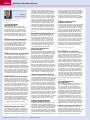
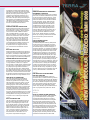
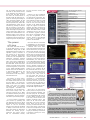
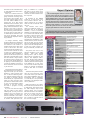
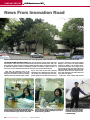
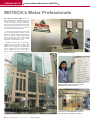
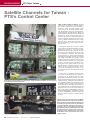
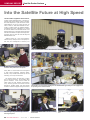
▲ Entrance to the PTS building. The organization “Taiwan Broadcasting System” can also be found
here marketing the channels from PTS.
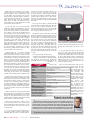
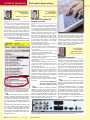
▲
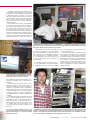
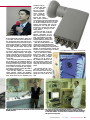
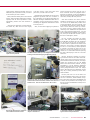
Ai-Chen Su is one of the technicians in the Master
Control room that keeps an eye on the production
of the TV channels. The monitors in the background
are showing the signals for Channel 1 and Channel
2, with the additional monitors for Channels 3 to
6 located to the right. The employees are wearing
jackets because the air conditioning system needs
to keep the electronic equipment at a constant low
temperature. Every employee leaves their shoes
at the Master Control room entrance and puts on
slippers instead.
56 TELE-satellite & Broadband — 06-07/2007 — www.TELE-satellite.com