1
Sample Discussion for ANSI Z136.6
• DO NOT aim at or near aircraft, except to make your position known in an emergency situation or
when a cooperating aircraft is looking for your signal. It is otherwise illegal to aim at aircraft and
distract pilots. Misuse may result in arrest, fines and/or imprisonment.
EXEMPTIONS
An Aviation Safety Label is required on Class 3 and Class 4 lasers which emit visible light. There are a
few exemptions, described below, where the label is not required on such lasers.
These exemptions are optional, A manufacturer may choose to affix an Aviation Safety Label even if the
laser is or might be exempt. This can be done for convenience (so the manufacturer does not have to
determine whether or not a laser is exempt) or simply to increase safety by providing additional
information to the user.
EXEMPTION FOR LASERS LARGER THAN “HANDHELD”
A laser is exempt if its largest dimension (length, width or height) is greater than 15 inches. This is
because smaller “handheld” lasers have been disproportionately involved in aircraft illumination incidents.
The 15” dimensional limit does not include wires, antennas, key chains, carrying straps or similar flexible
and/or small-diameter additions to the main emission device or module. Also, the 15” dimensional limit
encompasses the laser-emitting device; it does not include a shell, housing, lens hoods, detachable
handles, auxiliary battery packs, separate power supplies or any other parts that can be readily removed
so that the laser emission device or module’s greatest dimension becomes less than 15 inches.
EXEMPTION FOR LASERS NOT USED OUTDOORS
If a laser is of a size or configuration where it is expected never to be used outdoors, an Aviation Safety
Label is not required. Keep in mind that lasers originally intended for one purpose can be modified for
another. For example, many outdoor laser light shows have used YAG lasers originally sold for medical
purposes (e.g., indoors use). Also, it may be possible for a laser’s beam to be aimed out a window or
otherwise go into airspace, even if the laser itself cannot move. Therefore, it may be appropriate to have
an Aviation Safety Label somewhere on the equipment such that a person buying used equipment could
see the label.
EXEMPTION FOR HIGH-DIVERGENCE AND DIFFUSE LASERS
A laser is exempt if it has a highly diverging or diffuse beam, such that its irradiance is below 5 µW/cm² at
all distances beyond 500 feet from the laser source, under all operating conditions. (This corresponds to
being below the FAA’s Critical Zone light limit, at the minimum altitude Above Ground Level normally
required for aircraft in Federal Aviation Regulations Part 91, Section 119.)
EXEMPTION BASED ON VISUAL EQUIVALENCE FORMULA
A laser is exempt if its combination of power, wavelength and divergence is below the equivalent of 5 µW/
cm² of 555 nm (green) laser light, at all distances beyond 500 feet from the laser source. This is because
the human eye is most sensitive to green light; a laser of a different wavelength (color) may appear less
bright and thus may not present a visual interference hazard.
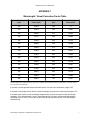
If a manufacturer wishes to consider wavelength as a factor for exemption, then measure the laser’s
power, wavelength and divergence and use the following Visual Equivalence Formula:
4 × Power × VCF
π × (15240 × Divergence)²
Patrick Murphy submission to ANSI Z136.6, February 2012!
3