1
Analyze haphazard occurrences with linear congruential generators
FA DRUNKARD starts from a
Before going further. I should try to
lamppost and randomly stag· clarify a point of language that can
gers away. how far will he have lead to confusion. Strictly speaking.
progressed in one thousand no such thing as a random number
steps? Expressed in varying forms. the exists-only a random process. The
"drunkard's walk" has become a number 12345 is neither less nor
staple of mathematical physics. How more random than the number
far will an impurity atom migrate in a 32719. In a series of 100.000 random·
crystal lattice? How many steps will be ly generated numbers. both of these
required for a photon to emerge from
would have the same chance of oca foggy atmosphere? They are all the curring. The idea that 12 34 5 is less
same question. and they can be random comes from comparing it
treated with "Monte Carlo" calcula- with a simple pattern of ascending
tions. These calculations are finding digits. Thus. instead of saying you are
increasing applications in business. as trying to produce random numbers.
well. For example. they provide an you should say you are trying to con·
analysis of how best to serve struct a method that will produce a
customers arriving haphazardly at a series of numbers that imitates the
counter. Carrying out such calcula· results of a random process. But for
tions depends on being able to imi· the purpose of this article. I will use
tate randomly generated numbers. the word "random" more loosely to
and this is not easy. It has been said refer to a random sequence or a ran·
that more time has been spent gen- ·dom number. without worrying about
erating and testing random numbers the niceties. If a sequence looks like
it was generated by a random prothan using them.
You can find numerical examples of cess. I will call it random and will put
random series all around you. The off the question of how to judge apfinal integers in a list of telephone pearances until I discuss methods of
numbers gives a good random series testing random-number generators.
1b carry out a Monte carlo calculain the range 0 to 9. The face values
of cards drawn from a well-shuffled tion. you need to work with random
deck and the final digits in license- numbers inside a computer. But you
plate numbers on passing cars are are faced with the fact that a purely
usually quite reliable. (But the first digital computer is a deterministic
digits of such numbers are often far machine-except on its "off" daysfrom random.)
and such a device cannot truly
The property that defines a ran- generate a random process. You have
domly generated series is that each to be satisfied with deterministic
number is independent of all earlier algorithms that imitate random pronumbers. In other words. the process cesses. You can thus generate
that generates the random series has "pseudorandom" numbers with some
no memory. Therefore. even if you of the earmarks of randomness.
know all the previous numbers. you Naturally. some random-number
cannot predict with certainty the next generators work better than others.
one. (And if you have been losing at and you must be wary.
a truly random game. you have no
reason to think you will start winning.) LINEAR CONCRUENTIAL
That's why flipping a coin is such a GENERATORS
good method of generating a random Mathematicians have suggested many
series of zeros and ones. Each flip is methods for generating pseudoranentirely independent of the others.
dom numbers with a digital computer.
Happily. the most common and
powerful one involves simple arith·
metic. This method is the linear congruential generator. or L.CG for short.
An LCG produces a series of
numbers. /,. where the subscript "i"
indicates the location of the number;
i - I indicates the first number. i 3 is the third. and so on. Since each
successive term. 1,. 1• is computed
from its predecessor. you can see
right awa'j that this series is not truly
random because it has memory. That
is why the L.CG is called a "pseudorandom"·number generator.
1b understand the L.CG. look at the
following linear expression:
1;. 1
-
al, + c. (a > 0. c :i!:: 0)
This expression multiplies each
number by the factor a and then adds
cto find the next member. It produces
an ascending series of numbers
whose differences are given by the
expression
/ 1• 1 -
11 - (a-1)11 + c
We call the process "mapping"
because it carries the integer. I, to
1,. 1• from one point to the next in a
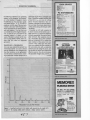
one-dimensional space. as shown in
figure I.
Suppose a - 2 and c - I; then you
have I. 3. 7. 15. As i~ stands. this series
doesn't look random. 1b create a
series that looks random. you need a
method of scrambling the output.
perhaps by cutting off the upward run.
One way to achieve this appearance
is to imagine you've subdivided the
number line representing the /-space
into segments of length '"· If you
make the multiplier. a. in the L.CG suf-
w"'''"lltll o11 , . 4421
Clulrlts A. WilitJit!l is a ph!lsicist at tilt
HarwmJ-Smitilsofliall Cntttr for Astropfr!l5ics
(60 Cardell St .. Cambridgt. MA 021 38)
arul is a professor of astronom11 at Harvard.
I
OCTOBER 1984 • BYTE
129