1
Manual for operation instructions. The StowAway-IS is also compatible
with HandCar software for the Palm® OS when used with a StowAway-IS
Coupler and Optic Base Station. See the HandCar Manual for operation
instructions.
Triggered Launch
Launch the StowAway-IS with the triggered launch box checked to enable
the triggered launch feature. The yellow LED will blink weakly every four
seconds while the logger waits to be triggered but the logger will not be
recording measurements. The StowAway-IS will start logging when a
strong magnet is brought near the logger. You can use the StowAway-IS
coupler, or any powerful magnet to trigger a launch. The yellow LED on
the StowAway-IS will flash brightly four times to indicate a successfully
triggered launch.
Delayed Start
Launch your StowAway-IS with delayed launch box checked to enable
delayed start feature. The yellow LED on the StowAway-IS will flash
weakly every six seconds while the logger waits for the delay period to
expire. Upon expiration the logger will start recording measurements at
every interval.
Multiple Sampling
Launch the StowAway-IS with the multiple sampling box checked to
enable the multiple sampling feature. In multiple sampling many
measurements are taken in any given logging interval but only one data
point is recorded. The exact number of measurements varies with the
interval selected. The maximum measurement rate is 1/2 second. The
StowAway-IS supports three types of multiple sampling. Maximum will
command the StowAway-IS to save only the highest measured temperature of the interval. Minimum will command the StowAway-IS to save
only the lowest measured temperature of the interval. Average will command the StowAway-IS to determine the average temperature of the all
the temperatures measured in the interval. Note that using multiple
sampling for extended periods of time will reduce battery life below five
years.
Alarm Indication
The StowAway-IS has two LEDs, one yellow and one red. The yellow LED
blinks during use if the alarm has not been tripped. The red LED will
blink if the StowAway-IS has recorded a temperature outside the user's
set alarm limits. When the StowAway-IS is full or has been downloaded,
neither LED will blink. Use of the alarm is optional and its limits are set
during launch with the logger software. The alarm limits can be set
anywhere between -40°F to +167°F (-40°C to +75°C).
Hardware Details
Logger Construction
The StowAway-IS uses infrared light to communicate which allows the
logger to be completely sealed in durable epoxy. The StowAway-IS has
been tested to NEMA 6 (IP67). This means that the logger can be used in
Page 3
dirty locations, sprayed, or even briefly submerged. For data retrieval, be
sure to clean the communication port of water, dirt, and dust. Clean the
StowAway-IS with a non-abrasive mild soap and warm water and a nonscratching sponge or towel. Scratches or abrasions on the communication
port may impair communication. Do not use the StowAway-IS in high
temperature condensing environments for extended periods of time as
this may affect the accuracy of the temperature measurements. Onset
recommends that the StowAway-IS not be used continuously in a condensing environment for more that ten weeks at temperatures exceeding
+86°F (+30°C).
Temperature Accuracy and Resolution
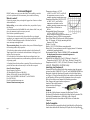
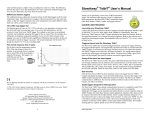
The StowAway-IS accuracy and resolution specifications are given in
Plot B. The logger’s accuracy specification is the maximum measurement
error, including the effects of thermistor error and quantization error. In
most cases the logger’s actual accuracy is better than the specified value.
The logger’s resolution is the difference between temperature steps.
Factors that affect the StowAway-IS accuracy are thermistor error,
component imperfections (resistor variations and A-D nonlinearities),
and quantization error (difference between temperature steps). Onset
Computer Corporation’s proprietary test procedures effectively eliminate
the resistor and A-D errors, leaving only the thermistor error, quantization error, and a small residual calibration error. Note that two loggers
will not necessarily have exactly the same step value and two loggers
exposed to the same temperatures may report different values, however
each one will be correct within its accuracy.
Intrinsically Safe
Factory Mutual Research has certified the StowAway-IS is safe for use in
certain hazardous areas. The National Electrical Code has classified
many types of hazardous locations. The StowAway-IS has been approved
to be intrinsically safe in Class I and II locations which are areas where
ignitable concentrations of gas (Class I) and/or dust (Class II) exist. The
NEC further classifies hazardous locations by Division (1 or 2). The
Division designation refers to the likelihood that the area will contain
ignitable concentrations of gas or dust. Division 1 locations will have
ignitable concentrations of gas or dust continuously or under normal
operating conditions. Division 2 locations will have ignitable concentrations of gas or dust only during infrequent or abnormal operation (which
may include areas located near Division 1 locations). The StowAway-IS
has been approved for use in both Division 1 and 2 locations. The hazardous area classification scheme is further defined by listing the types of
ignitable gases and dusts that may be present in a hazardous location.
Ignitable gases and dusts are sorted into groups with similar ignition
characteristics. The StowAway-IS is certified for all possible groups:
A-G for gas and A-D, F and G for dust. Finally every Intrinsically Safe
Device is given a temperature rating. The StowAway-IS has a T4
rating, which means that no part of the device will become warmer
than +275°F (+135°C) in a worst-case fault. For more information on
Hazardous (Classified) Locations visit the Underwriters Laboratory web
site at www.ul.com/hazloc/define.htm.
Page 4