1
Using the Pico-Injector (Contd)
Har vard Apparatus Model PLI-100A Pico Injector User's Manual
12
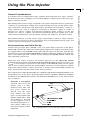
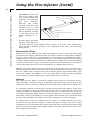
PLI-PPH: Unscrew the
end of the holder with
the 2 mm. diameter hole
and place it over the output hose (PLI-OH).
Reattach this fitting
securely with the hose
inserted as far as it will
go.The 1.5 mm. OD capillary is similarly attached
to the other end of the
holder through its “o”
ring.
Hex Nut
Output Hose
Holder
Bushing (Metal Sleeve)
Silicon Rubber Gasket (7.5mm L x 1.5mm ID)
Knurled Nut
Glass Tube
Fig. 4. PLI-PH1/PH1A 1.5 mm OD Glass Pipette Assembly
Attach output and holding hose to the appropriate front panel gas ports. Tighten them securely so that the valves within these
ports are open, allowing pressure to be controlled in the hose and connecting
micropipette.
Micropipette Filling
Filling can be done from the tip of the micropipette, or, with a few extra steps, from
the barrel of the pipette. Filling from the tip is most suitable if a filling fiber is deliberately not being used due to irregularities in the balancing (see BALANCE below).
Simply prepare a bolus of injection material on a glass slide and maneuver the tip into
it using a micromanipulator. Depress the FILL button to apply about 12 psi (82 kP.) of
suction continuously as long as needed. If evaporation of a small bolus is a concern, it
can be prepared under oil and the micropipette tip similarly moved into it.
Filling can be done from the back end (barrel) of the pipette using a syringe with a
thin hypodermic needle inserted so its tip is down in the tapered section. If the capillary has a filling fiber attached to the inner wall the pipette tip will then fill by capillary action without air bubbles, at least for larger tips. Variations on this procedure
involve filling a smaller capillary first and inserting it for the back fill.
Balance
The inflow into the pipette (caused by capillary forces) prior to or in-between injections should be a small percentage of that being injected.As the volume desired gets
smaller,the relative inflow gets larger even faster due to the smaller tip size being used.
To avoid this problem, set the balance pressure before placing the pipette in the cell’s
external medium.Ten percent of the injection pressure is a good starting value. Exact
balance is difficult to determine: often the fastest way to handle this is to set the balance high enough that slight outflow is observed. Balance is assessed by watching the
movement of the liquid meniscus in the pipette. The outflow left is still small compared to the continuous streaming used in the continuous ejection technique.
If a filling fiber is used, the capillary inflow is larger so a higher balance pressure is
needed. In general, however, when a balance pressure is being used, such a fiber
should not be used:sometimes the injection material will run out spontaneously or the
pressure needed to balance will abruptly change with time. (These may be due to particles lodging on the fiber).
Publication 5403-004-REV-E
www.harvardapparatus.com