1
3.1. Modeling Framework
3.1
Modeling Framework
The modeling framework consists of three basic ingredients:
communication views, grammars with conditional productions,
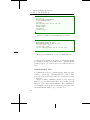
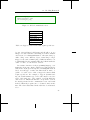
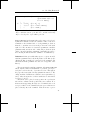
and assertions. We use the interface of the Java BufferedReader
(Figure 3.1) as a running example to explain these modeling
concepts. In particular, we formalize the following property of
the BufferedReader:
The BufferedReader may only be closed by the
same object which created it, and read actions may
only occur between the creation and closing of the
BufferedReader.
Note that the above property constrains the clients that
use the BufferedReader; in other words, it is a kind of “user
manual” for the reader, but does not guarantee that the reader
itself works properly (since this property does not restrict the
behavior of the reader itself). The property is a little unusual
in that the reader actually cannot even detect whether a client
uses it according to the above specification, since the reader
has no way to detect whether the caller of close is the same
object that constructed it. This last part can be seen as a form
of dynamically checked ownership: the client which created the
reader owns it, and the above property can serve as a first step
to ensure that no information about the reader is leaked to
other clients.
As a naive first step one might be tempted to define the
behavior of BufferedReader objects simply in terms of ‘callm(T )’ and ‘return-m(T )’ messages of all methods ‘m’ in its
interface, where the parameter types T are included to distinguish between overloaded methods (such as read). However,
interfaces in Java contain only signatures of provided methods:
methods where the BufferedReader is the callee. Calls to
these methods correspond to messages received by the object.
In general the behavior of objects also depends on messages
sent by that object (i.e. where the object is the caller), and on
the particular constructor (with parameter values) that created
the object. Moreover it is often useful to select a particular subset of method calls or returns, instead of using calls and returns
23