1
The first part of the theorem will be used in the proof of
refutational completeness (because
for arefutation on the
ground level,
i.e.
a
derivation
of
, only the empty
path set can be more general), while the second
part will be used in the proof of answer completeness (Theorem 2.3). In particular, to obtain this we have to demand
one
single substitution which maps any of the clauses used
in extension steps to the respective clause on the ground level.
Clearly, this result is harder to establish and more relevant
than a lifting result for SLI-resolution in [Lobo et al., 1992]
which “moves the quantification inside”: in our words, they
state that for every application of an input clause at the ground
level there exists an application at the first-order level, and
there exists a substitution to map this instance to the ground
level.
Theorem 2.3
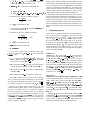
(Answer completeness of restartME) If is a correct answer for a program , then there exists a strict
restart
ME
refutation
from
) with computed answer
such that
entails ,
i.e.
! ' ! ' Informally, the theorem states that for every given correct
answer we can find a computed answer which can be instantiated by means of a single substitution to a subclause of the
given answer (and hence implies it). Unfortunately we can
not obtain a result stating that the computed answer contains
less (or equal) literals than the given answer.
All proofs are stated in the long version of this paper
[Baumgartner et al., 1995].
3 Definite Answers and Regularity
From theorem proving with ME we know that the regularity
check is an important means for improving efficiency. Regularity for ordinary ME means that it is never necessary to construct a tableau where a literal occurs more than once along a
path. Expressed more semantically, it says that it is never necessary to repeat in a derivation a previously derived subgoal
(viewing open leaves as subgoals).
Unfortunately, regularity is not compatible to restart ME.
In this section we will present a variant of restart ME, the
ancestry restart variant, which allows for extended regularity
checks. This variant is motivated by Loveland's UnH-Prolog
[Loveland and Reed, 1992].
As an interesting side effect it turns out that this variant offers considerable benefits with respect to logic programming:
occasionally one is interested in the question whether a given
program with query admits a definite answer, i.e. an answer
which is a single conjunction of atoms, but not a disjunction.
Of course, in general, a non-definite program does not always
admit a definite answer, but some programs do. It is the latter
class of problems we are interested in now.
The key idea to the direct computation of definite answers
is to restrict the use of the query to one single application in
the refutation, namely at its top. Then, by definition, definite
answers are obtained. However, such a restriction is incomplete. But if restart ME is modified in such a way that every
negative literal along a branch, not only the topmost literal,
may be used for the restart step then completeness is recovered. This follows from a more general result which states
that we can restrict to globally regular refutations (i.e. no literal except the literal used for the restart occurs more than
once along a branch). Let us now introduce all this more formally.
Definition 3.1
(Ancestry Restart Model Elimination) The calculus ancestry restart ME is the same as strict restart ME (Definition 1.2), except that the inference rule restart is modified by
replacing the condition 3. by the new condition 3' .:
3' . is a negative literal occurring in . In this context is
also called the restart literal.
The modified rule is called ancestry restart.
The term “ancestry” in the definition is explained by the use
of ancestor literals for restart steps. Note that any reduction
from a positive leaf literal to a negative ancestor literal can be
simulated in ancestry restart ME by a restart step followed by
a strict reduction step. Thus, non-strictness is “built-in” into
ancestry restart ME.
Note that the ancestry restart rule includes the restart rule
since the first literal can be used for the restart as well.
Clearly, in terms of a proof procedure the ancestry restart
rule induces a larger local search space than the restart rule.
On the other side, refutations may become much shorter. Indeed, this is the rationale for our proof procedure to search
the restart literals from the leaf towards the top. As a further
benefit of this search order note that a definite answer will be
enumerated before a non-definite answer.
Now we are going towards an appropriate completeness
result wrt. definite answers. As mentioned above, this result
shall be a consequence of a more general result concerning a
regularity restriction. Let us define this notion precisely:
Definition 3.2
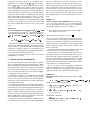
(Regularity) Let be path written as follows (the s and s
are atoms):
" " " " " " " " "
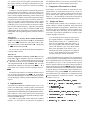
" " " Then is called blockwise regular iff
1. for ' % ', positive literals) and
2. for ' % , ' larity inside blocks).
(Regularity wrt.
,
(Regu-
If additionally it holds that
3. for ' % , ' (Global negative regularity)
,