1
Chapter 3
Prototyping and Design Techniques
Identifying Common Operations
As you design programs, you may find that certain operations are
performed frequently. Depending on the situation, using subVIs or loops
to repeat an action can simplify a VI.
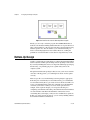
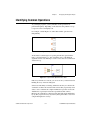
For example, consider Figure 3-6, where three similar operations run
independently.
Figure 3-6. Operations Run Independently
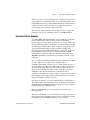
An alternative to this design is a loop that performs the operation three
times, as shown in Figure 3-7. You can build an array of the different
arguments and use auto-indexing to set the correct value for each iteration
of the For Loop.
Figure 3-7. Loop Performs Operation Three Times
If the array elements are constant, you can use an array constant instead of
building the array on the block diagram.
Some users mistakenly avoid using subVIs because they are afraid of the
overhead it can add to the execution time. It is true that you probably do not
want to create a subVI from a simple mathematical operation such as the
Add function, especially if it must be repeated thousands of times.
However, the overhead for a subVI is fairly small and usually minimized
by any I/O you perform or by any memory management that occurs from
complex manipulation of arrays.
© National Instruments Corporation
3-11
LabVIEW Development Guidelines