1
3
4,216,461
4
15 or in a RAM. The registers may be physically de
tachable for subsequent processing at a remote location
sion to pulses in, say, a control character register to
activate the appropriate numbers and characters for
by the PCU. Alternatively, in the preferred form of the
invention, the storage or registers may be internal, i.e.,
contained with in the circuitry of the chip. In another
embodiment, say, where only a numerical count is de
sired, the storage or registers may be an LED, LCD,
print out by a teletype 41. Similarly, other print out
instructions may be sent to an LED, LCD, 42 etc., via
a BCD-to-number decode 43, or to a printer 44 via a
printer interface 45. A bus synchronizing clock 46 oper
ating via a modem 47, synchronizes movement of pulses
incandescent display, etc. The storage or registers (e.g.
D.C. battery which enables them to store the informa
through the system and with the read out, if any. The
bus system is the UNIBUS variety, but other types may
be used. A real time clock 49 may be used to afford a
tion until released or accessed by the PCU.
date and time read out along with the other data. A
on a CMOS chip) are powered by an A.C. source or a
In addition to the usual sensing and counting cir
cuitry, the counter 10 may be provided with a hard
counter interface 50 is employed to input instructions to
the counter 10 from the microprocessor 31 through the
wired memory 16, 17 containing an owner access code
I/O decode 35.
and machine code respectively; alternatively, micro
electronic circuit registers 18 and 19 may be employed
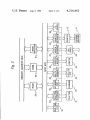
The PCU 12 may be a CMOS chip sold by RCA as
the CDP 1802 and described in their “User Manual for
to contain the access code and the machine code respec
the CDP 1802 COSMAC Microprocessor”, (1976)
.
.
tively. The latter has the advantage of permitting a code
change if the vending machine is relocated, or if the
ownership becomes changed, etc.
MPM-ZOIA. The processor unit 14 in the counter 10
may employ CMOS chip parts or a processor similar to
20 one manufactured by Western Digital Corporation as
An interlock 20 or other sensing device may be pro
their CR 1872 and described in their “CR 1872 User’s
vided to indicate service times of the vending machine;
Manual”, June l977; the latter may employ a “sleep
mode” by powering the registers at about l/50-l/50O
of the usual operating frequency when not in active use,
similarly, a power outage sense 21 may be employed to
indicate, viaa signal or read-out that battery tampering
or battery deterioration has occurred.
25 with PMOS.
The PCU I/O device 12 is provided for the system to
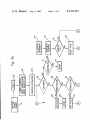
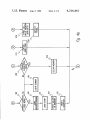
FIG. 3 illustrates a computer program employed for
input as appropriate access code into the counter and
operating the counter. Assuming the battery has been
thereby enable release of data or information stored
connected 61, the counter will be started 62, and the
therein. The PCU is adapted for converting the coin
counter, power alarm and service ?ags will be all reset
count from the counter into a total coin value and either 30 63 followed by counter initialization 64. Proceeding
display the results on a read-out 22 or store the value for
down the main path, if there is no coin input 65, and the
future use. In the latter case, a second access code may
power is on 66, and there has been no service for the
be employed to release the information from the PCU.
In addition to obtaining coin values and code
vending machine, the service ?ag will indicate “no” and
times, service dates, power interruptions and times, etc.,
be set 68 and the sensor will stop functioning 69. When
power is resumed, the power ?ag 63 is reset, the counter
is initialized 68, and the program will proceed. If a
the program will idle through A—A and return to the
changes, additional information such as coin collection 35 coin input 65. If a power failure has occurred, a flag will
can be read out from the counter to the PCU or they
may be stored in the PCU for subsequent read-out.
A real time clock 23 is used to provide times and
service flag has been set 70, a check is made for a ser
dates of various transactions which are synchronized 40 vice disable plug 71 (not shown), removal of which will
for read-out at convenient intervals, e.g. every 5 min
cause the program to idle until service is completed; the
utes. Hence, transaction activities can be monitored
program will then return to the main path and back to
with a reasonable degree of accuracy in terms of time.
the coin input 65. Upon termination of service to the
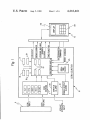
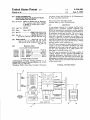
The architecture of the PCU is shown in FIG. 2 and
vending machine, a collector interrupt 71A will reset a
includes a keyboard input 29 for supplying speci?c data 45 service ?ag 71B and return to the coin input 65. '
acquisition requests, and codes such as access and
Assuming a coin input has occurred, a check is made
change codes to the system. Speci?c data acquisition
to determine if the counter is full 72, and if so, the
requests include obtaining coin totals from the counter ~ counter will be stopped 73 rather then being set to a
and determining their money values, dates and times of
zero value; consequently, only information on over?ow
use, servicing, etc.
50 beyond the maximum reading will‘be lost.
Inputs from the keyboard 29 are fed to a digit con
To collect data from the counter, an ‘external inter
verter 30 for converting keyboard contacts to digit
rupt 74 is used to forceably increment the counter 75.
pulses. These pulses are fed to a data bus'and then to a
The collector, given the capacity of the counter, moni
microprocessor 31 where they are converted to a com
tors the counter full ?ag and continually increments the
mand. If the command is an add, the microprocessor
counter by one. When the counter is full 76, a ?ag is set
will access information from a RAM 33 and a ROM 34
77, and the collector counts the number of increments,
to enable the instruction to be carried out. If the instruc
calculates the number in the counter prior to the incre
tion is a code validation, the operation may be carried
menting step and stores the number. If the counter is not
out in a comparison register using, say, a subtraction
full, a ?ag reset occurs and the program reiterates;
process. If the subtraction yields a number not equal to 60 eventually, the program determines if the count has
zero, the machine number and access code, which has
equalled the vending machine number 79 and then sets
been entered through the keyboard, are obviously not
a ?ag 83. A like operation is then performed for the
the same and the program will permit no information to
be transmitted or received at any I/O port. Preferably,
however, a code validation is carried by a program
described, infra. If the instruction is a print or read out,
data from the microprocessor will be decoded in an I/O
decode 35 and sent to a teletype interface 40 for conver
. access codes 80, 81, 82 and 84.
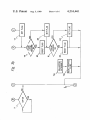
FIG. ‘4 shows'the program for the data collection
as
function of the PCU 12. When the PCU has been
plugged in and turned on 92, the registers are reset 93
and the {storage initialized 94; this can be set at zero or
set from a prior reading. The program then awaits the