1
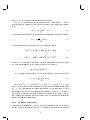
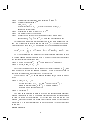
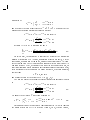
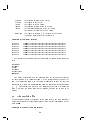
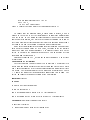
-fX Set error function 1: Hamming Distance (Gower), 2: L1 norm (MAE),
3: L2 norm (MSE), 4: Shannon codelength, 5: L1+Codelength (Default), 6: L2+Codelength
-w Use class-weighted codelength instead of basic one for (-f4,5,6,7)
-q No output (quiet)
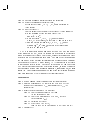
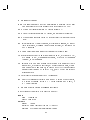
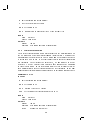
inputs
.centroids centroids saved with -l switch of the
classication module
.data
input set
.header format le
outputs
.output results
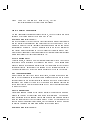
4.3.3 Data generator
The module generates random data sets or pseudo-data sets based on prior
knowledge. The rst option (-G1) is to generate completely random data.
This option is included to demonstrate the optimal classication by SC (10)
for the completely random data in the classication to one class only, i.e. the
completely random source is unclassiable.
The second option (-G2) generates random data weighted by the centroids
calculated from the given classication. Centroids are weighted by the sizes
of the classes. The data set produced in this way demonstrates the fact
that it might dier statistically from the original (the one the classication
was generated from), because clusters generated around the centroids have
uniform error, and this is not usually the case with the natural data.
The last option (-G3) picks random vectors from the given data set.
There is a sub-option (-u) not to place picked vectors back in the source
data set. This is reasonable only if the generated data set is smaller than
the original. The statistical prole of the data set generated in this way
resembles the statistics of the original.
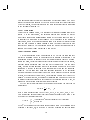
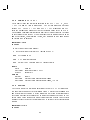
command: generate
switches
-q no screen output (quiet mode)
-vXX generate XX vectors
-GX data generator type 1: random, 2: Bernoulli-distributions, 3: sample
random vectors
43