1
>>>
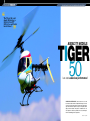
AUDACITY MODELS TIGER 50
SPECIFICATIONS
MODEL: Tiger 50
MANUFACTURER: Audacity Models
DISTRIBUTOR: Genesis Hobby
Distributors
MAIN ROTOR DIAMETER: 52.5 in.
(1,335mm)
LENGTH: 42.5 in. (1,232mm)
WEIGHT: 7 lb. 5 oz.
RADIO REQ’D: 5-channel heli w/120degree CCPM
PRICE: $285 kit; $299 ARF
>>>
COMMENTS
At last—a heli that’s well suited to both
beginners and experts. Low-cost and
easy to build and set up, the Tiger 50 is
the perfect heli for learning new tricks.
>>>
Four guides support the tail-rotor pushrod along the
length of the tail boom. Note the bead that the
pushrod rides in and how the guide firmly captures it.
HIGHLIGHTS
The latest heli in the .50-size market is
the Tiger 50 manufactured by Audacity
Models. This excellent, low-cost model is
certain to give the “other guys” a run for
their money. And don’t be fooled by its
price tag ($285 kit; $299 ARF; the Tiger 50
delivers heart-pounding 3D performance
right out of the box by using the simplicity
of 120-degree cyclic/collective pitch mixing
(CCPM) and a reliable belt-driven tail rotor.
As I found out, the Tiger 50 is a high-quality
heli that’s easy to build and fun to fly at a
cost that’s hard to beat. Read on to learn
more.
KIT OVERVIEW
The Tiger 50 comes in two versions: almostready-to-fly (ARF) and as a kit (the subject of
this review). To apply the term “kit” to the
Tiger 50 is somewhat misleading because all
its major assemblies (with the exception of
the engine/clutch, chassis and tail rotor) are
factory-built; the pushrods have even been
assembled to their correct lengths for a symmetrical 3D setup. This feature alone
demonstrates that the Tiger 50 is a cut above
the rest. And it doesn’t stop there, as it has
some features that are usually found only on
high-end helicopters. The main rotor head is
fully assembled and uses two radial bearings.
It also includes thrust bearings for the
demanding rigors of 3D flight. The seesaw
carrier is fully ball-raced for smooth operation, and the kit includes a set of finished
600mm wooden blades. I know that a lot of
experienced heli pilots prefer fiberglass or
carbon blades and won’t use the wooden
ones, but they are a welcome inclusion for
beginners. Also for beginners, the washoutmixing arms can be tuned to soften the con-
>Excellent manual
>Easy to build
>Low cost
>Outstanding flight characteristics
The sturdy rotor head is well designed for
responsive and smooth operation.
trol response.
The aluminum tail boom is well supported by two braces that are attached to the
bottom of the chassis for maximum stiffness; this helps to make the tail rotor
responsive and precise. The tail rotor has
more than 60 degrees of pitch range, and to
keep it under control, the pitch slider is
bearing-supported and guided by a dual-pin
bellcrank assembly. Another nice feature is
that each tail-rotor blade grip is equipped
with dual ball bearings. The fuel tank,
mounted on vibration-absorbing grommets,
is a massive 14 ounces for long flights, so
you can really wring this wildcat out.
The 58-page instruction manual is a highlight that deserves special mention: it’s very
well illustrated and lists the items needed to
complete the heli and the required assembly
tools. Further, almost every assembly stage
contains a “Pro tip.” It also clearly explains
the mechanical and electronic setups of 120degree CCPM and how they interact with
each other. To illustrates this, many graphs
show examples of throttle and pitch curves
for hovering and 3D aerobatics. If you’ve
never used CCPM, this is an excellent guide.
The manual also shows the precise position
of the servo arms, where the balls need to be
on the servo arms and the lengths of the
pushrods. As you can see, Audacity Models
has spent considerable time and energy to
make the Tiger 50 setup as easy as possible.
ASSEMBLY
>Chassis The Tiger 50 builds quickly, so I’ll
only highlight items and not recite a blowby-blow of “screw this part to that part.”
Most of the assembly centers on the chassis, which is molded of tough, reinforced
plastic that will survive many crashes. The
first items are the clutch bell and the tail
drive; both are factory assembled, so we’re
already ahead of the game! Attach the elevator link to the swashplate arm with a steel
pin that’s tapped into place. Make sure that
the mold marks on the link face toward the
rear of the heli, as the molded-in ball link is
a one-way link. Fuel-tank assembly is
straightforward; check the tank for any tiny
scraps of plastic in it before you seal it.
Instead of having to fiddle with separate
nuts to secure the servos, one-piece servo
boss plates are used. They’re simply pushed
into place wherever a servo is mounted and
make servo installation a snap. To assemble
the chassis, add the subassemblies and screw
the frames together. I really like that the
frames are held together with socket-head
bolts and locknuts instead of sheet-metal
screws; no stripped mounting holes here!
When you mate the frames, be sure to use
the main shaft to perfectly align its bearings.
Add the radio and gyro platform, the canopy
mounts and the landing gear to complete
the basic chassis build.
When you add the main shaft and the
main gear, make sure they’re oriented correctly, and be sure to use the proper shoulder bolt on the gear. A groove is machined
into the shaft for the mast stopper’s
setscrews. A lot of helis don’t have this welcome little detail.
The most difficult assembly task was
adding the cooling fan and clutch to the
engine, as the fan hub uses a straight hole
instead of a tapered collet and both must be
dial-indicated for a smooth-running heli.
When you add the engine to the chassis,
insert the start shaft first, or you’ll have to
remove the engine to add it.
>Main rotor and tail rotor. The rotor head,
swashplate and washout unit are factoryassembled, so all you need to do is add them
to the heli. Then install and center the flybar and its paddles, and snap the pushrods
into place. You have the option of installing
lead weight in the paddles for a softer con-
FROM TAME CAT TO WILDCAT
IN STOCK FORM, THE TIGER 50 is a real pussycat that can satisfy pilots of
This right-side view of the chassis shows a neat and orderly layout. Note the clips for the servos leads.
52 MODEL AIRPLANE NEWS
The pitch slider has two bearings for reliable
operation, and it’s guided by forked bellcrank
that uses dual pins.
different skill levels. To really unleash this cat, however, Audacity Models offers
a range of inexpensive parts that increase the heli’s prowess.
First is the 3D seesaw (flybar carrier). This part is included with the kit, and it
has an extra set of holes in it. This has the advantage of offering both the 1:1
and 0.7:1 Bell-Hiller mixing ratios (inner holes) that are used for 3D flight.
Audacity also offers harder 3D dampers that allow stiffer damping, and that, in
turn, permits more aggressive flight. To get more leverage from the swashplate,
a set of 3D ball extensions is offered and takes only a couple of minutes to add
to the swashplate. Top this off with a 3D flybar and paddles, and you’ll have a
heli that allows you a customized control response better suited for extreme
3D maneuvers. Just remember, though, that with increased control throw
comes the possibility of binding, so be sure to check for any interference at
the extremes of throw travel.
FEBRUARY 2002 13