1
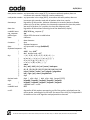
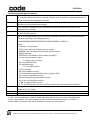
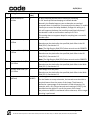
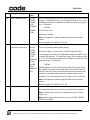
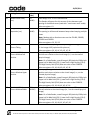
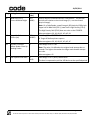
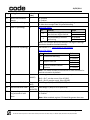
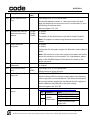
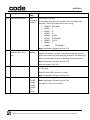
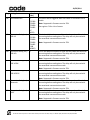
10/29/2014 P Put a value in a Reader register; data contains a printable ASCII string in the following format: hexadecimal register number in parentheses followed by a 32-bit signed integer value, expressed in ASCII hexadecimal characters (with optional minus sign) or ASCII decimal characters preceded by the ‘#’ character, e.g., /(2e)1000 or /(2e)#4096; the specified integer replaces the existing register value. (The Reader will respond with d or e.) Note: P([‘prefix’|’suffix’])<URL encoded text> will set the prefix or suffix to text. Example: P(suffix)%01X%1ean//n%04 will create a CodeXML® sequence to send the scan code for the enter key. Note: The P command saves changes immediately but those settings will not survive a reboot. If you issue a P(2B)0 command to change the value of register 2B from 1, then reboot the reader, the value of the 2B register will be 1 when the reader is ready again. In order to have that setting survive a reboot you must either issue a P then a W command or use the newer C command. C(2B)0 is the same as these three commands combined: P(2B)0, W (The Reader will respond with d or e.) Note: Also see commands O, P, Q, /, =, W. See Section 8 for possible Reader settings. Q Clear a bit (or bits) in a Reader register; data contains a printable ASCII string in the following format: hexadecimal register number in parentheses followed by a 32-bit signed integer value, expressed in ASCII hexadecimal characters (with optional minus sign) or ASCII decimal characters preceded by the ‘#’ character, e.g., /(2e)1000 or /(2e)#4096;; the ones-complement of the specified integer is AND’ed with the existing register value. The way a Q command is handled is equivalent to a P command – the effects are immediate but won’t survive a reboot. If you want the setting to be set after a reboot, issue a Q then W or use the newer CQ combination. (The Reader will respond with d or e.) R T Note: Also see commands O, P, Q, /, =, W. See Section 8 for possible Reader settings. Requests that the previously sent packet be re-sent by the Reader; data may specify a maximum packet size the receiver will accept: data is either empty or specifies a 16-bit big-endian unsigned integer (2 bytes). If data is empty or specifies a size less than 32 (the minimum packet size), the Reader will use its preferred maximum packet size. Otherwise, it will use the specified max packet size (or less) and will fragment data across multiple smaller packets when necessary. (The Reader will respond by resending its previous packet or with e if there was no previous packet. If the max data size has changed, it may resend the previous data in a sequence of more than one packet.) Requests the current date and time (no data) (The Reader will respond with d with data containing the date and time formatted as yyyy-mmdd hh:mm:ss.) Page 15 of 72 © 2014 The Code Corporation 12393 South Gateway Park Place Suite 600, Draper, UT 84020 (801) 495-2200 FAX (801) 495-0280